
“Mom, just eat quickly, then take your plate out to the garage, alright? There’s a blanket and some snacks waiting for you out there. We really want the house to look… cheerful tonight.” Vanessa’s voice was a syrupy poison, her pressed white apron spotless, lashes long enough to brush the dust from the floor, and all delivered with a saccharine smile that didn’t reach her eyes. Three of her friends lounged nearby, glued to their phones, indifferent to me standing there with my plate trembling—not from frailty but from the fire of contained fury.
Ethan, my son, barely glanced up from his beer, muttering, “It’s just one night, Mom. Don’t make this a big deal. We’re trying to keep things light.”
Keep things light.
On Thanksgiving.
In my own house.
I carried the paper plate like a server delivering a forgotten message, dragging my feet to the garage door. I opened it slowly. The chill rolled out first, followed by the acrid scent of oil fumes, moth-eaten dust, and rust. A feeble space heater sputtered softly in the corner, barely warning off the cold. A threadbare flannel blanket was tossed over a folding chair near the water heater, and my faithful dog Bruno lay curled on an old towel, his tail giving a weak thump against the concrete.
I lowered myself onto that hard folding chair, silence thick around me, plate balanced on my knees. Each bite of cold, dry turkey and instant mashed potatoes settled heavy in my stomach—not nourishment but insult. Through the thin walls, I caught the peals of laughter—loud, careless, fueled by too much wine and far too little heart.
Bruno rested his head on my foot.
I’ve held my tongue for years—not because I lack strength but because silence reveals the truth of who people think you are when they believe you’re powerless. It shows what they say when no one else is listening. And what they do when they think you won’t fight back.
But listen close. This isn’t the tale of an old woman exiled to a garage on Thanksgiving. This is how I played them to reveal their true colors—and to reclaim everything they thought they owned.
Part 1: The Foundation
Ethan and Vanessa weren’t always this way. Or perhaps they were, and I had simply chosen not to see.
When Ethan lost his job six years ago, they came to me desperate and broken. Their mortgage was drowning them, and with Vanessa pregnant with Mila, they had nowhere to turn.
I opened my door, and my heart, and even emptied my savings. I sold the gold bracelet Thomas had given me on our wedding day to cover three months of back payments. I co-signed a refinance when banks rejected Ethan’s shaky credit, and even gave my house deed as collateral for a second mortgage—because, as Vanessa told me, ‘No one else would help us, Mom.’
I fed them. Sheltered them. Surrendered the master bedroom while I took the couch. Watched as the sunny sunroom transformed into a nursery for my granddaughter.
But when Ethan found a new job and the money returned, Vanessa declared the house “too antique.” Too many photos of Thomas in uniform. Too many rosaries. Too many sturdy wooden chairs.
She began erasing me from the walls, the shelves, the very soul of the home.
Then came Thanksgiving—their twisted version. They insisted it was “their turn” to host. I agreed, as always. But what they really meant was, ‘It’s your turn to disappear.’
Vanessa’s Instagram said it all: “Thankful for fresh starts, clean energy, and chosen family.” Not a whisper of me—the woman who built the very floor they walked on.
Entitlement doesn’t tiptoe. It blares like a brass band, demanding applause.
But I stayed silent. I sat in that freezing garage and listened.
Through the thin wall, I caught Vanessa saying, “I told her the garage would be quieter; she just went. No fight at all. Old people don’t realize how lucky they are.”
Ethan chuckled, “She’s always been like that. Passive. Easier this way.”
Easier. That’s what they thought I was.
But people like me don’t battle loud and open. We fight in shadows—with memory. With papers. With truth.
And that night, while the heater whined weakly, and Bruno sighed softly by my side, I knew something they didn’t.
I still held the deed—legally, not just sentimentally.
With one phone call, I could cancel the $470,000 mortgage they pretended to control because, ha, I was still on the title.
While they played house, the foundation remained mine.
Part 2: The Teacher’s Resolve and the Conspiracy
Before the creak in my knees and the silver in my hair, I was a teacher for 34 years—lighting fires in students cast aside. I taught them to read, to speak, to fight for their place.
My late husband Thomas built that house with his own hands in 1982. Every beam, every nail, every detail was ours to protect. We planned to leave it someday to Ethan.
But then Vanessa arrived—like a sharp gust of designer perfume and steel stilettos. I tried to welcome her. Offered my mother’s pearls for her bouquet, helped hand-stitch her veil.
But when I gently told her once, after she barked at a waitress, that kindness lasts longer than being right, the ice settled between us.
I became the fossil in the corner, the outdated relic.
She mocked my teapot as “witchy,” my quilts “smothering,” my clothes “an ad for depression.” Yet when her friends questioned the old-fashioned charm, she smirked, “We kept some of his mom’s touches, you know, for character.”
Character—reduced to a mere stage prop.
That night, after the last guest left, I overheard their plan.
“You get the lawyer Monday, Johnston—the one who handled my aunt’s guardianship,” Vanessa said, cold and precise.
“If she doesn’t sign the deed, we petition for guardianship,” she whispered. “Claim confusion, dementia. Then the property becomes ours.”
I felt the floor shift beneath me.
Ethan added, “She’s already forgotten the stove twice this month. Record that. Judges eat that up. We move fast, liquidate, pay off the $470k mortgage, done.”
They had schemed—camera hidden behind the spice rack to catch me “acting old,” pre-planned lines to discredit me.
Their words were ice. A confession of betrayal.
But I made a vow in that cold garage.
Let them think I’m fading. Let them think I’ll break.
They hadn’t counted on my memory. Or the law. Or me.
Part 3: The Legal Fortress
I couldn’t confront them head-on—not yet. Their plan was sharp, but I had a sharper weapon: silence and the shield of law.
I called Clara, a former student who’d become a fierce estate lawyer. When she arrived while Ethan and Vanessa were away, I laid it all bare: the garage exile, the hidden camera, the dementia plot.
She nodded, opening her laptop. “This house is a prime candidate for asset protection. We’ll wrap it in a charitable trust.”
I sensed the meaning—no sale, no hijacking. Even guardianship wouldn’t touch it.
We filed the paperwork, creating the Heroes Heritage Foundation, named for Thomas and the teachers I once taught. The house became the trust’s heart, with me as Appointor and Clara as Successor Trustee.
The documents declared: no sale, transfer, or mortgage adjustment unless signed by me in front of two witnesses.
Even if deemed incapacitated, the trust stood strong—untouchable by guardianship.
A legal maze they couldn’t escape.
Days later, Clara called, breathless with news: the certificate was real. Filed. Active. The house was now protected.
That night, the garage didn’t feel cold or lonely. It hummed with quiet power—like the walls themselves knew the trap was set.
Part 4: The ‘Friendsgiving’ Livestream
They called it ‘Friendsgiving’—Vanessa’s polished creation. Days spent obsessing over color-coordinated pillows, floral arrangements, and picture-perfect ‘tablescapes.’
Not a word about me, except the note on my door:
Please wear the beige apron during the event.
Stay near the kitchen.
We’ll call if you need to help with the kids.
Try not to interrupt the livestream.
Beige apron. Kitchen helper. Invisible.
Guests arrived: young couples, influencers chasing wine sponsorships with barely disguised greed. Every laugh too loud, every compliment a Yelp review.
Vanessa, glowing in cream silk, presented the house: “This home has so much history. It belonged to Ethan’s mother, who now lives with us and helps out—a built-in childcare/kitchen angel.”
I stood frozen, beige apron crisp against my Sunday dress, just out of frame. Invisible.
When the doorbell rang, Vanessa practically leapt to greet two influencers with ring lights. “Content crew!” she squealed, “Here for our ‘Three Generations, One Table’ feature. Isn’t that adorable?”
When the camera swept the table, she shoved me out of the shot. “Let’s get the kids on this side,” she said quickly. “Helen? Can you help with pie in the kitchen?”
I nodded wordlessly, retreating to a folding chair near Bruno’s bed, tucked beside utility shelves—no placemat, no name card.
I watched as they devoured my home, my family’s history, cloaked in filters and staged smiles.
Mila danced a TikTok between turkey bites.
After the guests dwindled, the livestream still humming through the “after-party Q&A,” Vanessa leaned in, whispering, “Thanks for staying quiet. You’re learning your place.”
She laughed and walked away.
I did not cry. I watched. Absorbing every lie, every false smile.
Then a sharp knock shattered the moment.
Part 5: The Historical Designation
Firm. Authoritative. Too official for a holiday.
Vanessa hissed, “Ethan, get that. I didn’t order—”
Ethan opened the door to a sharply dressed man holding a black leather portfolio.
“Good evening. Is Mrs. Helen Porter present?”
All went still.
I rose from my chair, voice steady: “I am Helen.”
The man, David Crane, introduced himself as an agent from the Lone Star Heritage Authority and stepped inside.
He opened his folder: “Effective immediately, this home is designated a registered Texas Historic Property under Code 8.5 of the State Preservation Statute, Designation Number TX-879D.”
He looked pointedly at Vanessa and Ethan.
“This protects the structure, land, and fixtures by state law. Any sale, modification, or ownership transfer without written approval from the Founder/Trustee is a violation of state and federal law.”
A gasp erupted.
Vanessa faltered, “Wait… I don’t understand. This is our house. We live here…”
Mr. Crane turned to me: “You submitted the application two years ago, provided historical documentation including your late husband Thomas’s military records, and completed the preservation deed last quarter. I’m here to deliver this official designation.”
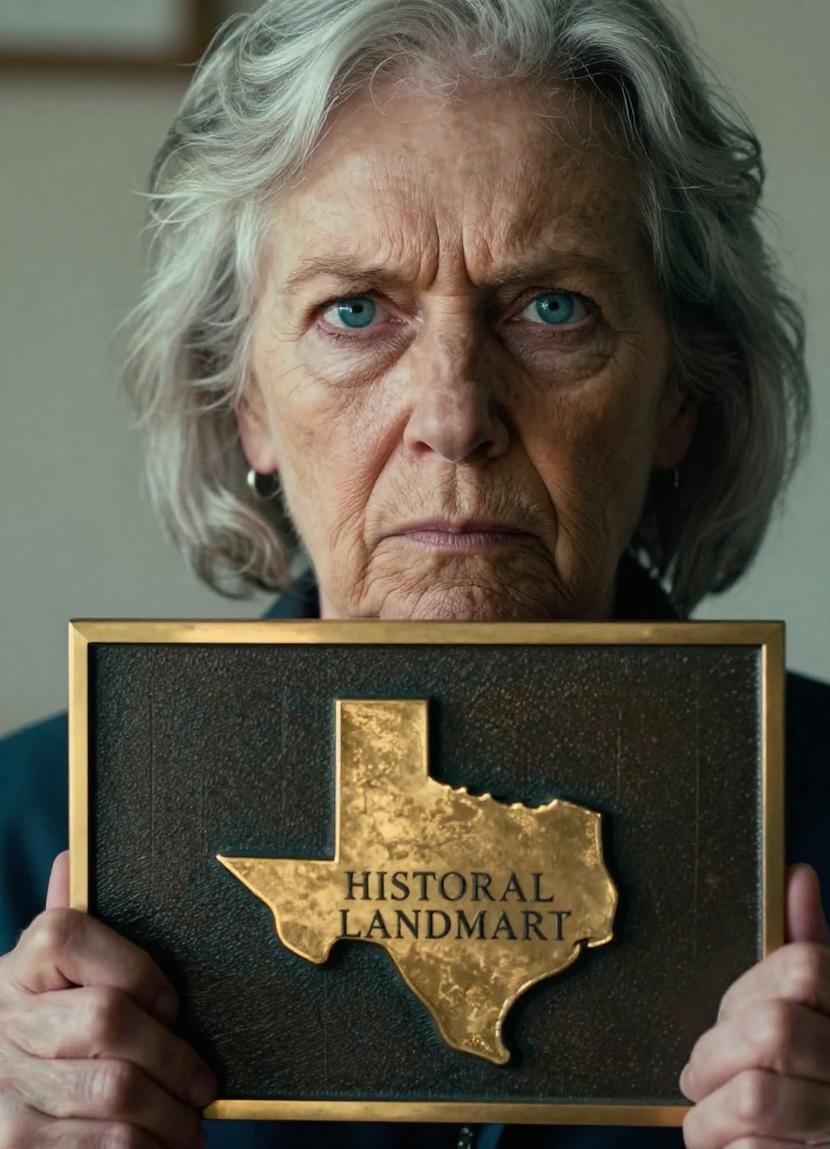
He handed me a heavy, gold-etched plaque: ‘PORTER HOME – TEXAS HISTORICAL LEGACY SITE. Established by Heroes Heritage Foundation.’
Vanessa’s face drained of color. Ethan looked like he’d swallowed gravel.
Irony, fate’s cruel joke, whispered when a guest gasped, “Is this being recorded?”
The livestream had never stopped.
Vanessa snapped, panic rising: “This isn’t fair! You tricked us!”
Louder, she raged: “I don’t care about some vet! This is MY house! I’ve done everything—renovations, the cooking!”
The room froze under the weight of her unraveling.
Someone’s phone dinged—a viral clip alert: ‘Texas Woman Explodes After Historic Deed Protects Elderly Mother-in-Law’s Home.’
Comments flooded in: “Did she just call her MIL a burden on Thanksgiving?!” “Protect Grandma at all costs.” “Using someone’s house for clout, then freaking out when she locks it down.”
Vanessa bolted to the bathroom. Ethan stood frozen, then whispered to me, “Mom… what did you do?”
I looked him in the eyes. “You called me forgetful. You plotted against me. You tried to erase who I am.” I lifted the plaque. “This is my home. My legacy. You just live in it.”
Part 6: The Aftermath and New Beginnings
Two days later, Vanessa lost her teaching job for unethical conduct. No place for those who publicly demean the elderly.
The influencer deals vanished—no more skincare endorsements or collaborations. The internet crowned her “Thanksgiving Karen.”
Ethan faced legal battles. Breach of contract claims, judge-mandated fees, and an IRS audit uncovered by viral attention.
The Heroes Heritage Foundation revoked their residency. Thirty days to leave—no appeals.
Vanessa broke down one night. “Please… we have nowhere else.”
Ethan stood behind her. “Mom, we screwed up. We know. But you don’t want the grandkids homeless.”
I studied him long and hard. “You called me a dusty antique,” I said. “Now, stay out of the frame, just like you wanted.”
They moved out on the 29th.
Months later, transformation bloomed. With Clara’s help, I converted the property into the Porter Heritage Center: a community space, an open reading room, and a rotating exhibit honoring veterans and teachers.
Volunteers painted walls and installed shelves. Former students gifted yearbooks. Children arrived for cookies and stories.
One afternoon, Ethan returned alone. He stood by the garden gate, hesitant, for 15 minutes before I opened it.
“I’m not here to ask for anything,” he said. “I watched the videos, read the comments. I was wrong. I knew you didn’t forget the stove—I just wanted control.”
I nodded once. “Want to help?”
He looked surprised, then nodded.
I handed him letters from our “Second Letters” program—notes people write to loved ones lost or forgiven. “Start here.”
Now, he volunteers quietly, humbly. We speak little of the past, but often about the work ahead.
Vanessa? I don’t know where she is.
But this house breathes again. Every creak, every breeze whispers that Thomas would be proud—not of our fight, but its end. Of how I turned a garage exile into a garden of reconciliation.
To anyone made to feel small, erased, edited from their own lives—I see you. Your story isn’t over.
Sometimes the quietest chapters lead to the unforgettable ones.
And this? This was my story—not for revenge, but so truth would outlive silence.