
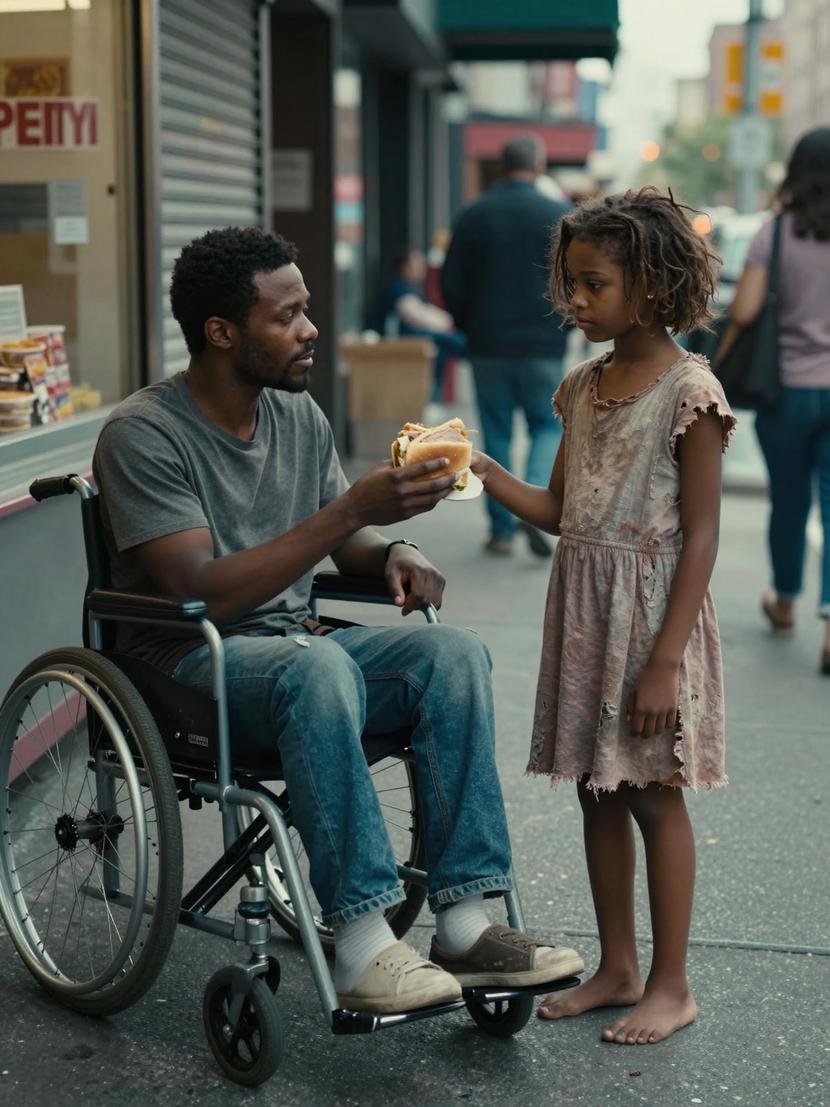
At first, no one even glanced at her.
That was the strange part—a girl standing alone on a bustling Chicago sidewalk, swallowed by the pulse of the city. People flowed around her like she was nothing more than a shadow. Her brown dress hung in tatters from one shoulder, bare feet smudged dark with grime, and tangled hair falling over eyes that seemed far too old for her young face. She couldn’t have been more than thirteen.
She stopped in front of a man in a weathered wheelchair, parked just outside a shuttered deli on North Alder Street. He was twenty-nine, but the deep creases on his face made him seem far older. Daniel Mercer was his name, and a faded cardboard sign leaned against one of his wheels:
“Disabled. Anything helps.”
He was used to being invisible. Coins dropped into his cup sometimes; scraps of food fell even more rarely. But words—kind words—never.
So when the girl spoke, Daniel thought he had imagined her voice.
‘If you give me food,’ she said softly, her voice like a whisper amidst the city’s roar, ‘I can help your legs walk again.’
Daniel blinked, caught off guard.
Cruel comments and hollow pity were all he expected from strangers. Nothing like this.
He looked up into her calm, steady eyes—not wild, not desperate, but sure, almost certain.
‘You can do that?’ he rasped, disbelief lacing his voice.
The girl offered a small, knowing smile—not playful, but quietly confident.
‘Really? Kid, not even the doctors could do that,’ Daniel scoffed bitterly.
She cocked her head, a hint of sadness in hers.
‘They didn’t listen,’ she replied gently.
A sudden chill crept through Daniel’s skin, paralysing and inexplicable on a warm afternoon.
From his battered bag, he pulled out half a turkey sandwich—the only meal he’d had all day. Hesitantly, he held it out.
The girl took it with trembling reverence, as if receiving an ancient treasure.
‘Sit straight,’ she urged.
‘What?’ he frowned.
‘Please,’ she pleaded softly.
Despite the knot of doubt tightening in his chest, Daniel obeyed.
She laid a small, dirt-streaked hand on his knee.
Then—
A sudden, searing pain burst through his legs.
‘Hey—what are you doing—’ he gasped, clutching the wheelchair’s wheels.
The girl leaned closer, whispering words swallowed by the city’s noise.
Then as suddenly as it came, the pain vanished.
Daniel sat frozen.
For the first time in six years, a sensation blossomed in his legs—warmth.
Not the cold numbness, not the phantom tingling.
Warmth.
His breath hitched. ‘I—I felt something.’
The girl took a step back, already fading into the crowd.
‘I’ll come back tonight,’ she promised, ‘if you want to walk.’
Heart thudding wildly, Daniel watched her disappear.
Was it hunger? Hope? A cruel delusion?
Or was something impossible brushing against his broken world?
That night, Daniel lay awake in his tiny studio draped in rain’s steady tap against the window.
Doctors had sentenced him to stillness—an expressway accident breaking more than just bones.
‘Permanent,’ they said. ‘Accept it.’
He had. Until today.
At exactly 9:47 p.m., a timid knock shattered his solitude.
His heart leapt — visitors never came.
Rolling up to the door, he opened it.
There she stood, dry beneath the rain’s chill—same torn dress, same quiet certainty in her eyes.
‘You came,’ he whispered.
‘You gave me food,’ she said. ‘That matters.’
She stepped inside, scanning the barren room—no television, no chair, only a thin mattress on the floor.
‘You lost more than your legs,’ she murmured.
Daniel’s throat tightened. ‘Who are you?’
She didn’t answer.
Instead, she knelt before him and pressed both hands firmly on his knees.
‘Stand,’ she said, voice soft but commanding.
A bitter laugh escaped him. ‘I can’t.’
‘You can,’ she insisted. ‘You’re only afraid.’
Closing his eyes, a storm of fear howled inside—fear of failing, of falling, of daring to believe.
Then the pain returned — but this time it was different.
Alive.
His toes involuntarily curled.
Muscles in his calves twitching.
Eyes snapping open, awe-struck.
‘Oh my God,’ he breathed.
‘Now,’ she urged, voice steady, ‘Stand.’
Summoning every ounce of strength, Daniel pushed against the wheelchair’s arms.
His legs shook violently.
Then—slowly—held firm.
He stood.
For three trembling seconds.
Before collapsing to his knees in a torrent of overwhelming emotion.
Laughter mingled with tears as hands trembled, touching the miracle beneath his skin.
When he looked up, the girl was already retreating.
‘Wait!’ he called out desperately. ‘Don’t leave. Please. Who are you?’
She paused.
‘My name doesn’t matter,’ she said softly. ‘What matters is what you do next.’
And then she was gone.
The next morning, Daniel walked.
Not far. Not steady.
But he walked.
Doctors called it a miracle. Reporters labeled it unexplainable. Social media erupted with wonder.
But Daniel knew the truth.
He searched the city’s streets for her.
Days melted into weeks.
No sign.
Until one evening, a fragile clue surfaced at Cedar Lane Library.
An old newspaper clipping headlined:
‘LOCAL GIRL, 13, DIES SAVING CHILD IN HIT-AND-RUN.’
The photo frozen in time made his blood run ice cold.
Same eyes.
Same faint smile.
Same tattered dress.
She had died two years before his crash.
Daniel sank into the chair, breath caught.
Then his eyes caught the final line of the article:
‘Witnesses say the girl whispered something before she passed.’
He closed his eyes.
He remembered the whisper he hadn’t heard.
And suddenly, it became clear.
‘You’re not done yet.’
Folding the paper, Daniel rose—stronger, steadier than before.
Outside, the city surged onward as always.
But somewhere, he knew, a barefoot girl was smiling.
Walking beside him.