
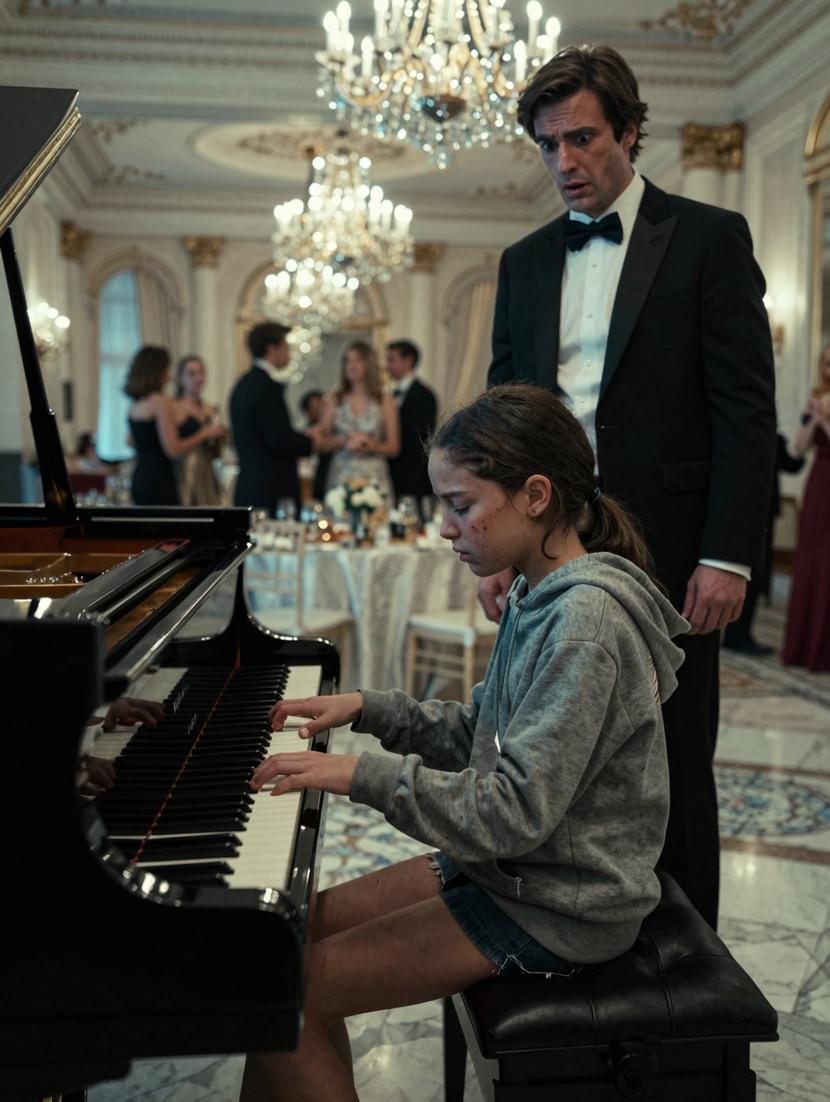
The annual ‘Pathways for Young Futures’ gala had transformed The Grand Bellamy ballroom into a dazzling display of excess and opulence, the kind of San Aurelio night where every beam of chandelier light burned with blinding intensity. Crystal chandeliers scattered rainbows over the marble floors as gleaming designer gowns swept past tables like living tapestries, diamonds sparkling on wrists and necks with an arrogant ease that expected no scrutiny. The air pulsed with the intoxicating scent of expensive perfume and quiet power—every smile a careful mask, every laugh a rehearsed note, every pledge broadcast to impress those with the deepest pockets.
At the heart of this orchestrated spectacle glided Celeste Harrington, the evening’s undisputed sovereign. A beacon of polished philanthropy, Celeste’s profile could have graced magazine covers, her features flawless and unreadable, her eyes cool and detached beneath perfectly arched brows. She drifted from one benefactor to another like a regal enchantress, her every movement wrapped in silk and anchored by heirloom jewels, a silent declaration that she didn’t merely host this gala—she owned it.
The soft strains of a string quartet floated through the air, punctuated by the delicate clink of crystal glasses and the murmured hum of affluent voices, all following the rehearsed choreography of high society—until a sudden, jarring disruption shattered the polished veneer like a thrown stone.
A girl, no more than twelve, had slipped past the velvet rope and the layers of practiced indifference surrounding the event. She was a raw, incongruous specter of survival bathed in the cruel glow of luxury. Her oversized hoodie, nicked and fraying at the elbow, hung over stained, threadbare pants; sneakers patched carelessly with gray tape dragged across the marble, and sweat-matted strands of hair clung to her forehead, dirt smudged across her pale cheeks. She was painfully thin, fragile as a whisper of air, yet her eyes burned with a fierce, unyielding fire—a blaze fueled by something sharper and more defiant than mere hunger.
Celeste was the first to intercept her, her role as gatekeeper quick to sharpen. The smile that once charmed froze into a blade’s edge. ‘You don’t belong here,’ she said, voice crisp and cutting through the murmured hush of the room like a scalpel. ‘This is a private event, not a refuge. You’re trespassing.’
With a subtle flick of her fingers, two broad-shouldered security guards materialized, their bored expressions a silent command to erase this unwelcome blemish from the picture-perfect scene. Around them, some guests let loose with hollow laughter—a twisted amusement tinted with cruelty—and slow, deliberate movements lifted phones, poised to record the humiliation of a child for unsparing spectators.
But the girl did not flinch. She stood tall beneath the chandelier’s crystal glare, head held high as though she were the star the room had somehow failed to notice. Then her voice rang out, steady and clear, slicing through the stifling atmosphere. ‘I came to play the piano,’ she declared. ‘I’ll play a song you won’t forget.’
The guards tightened their grip, nudging her toward the exit, her taped sneakers scraping the marble in reluctant protest. But before they could fully seize her, a calm yet commanding voice halted the charged moment.
‘Hold on.’
From a table near the stage, Lucian Mercer rose—a man whose presence demanded attention even before he moved. A legendary concert pianist, rare to the public eye, his performances were whispered about like sacred events. His hands had silenced entire concert halls, and now he advanced with measured steps, curiosity gleaming in his eyes—not pity, but the discerning intrigue of someone detecting a discordant note in an otherwise flawless symphony.
‘Ms. Harrington,’ Lucian’s voice was gentle but firm, a faint, enigmatic smile touching his lips. ‘If I’m not mistaken, tonight is dedicated to ‘opportunity’—the kind we claim to champion in speeches, the very mission we tout.’
Unease rippled through the ballroom. The guests exchanged quick, uneasy glances, suddenly reminded of cameras lurking like predators. The ideal of charity could swiftly turn from pageantry to spectacle when put to the test.
Lucian’s eyes didn’t waver. ‘Why not grant her one chance? One song. If it’s a waste of time, we escort her out with grace and move on. But if it’s not… then we’ve lived our mission tonight.’
Celeste’s gaze flickered, a brief but seismic crack in her carefully maintained facade. The assault was direct—on her image, her brand, her meticulously polished reputation. To deny now was social and professional suicide, witnessed by donors, journalists, and photographers hungry for her downfall. She forced a smile so tight it looked like pain and pivoted toward the stage, where a gleaming Steinway waited, lit like an altar in the ambient glow.
‘Of course,’ she said, sweetness laced with venom. ‘The stage is yours, dear. Astonish us.’
In her mind, she had already script-written the scene—an awkward display by this ragged interloper, met with polite laughter and dismissed as a quaint eccentricity. No one, however, bothered to ask the girl’s name, offer her a glass of water, or wonder at the origin of her audacious courage. Under a cascade of curious, judgmental stares and buzzing phones, the girl approached the piano, her small frame dwarfed by the vast, polished stage.
She perched on the bench, legs barely brushing the floor, feet trembling near the pedals like an apprentice hesitant to wield their power. Her fingers—grimy and delicate—hovered above the keys. Without searching the room for approval or mercy, she closed her eyes, drew a quivering breath, and began to play.
The opening chord was startling—impossible for a child, too profound for a beginner. The second chord followed with the same haunting precision. As the melody unfurled, the ballroom’s atmosphere shifted irrevocably. What poured forth was no mere lullaby, but a tapestry woven from sorrow and hope—a plaintive hymn braided with grief. Her left hand dragged chains of sorrow across the keys, while her right lifted fragile beams of light, too ancient for her years, too raw to be feigned. The music sank beneath skins, lodged within hearts, and refused to be forgotten.
Whispers ceased. Crystal glasses froze midair. A man in the front row fumbled, his hand trembling so fiercely his tumbler slipped and shattered, the sharp clang echoing like a thunderclap across the hush that followed. Yet the girl remained unfazed; she played as though broken glass was trivial compared to the burden she carried.
At the room’s core, Celeste became taut, fingers twitching toward her throat, her face draining of color as though the music exposed a festering secret long buried in shadow. Meanwhile, Lucian shot up to his feet so swiftly his chair toppled behind him, eyes wide as if watching an old wound tear open against his will—because the melody was no mystery to him. He knew it as intimately as a whispered vow never spoken aloud.
The final note trembled, heavy with accusation. The girl lifted her hands, not to bow, not to smile, not to revel in forgiveness, but standing fierce with chest heaving, eyes blazing. The silence pressed against every heartbeat like an unrelenting weight.
Lucian broke the stillness first, his voice strained, almost fragile. ‘Where did you learn that lullaby?’ he asked, not accusing but desperate. ‘That composition… it was never published. It was private.’
The girl held her silence for a moment, then locked eyes with Celeste at the gala’s center. Fury and pain spilled through her voice as she shouted, ‘Do you recognize it, Ms. Harrington?’
Celeste blinked, struggling to recombine her fractured mask with trembling hands. ‘I—I don’t know what you mean,’ she faltered. ‘It’s just a tune. Anyone could—’
Tears carved delicate tracks through dirt-streaked cheeks, grief overwhelming the dam she’d so fiercely defended. ‘THAT’S MY MOTHER’S LULLABY!’ she screamed, a force that slammed into the stunned room like a thrown chair. ‘The last song she ever composed—the one you stole from her desk after you fired her. After you evicted us from the apartment you pretended to rent. After you left us to rot on the streets like we were nothing!’
The room erupted in chaos. Cameras clicked frantically, journalists surged like a tidal wave, and guests transformed from benefactors to spectators, devouring the scandal. Celeste’s poised facade crumbled into raw hysteria.
‘Lies!’ she shrieked, her elegance corroding into venom. ‘Get her out! She’s a filthy little con artist! Her mother was a nobody I once helped—out of charity! She was jealous of my talent!’
‘Enough,’ Lucian’s voice sliced through the turmoil, steady and commanding—an unyielding gavel bringing a courtroom to order. The room fell silent, captivated as he planted himself between the girl and Celeste like a living shield.
His glare was ice, his words sharp. ‘Her talent?’ he spat, contempt thick in the venom beneath his calm. ‘Her mother was Isabela Cruz. My most brilliant student. A composer with a mind that intimidated the mediocre. Her genius made Celeste’s work look like pale imitations.’
Turning to the cameras, reporters, and donors who had applauded Celeste’s so-called masterpieces for years without questioning their origin, Lucian declared, ‘The acclaimed compositions that built her reputation were not hers. They belonged to Isabela Cruz. This woman is a thief.’
A chill rippled through the ballroom—theft of money was one crime; theft of genius, of soul, was another entirely. Celeste’s face tightened into a mask battling pure rage with raw terror.
Lucian’s gaze softened as he looked once more at the girl—not just recognizing a melody, but the shape of her jaw, the stubborn set of her mouth, the fire in her eyes. He stepped closer, drawn by a gravity he could not resist.
Kneeling at the edge of the stage, awkward as if the world beneath him had shifted, he whispered, ‘Your mother… where has she been? Why did she disappear?’
The girl trembled, her body convulsing in waves of silent anguish. ‘She’s gone,’ she whispered, voice fragile, edged with reluctant sorrow. ‘She died two months ago. Pneumonia. We couldn’t afford medicine. We were living in a shelter on Hollow Street.’
Lucian closed his eyes, a tear tracing the contour of his cheek in a moment of solemn vulnerability. When he opened them again, his voice was broken but resolute. ‘Isabela Cruz was not only my student,’ he said, addressing the room as if delivering a verdict, ‘she was the woman I intended to marry. She vanished while I was touring overseas. I believed she left me willingly. I never knew she was silenced by forces beyond her control.’
His hand rested gently on the girl’s shoulder—not for show but as if grounding the staggering reality. ‘And this child you treated like dirt,’ he continued, sweeping the room with a fierce gaze, ‘is my daughter.’
Something fractured in the air. Celeste’s reign crumbled alongside her fabricated world. The smiles once claiming Devotion now dissolved into hesitant steps backward, as people distanced themselves from a corruption too deep to touch. Hotel staff and security shifted their stance—no longer subjects serving a queen but sentinels wary of a fallen monarch. The media surged anew, feasting on the queen’s imminent collapse.
Ignoring the spectacle, Lucian shrugged off his tuxedo jacket and wrapped it around the girl’s fragile frame. The fabric engulfed her like a shield, less luxury than sanctuary against a world that had repeatedly refused to see her.
Then, arms pulled her close in a fierce embrace that silenced the nearest onlookers, his face buried in her tangled hair as if holding her was the only way to keep from losing all he’d already lost once before.
‘Did you come here for food?’ he murmured, voice cracking under his own weight.
Clinging to his collar, forehead resting against his chest, she whispered with fierce conviction, ‘Not just food. I saw your name on the guest list at the library. I needed you to hear her song. I needed someone to know what she created, who she was, and what they took from her. I promised her I would make the truth impossible to ignore.’
Lucian hugged her tighter, and amid The Grand Bellamy’s glittering illusion—a place where thousands had paid to applaud benevolence—something far more raw and relentless emerged. The night’s true cause had been fulfilled, not by checks or photo ops, but by a child who refused to be erased and a stolen lullaby that returned, haunting and sharp, like a ghost with teeth.