
The thunderous slam of the heavy mahogany door wasn’t just a sound—it was a seismic blow that rattled through my shoes and reverberated in the cavernous foyer of the Blackthorne Estate like a judge’s gavel sentencing a defendant to oblivion. My battered leather suitcase, hastily packed in ten minutes of trembling resolve, tumbled down the limestone steps, spilling a sleeve of silk blouse onto the meticulously raked gravel like a fragile white flag of surrender.
“You are a disgrace to this firm, Hannah!” Jonathan Mercer’s voice thundered from atop the grand staircase. He stood framed by the imposing Corinthian columns he revered more than his own family — his face a mask of rigid aristocratic rage, flushing a deep, dangerous crimson. “A dropout. A quitter. Don’t think for a second you can crawl back when the world chews you up and spits you out. You are cut off! Not one cent, do you hear me?”
I met his furious gaze. The waning afternoon sun cast elongated, distorted shadows across the facade of the house that had been my gilded prison my entire life. I did not scream. I did not cry. I did not beg for mercy I knew wouldn’t come.
My hand slipped deep into my coat pocket, fingertips brushing the smooth glass of my phone concealed beneath his condemning stare. The biometric interface of my crypto wallet glowed softly. I felt it pulse.
Sixty-five million dollars.
Liquid. Tax paid. Diversified. Mine.
He thought he was casting me into destitution, stripping me of every survival mechanism. What he didn’t know was that he was yelling at a centimillionaire who built a digital empire in the very hours he thought I was failing torts.
“Goodbye, Jonathan,” I said.
Not Dad. Not Father. Jonathan.
I descended the stairs, my heels clicking a relentless rhythm of departure against stone. I grabbed the suitcase, zipped it closed with meticulous control, and slid into the sleek black SUV waiting beyond the wrought-iron gates. As the engine growled alive, the gravel crunching under tires, I didn’t look back at the ivy-draped brick and iron. I gazed ahead, eyes fixed on the flight plan filed for Riverside Airfield.
The exile was over. The reign was just beginning.
As the Blackthorne Estate shrank in the rearview, my phone buzzed with a notification—not a bank alert, but a triggered security protocol from the private server buried in the estate’s basement—a secret Jonathan was oblivious to. Known as the “Dead Man’s Switch,” now set off by my exit from its geofence, it silently began archiving every email, every transaction, every buried secret Jonathan had hidden deep within the firm’s mainframe. I smiled at my reflection in the window, savoring the irony. He thought he’d thrown me out—but I had left behind a ghost.
—
The flight west to California became a ritual decompression, far from the oppressive clinks of cutlery at the Mercer dinner table, turning every breath into a judge’s scrutiny. Instead, I breathed the filtered luxury of a Gulfstream G650 cruising at 45,000 feet.
Sparkling water on my lips, I watched the patchwork earth scroll beneath me, dissecting six grueling years under my father’s gaze—Jonathan Mercer, Senior Partner at one of the oldest, most fossilized law firms in the region, worshipper of tradition, the firm, and an old boys’ club that excluded me.
In his archaic view, women were decorative, meant for charity galas and social diplomacy—a role Melissa embodied perfectly. Sons were heirs; daughters were liabilities to be managed or married off. Nicholas, my older brother by two years, was the golden boy, pampered from cradle to boardroom with tutors, internships, and applause for mediocrity. I, Hannah, was the ghost—the overlooked shadow.
When I announced my interest in corporate law during high school, Jonathan scoffed, “It’s a brutal world, Hannah. You don’t have the killer instinct.”
So I ceased the conversation and faded into silence.
Sent off to law school as a mere placeholder for a proper marriage, I did not waste my time on torts or property law. Instead, I dove into the archaic inefficiencies of the real estate market—its hollow valuations founded on whimsy, handshakes, and nepotism.
While my classmates pored over dusty legal tomes, I coded. I created EstateEye, an AI-powered valuation engine that analyzed satellite imagery, zoning maps, and predictive analytics to appraise commercial real estate instantly and accurately.
By year two, hedge funds licensed my software; by year three, I sold a minority stake for eight figures—all masked behind a web of shell companies.
Now, the sleek SUV rolled to a stop at Glasspoint Cove—Fortune Shore’s jewel. Here the earth was glass and steel; sunlight blazed merciless, antiseptic, a sharp contrast to hanging velvet drapes and the scent of stale paper back East.
The gates slid open silently. My new home was a $42 million fortress of minimalist design—planes of glass floating over the ocean, invisible walls guarding secrets.
Inside, I set my suitcase on polished concrete. The hollow echo was sharp, biting.
I pressed my palm to the cool windowpane, gazing at the endless Pacific. I had conquered. I escaped Jonathan’s crushing expectations and created a kingdom of my own making.
Italian minimalist furniture starkly contrasted the wild sea beyond. The chef’s kitchen probably would remain untouched.
But then the silence hit me—not the soothing hush of the jet—but a suffocating void.
Money doesn’t heal the wounds of exile; it only changes their texture.
I moved through the vast emptiness—five bedrooms, seven bathrooms, a screening room, wine cellar—for one.
Sitting on the edge of the massive white sofa, watching waves crash with indifferent power, I realized Jonathan had expelled me not for failure but because I failed to fail as he intended.
Here I was, surrounded by proof of my worth—and I felt icy emptiness.
Buying a castle doesn’t mend exile’s wound; it just provides a more opulent place to bleed.
I pulled out my phone.
No calls from Melissa. No texts from Nicholas. Silence.
They cut me off with surgical precision. To them, Hannah Mercer was dead.
‘Good,’ I whispered to the empty room, my voice breaking. ‘Let them think I’m gone.’
Because the Hannah they knew—the quiet, disappointing daughter—was dead.
This woman in the glass fortress? She was the Architect, and she was just beginning.
—
Six months later, as I sipped green juice reviewing acquisition targets, a red alert flared on my EstateEye dashboard.
A financial anomaly. Something I’d tagged for indefinite monitoring: the Blackthorne Estate—my childhood fortress.
The mortgage wasn’t just overdue; it was mortgaged AGAIN as collateral on a precarious operating line by a firm one step shy of insolvency.
I leaned back, ocean breeze brushing open terrace doors, unmoved by the salt air.
The Mercer law firm’s vaunted stability was a thin veneer over drowning debt. Jonathan was levered to the hilt, risking his legacy and home to maintain illusion.
My phone buzzed.
Nicholas.
I let it ring once. Twice. Three times before answering, savoring the suspense.
“Hello, Nicholas.”
“Thank God you picked up,” his voice trembling, absent arrogance. “I didn’t know if you still used this number.”
“It works. What do you want?”
“I… I need a favor. Big one. A temporary cash crunch—gambling debts. Just bad luck. I need fifty thousand for a month. I swear double back.”
I nearly laughed.
Classical Nicholas—gambling debts as cover for embezzlement from client escrow, used to prop his lifestyle.
“Fifty thousand is a lot for a dropout, Nicholas,” I said flatly.
“Please, Hannah, I remember you always had savings from your computer projects. If I don’t fix this Dad will kill me.”
He had no idea.
He thought I was scraping by on freelancing. Instead, he was pleading with a shark.
“I can help.”
Relief flooded him.
“You can? Thank God, Hannah.”
“One condition.”
“Anything.”
“You sign a promissory note, securing the loan against your future inheritance—specifically your interest in the estate.”
“What? Why?”
“Because I’m not your little sister who cleans your messes for free anymore. This is business. Sign or find money elsewhere.”
Silence. Then desperation. Fifty grand was insignificant to him, masked by future estate worth.
“Fine,” he snapped, gratitude gone.
I hung up and sent a message: Execute Protocol Trojan Horse.
I didn’t just wire fifty thousand.
I used the promissory note as leverage to initiate a larger transaction.
Through my shell company, Nemesis Holdings, I approached the bank holding the Blackthorne mortgage.
They were jittery over missed payments and firm instability—eager to offload the toxic asset to a private equity cash buyer.
I bought it.
I bought the debt, the loan, the roof over their heads.
Standing on my balcony, salt air filling my lungs, I reveled in their borrowed time—and in my newfound dominion.
Two days later, an email emerged from a confused former classmate’s forwarded flyer: The Mercer Firm Jubilee, celebrating three decades of legal excellence at the very Blackthorne Estate I now owned.
The audacity was breathtaking.
I glanced at the RSVP button.
I clicked “Yes.”
—
The night of the gala, I arrived not by train, but by private flight to Riverside Airfield, helicopter to a nearby pad, then slick black town car to the gates.
The house loomed unchanged—a cold relic of power.
The driveway gleamed with Bentleys and Mercs under soft landscape lighting.
I stepped out in a tailored black Alexander McQueen suit—sharp, severe, built not to impress but to protect.
Handing keys to the valet, I walked up the steps where my suitcase once fell.
Inside, the legal elite jostled—judges, politicians, partners—swirling wine amidst stale ambition and old money.
Melissa spotted me first. Frail, brittle smile cracking her flawless smoothing.
“Hannah?” she whispered, panic in her eyes. “What are you doing here?”
“I heard there was a party,” I said smoothly, plucking champagne from a passing waiter. “Wouldn’t miss a celebration of excellence.”
“Your father… he won’t be pleased. He thinks you’re still struggling.”
“Let him believe what he wants.”
I cut through the crowd like a shark through a school of minnows.
The ballroom suffocated with heat. At the front, Jonathan stood on a raised platform, glass of scotch raised, flushed with arrogant pride.
Nicholas stood by him, sweating nervously in an ill-fitting suit, forced smile faltering.
Jonathan tapped a spoon on the glass.
“Friends, colleagues,” he boomed, slightly slurred, “Tonight is about legacy—foundations outlasting us.” He gripped Nicholas’s shoulder like shackles rather than embrace. “I see in my son the future. Law demands strength, fortitude, men of character.”
A polite ripple of applause.
I felt the sting of the word.
Men.
Not accidental.
His thesis.
“My son has that character,” Jonathan continued with false pride. “Steel to make the hard calls. Unlike those who crumble. Those who lack discipline for the real world. Those chasing… childish fantasies.”
His gaze strafed the room.
Then rested on me, sneer curling his lip without naming me. The room followed, judgment like an avalanche—the failed dropout.
“To Nicholas,” Jonathan toasted, lifting his glass.
“To Nicholas,” echoed the room.
Nicholas caught my eye, no shame, just a smirk.
He glanced at his wrist, flashing a vintage Rolex Daytona—the very watch bought with my wired fifty thousand.
Cruelty refined to art.
Not just erased, but flaunted.
I slipped silently away, heart pounding, through the familiar corridors.
Upstairs, to Nicholas’s old room—now his office.
The door unlocked. Carelessness.
Inside, his laptop hummed.
Protected by lazy passwords: birthday, ‘Password123,’ football team name—unlocked.
I inserted a forensic USB drive, bypassing his clumsy file structure, diving deep into financial wreckage.
A tsunami of red ink spilled across the screen.
Nicholas wasn’t just borrowing to cover gambling.
He was running a Ponzi scheme—client retainers funding botched settlements.
Then, an email thread—Nicholas to Jonathan, three months old.
Subject: The Audit.
Jonathan’s words chilled me: “Fixed the accounts for Jones file. Don’t let this happen again. If Bar finds out, we’re finished. I leveraged the house to cover shortfall. Final time, Nicholas.”
The truth cut sharper than any blade.
Jonathan knew.
The arrogant patriarch was not blind; he was complicit.
Toasting his criminal son while exiling the daughter who could have saved them.
I extracted the USB.
I wasn’t just Architect—now, I was Judge.
—
Morning sun pierced heavy velvet drapes.
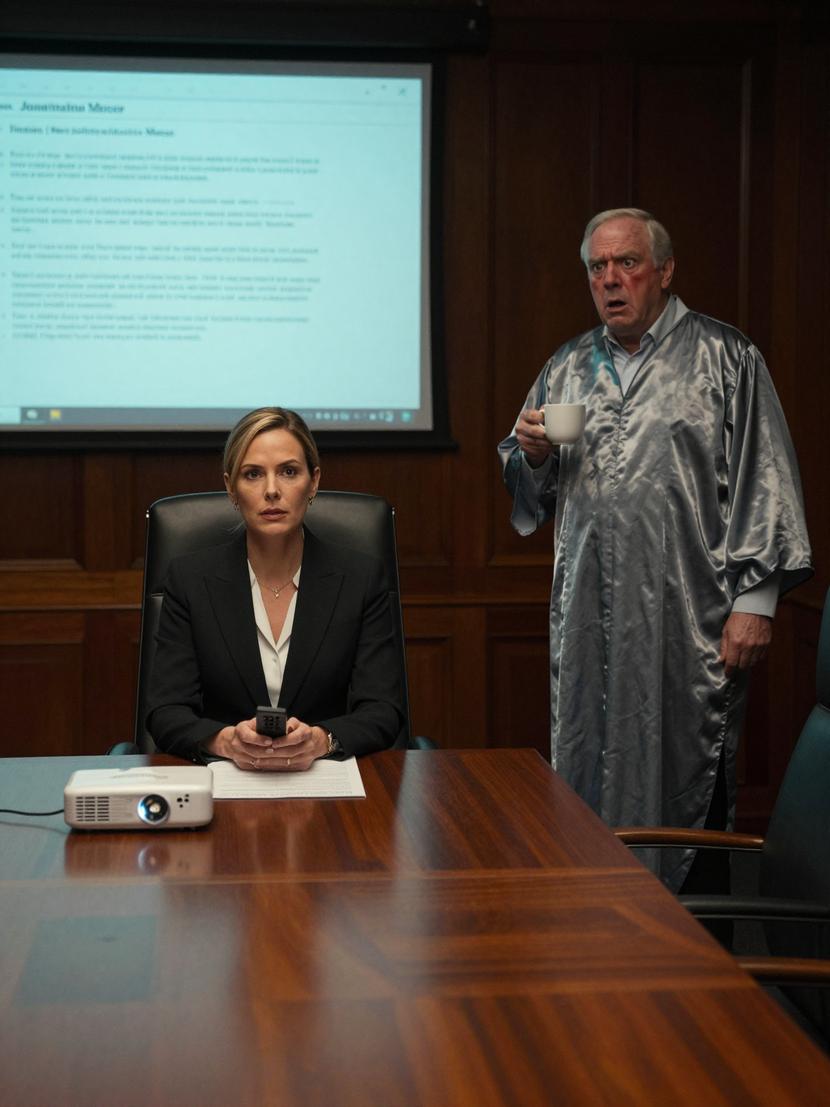
I sat in Jonathan’s leather chair at the black mahogany conference table head, waiting since dawn.
At eight sharp, double doors swung open.
Jonathan entered in silk robe, coffee in hand, stunned.
“Hannah? What the hell are you doing in my chair?”
“Sit, Jonathan,” I commanded, cold and unbothered.
“Excuse me? Get out before I call the cops!”
Nicholas shuffled in, disheveled, sweatpants replacing tailored suit. “What’s happening? Who let her in?”
“I let myself,” I said. “I have a key.”
“I took your key!” Jonathan snapped.
“I changed the locks an hour ago,” I smirked. “Sit down.”
My tone wielded undisputed authority.
Jonathan faltered; Nicholas slumped.
“I’ll be brief,” I said, remote in hand.
A projector flickered to life, illuminating the firm’s escrow account, showing illicit withdrawals.
“What is this?” Nicholas whispered, pale.
“Felony embezzlement. Forged signatures. Client funds funding your lease on a Porsche and your Rolex,” I enumerated coldly.
Jonathan smashed his hand on the table.
“If you hacked those files, I’ll have you arrested!”
“Sit.”
I advanced the presentation—email admitting Jonathan’s cover-up and mortgage leverage.
Jonathan sagged, defeated, old.
“You knew,” I said plainly. “You toasted a criminal son, calling him a man of character. What about me? Your daughter? You threw my suitcase down the stairs.”
“You walked away,” he spat.
“I didn’t quit,” I corrected.
“Don’t you see? I pivoted.”
Last slide: Notice of Foreclosure.
Lender: Nemesis Holdings LLC.
“Nemesis Holdings?” Jonathan squinted.
“Yes,” I said. “That is me.”
Silence drowned the room—final and suffocating.
“What?” Nicholas gasped.
“I own the mortgage. The debt. This house.”
Jonathan whispered, “You’re a dropout. You have nothing.”
“I’m worth sixty-five million dollars,” I declared. “I didn’t drop out because I failed. I dropped out because I realized I could buy the school.”
I slid an eviction notice across the table.
“Thirty days to vacate. The firm is insolvent. I sent embezzlement evidence to the State Bar. Nicholas will be disbarred. You’ll face sanctions, maybe jail.”
Jonathan whimpered, “We’re family.”
“Family?” I scoffed dryly. “Family supports each other. Family doesn’t call daughters disgraceful. Family doesn’t bury crimes to protect fragile egos while sacrificing innocent ones.”
Rising, I looked down at them—the patriarch and golden child reduced to tenants in a house they no longer owned.
“The verdict is in. You’re evicted.”
—
Aftermath was silent—no fights, no speeches about legacy.
Only the sound of packing boxes and papers scratching final settlements.
Nicholas was disbarred within a month, avoiding jail by turning in a co-conspirator.
Last heard, he worked low-wage shifts at a rental agency, living in a cramped apartment.
Jonathan and Melissa downsized to a modest retirement condo, funding debts with liquidated assets.
The Blackthorne Estate sold—not kept by me; it reeked of decay and lies. A boutique hotel awaited where my childhood home stood.
Back in Carmel Bay, I stood on my balcony at sunset, the Pacific ablaze in honey and violet.
Triumph felt like relief—heavy, profound, as if setting down a twenty-six-year burden of judgment and impossible expectations.
Anger dissolved; you cannot rage at those irrelevant to your existence.
The verdict was final. The case closed.
I scrolled through contacts.
Nicholas. Delete.
Jonathan. Delete.
Melissa. Delete.
I was no longer exile—I was sovereign.
Sovereignty, though powerful, could be lonely.
Inside, the glass house felt different; silence no longer lonely, but a blank canvas.
I opened my laptop and began drafting the charter for The Horizon Scholarship—a $50 million fund empowering women in PropTech, especially dropouts and outliers deemed too ambitious or emotional.
I would build a castle with room for them.
The glass fortress awaited, no longer empty, but alive, filled with promise.
I had survived the fire, built the empire, and now, it was time to build a life.