
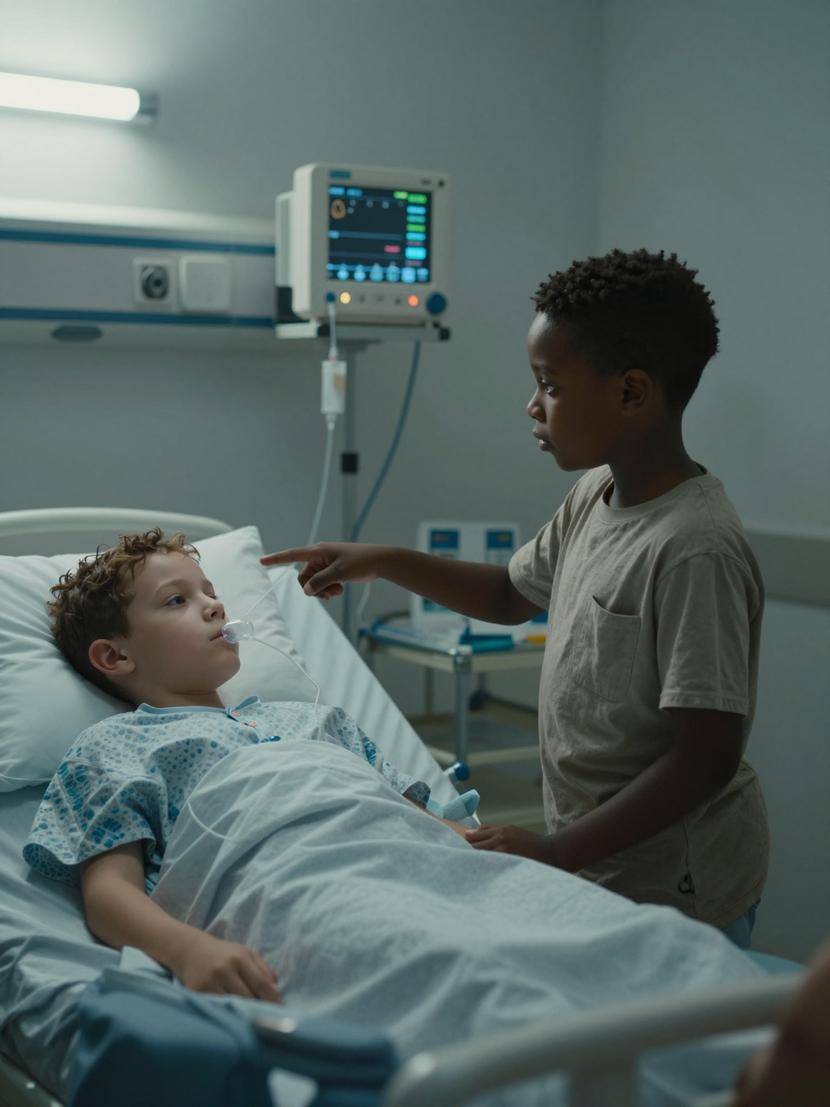
In the hushed, sterile confines of the intensive care unit, time itself seemed to falter. The relentless beeping of monitors pulsed like a fragile heartbeat, while a circle of eighteen of the world’s most renowned doctors stood frozen in disbelief. Before them lay Lucas Caldwell, a boy whose breaths grew thinner with each passing second, entangled in a silent struggle no one comprehended. Despite their expertise, every test returned nothing—no answers, no clues, no hope.
Then, from the far edge of the room, an unexpected voice pierced the tense stillness. Darian — a boy no one imagined holding the key — spoke softly yet deliberately, eyes sharp and unwavering amid the flurry of white coats and despair. His presence seemed unlikely: only ten years old, his threadbare clothes and worn shoes stark against the sterile hospital backdrop, yet his gaze was fierce and focused.
Tilting his head thoughtfully, Darian watched Lucas’s chest rise and fall, his brow furrowed as if deciphering a secret language whispered only to him. He sensed a hesitation in the air, a subtle resistance where pure breath should have flowed free, whispering of something hidden — something overlooked by every expert in the room.
The doctors, skeptical but desperate, listened as Darian pointed quietly toward an obscure curve in Lucas’s throat — a shadowed nook too elusive for machines, too subtle for exhaustion-weary eyes. Suddenly, alarms shrieked; monitors flashed urgent red warnings. Chaos erupted as nurses scrambled and doctors barked commands, but Darian stood steady, eyes locked onto Lucas, anchored by certainty.
Adrian Caldwell, Lucas’s father, watched the scene unravel with a fractured heart. His tailored suit wrinkled, his usually commanding eyes vacant with helplessness. This was a man accustomed to bending worlds to his will — a billionaire visionary, philanthropic titan, builder of hospitals and haven. Yet tonight, all his wealth and influence meant nothing.
Weeks earlier, life at the sprawling Hawthorne estate had seemed flawless. Adrian moved through impeccably appointed rooms, his mind tethered to boardrooms, endless engagements, and grand visions. Yet his greatest treasure was his son, Lucas: a gentle, brilliant, compassionate soul who carried no arrogance typical of their world’s privilege.
It was a gray, drizzling morning when Lucas’s curiosity stirred a rare moment of openness. He asked about homeless children, inquisitive about cold faces huddled outside Hope Fellowship Church, puzzled why some lives were drowned in hardship while theirs overflowed with comfort. Adrian brushed it off, rehearsing complicated explanations, choosing schedules over empathy — unaware how those words would soon echo in grief.
Hours later, school deathly silent, Lucas collapsed without warning. Panic ignited. Doctors flooded the emergency room, machines encircling the fragile boy. Yet despite intense scrutiny, every test contradicted itself, confounding the brightest minds and unraveling certainty.
Days dripped painfully by. Lucas’s breaths grew shallow, skin pallid and trembling against sterile sheets. Adrian, desperate and broken, rallied experts flown from the world’s most prestigious institutions — certain knowledge, finally, would unlock a cure.
But knowledge failed him. Power offered no shield against fear. Each day Lucas slipped further away, a fading light Adrian could neither grasp nor save. One night, lost in anguish, Adrian found himself drawn to Hope Fellowship Church, seeking shelter or perhaps penance.
Inside, humble warmth enveloped him, a stark contrast to the cold grandeur of his mansion. Grandmother Mabel sat serene behind well-worn hands, a life crafted in quiet service and indomitable faith despite decades of hardship.
Among the church’s children sat Darian, quietly turning the pages of donated medical texts far beyond his years. Orphaned, observant, and unseen by most, he absorbed knowledge and nuances that escaped the busiest eyes.
Adrian shared Lucas’s heartbreaking story, voice cracking under its weight. Grandmother Mabel listened with patient grace, as if the darkest journeys still led somewhere deeper—somewhere hope could bloom anew.
As Adrian prepared to leave, Darian’s soft voice stopped him. “Sometimes answers hide where no one thinks to look.” Adrian dismissed the cryptic remark, desperate for cures, not riddles.
That night, Lucas’s breaths never came. Alarms shattered the quiet. Doctors battled fiercely to resuscitate him. Adrian crumbled, face pressed against his son’s frail frame, confronting raw fragility he’d never imagined.
With defeat confessed, the doctors despaired. But dawn brought Dr. Caldwell — sharp-minded, relentless — who dared a bold theory: a minute obstruction, invisible to standard machines, might be choking Lucas’s tiny airway.
Hope reignited. Teams searched tirelessly. Days passed, Lucas weakened. Adrian abandoned every boardroom, every contract — presence now replacing power.
Then Grandmother Mabel returned, accompanied by Darian. They challenged convention with humility and quiet resolve — offering observation where credentials couldn’t penetrate. Adrian’s exhaustion finally softened pride, and permission was given.
Darian studied Lucas not as a case, but as a story told by breath and pulse. His eyes caught a flicker of resistance as ventilated breaths struggled. He pointed, once more, to that elusive bend in Lucas’s throat.
When Lucas’s condition crashed again, emergency endoscopy was performed. This time, the camera lingered where fatigue had blinded before — uncovering a tiny plastic shard.
A pen cap fragment, lodged cruelly — forming a hidden valve that let life hang on a thread, slowly suffocating. Scans had missed it; doctors hadn’t seen it; only Darian’s quiet observation saved the day.
Carefully, the object was extracted. The room exhaled collectively as realization crashed in. Adrian’s memory surged: Lucas’s habit of chewing pen caps, overlooked moments, the silent story lost in privilege and pride.
Lucas awoke, whispering confessions of school pain — a shove in the hallway, emotional bruises deeper than the physical. He had carried his silence to shield his tired father.
Adrian listened, shattered and humble, forging a new promise of presence, truth, and unity — embracing strength in vulnerability and courage in silent endurance.
Healing came swiftly. Breaths evened, peace settled. Adrian turned with quiet gratitude to the boy who saved his son without fanfare or request for reward.
Darian spoke gently of invisibility—of noticing what others miss because he himself lived unseen—reminding Adrian that answers often come from those the world neglects.
On being asked about compensation, Darian refused money, asking instead for attention and belief in children like him—overlooked souls waiting to be seen.
Transformed, Adrian returned to Hope Fellowship Church, bringing builders and plans. He no longer saw poverty as a project but a mirror — listening, learning humility through service.
Hope transformed the shelter; Darian became a trusted advisor — insisting on inclusion, dignity, and collaboration, shaping futures through connection, not rescue alone.
Yet shadows lingered. Gavin Mercer, a rival watching from afar, seethed as admiration shifted. Jealousy hardened into schemes, secrets whispered in shadows.
Threats emerged silently; hidden documents surfaced. Adrian confronted the looming storm, facing Gavin not with defense but honesty, choosing compassion over conflict.
He unveiled mistakes without excuse, meeting bitterness with understanding — a stance that unsettled Gavin, leaving him exposed to his own emptiness.
Back home, Lucas thrived, friendships blossomed, and Adrian embraced leadership grounded in listening rather than control.
Darian’s quiet vigilance saved a life, but his deeper lesson saved many: that miracles often arrive disguised in neglected voices finally granted the grace to be heard.