
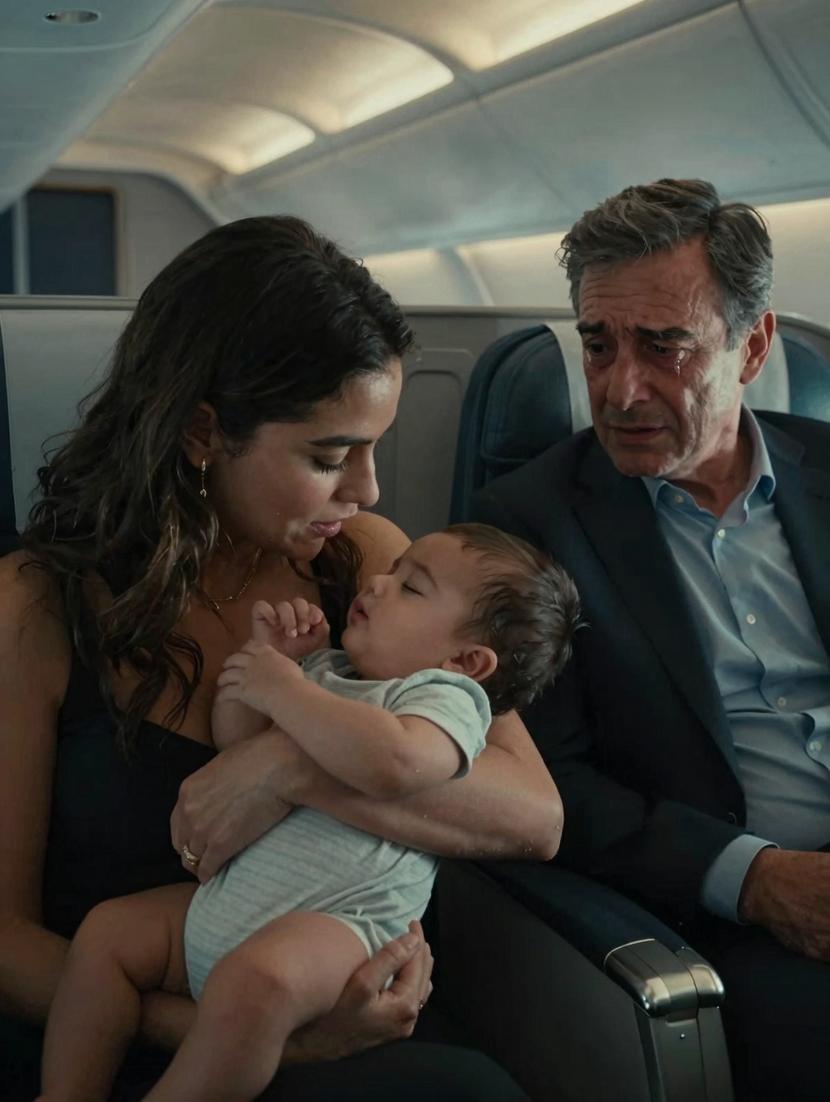
The flight from Puerto Azul to Villa Serena promised to be smooth and swift, barely a couple of hours slicing through the skies. Yet for Santiago Martínez, forty years old and commanding the helm of one of Spain’s tech giants, it became an endless torment. Impeccably dressed in an expensive suit, Santiago sat trapped within the plush confines of first class — a gilded cage where wealth could buy comfort, but not peace. Cradled in his arms was Mateo, his three-month-old son, whose cries pierced the cabin with relentless, agonizing intensity.
This wasn’t simple hunger or discomfort; it was an urgent, guttural wail of distress that Santiago couldn’t hush. For two torturous hours, Mateo had screamed, draining every drop of confidence from Santiago’s well-honed composure. He had tried all the advice come from nannies and parenting books: bottles, pacifiers, pacing nervously down the aisle, and gentle rocking — nothing could soothe his son’s persistent anguish.
Around him, the first-class passengers who once regarded Santiago with regard narrowed their eyes in thinly veiled annoyance. Judgments shimmered unspoken in their stares: “How could a man with millions and a corporate empire fail at calming his own child?” But deeper than their scrutiny was Santiago’s own crushing sense of failure. Every tear that rolled down Mateo’s cheeks echoed like a silent indictment—yet louder still was the absence of Isabel, his late wife, whose death in childbirth had left a void as deep as the ocean. Mateo’s cries felt like whispered accusations, as if saying, ‘You are not her. You don’t know how to love me.’
A few rows behind the curtain dividing luxury from economy, Lucía sat silently, watching through tired eyes. At twenty-eight, her face bore the marks of hardship years beyond her age. Nestled in her lap, sleeping peacefully, was Sara, her two-year-old daughter—an oasis of calm amid the cabin chaos. Dressed plainly in worn jeans and a threadbare T-shirt, Lucía held in her pocket the last few euros that financed this trip to Villa Serena. With a hope as fragile as her worn suitcase, she was seeking any humble job to rebuild her shattered life after her husband abandoned her.
Mateo’s cries did not irritate Lucía; they stirred something far more profound—a maternal pain transcending blood or circumstance. Through the navy curtain, she observed Santiago unraveling, the man whose hands trembled and posture stiffened with the strain. Santiago held Mateo like a fragile glass sculpture, treated with caution but starved of warmth.
The wails escalated. Flight attendants exchanged helpless glances. The cabin thickened with tension. Santiago, teetering on the edge of despair, reclined with eyes shut tight, wishing invisibility were possible.
At that moment, Lucía’s resolve crystallized. Quietly unbuckling her seatbelt, careful not to rouse Sara, she rose and crossed the threshold of first class. A flight attendant blocked her path.
‘Ma’am, you can’t enter first class,’ the attendant insisted.
Lucía’s gaze never wavered, locked on Santiago and the small storm in his arms.
‘Please, let me try,’ she said, her voice gentle yet unwavering.
Santiago looked up, meeting Lucía’s dark, honest eyes—eyes free of condescension or judgment, filled instead with human compassion. In that instant, Santiago sensed something fragile but vital stir within him: a lifeline. Unaware, he was about to entrust his son’s very soul to a woman he barely knew, a stranger whose touch could mend what years of sorrow had broken.
Trembling, Santiago shifted Mateo into Lucía’s arms. The exchange was electric yet effortless. Lucía drew the baby close immediately, skin to skin, heart beating in quiet communion.
What followed felt sacred, like an ancient rite whispered on the wind. Lucía did not jostle him hurriedly. She stood still, breathing slowly, infusing calm into the tense tiny body. Then, swaying gently, as fluid as waves meeting the shore, she began to sing.
Her song was no common lullaby but an old Andalusian melody—a tender blend of moonlight and olive branches, carried in a voice raw yet soft. To Lucía, the world dissolved; around her, the suits and glittering cabin vanished. Only Mateo existed in her embrace.
Miracles unfolded slowly. The scream fractured into fragile sobs; clenched little fists loosened, legs stilling. Santiago’s eyes brimmed with awe, witnessing a side of Mateo buried beneath months of tears. Wide, dark eyes—so like Isabel’s—met Lucía’s gaze.
‘Shh, my love, it’s over now,’ Lucía whispered, soothing with gentle circles on his back.
Five minutes was all it took for Lucía to achieve what Santiago couldn’t in months. With a sigh deep and full, Mateo surrendered to sleep.
Santiago sank back, tears of shame and relief blurring vision. As the plane descended toward Cerro Dorado airport, Mateo remained nestled in Lucía’s arms, serene and untroubled.
When disembarking, Santiago knew this moment was a crossroads. He waited for Lucía at baggage claim. There she was, hand in hand with Sara, her worn suitcase trailing shadows of past struggles.
‘Wait,’ Santiago called, breath uneven with urgency.
Lucía froze, instinctively shielding Sara behind her.
‘Sir, the baby is calm now. I’m in a hurry,’ she replied cautiously.
‘It’s not just that,’ Santiago said, searching for words stripped to raw truth. ‘You have something… something my son desperately needs. Something I don’t.’
There, amid rolling suitcases and rushing crowds, Santiago offered the unthinkable—a job not just as nursemaid, but as Mateo’s primary caregiver. A salary beyond years of scrubbing floors, a home to shelter her and Sara, and, most precious, the gift of stability.
Lucía’s worn face tightened with skepticism—years had taught her that generosity often bore chains.
‘I have a daughter,’ she said cautiously. ‘I can’t just move into a stranger’s house.’
‘Bring her,’ Santiago pleaded. ‘My home in Los Almendros is too vast for just us. One month’s trial. If Sara isn’t happy, I’ll pay three months’ salary and you both can go. But Mateo… he needs you.’
Lucía glanced down at Sara, who gazed curiously at the elegant stroller where Mateo slept. Thoughts of the grim boardinghouse and looming uncertainty fought with the raw sincerity in Santiago’s voice. Finally, she nodded.
Entering Santiago’s mansion in Los Almendros was like stepping into another world—a gleaming monument of glass, steel, and marble, breathtaking but cold, as if emotion had been architecturally erased. No toys scattered the pristine floors, no photos warmed the walls. It felt like a mausoleum for a perfect life that had crumbled.
Early days were uncertain. Lucía felt an outsider in that sterile grandeur. Yet slowly, the quiet magic that had saved Mateo aboard the plane seeped into the house. Curtains flung open, sunbeams poured eagerly across cold surfaces. The kitchen bloomed with the scent of sofrito, garlic, and spices—tiny awakenings of home.
Sara, with her innocent curiosity, lit the spark. To her, Santiago was not the powerful CEO but simply ‘the tall man.’ One afternoon, crashing into his solitary office with a ball, she asked, ‘Want to play?’
For the first time in years, Santiago set aside his empire. He met her bright eyes, sat on the Persian rug, and rolled the ball back. That day shifted everything.
Months passed and the mansion transformed. Toys lay strewn across gleaming floors. Laughter echoed down vast hallways. A family was born—not of blood, but of choice.
Santiago began leaving work early; mergers and deals lost their urgency. Baths, bedtime stories, whispered lullabies became the currency of his days. He learned by watching Lucía—the art of gentle touch, the language of infant murmurs, the courage to release fear and simply be a father. And through it all, he found himself falling—not in blazing passion, but in steady, enduring love.
Lucía watched as Santiago shed his armor, revealing vulnerably the man beneath tailored suits. She saw a tenderness reserved only for moments hidden from the world.
One golden autumn afternoon, nearly a year since that fateful flight, they sat in the garden. Leaves rustled under crawling babies Mateo and Sara, turning the grass into a mosaic of amber and gold. Silence settled comfortably between Lucía and Santiago.
‘The contract’s over,’ Santiago murmured.
Her heart fluttered, caught between hope and restraint. ‘Yes… I suppose I should find an apartment.’
Santiago turned, took her hand gently. Their fingers interlaced naturally, as if inseparable.
‘No,’ he said, voice raw with emotion. ‘The nanny contract’s over because I don’t want you to be my employee anymore.
‘Lucía, before you came, this house was lifeless. I was lifeless. You brought us back.’
He inhaled deeply, stripping every guard away. ‘I don’t want you to leave. I don’t want this to be work. I want it to be our life. I love you. And I believe Mateo and Sara aren’t just children under one roof—they are siblings in every way that matters.’
Tears slid down Lucía’s cheeks—not sorrow, but healing joy long delayed. ‘I love you, Santiago.’
Their kiss was soft, unhurried—a sanctuary reached after storms of grief and fear. It sealed a promise begun high above the earth, in that tiny fragile moment when strangers became family.
Two years later, sunlight streamed through the courthouse windows. An elderly judge smiled, adjusting his glasses.
‘Cases like this are rare,’ he said. ‘Where others see conflict and division, this is… creation.’
With hands steady and hearts full, Santiago signed Sara’s adoption papers; Lucía signed Mateo’s. Ink sealed the truth their souls had already embraced.
Outside, Mateo—now running, laughing, talking a mile a minute—grabbed Santiago’s hand, eyes bright with wonder.
‘Dad, look!’ he exclaimed, pointing at a plane carving paths across Villa Serena’s endless sky.
Santiago smiled, squeezing his son’s hand while wrapping his arm around Lucía’s shoulders. The memory of that tumultuous flight—the tears, the helplessness—shimmered in his mind.
‘Yes, son,’ Santiago said, meeting Lucía’s loving gaze. ‘That airplane is where our real life began.’
The Martínez family’s story spread—not for fortune, but for the truth it carried: family is not written in blood but forged in the hearts that choose each other, steadfast through sorrow and tears. Their tale is a testament to the power of vulnerability, generosity, and love born from the courage to ask for help—and to give it without condition. For in the end, the strongest bonds are those chosen time and again, defying every odd.