
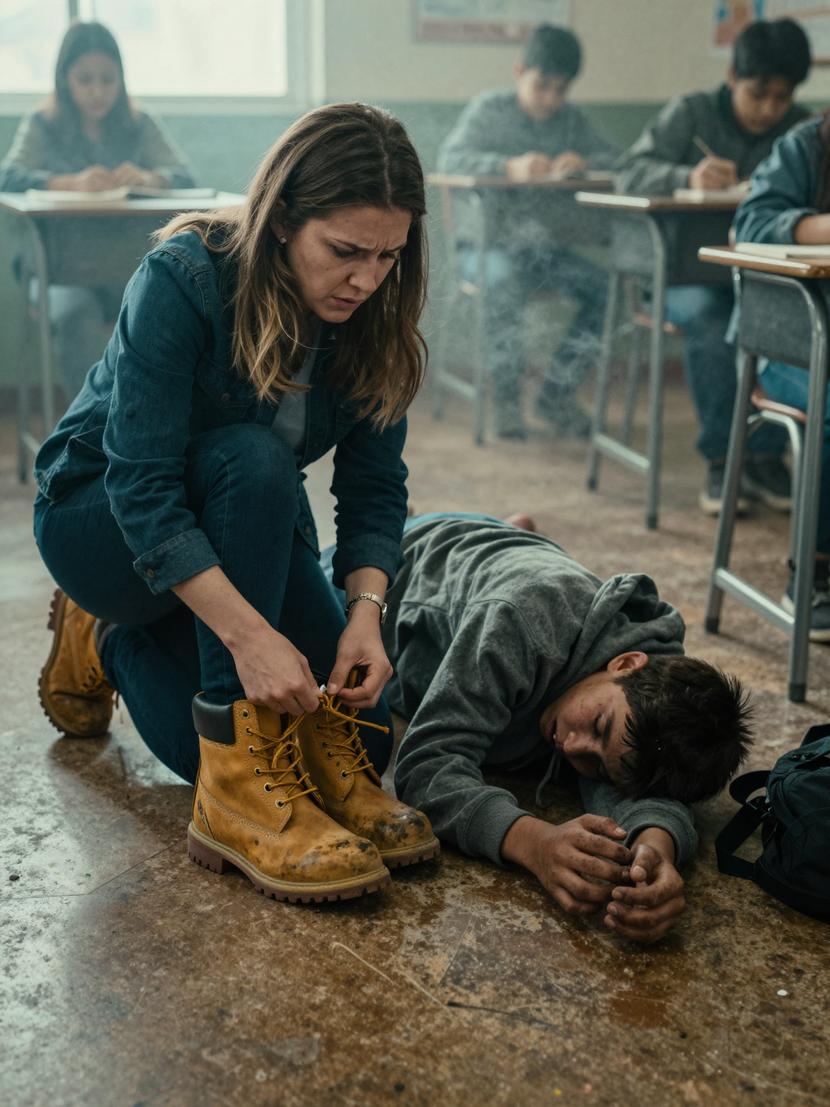
The stench hit me before I even heard the fall.
It wasn’t the common, musty odor of a locker room or damp gym clothes. This was something far more unbearable. Dense and thick, a sickly-sweet metallic scent burned my nose—like spoiled meat baked under the relentless sun—blended with the sharp, acidic bite of raw copper.
“Mrs. Carter? Nico looks off.”
I spun away from the whiteboard, marker cap clutched tightly in my hand. The mercury had hit ninety-two degrees in Cedar Hollow, North Carolina, and the ancient air conditioner in Room 4A had been wheezing its last breath since Tuesday.
The other fourth graders were slouched over their desks, flushed and panting, fanning themselves slowly with crumpled worksheets.
But Nico? Nico wasn’t fanning himself.
He was vibrating.
Perched in the back row as usual, cloaked in a bulky gray hoodie two sizes too large, and despite the scorching heat that turned the playground asphalt to molten tar, his thick, mud-streaked Timberland work boots stayed firmly laced.
Rain, shine, or a furnace-hot day—he wore them every single day.
“Nico?” I called, weaving around a pile of backpacks.
No response. His skin, normally pale, was now a ghastly, ashen gray—the color of cold ash after burning. Sweat wasn’t just beading; it was streaming down his face, soaking the collar of his heavy sweatshirt. His glassy eyes stared blankly into a distant shadow only he could see.
“Nico, sweetheart, you need to take off that jacket,” I said with the calm authority drilled into me by endless certification classes—the voice designed to steady nerves and stop panic in its tracks.
A tiny, violent shake of his head strained through the silence. “Cold,” he whispered. Teeth chattering audibly. “I’m… c-cold.”
“You’re overheating,” I said, hand reaching out uncertainly to touch his shoulder. Through the thick fabric, his body radiated heat like a furnace.
Sarah — no, Mrs. Carter, I reminded myself, clinging to that formal name like a lifeline. Don’t lose control. Calm down. Get him help.
“Everybody, eyes on your books,” I barked at the class. “Chapter four. Now.”
Turning back to Nico, I tried coaxing, “Come on, buddy. Let’s get you to Nurse Marlene.”
My hand went to his arm.
Then he screamed.
Not a child’s cry. A wild, piercing yelp packed with raw agony.
He whipped away from my touch. His chair scraped painfully against the linoleum floor as he struggled to stand. His knees buckled before he crumpled with a heavy thud.
“Oh my God!” shrieked a girl near the front.
Panic erupted. Chairs scraped back as twenty-five startled children scrambled to their feet.
“Sit down! Now!” I yelled, abandoning my calm tone. Dropping to my knees beside Nico, I fought to suppress the rising hysteria.
The smell now engulfed me—it rolled off Nico in oppressive waves, so thick I could almost taste it. It choked the cramped classroom.
Curled in a fetal posture, clutching his shins tightly, Nico muttered over and over, eyes rolled back to reveal only whites.
“Don’t… don’t look… Daddy said don’t look…”
‘Nico, can you hear me?” I whispered, placing my hand on his feverishly hot forehead. He burned with a dangerous fever.
My gaze dropped down to his feet.
Those boots.
Laced so tightly the leather appeared swollen and stretched. Near the cuff of his left boot, where the sock ought to peek through, the fabric was dark and wet.
“Someone get Nurse Marlene! Run!” I commanded, pointing to Dylan, the fastest kid in the classroom.
Dylan bolted.
Heatstroke could kill a child his size within minutes. I needed to cool him immediately.
I reached for the laces of his left boot.
His eyes snapped open.
For a terrifying moment, there was no recognition—just pure, primal fear.
“NO!” He kicked out fiercely, the heavy boot colliding with my thigh. Pain shot through me, but I held firm.
“Don’t touch them! You can’t touch them!” he cried.
“Nico, you’re sick. I have to take them off,” I pleaded, my hands shaky with dread. “We need to lower your temperature.”
“He’ll kill me,” Nico sobbed, the fight draining from his trembling frame as consciousness started to slip away. Tear streaks cut through dirt on his face. “If you take them off… he’ll kill me.”
Who?
The question raced through my mind, but there was no time for answers.
Nurse Marlene burst through the door, chest heaving from her sprint.
“Clear the area! Everyone away from him!” she ordered, urgency shaking her voice like nothing I had ever heard at Maple Ridge Elementary.
She knelt beside me, inhaling sharply as the stench assaulted her senses. Her face shifted from concern to stark terror in a heartbeat.
“Is that…?” she began, then stopped herself.
“Mrs. Carter, hold his shoulders. We need those boots off. Now. Circulation’s cut off.”
“He begged me not to,” I whispered as we held Nico down while he wriggled weakly. “He’s terrified.”
“I don’t care,” Marlene said sharply, producing trauma shears from her pocket. “Look at this swelling. Look at the discoloration of the leather.”
Closer scrutiny revealed more than wetness—the leather near the sole was stained a dark, reddish-brown.
She snipped the laces of the left boot swiftly.
The leather tongue puffed out—that horrible release unleashed a nauseating explosion of stench that forced me to gag, head turning away to choke back bile. Behind us, a child vomited.
“Oh, sweet Jesus,” Marlene whispered, frozen in shock.
Steeling herself, she gripped the heel and yanked.
The boot stuck briefly, suctioning wetly before finally pulling free with a sickening pop.
I looked down.
I wish I hadn’t.
Nico’s foot was no longer a foot. It was a grotesque, swollen mass of indigo and black, skin raw and weeping thick yellow pus from festering infection.
But the horror wasn’t just the infection.
Taped tightly along the arch, embedded deep beneath growing skin, was a thick, plastic-wrapped bundle.
Protruding from it, shimmering under the florescent glare, was the sharp corner of a razor blade.
Nico hadn’t simply been wearing boots. He was walking on a trap.
“Call 911,” Marlene’s voice cracked, tears shimmering in hardened eyes. “And the police. Tell them… tell them this was no accident.”
Nico whimpered, head lolling sideways, eyes locking with mine one last time before slipping shut.
“I’m sorry,” he breathed. “I just wanted to keep it safe.”
—
The classroom emptied in a rush, the clatter louder than the frail silence hanging in my mind.
“Everyone out! Go to Mrs. Gable’s room next door!” Marlene barked, voice breaking in a way I’d never heard in my six years at Maple Ridge Elementary.
The kids fled, terrified, never daring to glance back.
I could not look away.
Nico lay broken, his chest rising and falling in shallow, ragged gasps. The putrid scent of gangrene—sickly, decaying meat—filled the space between desks. It was the stench of death, seeping from a boy just ten years old.
“Mrs. Carter, put pressure on the calf—but don’t touch the wound,” Marlene ordered, gloves trembling as she readied herself.
I pressed my hands against Nico’s burning shin just above the lurid purple band where the boot had strangled circulation.
“Is he… Marlene, is he going to lose his foot?” My voice was barely a whisper.
No answer. She was busy slicing the laces of the second boot.
“No,” Nico groaned, struggling weakly, his head thrashing side to side on the cold tile floor. “Daddy said… the inventory. Don’t lose the inventory.”
Inventory.
That word echoed like a nightmare.
Kids talk about video games or football, not ‘inventory’ while their flesh rots away.
“Just hang on, baby. Help is coming,” I soothed, moving his damp hair from his forehead.
Sirens wailed—close, rising.
Marlene removed the second boot.
No gasp this time, just a weary exhale.
The right foot was worse—skin fused to the soggy sock by dried blood and pus. And glued to the ankle bone with silver duct tape was another sinister parcel wrapped in thick plastic. Inside lay compressed white powder.
“Drugs,” Marlene whispered. “He’s being used as a mule.”
The emergency doors burst open.
Two paramedics rushed in, pushing a gurney. Behind them, a uniformed police officer swept the room.
“What’ve we got?” the lead paramedic barked—a burly man named Harper.
“Severe infection, septic shock, possible gangrene—both lower extremities,” Marlene rattled. “And suspicious objects taped to the wounds.”
Harper’s gaze flicked down, a brief professional hesitation before snapping back to action.
“Alright, load and go. He’s crashing, BP dropping.”
They swarmed over Nico with IVs, oxygen masks, monitors beeping wildly.
“I’m coming,” I said suddenly, rising, knees weak.
“Ma’am, family only,” the officer blocked my path.
“I’m his teacher,” I stated firmly, voice trembling but resolute. “Right now, I’m the only person who cares. His father did this. You’re not leaving him alone.”
Harper glanced my way and nodded sharply.
“Alright, you’re with him. We need to keep him calm.”
—
The ambulance ride to Mercy Ridge Hospital blurred into a haze of flashing lights and static noise.
Nico woke once, eyes locking on mine—a flicker of lucidity in his pain.
“Mrs. Carter?”
“I’m here, Nico. Right here.”
“Did you find the razor?” he rasped.
Frozen, I whispered, “The razor? Why was there a razor?”
“To remind me,” he choked out, voice rough as sandpaper. “Daddy put it there. So I wouldn’t take the boots off. If I tried? It cuts.”
I swallowed sobs. The cruelty was unfathomable. The razor was torture—designed to punish the relief he sought.
“You’re safe now,” I promised, gripping his hand until my knuckles went white. “He can’t hurt you anymore.”
“He’s coming,” Nico murmured.
“He always comes for his inventory.”
—
At the hospital, Nico was rushed into surgery. Left outside, my dress stained with classroom grime and bodily fluids, I sat—feeling complicit, haunted.
How many times had I seen those boots?
September, still warm. “Cool boots, Nico,” I said casually. October. “Aren’t those heavy for gym?” November. That faint, terrible smell. I blamed poor hygiene, sent a note home. No answer.
I had failed him.
I’d watched him decay, silent and unseen.
“Mrs. Carter?”
Detective Harper appeared—grimed and weary, clutching a weathered notepad.
“How is he?” I asked.
“He’s in surgery,” Harper said grimly. “The sepsis is advanced—they’re fighting tooth and nail to save his legs.”
He sat next to me, coffee and cigarette breath heavy in the air. “Nurse Marlene told me what you found. The packages.”
“It was powder,” I said. “White powder.”
“Fentanyl,” Harper said quietly. “Pure grade. Street value in those boots alone? Fifty grand, maybe more.”
My stomach twisted. “He was carrying fifty thousand dollars worth of fentanyl. And a razor blade stuck to his foot?”
“We found three razors,” Harper corrected. “One in the left, two in the right—angled inward to slice the Achilles if he moves.”
I staggered to the trash and dry heaved.
Harper waited patiently.
“We need to know about the father—Elias Navarro, Sr. You met him?”
“Once,” I said, trying to recall. “At open house. Charming. Handsome. ‘Import-export’ was his line. Concerned about Nico’s grades. Said he was ‘undisciplined’ and needed structure.”
“Structure,” Harper repeated bitterly.
“He signed permission slips, answered the nurse’s call about a fever last month. Promised to handle it.” My voice cracked. “He handled it by tightening those laces.”
“We’re running his location now. Units headed there.”
“But Sarah… if this is cartel level, they never leave inventory behind.”
The ER doors glided open.
A man walked in.
Tall, dressed neat in a navy polo and khakis, car keys in one hand, phone in the other. The perfect suburban dad, wearing a practiced mask of frantic paternal concern.
“My son!” he shouted at triage. “Where is Nico Navarro? I just got the call—he collapsed!”
It was him.
The monster.
I looked at Harper. He slipped his hand to his holster.
“That’s the father,” I whispered.
The man’s gaze swept the room—at sick bodies, crying babies—and then locked onto me.
For a split second, the mask slipped.
The ‘worried father’ gave way to something cold, calculating—reptilian. His eyes didn’t see me as a teacher, but as an obstacle. As a butcher eyes a blunt blade.
Then the smile snapped back.
“Mrs. Carter!” he rushed forward, arms open, tears welling. “Thank God you’re here. What happened to my boy?”
I stood, trembling but burning with fury.
“You know what happened,” I said.
He stopped feet away, voice dropping so only I and Harper could hear.
“I hope you didn’t touch his shoes, Mrs. Carter,” he said, menace barely veiled beneath fake concern. “Nico has sensitive feet. He gets embarrassed.”
“We took them off,” I said, eyes boring into his. “And we found everything.”
The air thickened.
His smile froze, no longer reaching his eyes. He glanced at Harper, then back at me, realizing the trap was sprung.
“I see,” he said softly. “Well, that’s complicated.”
Harper stepped forward, badge flashing.
“Turn around. Hands behind your back.”
No resistance. Just a sigh, like being handed a parking ticket.
“You don’t know what you’ve done,” Elias Navarro muttered with chilling calm. “You didn’t save him. You opened the box. And you have no idea who else is looking inside.”
A terrifying smile curled his lips.
“I’m just the middleman, Mrs. Carter. The owners? They want their shoes back.”
—
2:00 AM at Mercy Ridge Hospital felt like a stifling aquarium trapped in stale water. The fluorescent hum buzzed overhead; the air faintly reeked of antiseptic and burnt coffee.
I hadn’t moved from the plastic chair in hours, phone buzzing with calls from my husband, principal, colleagues—but I couldn’t answer. My hands shook uncontrollably.
Every dark moment closed my eyes, I saw the razor. The purple, rotting foot of a ten-year-old.
“Mrs. Carter?”
Dr. Bennett, trauma surgeon, appeared—world-weary, hair tousled and graying, scrub cap removed.
“Is he…?” I choked.
“He’s alive,” he said, sinking beside me. “We saved the legs. Barely. Three toes amputated from the left foot—necrosis so deep it reached the bones.”
The sob I’d held collapsed.
“Three toes…” I whispered.
“Lucky it wasn’t more. Or him,” Bennett’s grim tone chilled me. “Sepsis was systemic; just hours away from organ failure. This was deliberate—slow, torturous.”
“His father,” I spat.
“Police have him detained,” Bennett stood, rubbing his neck. “Nico’s stable in ICU, room 512. Officer posted.”
“Can I see him?”
“Family only, usually, but… your ‘family’ is in custody. We’ll make an exception. He needs a friendly face.”
—
The ICU was oppressively quiet.
Room 512 at the end of a long, sterile hall.
A young officer guarded the door, distracted scrolling his phone, eyes flicking up as I approached.
“I’m his teacher,” I whispered, flashing badge from Dr. Bennett.
“Five minutes. He’s out cold.”
Inside the darkened room, only the eerie beeping of monitors pierced the silence.
Nico lay tiny beneath stark white blankets, face pale, cavernous dark circles shadowing bruised eyes. His legs swollen and bandaged, wrapped like casts.
I pulled a chair close, taking his slender, cold hand.
“I’m here, Nico,” I whispered. “I’m not leaving.”
I must have slipped asleep.
Awoken by a faint clicking—the turning of a door handle.
Sitting up, I whispered, “Officer?”
The door creaked open.
Not the young officer.
A man in blue scrubs entered, surgical mask and cap concealing his face, a metal tray with a syringe in hand.
“Just checking vitals,” he mumbled, voice muffled.
I glanced at the clock: 3:17 AM.
Something was wrong.
My skin crawled.
“Where’s Nurse Marlene? Or Lena?”
“Lena’s on break,” the man replied, not meeting my eyes, moving directly to Nico’s IV.
Doctors wear running shoes; nurses comfortable sneakers.
This man wore hard, black leather dress shoes, clicking sharply on the tiled floor.
The owners want their shoes back.
The truth hit me like a blow.
“Stop!” I lunged.
He moved fast, unflinching—backhanded me hard.
I crashed into the vitals monitor, the machine toppling with a horrific CRASH as the alarms shrieked.
“Shut up, bitch,” he hissed, eyes cold and lifeless.
He reached for Leo’s IV, syringe raised.
“No!”
I grabbed the metal IV pole—a weapon born of terror and fight.
With a desperate swing, it connected CRACK with his shoulder.
He grunted, dropping the syringe.
Fear surfaced in his eyes—not of me, but the noise.
“Code Silver! Room 512!” the intercom blared.
He glanced at the door, then me, pulling a serrated knife from his waistband.
“You should have stayed in that classroom,” he snarled, advancing.
I backed him, shielding Nico.
He murmured, “Mrs. Carter?”
“Stay down!” I screamed.
The knife rose.
BANG.
The door exploded inward.
Detective Harper, weapon smoking, stormed in.
The attacker staggered, blood blossoming on his shoulder, dropping the knife.
“Drop it! On the ground! Now!” Harper commanded, closing in.
The man looked to the window, then Harper—resigned.
“Don’t shoot,” he said, calm, professional. “I’m a contractor.”
I collapsed beside Nico, cradling him as tears streaked his hospital gown.
“It’s okay,” I soothed.
Harper kicked away the knife, cuffing the man hard.
“You alright, Sarah?” Harper shouted over the alarms.
“I think so,” I stammered, eyes on Nico. “He tried to inject something.”
Harper spotted the syringe: “Potassium chloride. Stops the heart instantly. A staged heart attack.”
He dragged the assailant up, demanding, “Who sent you?”
The man smiled beneath the mask.
“Arrest won’t stop them. You think a cell matters?” He looked at Nico and me. “Inventory compromised. Protocol: liquidation.”
“Get him out of here!” Harper yelled as officers flooded the room.
Turning to me, pale and grave, Harper said, “This was no random hit. That guy’s a pro. He got past tight security. The hospital isn’t safe.”
“What do you mean?” I whispered, clutching Nico tighter.
“We have to move him. Now. Before the next shift. I have a safe house—off the books,” Harper said, eyes pleading. “If he stays in the system, he dies. And you… you saw his face. You stopped the hit. You’re a target.”
Looking down, Nico clung to me, terrified.
No mother. No protector but me.
If I left him? He was gone.
I inhaled deeply, thought of tenure, quiet days, the stack of ungraded essays.
Then I let it go.
“Okay,” I said, standing with resolve. “Where do we go?”
—
The interstate at 4:00 AM—endless black ribbons of road, the rhythmic drone of tires, headlights blazing by eighteen-wheelers westbound.
I sat passenger in Harper’s unmarked SUV, rain streaking down the window. Dry blood from the IV pole stained my hands. My phone—my last link to my old life—was gone, tossed behind a gas station.
“No GPS,” Harper said quietly. “No pings. You don’t exist anymore, Mrs. Carter.”
In the backseat, Nico finally slept. Small, curled beneath a rough wool blanket, bandaged feet propped on a duffel bag. Even in peace, his brow furrowed, his grip tight on fabric like a soldier surviving a war.
“We cross state lines soon,” Harper muttered, eyes sharp in the rearview mirror.
“Where?”
“A cabin in the Blue Ridge Hills. Off grid. Solar power, well water, no mail.” He glanced at me. “Not comfortable, but safe. The Feds will help soon. For now… we disappear.”
My reflection shimmered in the glass. Maya Bennett.
Teacher of the Year runner-up. Book club president. Wife left behind two years ago for ‘caring too much about students.’
I looked at Nico.
“I can’t go back, can I?”
Harper’s shake was slow and sure.
“The cartel his father worked for? They don’t forget. You cost them millions. They want their shoes back. You’d be dead in a week.”
“You can drop him at the safe house. They’ll place him. You can disappear. Start fresh. Safer.”
I looked at Nico again. The fragile boy whose awful boots were the only armor against a monster.
“No,” I whispered. “We stick together.”
—
The cabin smelled of pine and dust, frigid and alien.
Days passed. Nico was silent, watching the woods from the window, flinching at birdcalls.
He refused bandage changes or eye contact.
“It’s okay,” I said, leaving soup nearby. “When you’re ready.”
On the fourth night, a storm exploded overhead—thunder like gunshots.
I was boiling water when I heard him scream.
“DADDY! I’M SORRY! I DIDN’T LOSE IT!”
I dashed into the living room.
Nico clawed at his bandages, frantic and weeping, scratching raw skin till it bled.
“I need them!” he hysterically cried. “Where are the boots? He’s coming! If I don’t have them, he’ll cut me! He said he’d cut my throat!”
“Stop, Nico!” I grabbed his wrists, holding him tight. He fought with desperate strength, kicking injured legs.
“There are no boots!” I yelled, pulling him close. “They’re gone. He is gone!”
He shuddered against me. “He said I’m worthless without them. Just a mule.”
My heart shattered.
I forced his wild gaze. “Listen to me. You are not a mule. You are smart, kind, brave.”
“I’m broken,” he whispered, eyes downcast at bloodstained bandages. “My feet—they’re monsters.”
“No,” I said firmly. “They’re battle scars. They mean you survived.”
I fetched first aid supplies.
“Let me help you heal.”
He hesitated, eyes scanning for shadows. Slowly, he nodded.
Through the storm’s rage, I carefully unwound the bandages. The infection’s harsh scent faded, replaced by clean ointment. Jagged red lines marked his feet—forever scarred.
But pink skin shone. Healing.
I rewrapped gently, sliding warm wool socks over feet—free from blades or nightmares.
“How’s that?” I asked.
Nico wiggled toes, wonder in his eyes.
“Warm,” he breathed.
He leaned in, resting his head on my shoulder. For months, his body relaxed.
“Thank you, Sarah,” he whispered—his voice soft, no longer Mrs. Carter.
—
One year later.
The New Mexico sun was harsher but clearer than North Carolina’s.
I sat on a park bench, sunglasses shading my face, short sun-bleached hair, under the name Maya Bennett.
“Mom! Watch this!”
Ben—once Nico—stood at the top of the slide. Grew taller, lighter under the freckles, dark circles vanished. He wore shorts.
And he was barefoot.
Months of therapy had peeled away his fear. The first beach trip landed him in a panic but step by step, we helped him reclaim his feet.
Scars gleamed like jagged lightning on his ankles, but he wore them proudly, telling classmates they were shark bites. Suddenly, he was the coolest kid around.
“I’m watching, Ben!”
He pushed off, sliding down with laughter ringing out, tumbling in the sand, digging toes in the warm earth.
He ran back, breathless, collapsing beside me.
“Did you see? I went super fast!”
“I saw,” I smiled, wiping sand from his cheek. “Like you were flying.”
He gazed at his feet buried in sand.
“Mom?”
“Yes?”
“Do you think… do you think he remembers me?”
The name we never spoke.
“I think he’s locked in a small, dark box where he can’t hurt anyone anymore. And you don’t need to worry. You’re becoming everything he never could.”
Ben leaned against me.
“I like being Ben,” he said softly. “Ben doesn’t hurt.”
“I like Ben, too,” I said, kissing his head.
My phone buzzed—a burner, one number: Harper.
Text: ‘Verdict is in. Life without parole, plus 30 years federal. He’s done. You’re free.’
A tear slipped beneath my sunglasses.
I switched the phone off.
“Hey,” I nudged Ben. “Ice cream?”
“Mint chocolate chip?”
“Is there any other kind?”
He sprang up, grabbing my hand, tugging me toward the truck.
“Come on, Mom! Run!”
So we ran.
Away from old lives, old selves.
And as I chased my boy across the sunlit grass, watching scarred feet dance free of pain, I realized—I hadn’t just saved him.
He saved me.
Together, we were walking again—for the very first time.