
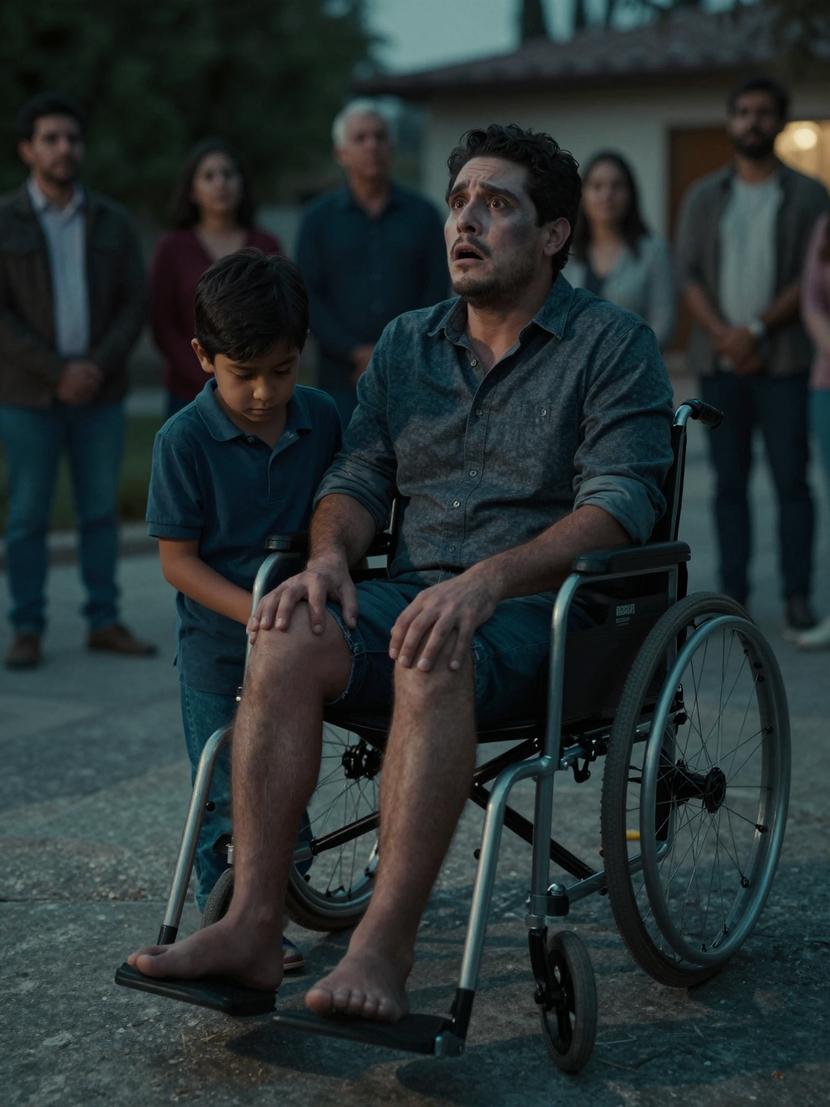
The patio fell into a tense stillness—not the polite silence of waiting, but a suffocating hush that pressed like a weight on every chest. Barefoot on the cold stone tiles, the boy’s fingers hovered mere inches from the knee of the man in the wheelchair. Exactly where the forgotten damage had been overlooked, as the dusty old medical journal had revealed.
The man, Diego Ramos, smiled—a slow, sharp smile.
“Fifteen seconds,” he declared, his voice cutting through the thick air. “After that, I’m calling the police.”
Phones flicked up, screens glowing in the gathering darkness. A hush of whispers spread—someone murmured that this would go viral.
The boy shut his eyes. The world narrowed. He pressed his fingertips down gently.
A scream shattered the night—harsh, raw.
“Get your hands off me!”
And then it stopped.
Diego froze. His breath hitched, his face drained of every color. A shift rippled beneath his skin—not pain, not movement—but something more elusive.
Sensation.
Something he hadn’t felt in eleven long years.
“That’s impossible,” he whispered, disbelief tangled in his voice.
The boy stepped back calmly.
“Try,” he said quietly.
A ripple of laughter swept through the crowd. Then silence, as all eyes fixed on Diego’s trembling fingers.
——
Eleven years ago, Diego Ramos had been given a verdict that felt like a tombstone: he would never walk again.
An accident. A shattered spine. A life sentence passed in sterile white rooms by strangers who never lived the consequences.
What he never knew was that his injury had been labeled “unlikely to recover,” not “impossible.”
But “unlikely” doesn’t win settlements. And “never” keeps inconvenient truths buried.
——
Diego gripped the arms of his wheelchair tightly.
“I can’t,” he confessed, voice trembling.
The boy’s steady gaze held his.
“Yes, you can.”
Driven by a deep, aching hope, Diego pushed down on the armrests.
His legs wobbled—frail, uncertain—but they answered.
He rose, unsteady and weak, but upright.
A check slipped unnoticed from his hand.
The crowd didn’t erupt in cheers. Instead, they recoiled, breath caught in stunned silence.
——
When the police arrived, it wasn’t for the boy—it was because too many unspoken questions had suddenly burst forth.
Doctors were named. Medical records summoned. Old case files pried open.
One officer knelt before the boy.
“What’s your name?”
The boy hesitated, shadows flashing in his eyes.
Names left trails.
“No,” Diego said quietly but firmly. “He stays with me.”
“Protecting him?” the officer asked.
Diego swallowed hard.
“No,” he admitted. “I’m afraid of losing him.”
——
That night, inside his penthouse overlooking the city lights, Diego learned the boy’s true story.
No miracles. No magic.
A photographic memory. A mind so brilliant it made doctors pause. A mother who had died in a clinical trial that vanished without explanation.
The same corporation Diego had invested in silently.
The very system that had made him wealthy.
And erased the boy.
For years, Diego believed he was the victim.
But watching the boy fluently read medical texts meant only for experts, the truth settled grim and unyielding.
He was not the victim.
He was the beneficiary.
——
“I’ll give you everything,” Diego said, desperation rasping his voice. “Money, a home, a name. Everything.”
The boy glanced up, eyes steady.
“I don’t want your money.”
“Then what do you want?”
For the first time, the boy smiled—brief, sharp.
“The truth.”
——
The fall came quietly.
Reports leaked. Lawsuits ignited. careers crumbled without spotlight.
Years later, a reporter confronted the boy, now a man shaped by pain and perseverance.
“Why did you do it?”
His answer was calm, unyielding.
“They laughed at me. They believed their money made them untouchable.”
He paused, eyes steady.
“It didn’t.”