
Chapter: The Space Between Them
The days that stretched ahead were far from the fairy tale Esteban might have wished for. There were no sudden miracles, no brilliant epiphanies illuminating their path. Instead, there was the slow, steady pulse of life—the quiet cadence of Diego’s soft, even breaths each night as Luzia sat quietly, her gaze never leaving his crib.
Esteban found himself lingering longer in the nursery, initially leaning against the wall, a silent sentinel trying to decipher a puzzle he hadn’t expected. He watched Luzia, searching for signs—any indication that she was performing some grand act of healing or magic. But Luzia moved like a gentle current, simple and consistent. She folded blankets with practiced hands, wiped the surfaces with care, and hummed the fragile melodies of her mother’s songs, whispering warmth into the cold corners.
Little by little, Diego started to change. The boy no longer screamed needing to be held the instant distress crept upon him. Instead, he quietly played on the soft rug, his little eyes flickering back every so often, ensuring Luzia was still there, a tether to safety in a world that had suddenly shifted beneath him.
One tense evening, Esteban finally broke the silence. “You don’t try to make him laugh,” he said, voice low, searching.
Luzia kept her eyes fixed elsewhere, calm but resolute. “Children don’t need endless distraction or spectacle,” she murmured, “They need to know there’s a place where they’re safe.”
That simple truth lingered inside Esteban far after Luzia left the room, echoing in the hollow spaces of his heart.
—
Esteban ruled his world with precision—boardrooms, markets, risks mapped out in sharp lines. But grief mocked control; it did not submit to power or tactics.
One night, cradling Diego as the boy slept peacefully in her arms, Luzia faced Esteban across the quiet room. “Aren’t you afraid?” he asked, voice brittle with more than just fatigue.
“Afraid of what?” she replied, eyes soft but wary.
“Of being here—with my family. The whispers, the judgment…”
Luzia offered a weary smile, the kind shaped by years of quiet endurance. “I work here to buy medicine for my mother. People will always talk, no matter what path you walk.”
Esteban’s gaze sharpened, taking in details he hadn’t noticed: the absence of makeup on her face, the roughness of her hands stained by cleaning chemicals, the careful distance she maintained—never overly familiar, never coldly aloof, striking a balance in the fragile dance of proximity.
“You could ask for more,” he said abruptly. “A promotion. Better pay. A different life.”
Luzia shook her head slowly. “I’m not here for title or advancement.”
A silence fell between them—heavy, strange. For the first time in ages, Esteban did not feel like the man with all the power.
—
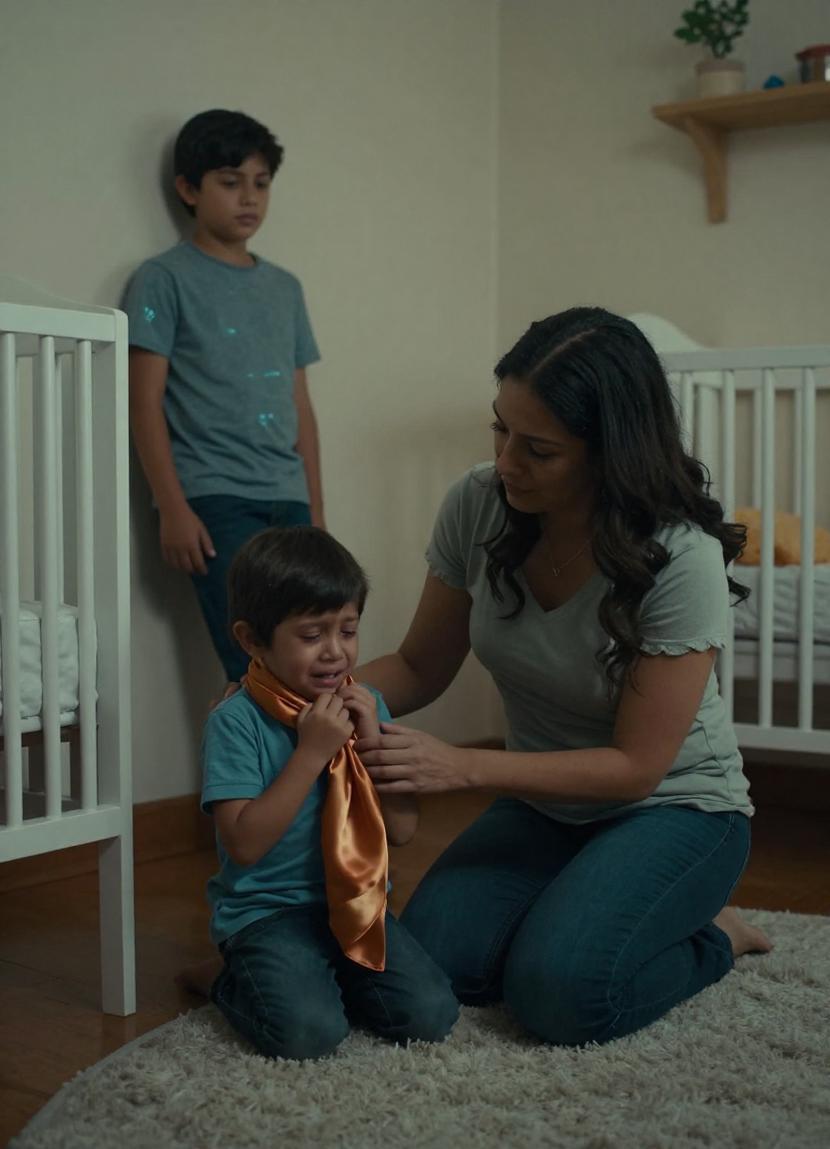
One afternoon, Diego pulled from a drawer a silk scarf once belonging to Marta, clutching it tightly as tears spilled down his small cheeks.
Instinct screamed at Esteban to take the treasure away, to wipe away the sorrow.
But Luzia’s gentle hand on his arm stopped him. “Don’t,” she said softly.
She knelt next to Diego. “You miss your mommy, don’t you?” she whispered with aching tenderness.
Diego nodded, his grief raw and unfurling in open waves.
Esteban stood stiff, witnessing Luzia’s quiet presence—not distracting Diego, not rushing to fix the pain—but allowing the sorrow to breathe and exist.
Gone was the frantic scream of panic; in its place was grief finally given permission to live.
That night, after Diego slipped into sleep, Esteban remained in the dim living room. Luzia returned with two warm cups of tea.
“You don’t have to do that,” he murmured.
Her eyes met his calmly. “This isn’t for you. It’s for him. If you’re stronger, he’ll feel it.”
A dry, humorless chuckle escaped Esteban’s lips. “You think I’m weak?”
Luzia held his gaze steady. “I think you’re afraid.”
He had no words to counter that.
—
Time passed as an unseen current, gentle yet relentless.
Esteban started coming home earlier, learning to lower himself to the floor beside his son instead of towering above him.
He told Diego stories about Marta—not grand or monumental tales, but small, simple moments that painted the colors of who she had been.
Slowly, ever so slowly, Diego reached out to him—not with the sudden magic of healing, but with evolving trust, fragile yet genuine.
One evening, as Luzia gathered her things to leave, Esteban’s voice stopped her. “I don’t know how to thank you.”
She paused, searching his face. “Don’t thank me,” she said firmly. “Just don’t push me away because of what people might say.”
He nodded, understanding the invisible walls drawn not from money or power, but from the unforgiving judgment of the world beyond.
He stepped closer—careful, measured. “I’m not keeping you here because you clean,” he confessed, “I’m keeping you because you’re the only person who doesn’t try to control my son.”
Luzia looked up, their eyes meeting fully for the first time—no evasions, no fleeting glances.
There was no dramatic music, no grand revelations. Just two grown souls standing quietly in a room warmed by the peaceful sleep of a child they both loved.
In that fragile stillness, something new took root—not a blazing love forged overnight, but a seed of respect, of trust, of fragile hope.
For the first time since Marta’s passing, the house no longer felt cold.