
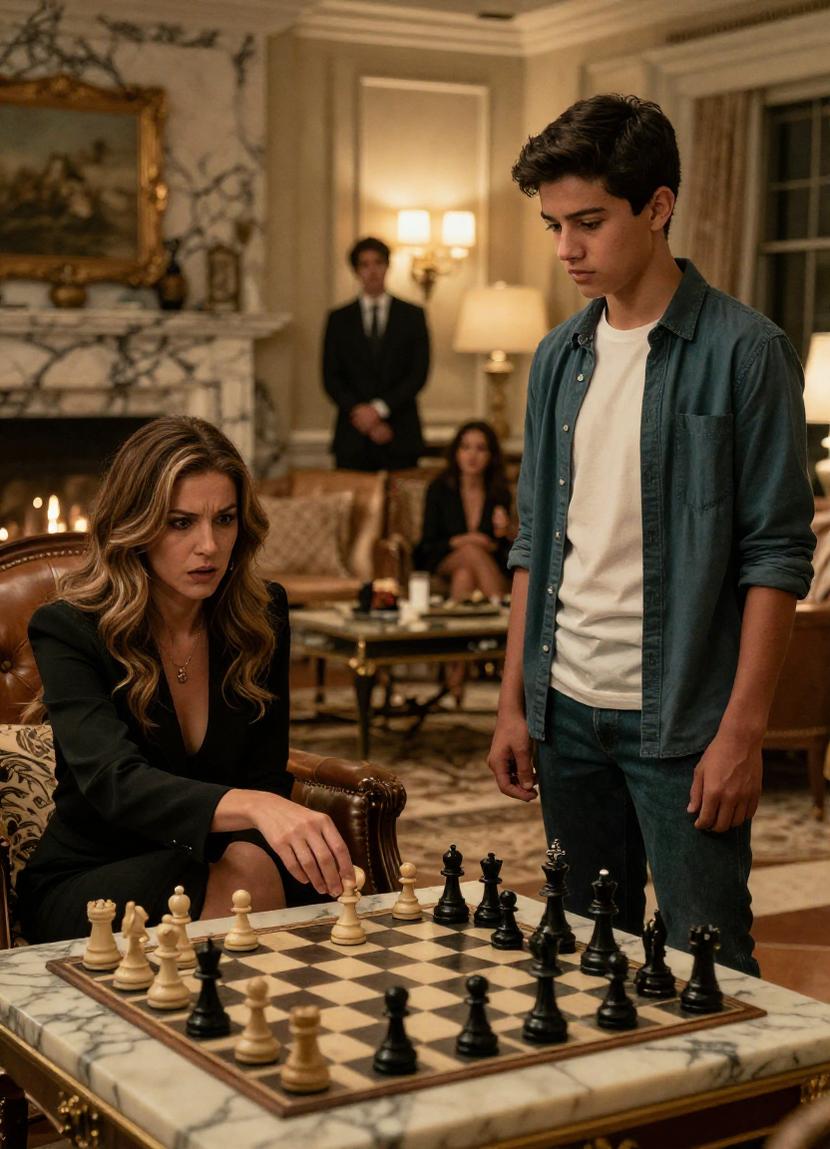
In the opulent expanse of the Silverlake Estate, Isabella Cortez’s voice rang out, laced with a sharp edge of condescension that seemed to echo off the marble walls. ‘Come here, boy. Why don’t you show us how chess is played down in the slums?’ she taunted, eyes gleaming with a cruel kind of amusement. Carlos Mendoza, only seventeen, paused his discreet service alongside his mother, Lucia, at the lavish charity dinner, shocked by the sudden summons. This was supposed to be a night for raising funds for underprivileged youth—yet the irony was lost on no one as the guests, a cluster of businessmen, politicians, and boardwives, barely concealed their snickers behind crystal flutes filled with pricey champagne.
Isabella, who was born with silver spoons in her mouth and never felt the sting of struggle, delighted in the spectacle. ‘I bet he can barely grasp the rules,’ she scoffed, gesturing to the exquisite Italian marble chessboard displayed prominently on the coffee table. ‘Let’s see what someone who’s actually studied the game can do against him.’
Mr. Prescott, a distinguished hotel magnate, whispered to his wife, ‘I wouldn’t be surprised if he doesn’t even know how the knight moves in an L-shape.’
Laughter rippled through the room like waves against a fortress of entitlement. Meanwhile, Lucia held her silver tray tightly, biting back the urge to confront her employer. Two decades of tireless work in this very mansion, raising Carlos on a meager maid’s salary—and now her son was being paraded like a sideshow act.
Isabella’s eyes shone with a faux sweetness. ‘Lucia, you can take a break and watch your son play. It’ll be a precious lesson for both of you,’ she said, her voice a dagger wrapped in velvet.
Carlos’s dark eyes swept the room, silently cataloging every sneer and smirk. He had learned long ago that silence, often, was the sharpest weapon. At seventeen, Carlos carried the calm of one who has faced judgment all his life—and an unshakable resolve hidden beneath that quiet exterior.
There was a magnetic stillness about him, a tension crackling like the moment before a storm breaks. His fingers twitched minutely, as if moving phantom chess pieces across an invisible board only he could see. ‘Of course, Mrs. Cortez. It would be my pleasure,’ Carlos answered, his voice steady, drawing curious glances from the guests.
Isabella sank into an oversized leather chair with the air of a queen awaiting a ceremony. ‘I suppose you’ve never handled a board like this,’ she teased, waving toward the Italian masterpiece. State Representative Emily Ross, sitting near a sunlit window, murmured, ‘Each piece costs more than some of us make in a month.’
‘Isabella, don’t you think this is a bit cruel? Your plan might backfire,’ Emily added cautiously.
‘Nonsense,’ Isabella flashed a diamond-studded smile while adjusting her earrings. ‘It’s a gift. He’ll be able to brag that he played chess at a real mansion.’
What Isabella did not realize—what no one in the room grasped—was that the boy she dismissed as a “slum kid” was, in fact, a chess prodigy. For eight relentless years, Carlos devoured chess books from the public library and watched legendary matches on a beaten-up computer repaired by his own hands. While his peers wasted time on video games, Carlos immersed himself in the grandmasters’ world.
During the cold, silent nights when Lucia worked double shifts, Carlos studied the games of Kasparov, Fischer, and Carlsen by candlelight. He committed over two hundred openings to memory and could recite the fifty most renowned defenses as though reciting poetry. None of the privileged guests could have anticipated the shocking lesson they were about to receive, courtesy of the very youth they thought beneath them.
As Isabella prepared the pieces with a flourish, Carlos scrutinized each face in the room, his mind not simply bracing for a game, but for the battlefield where assumptions about respect and worth would be shattered.
Isabella took the white pieces with the swagger of someone accustomed to winning—if only by default. ‘I always take white,’ she declared with misplaced confidence. ‘It’s tradition.’
Carlos set his black pieces with surgical precision, eliciting a wary glance from Mr. Prescott. Every piece sat impeccably centered on its square, as if the board was but a familiar stage in his many silent rehearsals.
‘Let’s up the stakes,’ Isabella proposed with a wicked grin. ‘If this boy scares me even once, I’ll donate a thousand dollars to—what?—a public school?’
Chuckles filled the room, but Carlos’s smile remained enigmatic, unreadable. Lucia’s heart quickened. That smile was no ordinary one; it was a silent promise, the same smile he had worn as a child when underestimated in school, the same determined gaze from a dozen math battles they’d fought together.
The game began. Isabella’s pawn moved briskly to E4. ‘Indian King opening,’ she proclaimed condescendingly, as if tutoring a child in the first step of shoelace tying.
Carlos countered smoothly with C5—the Sicilian Defense—stirring a tense hush among the observers. This was no novice move; it was a declaration of strategic mastery.
‘Impressive,’ Emily whispered, leaning in. Isabella faltered briefly, betraying that her knowledge was superficial.
She moved her knight to F3, clinging to cookie-cutter openings gleaned from social clubs and lunchroom chatter. Carlos responded immediately with Nc6, each calculated step peeling back the facade of Isabella’s assumed superiority.
A tiny smile played across Carlos’s lips as the memories of his journey flickered in his mind. Eight years ago, at nine, he’d found a torn chess book abandoned in the library trash—a discarded treasure. He’d smuggled it home, beseeching Lucia to teach him the basics.
‘Why chess, mijo?’ Lucia had sighed, worn out after a grueling shift.
‘To be like the rich kids, Mom. They’re always saying they’re smarter than us,’ Carlos had said then, his young eyes burning with quiet rebellion.
With a scant $600 a month, no lessons, no internet, and a broken computer as his only window, Carlos’s sanctuary became the public library. Every afternoon, he’d walk miles to study the dusty volumes no one else cared to touch.
Isabella played D3, a timid, defensive move, reflecting her approach to the game—and to life—safe, predictable, and relying on status rather than skill. Carlos answered routinely with Nf6, developing his bishop’s fianchetto with an understated yet invisible strategic thread that would unravel in time.
‘Slow down,’ Isabella whispered, bemused to the guests. ‘In chess, you’re supposed to think before you move, not speed through like that.’
But Carlos’s calculated pause before a deliberate G6 was no hurried guess—it was the first step in a complex plan that would take the next several moves to fully unveil.
‘See? No patience,’ Isabella crowed. Yet Mr. Prescott, a seasoned chess player, frowned. ‘Isabella, that’s a Dragon Variation, a sophisticated Sicilian line.’
‘Oh, come off it,’ Isabella snapped, denial tightening her voice. ‘Must be something he’s seen in a movie.’
But as the moves unfolded, the room’s energy palpably shifted. Carlos wasn’t just reacting; he was orchestrating every move, turning the gleaming board into a symphony of grace and precision. Lucia watched, breath shallow and heart pounding. For the first time, she glimpsed the flicker of genuine fear in Isabella Cortez’s usually unflappable eyes—the fear of losing, not just a game, but her presumed place in the world.
With each dismissive shove of a pawn or knight, Isabella unwittingly scripted her downfall on the sixty-four squares. Carlos’s tenth move startled Mr. Prescott so severely he nearly choked on his drink—a pawn sacrifice, seemingly innocent, but in truth the lethal bait for a trap no amateur could conceive.
‘Isabella,’ Mr. Prescott whispered urgently, ‘this boy isn’t just skilled; he’s brilliant.’
Isabella, blinded by hubris, waved off the warning. ‘Relax, dear. He’s probably memorized a few online moves. I’ll end this in five minutes.’
But then Carlos rose calmly, approaching Lucia in the corner, where she stood silent, hands trembling. ‘Mom,’ he whispered, his steady voice slicing through the room’s heavy tension. ‘Remember when you said that one day I’d show them who we really are?’
Lucia’s eyes glistened. She remembered the promise made quietly on his fifteenth birthday when there was no money for cake or celebration. ‘Sí, mijo. I remember.’
‘That boy has more class than all these people put together,’ muttered Emily Ross, her voice respectful, watching the exchange.
Isabella drummed fingers impatiently, breaking the moment. ‘Can we continue? I have other matters to attend to.’
But Carlos was no longer just a boy summoned for amusement; he was a young man undefeated by poverty and prejudice, fortified by sacrifice and relentless determination. His eleventh move sliced through Isabella’s defenses, creating a cruel fork: save the king, and the queen falls; shield the queen, and checkmate follows in three moves.
‘Impossible,’ Isabella stammered, eyes glued to the board as confusion flickered into panic.
‘You’re being outplayed by a kid who has likely never set foot in a formal chess club,’ Mr. Prescott said flatly.
Around the room, the audience shifted—Emily lowered her glass, riveted. Mr. Prescott’s wife put down a fashion magazine, engaged for the first time. Lucia recognized the fierce intensity in Carlos’s gaze, the same expression he’d worn studying chess at dawn, the same with which he had conquered countless hidden battles before the world.
Isabella made a desperate, clumsy move to escape the unfolding catastrophe. It was too late.
‘Check,’ Carlos announced softly, positioning his queen with calm finality. The board now held the promise of three different wins.
The room sank into stunned silence. Isabella’s hands trembled—not with fear, but simmering fury, aware for the first time that she had seriously underestimated the boy she thought was a jest.
‘You must have seen this somewhere,’ she said, voice sharp. ‘No one masters that alone.’
Carlos smiled for the first time, a quiet revelation in his eyes. ‘You’re right, ma’am. I learned it from Garry Kasparov.’
‘Kasparov taught you?’ Mr. Prescott breathed.
‘Not in person,’ Carlos clarified, with a confident nod. ‘But I studied every documented game—1,183 in total. This particular tactic is from the 1984 World Championship, game 23 against Karpov.’
Isabella sought allies in the room, but found only quiet disapproval and shifting discomfort.
Summoning courage, Lucia stepped forward. ‘My son wakes at five every morning to study. He walked six miles to the library because we couldn’t afford internet. When the electricity was cut, he stayed up solving puzzles by candlelight while I worked double shifts.’
Silence deepened, heavy and complete. Carlos glanced at his mother with fierce love, and several guests averted their eyes, shame flickering across their faces.
‘Checkmate,’ Carlos said gently, placing his queen decisively.
Isabella’s gaze returned to the board as if expecting the pieces to shift differently. Finally, she looked up—met by the calm, unyielding stare she had ignited, now turned fully against her.
The room’s atmosphere was irrevocably changed. Carlos Mendoza was no longer just entertainment, but a force that had rewritten every assumption about talent, class, and respect. The guests now regarded Isabella with a blend of embarrassment and disillusionment unlike anything she had ever encountered.
What Isabella Cortez didn’t yet see was that this game was only the opening move in a much larger contest. The social order she took for granted was about to be challenged in ways no one foresaw. And Carlos—the boy she had mocked—would soon prove that true nobility isn’t etched in surnames or bank accounts, but forged in courage, knowledge, and heart.