
There’s a distinct, haunting scent that fills a trauma bay after a monstrous crash arrives through the doors—a metallic tang of copper mingled with the sterile sting of antiseptic, the acrid burn of rubber, and the biting chill of a winter storm’s damp breath.
I am Dr. Elena, a senior trauma surgeon at a Level 1 trauma center in Chicago, with a dozen years spent facing the brutal aftermath of twisted metal and shattered glass. I believed my heart had armored itself against the horrors I witnessed daily. I was wrong.
It was a viciously cold Tuesday night in late January. The mercury outside had plunged to a punishing negative ten degrees. Interstate 90 lay cloaked in treacherous black ice—a flash freeze turning the highway into a death trap. For over an hour, our emergency radio had howled relentlessly: a catastrophic twenty-five-car pile-up.
Suddenly, the ambulance bay’s double doors flung wide open. Frigid gusts screamed down the corridor, carrying frantic voices overlapping each other.
“Trauma One! Clear the way! Central line kit, now!” barked a paramedic, pushing a stretcher with wheels squealing on the linoleum.
I sprinted to the stretcher’s head, snapping my gloves into place. My team swarmed like bees, poised for action.
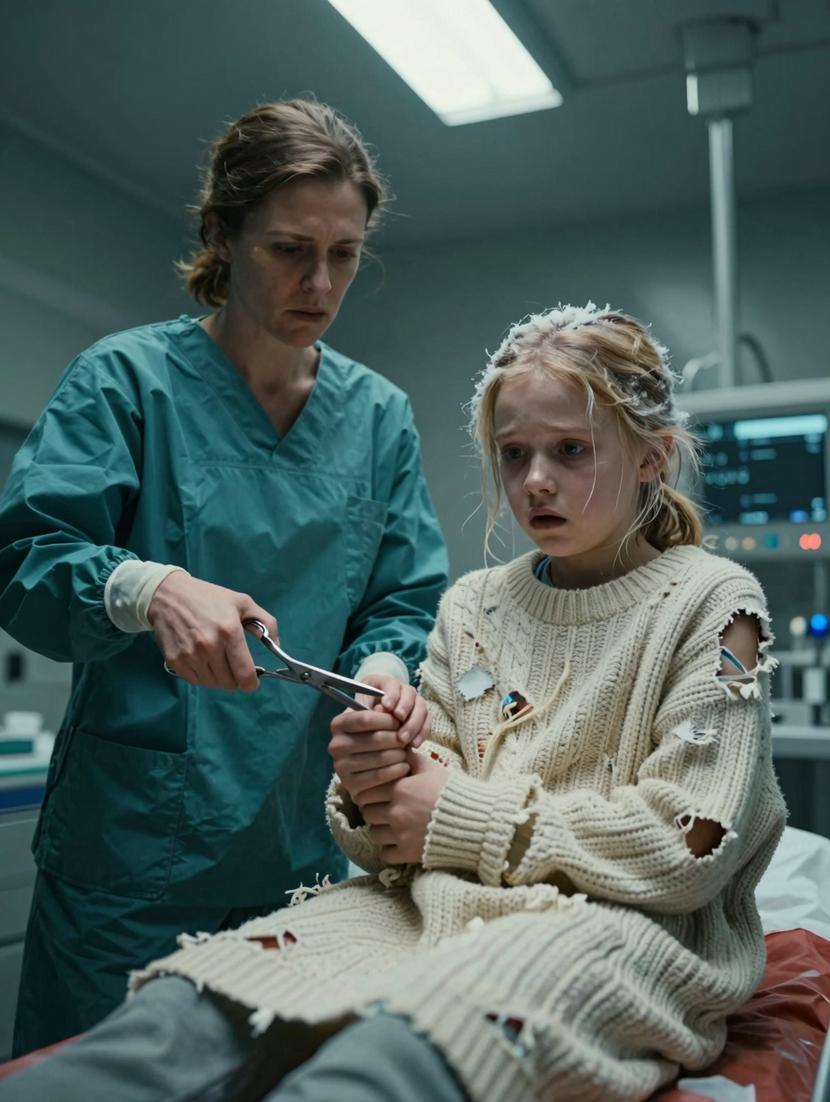
On the narrow bed lay a girl no older than seven—Isabel. Her blonde hair, matted and frozen to her forehead, framed a face so pale it seemed nearly translucent under the harsh fluorescent lights.
But it was her clothing that seized my attention immediately—an enormous, cable-knit sweater, drenched and ruined, utterly engulfing her small frame. The wool was torn, caked with icy slush and debris from the crushed vehicle.
“Talk to me,” I urged, shining my penlight into her dim eyes.
“Female, approximate age seven, retrieved from the backseat of a sedan squeezed between two semi-trucks,” the paramedic panted. “Parents deceased in front seat. She was trapped close to forty minutes in freezing conditions. Blood pressure dropping fast. Heart rate dangerously elevated. Suspected severe internal bleeding and hypothermia.”
My chest constricted, but training took command. In trauma, the first sixty minutes—the golden hour—dictate life or death. Step one: expose the patient. You cannot mend what you cannot see.
“Alright, on three, team… One, two, three!”
We shifted Isabel onto the trauma table. Her breath came out in a frail, trembling whimper.
“Isabel, you’re safe here now. I’m Dr. Elena. We’re going to help you, but I need you to stay still,” I said, trying to pierce the fog of shock surrounding her.
I reached for my heavy trauma shears—designed to shred through thick winter gear and tangled seatbelts in seconds. Time was merciless. We had to unveil her injuries immediately.
“Let’s expose,” I ordered my team.
Carefully, I slid the blade beneath the ruined collar near her collarbone. Suddenly, her eyes snapped wide—no longer sluggish but frantic, filled with raw terror.
Before I could cut, her tiny hands shot up, clutching my wrist with astonishing strength.
“No!” she screamed, voice raw and shattering in the sudden silence.
Dr. Ramirez stepped forward, bewildered. “Sweetheart, we have to. We need to see your tummy to stop the bleeding.”
“No!” she shrieked again, twisting, kicking. She then crossed her arms fiercely over the sweater’s center, clutching it desperately. “You can’t take it! You can’t!”
“Gently hold her shoulders,” I instructed the nurses, suppressing the rising panic. Her heart monitor beamed frantically.
“Isabel,” I coaxed, inching my face close. “I have to cut this. You’re badly hurt. If I don’t, you might not make it. Do you understand?”
I moved to cut from the sweater’s bottom edge.
Then, an agonizing sob tore from her—a full-body, desperate cry. “Please… if you cut it, he’ll die. Please don’t kill him. I promised Mommy I would keep him safe.”
Time froze.
My scissors halted mid-air. The trauma bay fell silent except for the frantic beep of her heart and the howling winter outside.
If you cut it, he’ll die.
Her eyes bore into mine—not childish fear but fierce, desperate protection.
I glanced at the massive sweater swallowed by her grip. It bulged unnaturally at her chest.
I dropped the scissors with a sharp clang.
“No one move,” I whispered.
Slowly, I raised my hands, showing openness.
“Okay, I’m not cutting it. But you have to let me see inside.”
Tears streamed down Isabel’s bruised face. Shivering violently with hypothermia, she paused, then slowly peeled back the wool collar.
Peering inside the dark warmth of the oversized sweater, my breath caught—my knees threatened to buckle.
Nestled tight against her bare chest was something no one expected.
A tiny, fragile infant—Mateo—swaddled by Isabel’s body heat and the thick wool, a cruel balm against the brutal cold.
The baby’s lips were dusky blue, his breaths shallow and rapid, but he was alive.
A stunned hush gripped the room.
“Oh my God,” Dr. Ramirez whispered, stepping back, awestruck.
“Call the NICU! Neonatal team, now! We have an extreme pediatric hypothermia case!” I commanded, adrenaline surging.
Chaos exploded into swift, precise urgency. Nurses rushed to phones.
I looked at Isabel—exhausted eyes pleading. “I kept him warm,” she murmured. “Mommy said… keep Mateo warm.”
Emotions surged, threatening to overwhelm me. Twelve years as a trauma surgeon, yet here was purity of sacrifice beyond any textbook.
Trapped in a freezing wreck for over forty minutes, she watched her parents die—and in that freezing dark, stripped off her own coat, donned her father’s massive sweater, and nestled her newborn brother against her bare skin to keep him alive.
“You did perfectly, sweetheart. You’re a hero. Now I need to keep him warm so my friends can help. Can you do that?”
After a long moment, she released her grip.
“Dr. Ramirez, warm blankets—now!” I ordered.
The infant’s skin was ice-cold, but as I gently lifted him, he weakly cried—the sweetest sound.
The pediatric nurse seized the tiny boy and swaddled him.
The NICU team burst in moments later, whisking Mateo away in a heated isolette.
Turning back to Isabel, I picked up the trauma shears for the first time that night and cut away the heavy sweater. Her skin was pale, mottled, frozen.
A dark—perfectly shaped—bruise spanned her belly button: the cruel seatbelt sign.
“Her abdomen’s rigid,” I said, fingers pressing cautiously.
Dr. Ramirez shouted, “Blood pressure dropping, sixty over forty! She’s slipping into shock!”
She was bleeding inside, fading fast.
Her eyes rolled back.
“She’s unresponsive!” a nurse cried.
“Massive transfusion protocol! O-negative blood, rapid infusion! Pediatric intubation kit—now!”
The room became a desperate battle. Dr. Ramirez secured her airway as ventilators labored.
“She’s crashing!”
“No CT scans. Straight to OR. We find the bleed, now!” I ordered.
The team pushed her through the sterile corridors, blood bags squeezed manually to fight the internal tide.
In OR 3, surgical nurses waited, cold steel instruments gleaming.
I scrubbed, heart pounding, nerves raw but focused.
“Scalpel,” I commanded.
With a steady breath, I cut into her abdomen. Blood erupted—fierce, overwhelming.
“Suction! Max suction!”
The flood was relentless.
Anesthesiologist warned, “She’s dropping. Pressors maxed. More blood!”
Operating in a pool of blood was chaos embodied—blind, frantic, primal.
Packing gauze stuffed the cavity, pressure held desperately.
“Lift on my count,” I directed Dr. Ramirez.
Removing gauze revealed it—her shattered spleen, artery rent open.
“Clamp!”
Bare fingers found the artery, pinched. The bleeding slowed.
Clamps locked. Pressure stabilized.
“She’s holding, but barely,” the anesthesiologist sighed.
Damage control: spleen removed, abdomen packed, vacuum dressing sealing the open wound.
Exhausted, I peeled off bloody gloves and padded off to gather intel.
Upstairs, in the warm, softly lit NICU, the world shifted—Lucia, head nurse, stood by Mateo’s isolette, a police officer nearby.
Officer Martinez, worn and damp from snow, held an evidence bag—Isabel’s ruined sweater.
He described the horrific scene—the crushed blue sedan, instant death of parents.
The baby’s empty car seat, unbuckled harness—panic.
Then, Isabel, wedged on the floor, wrapped in the massive sweater, staring with terrified eyes.
The jaws of life freed her after forty brutal minutes; she growled, refusing to move.
“I thought she clung to a stuffed animal,” he choked.
His revelation: she unbuckled the newborn, wrapped him in her father’s sweater, using her body as a shield.
“We found her backpack. Her name’s Isabel. Her brother, Mateo. Returning from grandparents’ in Wisconsin.”
I faced the nursery’s warmth. “Is she going to make it?”
“Uncertain,” I confessed. “She lost half her blood. Organs battered. Medically induced coma now.”
Down the hallway to PICU—Room 312 held Isabel’s pale, fragile form.
Monitors hummed a tense lullaby.
Hours slipped by. The storm raged outside; inside remained a fragile battle of life.
At dawn, Dr. Ramirez relieved me. “Rest, Elena. She’s stable. That’s a win.”
Four hours later, my phone shattered the quiet.
“Dr. Elena?” The charge nurse’s voice cracked. Isabel was waking—frightened, fighting vents, surging brain pressure.
I raced back.
Three nurses pinned her down as alarms screamed.
Isabel fought restraints with impossible strength, eyes wild with terror.
“Sedate her!” the nurse ordered.
“Wait!” I stopped it. “I need a neurological assessment. Thirty seconds.”
I leaned over. “Isabel, look at me! You’re safe! You’re in a hospital. Do you understand?”
Eyes locked on mine; she clawed at her chest where the sweater had been.
Silent, agonized screams through the breathing tube twisted her face.
“She’s searching for Mateo.”
I grabbed my phone, paging Lucia.
A FaceTime call flooded the screen—Mateo, peaceful, pink, safe.
Holding the phone before Isabel, her frantic panic ebbed to calm.
A nearly imperceptible smile formed. Tears of relief streamed down.
“He’s okay, sweetheart,” I whispered. “You saved him.”
“Cancel sedation,” I ordered. “She needed to see he lived.”
For days, I lived in the PICU—managing Isabel’s delicate balance—each waking moment anchored by photos of Mateo taped to her bed.
Then came the crucial second surgery—to close her abdomen.
But beneath the plastic vacuum dressing lurked death.
Necrotic bowel—blackened, deadly.
Sudden septic shock struck violently.
“Code Blue! Start compressions!”
The OR erupted into chaos. Dead tissue had ruptured, flooding her small body with fatal bacteria.
Three harrowing minutes of CPR. Epinephrine flooding veins. Desperate manual compressions cracking fragile ribs.
I wielded the scalpel amidst the chaos—cutting and removing dead bowel, washing the toxic invasion with warm saline.
Defibrillator shocks jarred her; each time flatline.
But then—faint, fragile rhythm returned.
“Heart rate’s coming back,” the anesthesiologist gasped.
Three hours later, stitches closed the wound. The enemy excised. Hope clung tightly.
Days blurred agonizingly as Isabel lay in coma, battling infection, while Mateo thrived.
Finally, sedation eased. Fingers twitched. Eyelids fluttered.
Breathing tube removed. Isabel coughed, gasped fresh air.
“Hi, sweetie,” I smiled, tears blurring vision.
She asked, voice raw, “Is Mateo warm?”
“Yes,” I whispered, tears streaming. “He’s safe and warm.”
The NICU nurse entered, cradling Mateo swaddled and warm.
Isabel reached out weakly, arms trembling as she embraced her brother.
Tears of profound relief and healing spilled freely.
“I got you, Mateo,” she whispered.
In that moment, surrounded by battle-hardened medical teams, we remembered why we fight.
A month later, Isabel and Mateo went to live with their grandparents.
Before they left, I knelt, placing a small, clean scrap of her father’s wool sweater into Isabel’s hands.
“Whenever you feel cold or scared,” I said, “hold this and remember the warmest, strongest heart I’ve ever seen.”
Isabel gripped it tightly, hugging me. “Thank you, Dr. Elena.”
As she wheeled away toward new beginnings, I knew, despite the darkness of trauma, the human spirit’s light blazes fiercely, inspiring us all.