
The faint clatter of plates hitting the table was almost a reassurance—a fragile moment of normalcy amid weeks of growing unease. Simon moved around the kitchen with an unusual precision, humming a nervous tune beneath his breath as he wiped the counters not once but twice. The familiar clutter of our hectic nights gave way to polished plates and cutlery laid out with meticulous care. Then, he poured Jonah a small glass of apple juice, flashing a smile that felt just a bit too forced.
“Look at Dad,” Jonah teased, eyes twinkling despite the tension. “Chef Simon.”
I returned his smile, but a chill knotted my stomach. Simon wasn’t more loving or gentler lately—he was quieter, more deliberate, like every step he took was calculated and veiled beneath a fragile mask.
We sat to eat: chicken and rice, a meal meant to be safe, comforting. Simon barely nibbled at his food, his eyes flitting nervously to the phone lying face down beside his fork, as though he awaited a signal.
Midway through the meal, a sudden heaviness fell over me. My tongue thickened, limbs sluggish like I was drowning invisible currents.
Jonah’s eyelids fluttered rapidly. “Mom,” he whispered, voice laced with confusion and fatigue. “I’m… so sleepy.”
Simon rested a hand on Jonah’s shoulder, gentle but strange in its softness. “Just rest, bud. It’s okay.”
The fog of terror slammed into me like ice. I bolted upright too fast, the room tilting wildly. My knees buckled and my hands reached out, grasping at air as the floor rushed to meet me. Darkness crept, threatening to swallow all sense.
But then, a single instinct steeled me: surrender my body to the fall, but clutch my mind relentlessly awake.
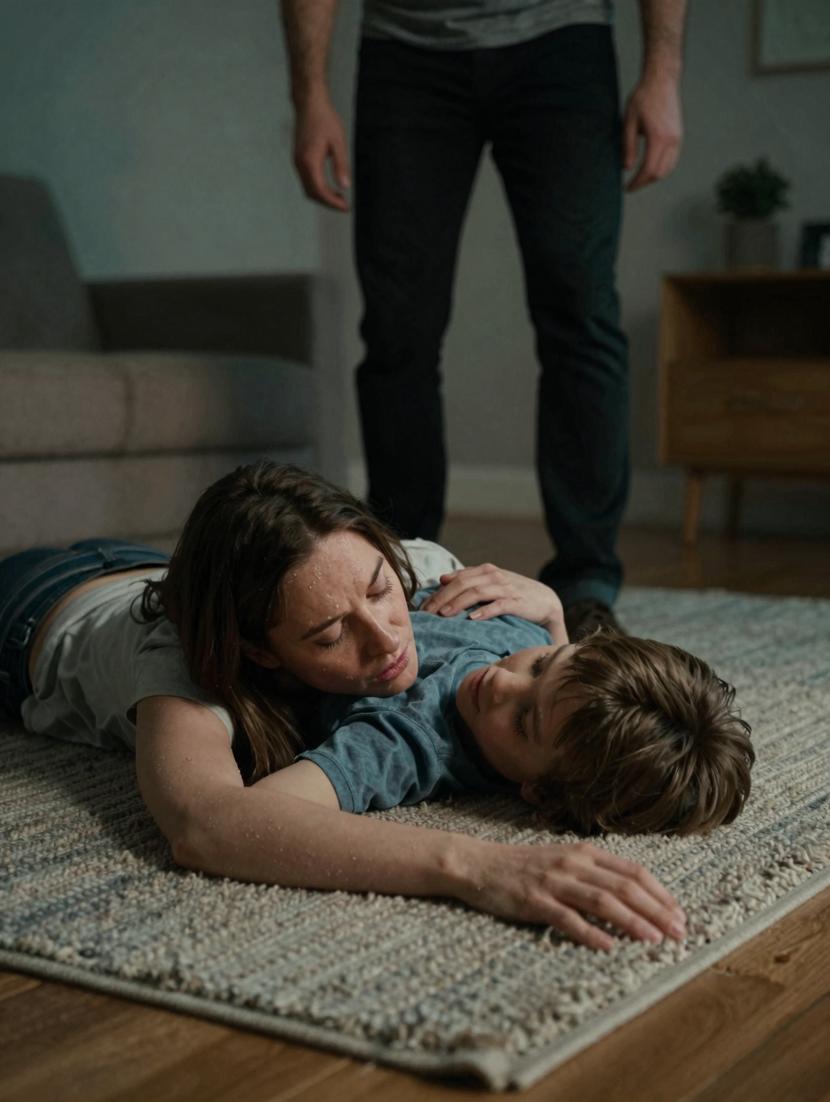
I landed on the rug by the couch, cheek pressed against fibers faintly scented with detergent. Jonah’s small frame slipped down beside me, a soft whimper escaping his lips before silence settled.
Every urge screamed to grab him—to shout or cry—but I remained frozen, listening.
Simon slid his chair back, footsteps slow and tentative, like a predator stepping through a fragile scene. His shadow loomed over my face; the toe of a shoe nudged my shoulder, a probing test.
“Good,” he murmured.
Then his phone buzzed softly. He trailed into the hallway, voice low and urgent. ‘It’s done,’ Simon breathed into the receiver. “They ate it. They’ll both be gone soon.”
My insides clenched with icy dread.
A woman’s sharp voice crackled back, excitement barely contained. “Are you certain?”
Simon’s answer was cold and resolute. “Followed the dose exactly. It’ll seem like accidental poisoning. I’ll call 911 afterward, once it’s too late.”
“Finally,” the woman exhaled, “we can stop hiding.”
A breath released—long, heavy, as if he’d been holding it years. “I’ll be free.”
The soft shuffle of footsteps. A closet door creaked open; the scrape of a drawer sliding out. Metallic clinks echoed.
Simon reappeared, dragging something heavy—maybe a duffel bag. He paused beside us, his silence like a hand tightening around my throat.
‘Goodbye,’ he whispered.
The front door opened and closed with the rush of cold air.
Silence descended. My heart thundered so loud I feared it would betray us.
I barely moved lips and whispered to Jonah, “Don’t move yet…”
A faint tremor—a twitch of his fingers against mine.
He was still with me. Awake.
Jonah squeezed my hand, a weak, frightened grip. Relief threatened to spill into tears, but I forced calm through a whisper. “Quiet. Pretend.”
His breaths came ragged but steady. Simon’s poison hadn’t taken full hold; maybe Jonah had taken less, or spilled some juice—luck was on our side for once.
I stayed motionless, ears straining until the house fell utterly silent—no footsteps, no doors, no sound except the quiet glow of the microwave clock.
8:42 p.m.
My limbs felt leaden but I summoned slow, deliberate movements. Reaching into my back pocket, I fished out my phone, lighting the screen with the slightest tilt. Heart jolted. Signal—barely one bar. Then none.
Of course. The living room was always a dead zone. Simon used to joke about it.
I crawled, dragging my body by elbows, each inch a whispered assault on my will. Jonah followed silently, trembling but steady. Every sound seemed amplified—the scratch of elbows, the shallow breaths, the pounding in my ears.
Near the hallway, a single bar flickered.
I dialed 911.
No answer.
Again. Pulse racing. Again.
At last, a voice: “911, what’s your emergency?”
“My husband poisoned us,” I whispered, voice trembling. “He left. My son is alive. We need help. Now.”
The dispatcher’s tone sharpened with concern. “What’s your address? Are you safe right now?”
“I don’t know if he’ll come back,” I said, swallowing fear. “He’s talking to someone. Said he’ll call you later to make it look accidental.”
“Stay on the line. Officers are en route. Can you get fresh air? Unlock a door?”
I glanced at Jonah. His eyes were wide and glassy, skin icy.
“Jonah,” I murmured, “can you stand?”
He tried, knees trembling. “I feel strange,” he admitted.
“Okay,” I breathed, voice steady with forced calm. “We’ll go to the bathroom and lock the door. If you feel sleepy, keep your eyes on me, alright?”
We stumbled down the hall, door locking behind us. I trickled cool water from the faucet, letting Jonah sip slowly. Not too much—years of forgotten first aid advice whispered, get help. Buy time. Don’t act impulsively.
The dispatcher questioned me about our meal, timing, allergies. My answers came through a haze of nausea and ringing ears.
Then a message buzzed from an unknown number.
CHECK THE TRASH. PROOF. HE’S COMING BACK.
My stomach twisted in knots. The same woman? A secret watcher?
I opened the bathroom cabinet and found an old bottle of activated charcoal from a forgotten stomach bug. A pause. Then decision. I wouldn’t gamble with Jonah’s life.
Outside, distant sirens grew louder.
Suddenly, downstairs—the front doorknob rattled.
Simon was back.
Two sets of footsteps crossed the living room. He wasn’t alone.
The dispatcher’s calm voice sliced through panic. “Officers have arrived. Stay inside. Do not exit unless told.”
I pressed a finger softly to Jonah’s lips—not to silence but to remind: stillness, silence.
Footsteps stopped just outside our door. An unfamiliar man muttered, “You said they were out.”
“They are,” Simon whispered darkly. “Checked and confirmed.”
Cold fear clenched my veins. He hadn’t come alone—he’d brought an accomplice to cover the evidence, confirm our supposed silence.
Simon’s shoes halted in front of the door. I held my breath, imagining him trying the knob and discovering the lock.
But he didn’t.
Instead, his voice softened, almost tender. “In a minute, we call. We cry. We tell them we found them like this.”
A bitter laugh from his partner. “You sure the kid won’t wake up?”
Simon’s tone hardened. “He ate enough. He’ll be gone.”
Jonah’s eyes brimmed with tears. I captured his gaze—stay with me. Not yet.
Then a sudden pounding shattered the tension.
‘POLICE! OPEN UP!’
Chaos erupted. The stranger swore. Simon hissed back, footsteps scrambled. A drawer crashed. Something metal clattered to the floor.
“Officers are inside. Do not leave the room,” the dispatcher instructed urgently.
Voices filled the house—sharp, commanding.
‘Sir, step away from the hallway. Hands where we see them. Who else is inside?’
Simon adopted a practiced facade. ‘Officer, I called… my wife and son collapsed, I—’
An officer cut him off. ‘We have a call from your wife. She’s alive.’
Silence hung thick. Then Simon drew a sharp breath—the mask cracking.
I unlocked the door, standing shakily with Jonah close behind. Officers flooded the hall. One knelt to Jonah, speaking softly; another guided me to paramedics.
Simon lingered in the living room, hands half raised, face contorted in fake shock. His cold eyes locked with mine—no apology, no plea, only fury.
“You lied,” he spat.
A paramedic wrapped a cuff around my arm, questioning our meal. Another placed an oxygen mask on Jonah. Relief swelled inside me as I watched them work—time was finally an ally.
Detectives swarmed our trash as instructed, uncovering a ripped label from a pesticide concentrate Simon kept ‘for ants.’ Methodically documented evidence began to mount.
Then came his phone records. The woman on the call? Lena Hart—his ex, once dismissed as ‘ancient history,’ now revealed as an accomplice. The stranger? A coworker enlisted to clean up the mess.
And the mysterious text? From Mrs. Callow, our wary neighbor, who’d witnessed suspicious activity and chosen risk over silence.
As the ambulance doors closed behind Jonah and me, Simon’s face twisted in silent rage—his charms extinguished.
But Jonah’s breath steadied, and that was everything.
Later, the sterile hospital air weighed heavy with bleach and eerie quiet. Sleep fled me; each minute threaded with memories of his smile, his voice, the chilling phone call.
At 3 a.m., Detective Sloan returned. Calm and assured, she sat beside me.
“We’ve secured your home. You won’t need to go back soon.”
I nodded, throat tight.
Jonah stirred beside me, fragile and pale.
“You mentioned a mysterious texter,” Sloan pressed.
My heart leapt. “Who?”
“Mrs. Callow—the neighbor who watches her roses at dawn. She witnessed Simon’s actions, contacted you out of concern.”
Mrs. Callow wished to remain anonymous, afraid of retaliation given Simon’s preparations.
Preparations. Such a mild word for calculated evil.
“He bought chemicals two months ago, researched precise doses and disguises, used burner phones and a texting app to coordinate with Lena. His plan: a clean break, no custody battles, insurance money secured,” Sloan explained. “I’m sorry.”
The weight of months of deception crushed me—Simon had plotted our end while smiling at Jonah’s bedtime stories.
“Will he be released on bail?” I asked, voice small.
Sloan’s jaw clenched. “Not tonight. Maybe never.”
Yet relief felt hollow.
My phone buzzed again: a text from the unknown number.
I’ll testify. Just make sure he can’t hurt anyone else.
Mrs. Callow wasn’t silent anymore.
With trembling hands, I replied:
Thank you. You saved us.
Her answer was immediate:
No. You saved yourself. You woke up. You fought. Now finish it.
I stared at the message long after the screen dimmed, understanding her words weren’t about vengeance.
They were about survival.
And survival was a choice—a fierce, relentless choice made again and again.
Two days later, Detective Sloan met me in a small, cold interview room. Jonah was downstairs in pediatrics, drawing animals—but today, his sketches were shades of gray instead of bright color.
On the table lay a sealed bag containing a small, metallic object: Simon’s key. Not to our home, but to a storage unit rented under a false identity.
“We executed a warrant this morning,” Sloan said quietly. “You need to see what was inside.”
I braced myself.
The unit was damp and musty, lit by a single buzzing bulb. Two identical duffel bags sat against a wall—one empty, the other filled with nightmares:
– Printed manuals on making undetectable toxins
– Fake IDs with Simon’s face under various aliases
– Three burner phones
– A notebook chronicling doses and chilling notes: ‘increase dosage next time’
– A photo of Jonah and me, snapped from outside our window
My breath caught. “He stalked us.”
“He monitored your routines,” Sloan corrected. “Meal times, outings, when you slept.”
A shiver hollowed me out.
Then Sloan handed me a worn recipe card scrawled with Simon’s handwriting:
Trial 1 – too bitter
Trial 2 – increase ratio
Trial 3 – perfect
Not a recipe for dinner.
A recipe for poison.
Nausea surged. I barely kept composed.
“There’s more,” Sloan said, unfolding a text thread between Simon and Lena. At first, it seemed like a rekindled affair—but the tone darkened:
“She won’t leave. She thinks the marriage is salvageable.”
“If she’s gone, no divorce mess. No custody.”
“The kid too?”
“He can’t stay. He’s her anchor.”
As if Jonah’s love made me dispensable.
Tears burned my eyes. Sloan passed me tissues.
“We’re adding attempted murder of a minor,” she said firmly. “This solidifies every charge.”
“How long has he been like this?” I asked.
Sloan looked away.
“There were older notes—before Jonah was born.”
A cold truth settled like ice.
Simon hadn’t been just my husband.
He was an architect of terror, drafting a blueprint for our destruction long before any suspicion.
But I was no longer the woman who fell and feigned unconsciousness.
I was wide awake.
Dangerously awake.
Six months later, the courtroom was colder, sterner than the hospital’s sterile walls. Trials aren’t the dramatic chaos of movies—they’re slow, exhausting unravelings of truth.
Simon entered, shrunken and coated in a court-issued suit, but his eyes still burned with that calculating gleam: the man who believed he could charm his way free.
My attorney leaned in, “Don’t look at him unless you have to.”
I stole one glance. Because confronting monsters is the first step to ending them.
The prosecution laid out evidence meticulously—the storage unit, messages, recordings, recipe notes, pesticide, duffel bag, the call I overheard.
Mrs. Callow testified anonymously behind a screen, trembling but resolute.
The defense tried to paint Simon as confused and overwhelmed.
Then Detective Sloan presented the poison notebook.
The room froze.
No one keeps detailed poison trials for years by accident.
When my turn came, my palms sweated, throat tightened, yet my voice held steady.
I relayed every chilling detail: the dinner, the heaviness, the fall, the phone call, the locked bathroom, the dread, Jonah’s trembling fingers tightening around mine.
When I whispered, ‘Don’t move yet,’ I saw jurors recoil, feeling the terror lurking beneath every word.
Simon’s eyes never wavered. He looked at me like a problem he still thought he could solve.
Stepping down, my knees nearly gave, but my attorney caught me. “You did it.”
But the nightmare wasn’t over.
After three days, the jury returned.
Guilty on all counts. First-degree attempted murder. Attempted murder of a child. Conspiracy. Premeditation.
Simon sat stone-faced, jaw tightening—a crack in his mask.
As officers led him away, he glanced at me one last time.
“You should’ve stayed down,” he hissed. “Both of you.”
For a heartbeat, cold fear clawed back.
Then another voice echoed inside me:
Now finish it.
Mrs. Callow had been right.
Survival wasn’t just about staying alive.
It was defiance.
Jonah and I stepped outside into sunlight brighter than anything we’d known lately. His small hand found mine, steady and warm.
“Are we safe now?” he asked, eyes searching mine.
I crouched to meet him.
“We’re safer than ever,” I told him honestly.
Not perfectly safe.
But safer.
Because monsters don’t vanish just because they’re locked away.
And neither do the ones who survive them.