
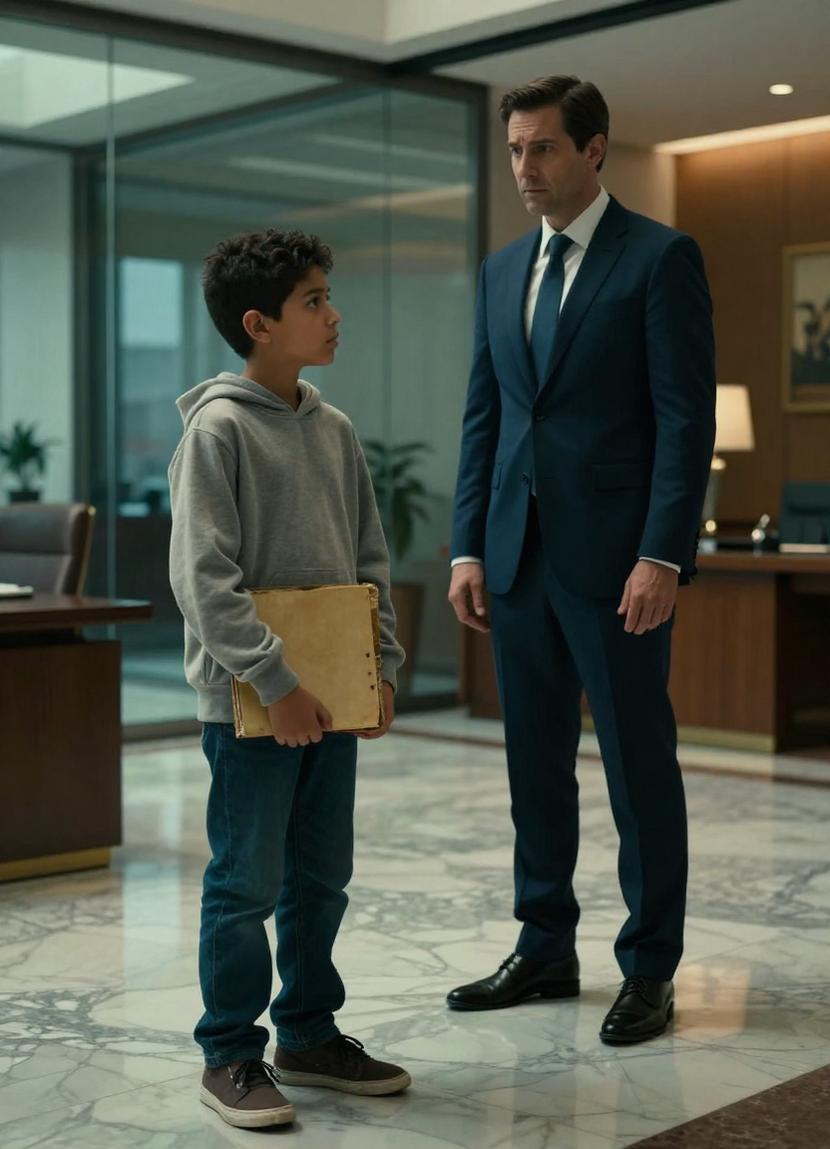
Lucas Delgado learned early the profound weight a promise can carry. At the tender age of seven, beside a sterile hospital bed, he gripped his grandfather Ricardo Delgado’s frail hand. Ricardo—the only man who had ever called Lucas by his full name as if it held power—was hours away from silence. His voice, fragile but resolute, broke through the muffled beeps and quiet hum of machines. ‘When the time comes,’ Ricardo whispered, ‘go exactly where I told you. Don’t hesitate. You’ll know what to say.’
Back then, Lucas was too young to grasp the full meaning of those words. But etched in his heart, they were an unbreakable vow.
Three days after the funeral, that long-awaited moment unfurled with eerie subtlety.
The sky was a heavy charcoal, soaked with the promise of rain, while faint scents of fresh bread from the bakery across the street seeped through the cracked window of their cramped kitchen. Lucas sat motionless, his young face a mask of quiet anticipation as his mother, Isabel, gingerly sliced open a wax-sealed envelope. The paper inside was faded, fragile with age.
Her eyes softened with a mix of sorrow and solemnity. ‘He left you instructions,’ Isabel said gently, voice trembling slightly. ‘He wants you to go to Eastbridge Commerce Plaza. Ask for someone named Mr. Delacroix. The executive floor.’
Lucas only nodded, a silent oath forming anew. No questions.
Dawn broke cold and gray when Lucas gathered the fragile remnants of his grandfather’s past: dusty old documents housed in a cracked plastic folder, a worn brass key nicked along one edge, and a small handwritten note inked in fading script: For today. Be brave. Never let money make you feel less than you are.
Eastbridge Commerce Plaza towered above downtown Chicago, a gleaming monolith of glass and steel that seemed to challenge the sky itself. Inside, the air buzzed with clipped conversations and the confident rhythm of footsteps on marble. Lucas’s scuffed sneakers and threadbare hoodie set him apart like a whisper in a storm, but he walked steadily forward.
The concierge glanced at him, intrigued yet faintly amused. ‘I need to see Mr. Delacroix,’ Lucas said, holding his folder with quiet determination. His voice did not betray a hint of fear.
They escorted him up, sharing subtle smiles that masked their expectations of a harmless child lost in the adult world. On the executive floor, heads turned. Lips curled into disbelief and suppressed laughter behind glass walls.
A sharply dressed man in a navy suit stepped forward, amusement clear. ‘Hey, kid,’ he sneered. ‘You’re in the wrong place.’
Lucas drew a steady breath and began to speak, but before his voice could truly carry, a door at the end of the hallway swung open.
Mr. Delacroix appeared.
The instant his eyes locked on Lucas and the worn folder he clutched, the room’s entire atmosphere shifted.
Mr. Delacroix stood perfectly still, his gaze fixed on the document as if it carried a secret worth more than fortune. Slowly, his sharp eyes lifted to meet the boy’s unflinching stare. Lucas did not shift or fidget; his pale face was calm, solemn—as if he understood the grave importance cradled within those pages.
The laughter that had filled the space collapsed into silence. Conversations halted mid-phrase. Even the soft clinking of glasses withdrew, replaced by a tension thick enough to taste.
Finally, Delacroix’s voice cut through the stillness, low and laced with a strange reverence. ‘Where did you get that?’
Lucas swallowed hard, fingers tightening gently on the folder—not with possessiveness, but as a guardian of his grandfather’s legacy. ‘My grandfather,’ he said simply. ‘Ricardo Delgado.’
The name resonated like a whispered thunder.
Delacroix’s posture shifted imperceptibly; his shoulders tightened, eyes narrowing with flickers of recognition and unspoken history. Carefully, deliberately, he stepped forward, lifting the folder as one might cradle a rare artifact. As he turned each page, his hands trembled—not with fury, but with the weight of memory.
Around them, guests edged closer unwittingly. Unease bloomed in subtle coughs and restless shuffles.
Reaching the final page, Delacroix paused—then closed the folder with a tender finality. ‘You should have called,’ he murmured, voice barely audible.
His words were meant for a ghost—the man no one else seemed to recall in the gleaming tower.
Delacroix’s gaze lifted, voice steady but commanding: ‘Clear the room.’
Confusion flickered across faces accustomed to power and prerogative. Chairs scraped, glasses set down abruptly, footsteps quickened. In moments, the opulent VIP floor emptied—except for Delacroix, Lucas, and a woman in a gray suit who had watched silently, as if awaiting this day from the beginning.
‘That’s my mom,’ Lucas said quietly, nodding toward the elevator shaft. ‘She’s downstairs.’
Delacroix’s single nod was sharp. ‘Bring her up.’
The elevator doors slid open again to reveal Isabel, frozen by the grandeur. Floor-to-ceiling windows framed a sprawling cityscape glittering far below; the dizzying height seemed to swallow her resolve. For a heartbeat, she hovered on the edge of retreat.
Then Lucas closed the distance and took her hand firmly, anchoring her.
‘It’s okay, Mom,’ he whispered.
Isabel exhaled shakily, nodded, but her gaze never left Delacroix.
‘Please,’ he gestured toward the polished conference table. ‘Sit.’
They obeyed.
‘I owe your family an explanation,’ Delacroix began, voice measured but grave. He unveiled a story of silent sacrifice: decades ago, when a financial crisis threatened to dismantle everything he now commanded. Ricardo Delgado had intervened silently, risking everything when no one else dared—a shadow guardian protecting more than just numbers.
He spoke of trusts carefully buried until the precise moment arrived, of documents locked away to mature beyond ordinary time.
‘That account,’ Delacroix said, resting his hand on the folder, ‘was never meant to be opened prematurely. Your grandfather’s instructions were explicit: protect it until the right moment.’
Isabel’s voice cracked slightly. ‘How much…?’
Delacroix named a sum that seemed to tilt the very room’s axis.
The staggering figure represented more than safety—it was a key to a new life, to freedom from fear. Yet it also trembled with the terrifying responsibility of legacy.
Lucas remained composed, absorbing every word.
‘One more thing,’ Delacroix added, sliding the brass key across the table. He moved to a hidden safe built into the wall, retrieving another envelope frayed by time’s march.
‘Instructions were left with this,’ he said.
Lucas unfolded the letter with reverence. The inked words spoke not of wealth, but of restraint, compassion beyond survival, and the imperative to remember one’s origins when the world threatens to rewrite identity.
As they descended from Eastbridge Commerce Plaza that evening, the city outside pulsed unaware—traffic roared, voices collided, life surged relentlessly onward.
But Lucas gripped Isabel’s hand tighter than before.
‘We’re going to be okay,’ Isabel murmured, half to herself.
Lucas nodded knowingly.
The promise—silent, patient, and fiercely protected—had been fulfilled at last.