
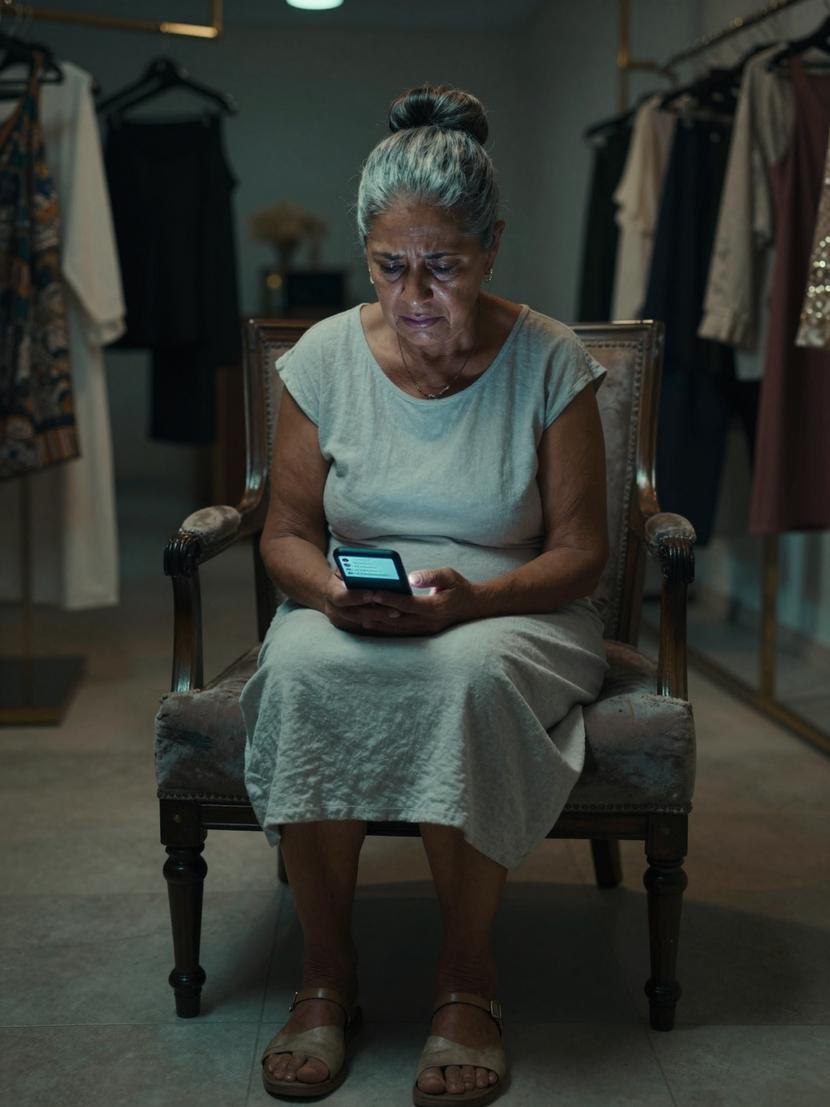
Marina Solis had never seen clothing as a measure of the soul, but that sweltering afternoon in Santa Aurora, standing before the glittering window of a luxury boutique, she was forced to see differently. Her simple cotton dress, beaten-down shoes softened by years of hard travel, and gray hair tightly pinned in a no-nonsense bun marked her plainly. She had journeyed from her quiet countryside home with one solemn purpose: to find a dress worthy of a night that was far from ordinary. After half a decade living in the United States, her daughter Valeria Mendez was returning to Brazil to receive a prestigious honor, and Marina wanted to stand beside her with the pride and grace that moment demanded.
Drawing a steadying breath, Marina crossed the boutique’s threshold. This was not vanity; she had never cared for the fleeting judgments of appearance. But this occasion symbolized a lifetime of tireless labor, sacrifice at dawn, moments of hunger, and a mother’s undying hope. She needed to look the part—not for others, but to honor the incredible story they had sculpted together.
The moment she stepped inside, a sharply dressed saleswoman swept a rapid, appraising glance over Marina—from weathered shoes to the careful lines of her face—and a smile flickered, but it was the kind that veiled disdain.
‘Excuse me,’ the woman said, voice tinged with disbelief, ‘are you sure this is the right boutique for you?’
Marina’s heart tasted a bitter sting, but her eyes met the gaze unflinchingly.
‘I’m here for a dress,’ she said quietly, ‘something elegant for a ceremony.’
A barely suppressed chuckle escaped the saleswoman’s lips, as if mocking her. Before Marina could respond, a second woman, likely the manager, approached with an air of refined authority but eyes equally cold, scrutinizing Marina as if assessing whether she belonged.
‘Our dresses start at five thousand reais,’ the manager said, her tone thick with condescension. ‘You might find more… affordable choices downstairs, better suited to your budget.’
The words scorched Marina’s chest, but she straightened her back. She had endured worse than this—years of cleaning floors while being treated like a ghost, sharp orders barked from aloof mouths, stinging comments that cut deep. Widowhood, starvation, endless nights without sleep had tried to break her but never succeeded. These two women would not be her breaking point.
‘I can afford it,’ she said, voice calm and steady. ‘But I’d like to see some options.’
The saleswoman’s eyes narrowed as she retrieved a black dress from a shadowy corner—a dull, joyless thing, as if it was the only thing someone like Marina could ever deserve.
‘This would be perfect,’ the woman said with a sly smile. ‘Simple, discreet… and it’s on sale.’
Marina gazed at the dress. It was plain, almost lifeless—not a single thread spoke of celebration, triumph, or joy. This was not the image she had dreamed for the night her daughter would be honored before a hall of executives, journalists, and officials. She had the savings to buy anything here; it was never about money. It was the ugly poison of prejudice.
‘Could I see the dresses displayed in the window?’ she asked, gesturing toward the luminous gowns bathed in spotlight.
The manager raised polished eyebrows in disdain.
‘Those are exclusive imports,’ she said coldly. ‘Prices well over fifteen thousand reais. One must be realistic, madam.’
A cluster of onlookers began murmuring, their curious gazes feigning ignorance. An elegant bystander’s voice rang out just loud enough for others to hear: ‘These places really let anyone in nowadays.’
Marina felt her cheeks burn but said nothing. Her dignity was sovereign over the idle whispers of strangers. Her phone buzzed—Valeria’s message: ‘Mom, I’m almost there. I can’t wait to see you. Thank you for being with me today.’
A soft smile curved Marina’s lips.
‘I’ll wait,’ she murmured. ‘Someone important is coming.’
They showed her to an awkward chair in the back. Marina sat, the minutes crawling. Her mind drifted through time.
She was nineteen when she first heard the life within—young, in love, full of naive hope. Rafael was a mechanic, a kind soul with calloused hands and dreams bigger than their means. He would rest his palm tenderly over her belly and whisper: if it’s a girl, Valeria would be her name. He dreamed of a future where she would study, soar beyond the humble life they lived.
But fate was a cruel underminer.
When Valeria was two, Rafael was stolen from them in a tragic accident. Marina was left alone at twenty-one, with a child, no career, no safety net, and no moment to crumble.
‘What will we do now?’ little Valeria once asked, wide-eyed.
‘We’ll work,’ Marina promised fiercely. ‘I’ll work so you can have the life your father wished for you.’
And so she did.
From dawn to late night, Marina cleaned houses and scrubbed floors, stretched every coin, and every night—pain and exhaustion pressing deep—she sat beside her daughter.
‘Education,’ she told Valeria, ‘is the one thing no one can ever steal.’
Valeria listened. She thrived, earned a scholarship, and then set foot on a university campus studying software engineering. Marina didn’t grasp the complex words but believed fiercely in every step Valeria took.
Then came the hardest test: Valeria leaving for the United States.
Fear clawed at Marina’s heart, but she let her go.
Valeria struggled, fought, studied, and finally succeeded—building a company, becoming one of Crystal Valley’s most admired entrepreneurs.
The wealth followed later.
But Marina stayed the same.
She never worked to be rich.
She worked to set her daughter free.
The boutique door swung open.
Valeria stepped in.
Radiant and poised—the power wasn’t in the threads elegantly draped over her body, but in the fierce energy she carried.
Her eyes locked onto Marina’s.
Then onto the staff.
She could feel the lingering judgment hanging heavy in the air.
‘Mom, stay right here,’ Valeria said, voice calm but steely.
Striding forward, she faced the manager, eyes blazing.
‘I want to know why my mother is being treated like she doesn’t belong here.’
The manager stammered, trying to smooth the situation.
‘It must be a misunderstanding—’
‘No,’ Valeria cut her off sharply. ‘This is pure humiliation.’
She reached out and helped Marina rise, pulling her into a warm embrace.
‘Did they treat you well?’
‘It was nothing,’ Marina whispered, shrinking.
Valeria’s expression darkened.
‘Then why were you left sitting there, as if they had the right to decide what kind of person you are?’
Stunned silence.
‘Ten minutes ago, you told her these dresses were beyond her means. You pushed her to the worst corner of the store. Suggested she leave. What changed? My bag? My shoes? My last name?’
No one answered.
Valeria placed a sleek black card on the glass counter.
‘With this,’ she said, ‘my mother could buy every dress here. But that’s not the point. She should never have had to prove her worth to earn respect.’
Turning to the room, she proclaimed, ‘This is Marina Solis. She raised me alone. Worked her entire life so I could get an education. That daughter—me—is Valeria Mendez. Founder and CEO of one of the world’s leading AI companies. Tomorrow, I receive a national award. And she will be there in the front row—not because of my success, but because all that I am began with her.’
Heads bowed.
‘But the greatest truth,’ Valeria added, ‘is that my mother carries more class in her humble simplicity than all the arrogance in this room combined.’
Marina squeezed her daughter’s hand, tears glistening.
‘Let’s go,’ she said gently.
‘Yes,’ Valeria agreed fiercely. ‘This place doesn’t deserve your presence or your money.’
The next boutique welcomed them with warmth and respect.
Marina chose a navy blue dress—radiant, alive, perfect.
The following evening, at the grand theater, Valeria stood beneath the spotlight.
Before her speech, her gaze found her mother.
‘My success belongs to her,’ she declared, voice cracking with pride.
Marina wept—not in pain, but overwhelmed by recognition and love.
Later, Valeria hugged her tightly.
‘I am proud to be your daughter.’
Marina smiled, heart full.
‘And I’m proud you never forgot where you came from.’