
Part-2
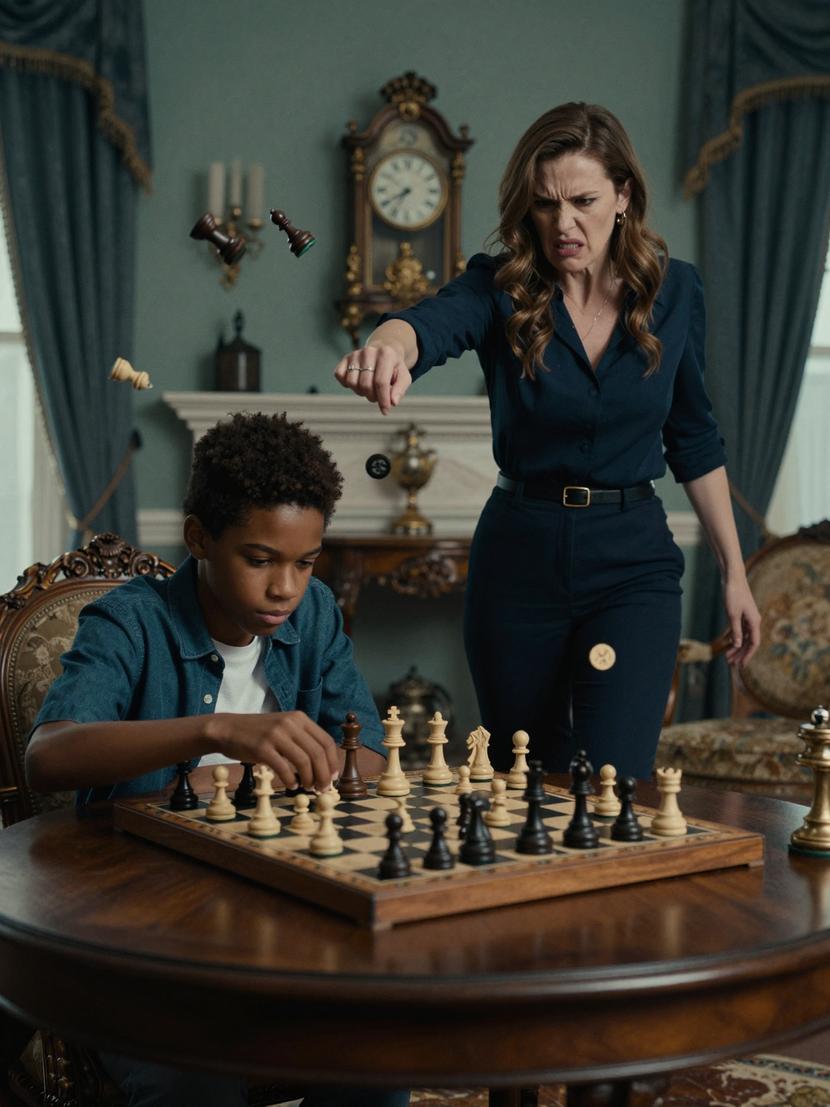
Isabel Hartman’s gaze locked onto the chessboard, her breath caught in a sudden, suffocating silence. For fifteen agonizing seconds, her trembling fingers hovered over the fallen king, as though willing it to rise and negate the devastating checkmate laid bare before her. The lavish room was cloaked in stillness so profound that the slow, measured ticking of the $15,000 wall clock echoed like a drumbeat in her ears.
‘That… that was mere luck,’ Isabel stammered, her voice barely hiding the tremor of shattered confidence. The sharp edges of her former certainty crumbled into dust.
Bradford stood, adjusting his suit with measured composure. ‘Isabel, that boy just executed a complex Sicilian defense variation — one even I haven’t encountered in my forty years of playing.’
From a corner, Congresswoman Ramirez silently lifted her phone, fingers pressing record with the shrewd eye of someone sensing a viral moment: a wealthy, prejudiced hostess humiliated by an underestimated prodigy.
‘I refuse to believe this,’ Isabel declared, standing abruptly and sending chess pieces scattering in her fury. ‘Someone must have trained him specifically to embarrass me.’
Mateo Alvarez remained seated, an unshakeable calm in his eyes. ‘Would you like a rematch? I’m ready to face anyone here — or even all of you at once, if you prefer.’
The audacity sent ripples through the room — nervous whispers, a tightening of jaws. Yet no one doubted the boy’s certainty.
“You’re arrogant,” Isabel spat, her cheeks flaring crimson. “A boy from the slums doesn’t speak to his superiors this way.”
Lucia stepped forward, finally meeting Isabel’s eyes after two decades of silent endurance. Her voice was steady, unwavering. ‘Mrs. Hartman, my son isn’t from the slums. We come from a working-class neighborhood. Mateo isn’t arrogant — he’s simply honest about his abilities, which is clearly something you’ve never learned.’
Tension thickened the air like a gathering storm. Guests exchanged uneasy glances, sensing this was no mere chess game — it was a confrontation revealing much deeper fault lines.
Isabel’s fury blazed anew as she turned to Lucia. ‘How dare you speak to me like that? Have you forgotten your place in this house?’
“No,” Lucia replied, calm and resolute. “I remembered my worth.’
Bradford, visibly uncomfortable, interjected, “Isabel, maybe it’s time to recognize that this young man’s talent is genuine.”
She laughed, a harsh, bitter sound. “Don’t you see? This was a setup. Someone taught him just to make me look like a fool in my own home.”
Mateo finally rose, his voice quiet yet commanding enough to hush the entire room. ‘Mrs. Hartman, here’s the truth: I wasn’t trained to humiliate you. I spent eight years studying chess because I dreamed of competing against people who truly respected the game — people who understand that talent transcends color, class, or last names.’
He scanned the faces of the stunned guests. ‘When you invited me to play ‘like they do in the slums,’ I thought it might finally be my chance to earn respect. But now I see clearly you never wanted a fair match — you wanted a spectacle of humiliation.’
Congresswoman Ramirez stopped recording, captivated entirely. “How old are you, young man?” she asked.
‘Seventeen,’ Mateo answered, his voice steady.
“And how long have you been playing seriously?”
Mateo met her gaze. “Eight years.”
Ramirez turned sharply to Isabel, disapproval written across her features. ‘Isabel, you just lost to a self-taught teenager — a teenager you employ, and one you invited as a joke.’
Isabel felt the weight of every gaze crushing down on her — not admiration or envy now, but harsh judgment. ‘I… I didn’t know he played seriously,’ she faltered, the façade crumbling.
‘It’s not about whether he played seriously,’ Bradford said, irritation plain in his voice. “The question is why you invited him, assuming he’d be an easy defeat — just because he’s your maid’s son, because he’s black, because he isn’t rich.”
A heavy silence engulfed the room.
Mateo calmly began resetting the chess pieces, his movements precise and deliberate — each a quiet declaration of mastery. ‘Thanks for the game, Ms. Hartman. It’s been educational.’
He glanced at his mother. ‘Mom, can we go? I have school tomorrow.’
Lucia nodded, removing the apron she’d worn while serving the guests. Before departing, she faced Isabel once more. ‘Mrs. Hartman, thank you for reminding me that my son belongs far beyond the confines of this house.’
As mother and son moved toward the grand entrance, Congresswoman Ramirez called out, “Mateo, interested in scholarships? I know several universities eager to welcome talent like yours.”
Mateo stopped, a genuine smile breaking through the evening’s tension for the first time. ‘Very interested, ma’am.’
Ramirez handed him her card. “Call me Monday.”
Isabel stood frozen, her carefully curated control shattered. In less than an hour, she had plummeted from respected hostess to the embodiment of entitled prejudice, exposed before an audience she had hoped to impress.
Once the door shut behind Mateo and Lucia, the remaining guests exchanged awkward glances. Bradford was the first to rise. “I believe I should take my leave.”
One after another, the guests departed with cold farewells and condemning looks, leaving Isabel alone — surrounded by the scattered chess pieces that narrated her downfall.
What Isabel didn’t realize was that this evening was only the opening move of a grander game. Mateo Alvarez was about to rewrite his destiny and challenge the very foundation of the privilege she embodied without question.
Under the shimmering stars of Crestview Hills, Mateo walked home beside his mother, clutching the card that might change his life forever. In his mind, he was already strategizing — not just for chess, but for the greater battle ahead: proving that true nobility isn’t purchased; it’s built on character.
Six months later, Mateo Alvarez strode confidently through the halls of Harrington University on a full engineering scholarship. Congresswoman Ramirez kept her promise, connecting him with mentors and academic opportunities that valued talent over lineage.
The footage from that fateful night at Isabel’s estate exploded across social media — three million views in just two weeks. It wasn’t simply the recorded game, but the Congresswoman’s sharing that transformed Mateo into a symbol of triumph over bias and Isabel into a cautionary figure.
‘Young prodigy shatters prejudiced millionaire in chess’ blazed the headlines. Comments flooded in: ‘She got what she deserved. That boy is worthy of every opportunity in the world.’
Isabel Hartman became a pariah in her social circles. Her golf club membership was revoked under mounting pressure. Three charities removed her name from their events. Even Bradford, her longtime confidant, began avoiding her. “Isabel has always been arrogant,” his wife confided at a dinner in Pine Cove, “but I never imagined she could be so cruel — humiliating a child like that in front of everyone.”
The cruelest blow was Isabel’s realization that Mateo had never sought revenge or notoriety. He had merely played the game he loved, honed across countless quiet nights. Her own prejudice had been the architect of her disgrace.
Lucia was promoted to cleaning supervisor at the Seabreeze Grand Hotel, earning triple her previous salary with full benefits. Her professionalism, finally recognized, stood as a testament beyond charity or pity.
Mateo founded a free online chess initiative connecting underserved youth with college mentors. Within half a year, 1,200 children were learning lessons stretching far beyond chess. ‘Chess showed me every person holds unique strategic value,’ Mateo said during a passionate NNC interview. “Isabel Hartman taught me that some must lose everything before they understand what truly matters.”
When asked if he harbored any grudge against the woman who humiliated him, Mateo’s calm smile returned. ‘Grudges are just pieces that hinder the game. I’d rather focus on building something greater.’
Isabel watched that interview alone in her vast mansion, abandoned by friends and drowning in regret. At long last, she understood: she lost not only a chess match, but the chance to become a better woman.
Bradford called her days later. “Isabel, you set this in motion.”
Mateo responded with grace, “A lesson you should have shown from the very start.”
This story’s echo resounded far beyond Crestview Hills. Mateo proved true nobility arises not from surnames or wealth, but from character forged in adversity and expressed through actions. He transformed prejudice into purpose, and humiliation into growth.
Today, Mateo sees no limits imposed by others — only infinite possibilities shaped by his own unwavering resolve. Isabel tried to diminish him to feel greater, but in the end, revealed that true greatness stems from lifting others up, not tearing them down.
Lucia proudly framed Mateo’s first academic honor from Harrington, placing it next to a certificate commemorating the chess program that had already changed thousands of lives — achievements money cannot buy and bigotry cannot steal.
As Mateo discovered, the greatest revenge isn’t to break those who belittle you but to build something extraordinary that makes their mediocrity irrelevant. Isabel made him entertainment; Mateo became inspiration.
That difference—between tearing down and building up—defines who truly wins at chess, and in life.
If this powerful story of perseverance and justice moved you, subscribe for more inspiring tales showing that real power lies in transforming obstacles into stepping stones for extraordinary growth.