
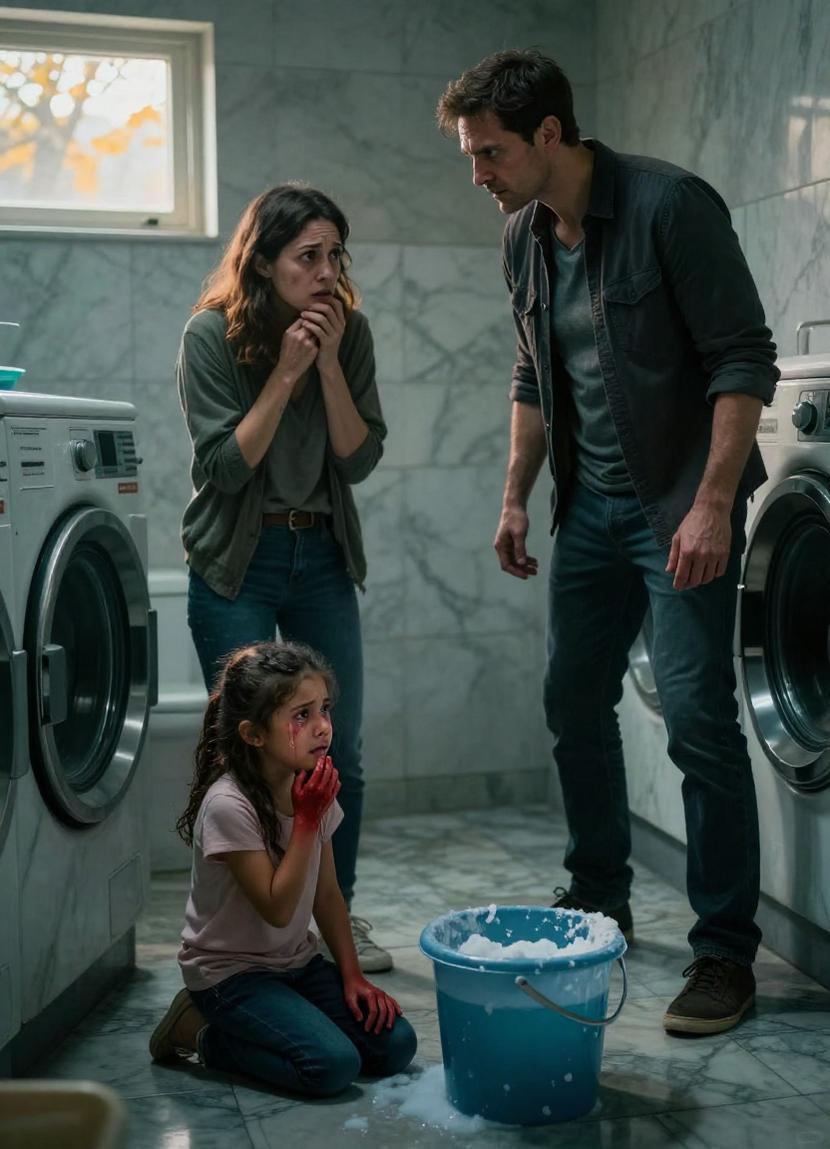
Before dawn’s fragile glow could touch the horizon on a cold autumn morning, six-year-old Isabel Sutton knelt trembling in the shadowed laundry room of Ashbourne manor. Her small hands, raw and blistered from relentless scrubbing, dragged over the cold marble floor drenched in bleach. Tears carved silent rivers down her cheeks as her stepmother, Vivian Merrick, burst in like a storm, her voice a whip of cruelty slicing through the stillness. ‘You don’t belong here,’ Vivian spat venomously. ‘You’re nothing but a disgrace.’
Across the hall, the front door clicked—a sound both sudden and unwelcome. Jonathan Clayborne was home earlier than expected, a prickling unease crawling under his skin. His footsteps echoed through the grand foyer until he found Isabel curled beside the abandoned bucket, her hand red and swollen from the harsh chemicals. Vivian stood frozen, terror flickering behind her sharp eyes.
‘What in God’s name is happening here?’ Jonathan demanded, his voice dropping into an icy command. Vivian faltered, voice brittle as she muttered that she had merely been ‘teaching the girl her place.’
In a flash of righteous fury, Jonathan’s hand struck Vivian’s cheek—the sharp crack reverberating like a thunderclap. Vivian recoiled, stunned into silence. Kneeling, Jonathan cradled Isabel’s aching hand gently, pulling her close into an embrace thick with apology and love. ‘Daddy’s here now,’ he whispered, choking back his own tears. ‘I’m so sorry, sweetheart.’
That very night, Jonathan initiated emergency custody proceedings and filed a criminal complaint for child abuse. Security footage painted a horrifying picture: bleach-laden baths, doors locked tight to darken her world, beatings masked as harsh discipline. For the first time in months, Isabel slept in the sanctuary of the master suite, wrapped in her father’s unwavering protection. Jonathan called in Dr. Emerson, a specialist in pediatric trauma, whose assessment revealed a tapestry of malnutrition, bruises, and sprains—a haunting testimony to months of neglect. Armed with irrefutable medical evidence and the counsel of his determined lawyer, Marina Alvarez, Jonathan braced for the grueling courtroom battle ahead.
The courtroom air was icy the day Vivian Merrick faced her reckoning. Draped in expensive fabrics, Vivian feigned sorrow, her voice weaving a cruel narrative of ‘tough love.’ Her defense attorney argued that Jonathan’s grief over his late wife and daughter had warped his perception, painting Vivian as the misunderstood victim. But the brutal truth surfaced relentlessly—the testimony of Dr. Emerson, the fearful whispers of the old butler, and the damning video footage shattered Vivian’s façade. By midday, Judge Carmichael handed down the verdict: full custody awarded to Jonathan, Vivian barred from any contact with Isabel.
Outside the courthouse, Jonathan lifted Isabel into his arms, promising her a life bathed in safety and love. But Vivian’s defeat did not extinguish her dark fire. From her vacant townhouse, she orchestrated a venomous smear campaign—hiring insiders to leak false claims about Jonathan’s mental state, fabricating staged photos of Isabel crying on cue, and enlisting Arnold Hale, a disgraced attorney known for ruthless blackmail. Headlines twisted truth, questioning Isabel’s credibility and painting Vivian as the wronged woman crushed by ‘billionaire injustice.’ Protesters swarmed Ashbourne manor’s gates, their chants rippling with venomous accusations.
Jonathan refused to be baited. With Marina’s savvy strategies and Victor Rowe’s sharp investigative skills, he uncovered financial trails and encrypted communications linking Vivian and Hale in a calculated conspiracy of harassment. He exposed the payoffs and forged documents to reputable news outlets, turning the tide of public opinion. Vivian’s fury escalated into desperate acts—sending anonymous photos of Isabel at school, sabotaging power lines, daring Jonathan to ‘keep her locked away forever.’ Each assault forced tight lockdowns at Ashbourne manor, yet Isabel’s spirit grew fiercer, her resilience a quiet battle cry echoing through every locked door.
One afternoon, after yet another onslaught of fabricated tabloid lies, Jonathan found Isabel resting in the sunroom, clutching her battered stuffed rabbit. ‘Why do people believe the lies, Daddy?’ she asked, her voice trembling with hurt. He knelt beside her, voice tender and steady. ‘Lies are loud,’ he murmured, ‘but the truth lives quietly inside us, in our hearts.’
Together, they wove a shield of words—’I am not alone. I am not weak. I am not what they say I am.’ With every repetition, Isabel’s back straightened, a fierce glint ignited in her eyes. For the first time, she seemed unafraid.
In a secluded hearing, Isabel’s recorded testimony unfolded under Judge Carmichael’s strict confines—no cross-examination, only the unvarnished truth of her voice. She spoke of bleach poured into her bath, of being trapped in darkness, and Vivian’s twisted threats to send her away. ‘He always came back,’ Isabel said, her voice steady. ‘He loves me.’
The courtroom grew silent as her words played, dismantling Vivian’s defense. When the jury returned, the verdict was unanimous: Vivian guilty on charges of child endangerment, obstruction of justice, and witness intimidation. Two weeks later, Vivian Merrick was sentenced to twenty years behind bars.
With the battle won, Isabel’s healing journey began. She returned to school where Miss Harper, a kind-hearted teacher, nurtured her creativity and love for storytelling and art. One evening, Isabel’s eyes gleamed with newfound purpose. ‘I want to start a club for kids who’ve been through bad things—but who found something good after,’ she shared.
Jonathan and Marina helped her launch the Bright Oak Club at the Willow Creek Library, where stories and drawings transformed pain into courage. In mere weeks, dozens of children gathered, their shared voices stitching a tapestry of hope and friendship.
A year later, in the manor’s garden, a majestic oak tree stood adorned with a plaque celebrating resilience, truth, and the meaning of home. Seven-year-old Isabel addressed a crowd of lawmakers, social workers, and families, her voice a beacon: ‘We are not just what happened to us. We are what we choose next.’
That autumn, Jonathan established the Isabel Sutton Clayborne Fund—a lifeline providing legal aid, counseling, and emergency shelter for vulnerable children. He joined a statewide task force dedicated to reforming child protective services, ensuring no cry for help would ever be ignored again. Vivian Merrick was behind bars, Arnold Hale soon to follow, but Jonathan knew the true victory lived in Isabel’s growing laughter, her bedtime stories, and her fierce claim on life.
One quiet evening beneath the branches of the Bright Oak, Isabel looked up at her father. ‘Daddy, do people ever stop hurting kids?’ she asked, voice soft but curious.
Jonathan traced the delicate edge of her hand, his heart heavy yet hopeful. ‘Some do,’ he said. ‘Some don’t. But we will never stop being those who protect, who see, who speak.’
Isabel sighed with peaceful resolve. ‘Then I want to be like you.’
He gathered her close. ‘You already are.’
Years passed, and Isabel blossomed into a young woman whose voice shaped laws, whose art stirred hearts, and whose compassion inspired truth. Jonathan, once shattered by grief, found new purpose in fatherhood and fierce advocacy. Together, they ensured that no child under their care would ever be silenced again.
The Bright Oak thrived in the manor’s garden, its roots deep in hope—a living testament that even in cruelty’s darkest shadow, love endures, truth prevails, and one brave voice can ignite the path for many.