
The worst sound in the world isn’t the shriek of a scream or the desperate screech of tires inches from disaster. It isn’t the relentless beeping of machines mourning a flatlined heart. I’ve endured those sounds. No, the most haunting noise is softer — the collective breath held by five hundred teenagers, the silent signal before a cruel performance begins. That pause means one thing only: something is about to shatter.
It was a bleak Tuesday afternoon in November, the kind of murky day in Riverton State that seeps into your bones and refuses to let go. The sky wore a tired shroud of gray, the sun a dim beacon that seemed ready to quit. And beneath that dull canopy, it marked the exact third anniversary of my mother’s death.
I stood solitary in the girls’ locker room, cold water splashing my cracked face as I willed my trembling hands to still. The unforgiving fluorescent lights turned everyone spectral — but on me, they carved shadows deeper than my grief.
My name is Nina Carter. I was seventeen. And I looked like someone barely breathing, worn thin by loss and loneliness. Pale skin stretched tight over my bones. Dark circles cradled my weary eyes that had mastered scanning rooms for danger long before they ever learned to smile.
On me, the only treasure I owned: my mother’s vintage Laura Ashley dress. Cotton patterned with delicate blue flowers, faded yet clean, smelling faintly of lavender and old pages. A dress that draped loosely — a ghost of better times when dinners weren’t skipped to save the electric bill. Today, that dress was my shield.
Because today I had to face the gymnasium.
The dreaded Spirit Assembly. Mandatory attendance. Skip it, and Principal Keller would mark me absent. Too many absences meant suspension, which meant losing my after-school diner job. Lose the job, lose the lights. Lose the lights, and the world would turn to darkness in ways far beyond the obvious.
I leaned into the mirror and whispered to my reflection, “Just get through this.”
Then the unmistakable click of designer heels on tile echoed behind me.
Sienna Blake had arrived.
I didn’t turn — her presence weighed too heavily in the air. Sienna could enter and claim a room with a predator’s gaze, hunting for her prey.
“Chatting with yourself again?” she purred, voice silky with boredom.
I shut off the faucet deliberately slow. Her reflection slid behind mine — flawless blonde waves, her face the polished mask of privilege, and that smile — sharp enough to cut.
Trailing behind were Brielle and Tessa, her loyal shadows, ready to revel in another conquest.
Sienna leaned casually against the lockers, eyeing me up and down. Her gaze flicked to the hem of my mother’s dress, amusement twitching on her lips.
‘Wow.’ The single word was a whip.
My throat seized. I braced myself.
“Didn’t know tonight was ‘Thrift Store Formal’,” she taunted. “Is that… cotton?”
“It was my mother’s,” I whispered, the confession bitter on my tongue.
Sienna’s brows arched mockingly. “Oh. Right. The dead mom.”
Brielle giggled. Tessa smirked.
“You really are the full tragedy starter pack, huh?” Sienna mocked, flicking her nails like she discussed the weather. “Dead mom, absent dad, poor little dress.”
“My dad isn’t absent,” I snapped too quickly, too fiercely.
She tilted her head with cruel curiosity. “Oh? Then where is he?”
Silence squeezed around me. I hadn’t seen my father in six years — no calls, no visits, just a trickle of money until even that dried up. After Mom died, I didn’t know where to direct the bitterness.
“So…” I lied reflexively. “He’s deployed.”
Sienna’s laugh was low, venomous. “Sure he is.”
Stepping forward, her voice dropped to a whisper meant only for me. “Look, Nina. You try to pretend you’re strong. But you’re not. You’re just… alone.”
Her eyes narrowed, savoring the moment. “And today, the whole school’s gonna see it.”
Then she glided away, shadows following like loyal hounds.
I should have fled. I should have vanished.
But survival rarely heeds shoulds and coulds.
I patted my face dry, smoothed the skirt of my mother’s dress, steeled my chin.
And I stepped into the gym.
The noise hit like a wave — five hundred teenagers packed tight in bleachers, maroon and gold bleeding across the walls. The pep band blasted a ragged version of “Eye of the Tiger,” the air thick with the mingled scents of floor wax, sweat, and cheap perfume.
I hugged the wall, inching to the highest row, curling into a small, invisible nook.
Invisible. Safe. Or so I thought.
At center court, Principal Keller held desperately to a microphone as if it might stave off chaos.
“Alright, settle down!” he bellowed. “We have a special presentation from the Student Council!”
My stomach plummeted.
Sienna Blake strutted forward, wearing a sparkling dress and a practiced smile that only revealed its emptiness upon close inspection.
Cheers erupted from popular kids. Teachers nodded politely. Principal Keller exhaled — Sienna’s father funded half the school.
Sienna grabbed the mic. “Hey everyone!” she sang.
The cheers swelled.
“This year, we’re starting a new tradition — the Maple Ridge Charity Award.”
The gym quieted. My heartbeat slammed loud in my ears.
Sienna’s smile sharpened. “We want to recognize a student who really needs our help. Someone who shows us that even when you have nothing, you can still show up.”
Cold fear snaked up my spine.
Then she said it.
“Nina Carter!”
The spotlight swung to me like a hammer blow.
I froze.
My mind grasped for mercy. Maybe this was kindness. Maybe help. Maybe someone had noticed. Maybe…
“Come on, Nina!” Sienna called, honey dripping from her voice. “Don’t be shy!”
A shove jarred my shoulder.
“Go,” hissed a boy, laughing.
I rose, legs foreign beneath me. Down the bleachers I descended, each step thudding in the thick silence — sneakers clacking wood like an ominous countdown.
On the court, Sienna’s smile was steel.
“Here she is,” she announced to the crowd. “Nina. We know it’s tough. No mom. No dad. Just you.”
Laughter rippled.
I forced my voice steady. “Why am I here?”
Pretending softness, Sienna shrugged. “Because we got you something.”
Brielle and Tessa hauled forward a large box wrapped in gleaming gold paper — the kind reserved for costly gifts.
My hands went numb.
Sienna handed me the box like a prize.
“Open it,” she urged.
The gym leaned in.
Fumbling, the ribbon slipped from my fingers as they shook violently. I lifted the lid.
A foul stench hit first — rotten, sour, decayed.
Then the sight.
Trash. The kind that belongs in a landfill.
Banana peels, crumpled tissues, squashed soda cans, stained coffee cups, crushed wrappers — and a slimy film coating the bottom.
My mind blanked for a heartbeat.
Then the laughter crashed down.
Sienna leaned close, breath cold. “Because you’re garbage,” she whispered. “And garbage belongs with garbage.”
My throat clenched. Tears stung.
I scanned the gym.
Some teachers shifted uneasily. None intervened.
Principal Keller stared at the floor like it was absorbing him.
Sienna wasn’t finished.
She yanked out an egg from behind the podium. Held it like a trophy.
The crowd roared.
She hurled it.
Crack.
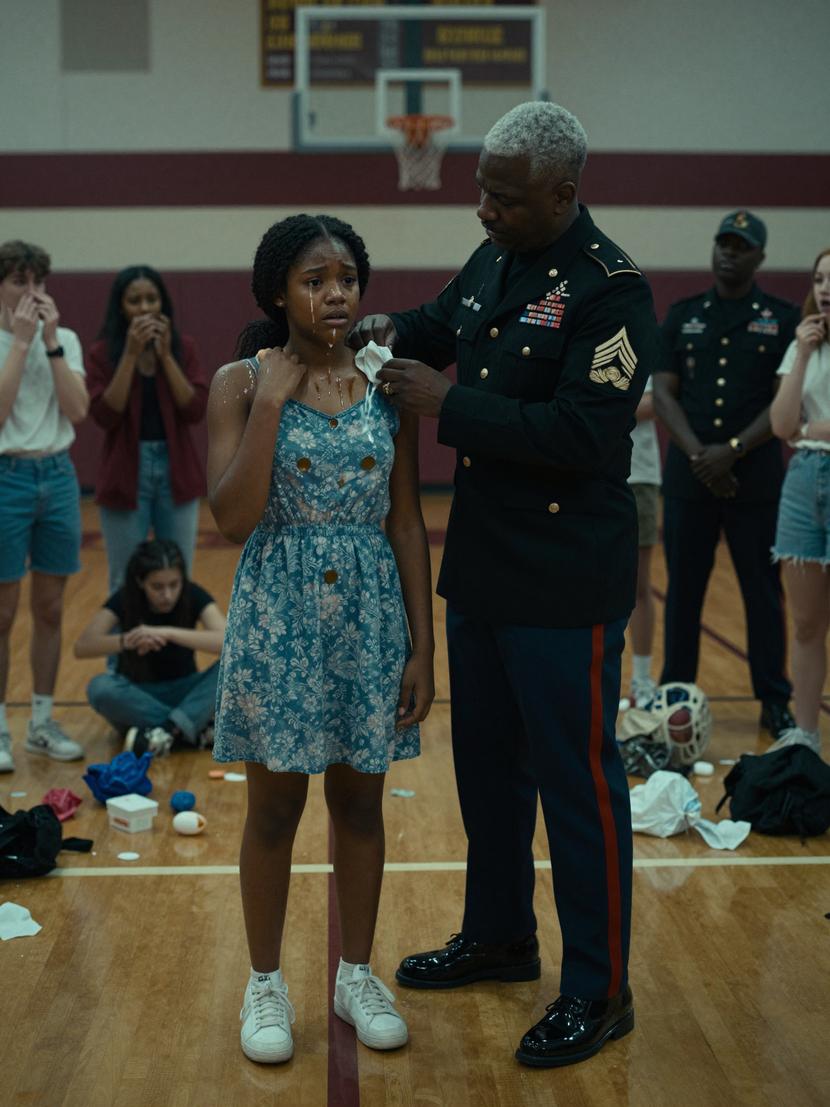
Cold yolk splattered over my shoulder and ran down my neck, soaking the collar of my mother’s dress.
I gasped.
“Food fight!” a boy shouted.
And chaos erupted like a storm unleashed.
Eggs flew. Tomatoes arced through the heavy air. Milk cartons burst at my feet, splashing white across my dress’s blue flowers like a cruel brand.
The laughter slammed into me, a relentless wave.
I stayed rooted, my body shutting down as it always did in unbearable moments.
I wrapped myself tight with invisible armor, begging to disappear.
Sienna grabbed a fistful of trash from the box, pelting it at my chest.
“Where’s your soldier daddy?” she screamed, her voice slicing through the noise. “Too busy saving the world to save his trash daughter?”
The gym howled.
My vision blurred.
I thought of my mother — her withering hand in mine, whispering his name like a prayer.
Darius Walker.
My father.
A shadow. A myth. A man who never showed.
I swallowed a sob, eyes locked on the flickering ceiling lights — as if they might open and swallow me whole.
Then —
BOOM.
The double doors at the gym’s far end thundered open with a force that ripped through the chaos.
This wasn’t a mere entrance.
Not a tardy teacher.
It was a breach.
The band’s music screeched to a halt.
Laughter died faster.
A tomato, midair, fell with a wet thud.
The gym froze.
All eyes whipped toward the doorway.
In the frame stood men apart from high school life.
No school colors, no backpacks — only purpose.
Clad in sleek, dark tactical gear, they moved as one, eyes sharp, bodies taut.
The air chilled.
Teenage bravado evaporated like morning mist.
Then, a gap appeared in their ranks.
Through it strode a man without armor.
He wore a uniform — a masterpiece of tailored fabric and heavy with ribbons that whispered history and consequence.
His hair was short, silver edged. His face bore the weight of hard choices carved deep.
He stopped at center court.
He didn’t look at the crowd.
He didn’t look at Sienna.
He looked at me.
My breath caught.
Those eyes — I’d glimpsed them years ago, preserved in a photograph my mother guarded like a relic.
The same eyes I faced every morning in the mirror.
Darius Walker.
My father.
The ghost who was impossibly real.
He stepped forward.
One step.
Then another.
The sound of his polished shoes echoed like a beating drum in the dead silence.
Click.
Click.
Click.
He stopped three feet away.
His eyes roamed over me — the egg in my hair, the milk staining my dress, the garbage littered at my feet.
His jaw clenched. A muscle twitched violently in his cheek.
He drew a steady breath — as if restraining something fierce within.
Then his voice rumbled low but clear, like distant thunder cracking beneath the earth.
“Who is in charge here?”
Principal Keller’s voice cracked. “I… I am. Principal Keller.”
Darius didn’t shift his gaze.
He reached out gently, peeling a banana peel from my shoulder.
My knees trembled and gave way.
But before I hit the floor, his arm encircled me, steady and strong.
Real.
Solid.
He drew me close, scenting leather, starch, cold air — and something metallic, like the past itself.
He leaned down, just enough.
“I’ve got you,” he said.
My throat broke wide open.
I didn’t cry like a proper girl.
I wailed — a raw, wounded sound buried deep inside.
Darius rose and finally surveyed the crowd.
It was as if the gym shrank beneath the weight of his glare.
His eyes cut across students, teachers, adults who watched but did nothing.
Then they pinned on Sienna.
Her hand trembled as she gripped another egg.
The egg slipped, cracking at her feet.
Darius’s voice remained calm — the cruelest part.
“You,” he said, fixing her with his gaze.
She swallowed hard. “I… it was a joke.”
“A joke,” he repeated, slow and heavy.
Then he turned to Principal Keller.
“You watched a child be assaulted,” Darius said evenly, “in this building. Under your authority. With your staff sitting here like spectators.”
Keller stammered, “General Walker, we didn’t — we didn’t know Nina had—”
“My daughter doesn’t need connections to deserve safety,” Darius interrupted, voice icy. “She needed an adult. And you failed.”
He looked back at the men behind him, voice steely with command. “Clear a path.”
The guards moved instantly, parting like the sea.
The crowd backed away, making room.
Darius kept me close as we walked — past faces now ashamed where once they laughed.
Phones lowered. Eyes averted. Unspoken guilt lingering thick.
Sienna stood frozen, mouth agape, eyes wet — not from remorse, but fear.
We reached the double doors.
The chill of the hallway air was like rebirth.
Before leaving, Darius stopped and glanced back at the gym one last time.
“I’m asking one question,” he said softly but firmly. “And I want an honest answer.”
Silence.
He pointed to the trash-littered box.
“Who thought this was acceptable?”
No one moved.
He nodded once, sharp and sure.
“That tells me everything.”
Then we walked out.