
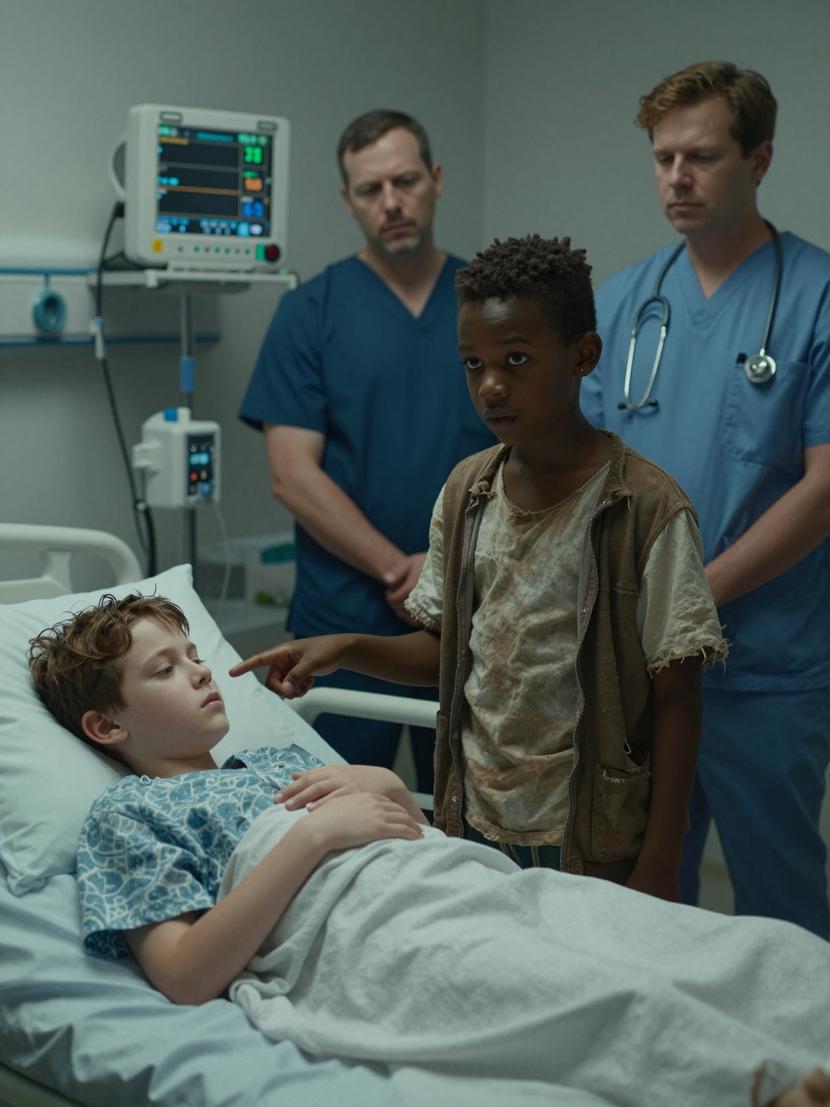
The critical care ward held its breath in a tense silence, monitors beeping a relentless, haunting rhythm. Doctors stood frozen, their faces masks of exhaustion and despair, surrounding a fading boy whose fragile chest struggled with each shallow breath. Unseen by the world’s most skilled medical minds was a quiet secret nestled deep within the curve of his throat—a truth so small it had been utterly overlooked.
Minutes ticked agonizingly by, hope draining with every passing second. No signs of recovery, no clues, no miracles. Then, from where no one expected, a soft voice broke the stillness. It came from Darian, a ten-year-old boy whose threadbare clothes and worn-out shoes made him invisible in a world defined by wealth and prestige.
Darian tilted his head thoughtfully, his dark eyes sharp and searching. There, in the subtle hesitations of Noah’s breath, Darian sensed something wrong—a slight resistance, a hesitation that machines and experts had missed, a silent struggle in a place few had dared to look closely.
Skeptical yet desperate, the doctors gathered around as Darian pointed confidently to the shadowed curve of Noah’s throat, a place hidden from clear view by even the most advanced cameras and tests. Suddenly, the emergency alarms screamed to life, monitors flashed red, and chaos erupted as nurses hurried and doctors shouted commands. But Darian remained still, calm and certain—the answer lay exactly where he had said.
The boy was painfully out of place amid the sea of expensive suits and shining medals—a poor black child whose keen observation revealed what eighteen brilliant doctors had failed to find.
Marcus Ellery, Noah’s father, stood broken. His once impeccable suit now rumpled, eyes hollow and empty of the arrogance wealth often brought. His power, his fortune—nothing could buy the miracle his son desperately needed. Hope came to him in the form of the unexpected.
Weeks before, the vast Briarwood estate bustled with luxury, its grandeur a stark contrast to the quiet questions stirring in young Noah’s heart. He had been gentle, bright, and full of compassion, untouched by the arrogance that money sometimes breeds.
On a rainy morning, Noah had asked Marcus about the homeless children whose cold faces gathered outside a chapel. “Why does the world forget them, Papa? Why do some lives overflow with comfort while others shiver in shadows?”
Marcus deflected with smooth rehearsed answers—“Life is complicated, Noah,” he said, turning his back to meetings and charts. Little did he know those very words would haunt him when the simplicity of truth demanded courage over convenience.
Hours later, the unthinkable happened. Noah collapsed at the academy, his body betraying him without warning. Panic exploded around him as doctors poured in, and the illusion of control Marcus had clung to shattered in an instant.
Specialists streamed in, machines encircled Noah like sentinels, but tests revealed nothing—only confusion and fear. The man who built medical centers across the globe faced the helplessness of uncertainty, as his son’s life hung by a fragile thread.
Days morphed into an endless nightmare. Noah’s breath grew faint, his skin washed out and cold. Marcus summoned the best minds in medicine, spending fortunes in search of a solution that refused to reveal itself.
One evening, desperate and weary, Marcus found himself inside the same humble chapel Noah had once noticed but Marcus had mostly ignored. There, he met Grandmother Marlene, whose life was an untold story of service, faith, and unwavering hope amid hardship.
Among the scattered pews sat Darian, the orphaned boy with eyes too old for his years, absorbed in medical books donated long ago. His quiet wisdom was born of living unseen, of noticing the small things others hurried past.
Marcus shared Noah’s story with a voice cracking under the weight of sorrow. Grandmother Marlene listened with steady compassion, believing in the hidden paths of broken lives.
As Marcus prepared to leave, Darian’s soft words lingered in the air, “Sometimes, answers hide where no one cares to look.” The billionaire dismissed it as a child’s innocent hope, unaware that those words would soon be the key to life itself.
That very night, Noah’s breath faltered—and then stopped. Chaos erupted anew as doctors battled to revive him, while Marcus crumpled nearby, overwhelmed by fragility’s raw truth.
Doctors confessed their defeat. Exhausted and defeated, Marcus stayed by Noah’s side, praying in the silence that had become his only refuge.
With dawn came Dr. Harwood, a sharp-eyed physician proposing an unconventional theory: a tiny obstruction, invisible to scans and tests, might be suffocating Noah slowly, like a silent assassin.
Hope briefly bloomed as teams searched relentlessly, yet failure followed failure. Noah’s condition worsened, and Marcus abandoned business empires to dedicate himself solely to his son’s survival.
Then Grandmother Marlene arrived at Briarwood, bringing Darian with her. They challenged convention—offering observation over credentials, trust over certainty.
Exhausted and desperate, Marcus agreed. Darian viewed Noah not as a patient but as a story, listening to every breath, feeling every subtle sound.
He noticed once more the hesitation in Noah’s assisted breathing and pointed firmly to the hidden curve of his throat. Dr. Harwood reconsidered the angles once dismissed by routine.
When Noah’s breathing crashed again, an emergency endoscopy was performed. This time, the camera lingered longer, relentless in its search. Inside, they found it: a tiny fragment of plastic—a blue pen cap, lodged like a cruel valve.
This small piece had woven a merciless trap, allowing Noah just enough air to survive but slowly stealing life away in silence, invisible to every scan, every experienced eye.
Careful hands removed the fragment. Realization thundered through the room.
Marcus’s mind flashed back to forgotten moments—Noah’s habit of chewing pen caps, small signs overlooked, a hidden pain unnoticed.
When Noah finally woke, his whispered words spilled secrets of fear, bullying, and a shove in the academy hallway—wounds deeper and more painful than his physical injury, carried alone to shield his busy father.
Marcus listened, shattered but enlightened, promising presence where once there was absence, honesty where silence ruled, unity over isolation.
Healing came like gentle rain—breaths steadied, sleep deepened, and hope blossomed.
Marcus turned toward Darian, the boy who had saved his son without seeking glory.
Darian spoke softly of invisibility, of seeing what others ignore because he himself was unseen, reminding Marcus that those overlooked often hold the keys to our salvation.
When offered a reward, Darian refused money, instead asking for something far greater—recognition and care for children like him—those waiting not for charity, but for belief.
Transformed, Marcus returned to the chapel with builders and blueprints, his eyes opened to the stark realities of poverty. He committed to listening, learning humility through service rather than status.
Together, hope reshaped the shelter. Darian became an advisor, insisting on inclusion, respect, and collaboration—building futures through shared dignity rather than rescue alone.
Yet beyond this fragile sanctuary, Stephen Calloway watched with envy. His bitterness fermented into cold strategy, as he plotted to destroy what Marcus had rebuilt, wielding secrets buried deep in shadows.
Threats emerged silently, secrets leaked, pushing Marcus toward a reckoning that tested whether redemption withstands exposure, and if true change can survive truth.
Confronting Stephen, Marcus chose honesty over defense, compassion over combat, refusing to let fear and bitterness rule his heart.
He offered understanding instead of revenge, leaving Stephen exposed to his own emptiness—an enemy without ground to stand on.
Back home, Noah healed surrounded by new friendships, while Marcus learned to lead with empathy, balancing justice with mercy.
Darian’s quiet observation had saved one precious life but taught a timeless lesson: miracles come not to those who command, but to those who listen—to the invisible voices finally given a chance to be heard.