
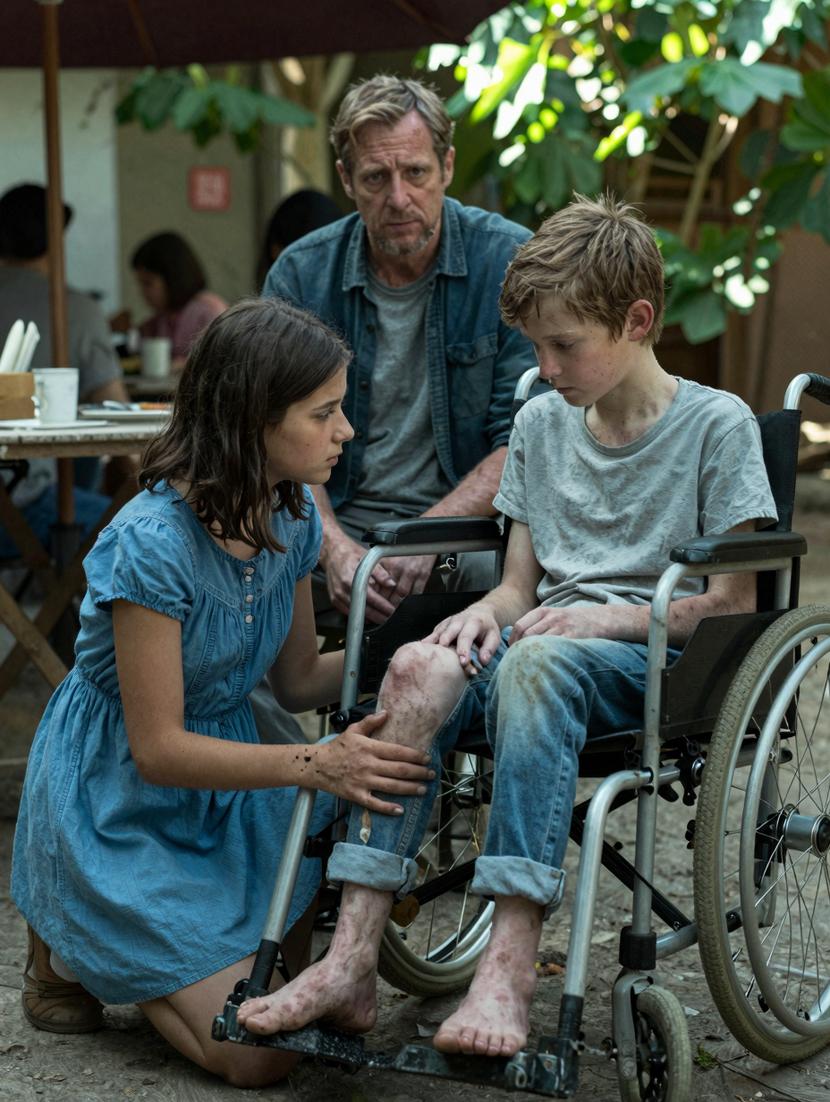
Daniel Mercer froze, a bite halfway to his mouth, as the small figure beside their bistro table quietly spoke. The girl couldn’t have been older than eleven, wearing a faded blue cotton dress that hung loosely on her slender frame. Her hair was neatly pulled back, but dirt smudged the palms of her small hands, telling a story of hardship. Across from Daniel sat Noah, his ten-year-old son, silent and still in his wheelchair. His legs, thin and frail beneath faded jeans, seemed almost disconnected from the boy he was once so full of life.
A short, bitter laugh escaped Daniel’s lips. “You’re going to heal my son? You’re just a child.”
The girl’s gaze never faltered. “I don’t want your money. Just food — one meal — and I’ll help him, the way my grandmother helped people back home.”
Daniel exhaled a long, weary breath. For three relentless years since Hannah’s death, the accident that stole his wife and shattered Noah’s spine, he had watched his son’s world grow smaller with each passing day. Doctors had told him Noah would never walk again.
“Please, Dad,” Noah whispered quietly, vulnerability threading his voice. “Just let her try.”
Wrestling with his doubt, Daniel nodded toward the waiter. The girl introduced herself as Maya Brooks. When her food arrived, she ate with a hunger that spoke of days without a proper meal, her eyes flickering with something unspoken.
Finishing the meal, Maya spoke softly, “Can we go somewhere private? I want to show you.”
Reluctantly, Daniel wheeled Noah out to the quiet garden behind the bistro. Maya knelt beside Noah, gently rolling up his pant leg. Her hands moved with a surprising confidence, pressing and stretching his muscles through slow, deliberate motions.
“This is nonsense,” Daniel muttered, skepticism creasing his brow.
But Noah shook his head, a faint spark lighting his eyes. “Dad… it feels strange. But good. Like something’s waking up.”
Maya looked up at Daniel, steady and calm. “Noah needs deep tissue work, not just pills. His muscles are shutting down, not his nerves. And those medicines he’s on—they’re making things worse.”
Daniel’s heart clenched. “What medicines?”
“The ones Rebecca gives him,” Maya said quietly. “The ones that make him cold and tired. They slow his blood. I’ve seen this before.”
Daniel’s mind reeled. Rebecca, his new wife, had insisted those pills were critical. Her private doctor prescribed them, and Daniel had never questioned it.
“You can’t accuse someone without proof,” he said harshly.
Maya met his gaze unwaveringly. “Then find proof. Test the pills—you’ll see I’m right.”
Daniel opened his mouth to shut her down, but a sharp gasp broke the tense silence.
“Dad—I can feel her hands!” Noah’s face brightened as tears welled in his eyes for the first time in years.
Daniel stood frozen, watching his son’s fragile hope bloom.
Maya rose, brushing dirt from her hands. “Stop the pills, Mr. Mercer. They’re killing what’s left of his strength.”
Trembling, Daniel asked, “How do you know this?”
“Because I lost someone the same way,” she said softly. “And I won’t stand by and watch it happen again.”
Then, without another word, Maya vanished into the dusk, leaving Daniel haunted by doubt — and a terrifying suspicion about Rebecca.
That night, Daniel lay awake, haunted by Maya’s words as he stared at Noah’s medicine bottle. ‘They’re killing what’s left of his strength,’ echoed relentlessly.
After Rebecca fell asleep, Daniel scoured the internet, uncovering damning details buried in health forums. Neruvex-A—marketed as a nerve-recovery drug—masked a devastating secret: long-term use caused muscle atrophy.
The next morning, Daniel skipped Noah’s dose. By afternoon, the boy’s cheeks flushed with color, his eyes sharper, more alive.
Three days later, clinic lab results returned, confirming the horrible truth. The pills contained a potent muscle relaxant, not nerve treatment. Continued use could permanently rob Noah of muscle control.
Daniel’s hands shook. Why would Rebecca do this?
Desperate for answers, he dug deeper into old accident files. Hannah’s car had plunged off a rain-slick bridge. The police ruled it mechanical failure — but unease gnawed at him. A call to the retired officer who handled the case confirmed his suspicions.
“Funny you ask,” the officer said quietly. “The brake line was tampered with. We suspected foul play, but your insurance company pushed to close it fast. Said you wanted it that way.”
A cold shiver ran through Daniel. He had never known.
That evening, tension filled the kitchen as Rebecca prepared dinner.
“What exactly have you been giving my son?” Daniel demanded.
Calm and composed, Rebecca replied, “The medication prescribed by Dr. Ellison.”
“I had it tested,” Daniel said, slamming the report on the counter. “It’s poison.”
Her eyes hardened. “You shouldn’t have done that.”
Anger flared. “Why, Rebecca? Why hurt Noah? What has he ever done to you?”
Her facade cracked, revealing bitter truth. “Because he’s a reminder. Every day, that boy looks at me with Hannah’s eyes—the woman you can’t let go of.”
Daniel staggered, stunned into silence.
Her voice lowered to a chilling whisper. “She never deserved it all. You, the company, the life. I just wanted my turn.”
“You killed her,” Daniel breathed.
“She was standing in my way.”
Before he could react, Rebecca grabbed a kitchen knife.
“Noah, stay back!” Daniel shouted, twisting her wrist until the blade clattered to the floor. Their struggle echoed through the house. Noah cried out. Neighbors, alarmed, called the police.
Minutes later, officers hauled Rebecca away in handcuffs, her screams filled with rage that she “deserved the life she built.”
In interrogation, she confessed. She had paid a mechanic to sabotage Hannah’s brakes and bribed a doctor to supply fake medication that weakened Noah—ensuring his dependence and Daniel’s emotional imprisonment.
The truth shattered Daniel. Years of self-blame dissolved into the painful awareness he had trusted the wrong person.
Weeks later, with proper care and the healing techniques Maya had shown them, Noah’s therapy transformed. Slowly, his muscles regained strength.
Daniel searched everywhere for Maya—returning to the bistro, checking shelters, visiting neighborhood centers—but she had vanished like a ghost. Yet, her words lingered, a beacon of hope.
Noah’s progress was gradual but undeniable. Supported by family and newfound strength, he learned to stand with assistance. Each therapy session ended with Daniel leaning close, whispering, “You’re growing stronger, son. Step by step.”
One crisp autumn afternoon, nearly six months later, Noah took two tentative steps toward his father. Tears glistened in Daniel’s eyes.
“You did it, buddy,” he choked, overwhelmed with pride. “You really did it.”
Noah smiled faintly. “Maya said I could. Remember?”
Daniel nodded, glancing toward the garden beyond the window, half expecting to see her there once more in that faded blue dress.
She never returned.
But in Daniel’s heart, he knew she never had to. Maya had done what no doctor, no fortune could accomplish—opened his eyes to the truth and redefined healing: not in medicine or money, but in love, honesty, and hope.
For the first time in three long years, Daniel Mercer felt true peace.