
There’s an unmistakable scent that grips the trauma bay whenever a catastrophic accident rolls through the doors. It’s a sharp, metallic blend of copper and antiseptic mingled with the biting smell of burnt rubber and the icy chill of a relentless winter storm.
For twelve grueling years, I’ve been Mara, an attending trauma surgeon at Cedar Ridge Trauma Center here in Riverton. I’ve stared down the most harrowing consequences of twisted metal and shattered glass. I believed I had grown impervious to the heartbreak, that my heart had armored itself against despair. But that night shattered my false immunity.
It was a bleak Tuesday in late January. Outside, the mercury had plunged to a brutal negative ten degrees, and a sudden flash freeze had transformed Highway 47 into a treacherous, invisible trap of black ice. The emergency radio had been wailing nonstop. A massive pile-up—a nightmare of twenty-five vehicles crumpled together—had just flooded our emergency bay.
The ambulance doors slammed open, sending a blast of freezing wind howling through the corridor, carrying with it the frantic, overlapping shouts of paramedics.
“Trauma One! Clear the way! Central line kit, stat!” a harried paramedic barked, pushing a stretcher that squealed on the linoleum as it skidded forward.
I sprinted alongside, snapping on gloves as my team swarmed the stretcher like a furious hive.
Lying there was a fragile girl no older than seven. Her blonde hair clung in wet strands to her forehead. Her pale skin seemed almost translucent beneath the cold, clinical glare of the trauma room lights.
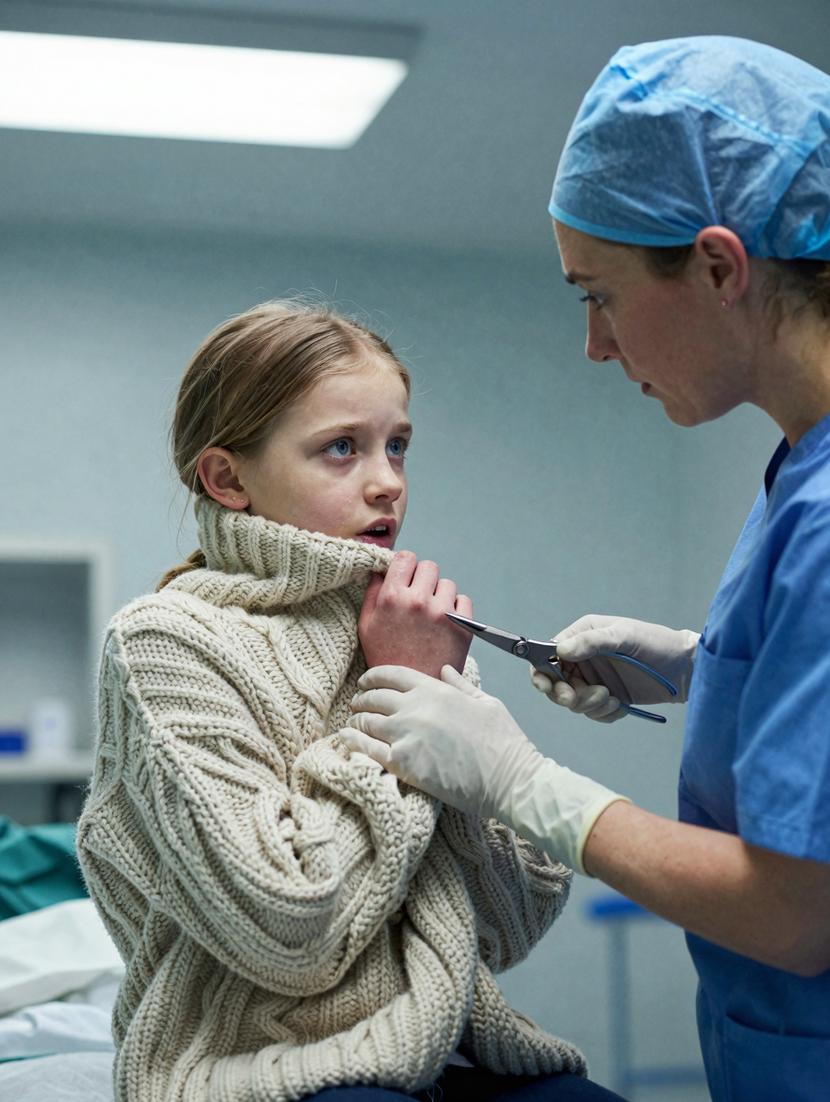
But it was the clothing that struck me first—an enormous, heavy, cable-knit sweater swallowing her small frame, torn at the shoulders and soaked with icy slush and dirt from the wreckage. It looked like it belonged to an adult—a father’s sweater, massive and protective.
“Talk to me,” I commanded gently, shining my penlight into those sluggish blue eyes. She was conscious, just barely.
“Female, approx. seven years old. Extracted from the back seat of a sedan crushed between two semis,” the paramedic rattled breathlessly. “Parents deceased in front seats. She was trapped nearly forty minutes in this brutal cold. Blood pressure’s bottoming out. Heart rate’s sky-high. Suspected internal bleeding and hypothermia.”
My heart clenched, but my training snapped into gear. In trauma care, there’s the ‘golden hour’—the unforgiving sixty minutes when every second could mean the difference between life and death. Protocol demands the first step: expose the patient. We have to see the damage to fight it.
“Okay, on three, transfer her onto the trauma table. One, two, three!”
They lifted her shivering body onto the cold steel table. She whimpered, barely a ghost of sound.
“Hey, sweetheart. I’m Mara. We’re here to help. I need you to stay still, okay?” I tried to pierce through the haze around her.
I reached for my trauma shears—the heavy, ruthless blades designed to obliterate even the thickest winter gear in seconds. There was no time to undress her carefully.
“Let’s expose,” I ordered.
As I slid the bottom blade under the swollen collar of the sweater near her collarbone, her eyes snapped wide open. No longer sluggish, they were wild, frantic, filled with a raw, desperate terror that pierced straight through me.
Before my hand could move, her tiny, freezing fingers shot upward and clamped with surprising strength around my wrist.
“No!” she screamed, voice hoarse and raw, breaking through the room’s tense silence. “Please, don’t cut it!”
Hayes, my resident, frowned, stepping closer. “Sweetheart, we have to. It’s soaking and freezing—you’re hurt, and we have to see where the bleeding is.”
“No! No!” she shrieked again, twisting violently, kicking her legs with frantic energy. She let go of my wrist, then crossed her arms fiercely over the sweater’s center, clutching it desperately to her chest. “You can’t take it! You can’t!”
“Hold her shoulders gently,” I instructed the nurses, voice calm but my heart pounding. Her monitor beeped wildly; every second she resisted, she risked bleeding out.
“Honey,” I whispered close to her face, “I’m sorry, but I have to cut the sweater. You’re badly hurt. If I don’t take it off, you could die. Do you understand?”
She sobbed uncontrolled, deep, shaking sobs that rattled her tiny frame. “Please… please… if you cut it, he’ll die. Please don’t kill him. I promised Mommy I’d keep him safe.”
Time stopped.
The shears hovered frozen.
The whole trauma team fell utterly silent except for her pounding heart on the monitor and the winter storm roaring outside.
If you cut it, he’ll die.
Her terrified, pleading face wasn’t childish fear of doctors. It was fierce, raw, protective love.
I glanced down at the swampy sweater, way too big for her, oddly bulging at the center.
I dropped the scissors onto the metal tray with a clang.
“No one moves,” I whispered sharply.
Slowly, I stepped closer to her, raising my empty hands in peace.
“Okay,” I said softly, voice trembling. “I won’t cut it. But you have to let me see what’s inside.”
Her tears wet the bruised dirt on her cheeks. She trembled violently with cold and shock. The silence stretched, unbearable.
Then, with agonizing slowness, her icy, shaking hands unclenched. She reached into the sweater’s thick collar and gently peeled it aside.
I leaned in and looked into the dim, warm hollow of the oversized wool.
My breath caught.
My knees threatened to buckle.
Nestled against her bare chest was an impossible sight that sucked every breath from the bustling trauma room.
Bathed in harsh surgical light spilling into shadowed wool was a tiny, fragile face.
A newborn boy, no older than weeks, curled instinctively into a fetal ball, cradled within his sister’s body heat and the father’s massive sweater.
The baby’s lips were an eerie dusky blue, his chest rising in shallow, rapid gasps—but alive.
The room’s stunned silence stretched like a held breath.
“Oh God,” Hayes whispered, stepping back, voice trembling.
“Don’t just stand there!” I snapped, adrenaline surging anew. “Call Sunrise Neonatal Unit—page the neonatal team immediately. Pediatric hypothermia, infant unknown age. Move!”
Chaos burst anew. Nurses sprinted to phones.
I looked to the small girl trembling on the table. Her blue eyes, glazed with shock and exhaustion, searched me desperately. Her teeth chattered uncontrollably.
“I kept him warm,” she stammered faintly. “Mommy said… keep Ethan warm.”
A fierce wave of emotion surged through me. In all my years as a trauma surgeon, I’d never seen such selfless sacrifice.
Trapped in crushed metal for forty frigid minutes, she’d stripped off her own winter coat, draped her father’s oversized sweater over herself, and nestled the shivering newborn within, using her bare skin as a life-saving incubator.
She gave him every ounce of her own heat.
“You did perfect, sweetheart,” I whispered, voice thick. “You’re a hero. But now I need you to let me take him so we can warm him up. Can you?”
She studied me long and hard, then slowly relaxed her grip on the heavy wool.
“Okay,” she whispered.
“Hayes, warm blankets—now!” I ordered, reaching carefully inside the sweater. The baby’s skin was chillingly cold, like smooth marble.
Cradling him gently, I lifted Ethan from the protective cocoon. He let out a fragile, rasping cry—music to my ears.
“I’ve got him, Mara,” the lead pediatric nurse declared, approaching with hot blankets from the warmer.
We swaddled him tightly just as the neonatal team burst in, surrounded him, quickly assessing vitals and hooking monitors before rushing him away to the SCU.
Turning back, my fierce little patient didn’t resist as I grasped the trauma shears, cutting down the middle of the heavy wool sweater, peeling it away from her chilled, battered body.
Her skin bore the marks of shock—mottled and ghostly pale.
But what stopped my breath once again was the massive dark bruise etched across her small abdomen—the unmistakable ‘‘seatbelt sign’’, shaped like a brutal slash right at her belly button.
The violent force of sudden deceleration had torn into her organs.
“Her abdomen is rigid,” I noted, touching gently over the bruising. Her body was fighting massive internal bleeding.
“BP dropping fast!” Hayes called, panic sharpening his tone. “Sixty over forty, HR up at 140. She’s slipping into hypovolemic shock!”
Her fragile body was hemorrhaging inside.
The adrenaline that had kept her alive guarding her brother was loosing grip. Her eyelids rolled back.
“She’s unresponsive!” a nurse yelled.
“Start massive transfusion! Two units O-negative, rapid infusion! Pediatric intubation kit, stat!”
The trauma bay shifted from turmoil to desperation.
Hayes intubated her swiftly, bagging oxygen as her pressure plummeted.
“No time for CT—OR now!”
The charge nurse confirmed Surgery Suite 3 was ready.
We dashed through a lit corridor, pushing the stretcher amid nurses manually squeezing blood bags.
“Hang on, Lily,” I murmured, eyes locked on her pallid face.
Bursting into the surgery suite, scrub nurses were poised with sterile drapes and shining instruments.
Transferred onto the table, I scrubbed in briskly, heart pounding, adrenaline sharp.
The anesthesiologist shook his head, grim. “She’s barely hanging on, Mara. One misstep and she’s gone.”
“Scalpel,” I said, fingers steady despite the storm inside me.
I cut a vertical incision, and instantly blood surged—a torrent flooding our view.
“Suction max, now!”
Operating blindly in a pool of blood is terror and instinct combined. Her cold blood defied clotting.
“Pack her abdomen! Gauze full force!”
Hayes’s hands pressed in with mine, clamping down on gauze to stem the flood.
“Remove upper left quadrant pack on my count,” I instructed.
Hayes pulled back soaked pads, and a fresh geyser erupted.
“It’s the spleen!” I yelled, reaching with trembling hands to clamp the shattered artery.
The flow slowed.
“Smedberg clamp!”
The forceps snapped into place.
Pressure stabilized.
“Damage control only,” I said. We removed the shredded spleen, packed the cavity, and left the abdomen open under a clear vacuum dressing—giving swollen organs space to breathe and avoiding fatal pressure.
Vital signs remained fragile but steady.
Exhausted, I scrubbed my face with icy water, sought answers.
I made my way to Sunrise Neonatal Unit, a warm haven scented of lotion and baby milk.
At Cradle Pod 4 stood Nina, the SCU head nurse, alongside a soaked uniformed police officer.
Inside the incubator was Ethan—pink, stable, breathing rhythmically.
“He’s a fighter,” the officer murmured, eyes tired.
“I was first at the scene,” he said, voice rough. “A blue sedan crushed between jackknifed truck and barrier. Parents were gone instantly—nothing we could do.”
“I thought the baby was thrown clear—car seat empty, straps undone. Then I saw Lily, huddled on the floor behind the driver, wrapped in that massive sweater. She didn’t cry, just stared at me with scared eyes.”
Tears brimmed unashamedly.
“We battled forty freezing minutes with jaws of life. When I reached her, she growled—guarding what I didn’t realize was Ethan inside.”
“She unbuckled him?” I whispered.
“After the crash, in the dark. She bit the plastic to unclip. Took off her coat, wrapped him in her dad’s sweater to keep him warm.”
“Lily,” I breathed—the name heavy now with meaning.
“Is she going to make it?” the officer asked, hope trembling in his voice.
“I don’t know,” I admitted. “She lost half her blood. Organs battered. She’s comatose now.”
I entered the Children’s Critical Care Unit.
Room 312 hummed with harsh ventilator breath and alarm beeps.
Lily lay tiny and frail, covered in tubes, clad in bruised skin. The vacuum dressing pulsed ominously over her open abdomen.
I sat beside her, listening to machines that whispered a fragile thread of life. The storm outside raged, cold and gray.
The first twenty-four hours after catastrophic hemorrhage are a tense watch. You pray kidneys wake. You hope for the brain’s light to return. You fear the stillness of surrender.
Dawn crept over the city. Lily hadn’t moved.
Hayes arrived, a steady hand on my shoulder. “Go rest, Mara. She’s stable for now. No increase in swelling. That’s a win.”
I left and slept desperately, but at midnight my phone buzzed.
The CCU charge nurse’s voice was strained. “Her brain monitor alarms are raging. ICP’s spiking, heart racing. She’s fighting the vent.”
“She seizing?” I demanded.
“No, but she’s waking. And terrified.”
I dashed back.
Alarms screamed a terrifying chorus. Nurses held Lily down as she thrashed violently, eyes wild with panic.
With the breathing tube gagging her silent screams and restraints binding desperate wrists, she pulled with impossible strength.
“Sedate!” the nurse shouted.
“Wait!” I grabbed her wrist. “No. We need to assess her brain function. Give me thirty seconds.”
I leaned into Lily’s frantic gaze. “Lily! Look at me! You’re safe here in Riverton. You were in a terrible crash. Do you understand?”
Her wild eyes fixed somewhere between fear and hope.
She clawed at her chest—the spot where the sweater once shielded so fiercely.
Through the tube’s clear plastic, I could see her lips move—a silent, tortured scream.
She was searching for Ethan, afraid she had lost him.
I spun to call Nina in the Sunrise Unit. “Open FaceTime—show me Ethan—now!”
The video came alive: Ethan, warm and rosy, sleeping peacefully in Cradle Pod 4.
I held the glowing screen to Lily’s face.
Her frantic energy halted. She gazed intently at her brother’s face, breathing steadied, hands slackened.
A tiny smile cracked through her tears.
“Cancel the sedation,” I ordered. “She needed to see he’s alive.”
Over the next two days, I lived in the CCU room. Lily’s body was a fragile battlefield—balancing fluids, battling infection, breathing through pain.
Each time she stirred, I showed her a new photo of Ethan. She squeezed my hand—a silent promise.
On day three, her strength grew enough to remove the breathing tube.
“Big cough, Lily—one, two, three!” I coaxed.
She coughed, gasped fresh air, and breathed on her own.
“How do you feel?” I smiled.
Her voice was a fragile rasp. “Is Ethan… really warm?”
“He’s so warm,” I assured her, fighting back tears. “He’s eating and growing. A hungry boy.”
Lily sighed in relief.
She began to share her story—broken, trembling words painting horror and hope.
“We were listening to the radio. Daddy drove slow. Then car spun out. Daddy slammed brakes.”
She clutched her blanket tightly.
“Crash was thunder inside the car. Glass everywhere. We flew then stopped so fast it hurt my tummy.”
She paused, tears slipping.
“It was dark. Cold wind blew through windows. I called Daddy but he didn’t answer. He was on the steering wheel.”
“And Mommy?” I asked softly.
“She was awake but couldn’t move. Said she loved me. Said she was going to sleep.”
Her blue eyes held heartbreaking clarity.
“She told me to keep Ethan warm, promise to keep him safe.”
The raw courage of that child shook me.
“I couldn’t get his seatbelt off—fingers froze. Bit the clip open. He cried so much. I took off my coat—it was stiff and cold. Found Daddy’s sweater on the floor. Huge.”
“I put Ethan against my tummy like a kangaroo. Hugged my knees tight. Told him stories. He stopped crying… and I got so tired.”
“You did exactly what Mommy asked. You’re the best sister in the world. You kept him alive.”
She offered a weak smile, finally letting the trauma settle.
But the fight was far from over.
Lily’s healing abdomen still bore a massive open wound, clotting only by gauze and vacuum. A second surgery was necessary—to clean, inspect, and close the wound permanently.
Late afternoon, the transport team arrived.
As we lifted her, Lily gripped my white coat tightly.
“Mara?” she whispered, searching my eyes. “If I don’t wake up… if I go like Mommy and Daddy… promise me one thing.”
“You’ll wake up,” I said firmly.
“Promise me you’ll keep Ethan warm.”
My throat tightened—and I nodded fiercely. “On my life. But you’ll be here to do it yourself.”
A small nod. We wheeled her into Surgery Suite 3.
Anesthetized, Lily slipped into darkness.
I scrubbed in, heart heavy.
Peeling away the vacuum dressing, the sterile calm shattered.
A vast section of her lower intestines was pitch black—necrotic.
“Oh God,” whispered the assistant, stepping back.
The dead tissue had ruptured. Bacteria flooded her bloodstream.
“She’s crashing!” the anesthesiologist yelled.
“Code Blue! Start compressions!” I screamed.
Lily’s heart flatlined.
Hayes pumped her chest with desperate force.
“Push epi! We need to get the dead bowel out now!” I cried.
Working frantically through the chaos, I excised the blackened tissue, sealing healthy edges with surgical staples.
Warm saline flooded the cavity as suction fought to keep pace.
Minutes passed in a blur of shock and determination.
Finally, a faint rhythm returned.
Slow, unstable—but alive.
I exhaled, knees weak.
We completed surgery, closing the wound.
Lily was stable but hanging by a thread.
Days dragged on in the CCU as she fought sepsis.
Meanwhile, Ethan thrived in the SCU, growing stronger each day. I taped his photos to her bed’s railing—a beacon of hope.
On day eight, Lily’s fever broke. Her organs rallied.
It was time to awaken her.
I stood watch as sedatives faded.
Then, fluttering lids, groans, a fragile hello.
“Lily, it’s Mara. You’re safe,” I whispered.
Her eyes cleared, taking in the scene.
I pulled the breathing tube gently away.
She gasped, then asked, weak and raw, “Did you keep Ethan warm?”
Unable to speak, I nodded, tears flowing freely.
The door opened softly.
Nina appeared carrying Ethan, wrapped in a cozy blue blanket.
Lily’s eyes widened. She tried to sit, but I gently lowered her back.
I placed Ethan beside her.
He blinked at his sister, warm and alive.
Lily wrapped an arm around him, burying her face in the blanket, crying deep, healing tears.
“I got you, Ethan,” she whispered.
The room’s hardened medical souls wiped their eyes.
In that moment, amidst trauma and loss, we remembered why we do this sacred work.
A month later, Lily and Ethan went to live with their grandparents in Wisconsin.
Before they left, I visited their hospital room.
Lily held a stuffed bear, fragile but brave.
I knelt and pulled a small, sterilized square of thick, dark red cable-knit wool from my pocket—a piece of her father’s ruined sweater.
I placed it in her hands.
“Keep this,” I said, meeting her brave blue eyes. “Whenever you feel cold or scared, hold this and remember you have the warmest, strongest heart I’ve ever seen.”
Lily gripped the wool tightly, then wrapped her arms around my neck.
“Thank you, Mara,” she whispered.
I stood, watching as nurses wheeled her toward the hospital exit and a new, bright life.
I am Mara, trauma surgeon. I have faced the worst of our world. But because of a seven-year-old girl in an oversized sweater, I know even in the darkest, freezing storms, the human spirit can burn fierce enough to save us all.