
There’s a distinct, almost haunting smell that clings to the trauma bay whenever the worst accidents roar through the hospital doors. It’s a heavy metallic tang of copper that mixes unsettlingly with the sharp sting of antiseptics, the acrid scent of burning rubber, and the biting chill of damp winter air pressing down from outside.
I’m Megan, a senior trauma surgeon at Riverton’s premier Level 1 regional trauma center, and I’ve spent twelve relentless years witnessing the cruel ravages twisted steel and broken glass wreak on human flesh. I believed my heart had grown impenetrable, armored against the ravages of tragedy—until one icy January night shattered that belief.
It was a frigid Tuesday. Outside, the temperature had dipped mercilessly to a brutal -10 degrees as a sudden flash freeze turned Highway 47 into a treacherous slick of black ice. The emergency radio had been piercing the night air nonstop—the chaos of a catastrophic twenty-five-car pile-up.
Suddenly, the double ambulance bay doors crashed open, a blast of freezing wind howling through the corridor, carrying the frantic, overlapping shouts of paramedics.
‘Trauma Unit One! Clear the way! Central line kit, stat!’ barked a paramedic, urgency in his voice as he shoved a wheeled stretcher with such force the wheels screeched on the linoleum.
I sprinted forward, snapping on gloves, as my team converged like a hive of bees.
On the stretcher lay a tiny figure—a girl no older than seven, her tangled blonde hair plastered to a pale, almost translucent forehead under the harsh fluorescent glare.
But it was her clothing that stopped me cold: a cavernous, worn cable-knit sweater that dwarfed her thin frame. The heavy wool was shredded at the shoulders, soaked through with filthy slush and speckled with grime from the wreckage.
‘Talk to me,’ I commanded gently, shining my penlight into her dim, sluggish eyes.
She blinked faintly.
‘Female, approximately seven,’ the paramedic reported breathlessly. ‘Trapped in the backseat of a sedan crushed between two semis. Parents were in the front—they didn’t survive. She was caught inside that wreckage for nearly forty minutes in the freezing cold. Blood pressure’s plummeting, heart rate’s dangerously high… suspected severe internal bleeding and hypothermia.’
The weight in my chest grew heavier, but my training kicked in. In trauma, the golden hour is sacred—the razor-thin margin between death and life. The first rule is sacred too: expose the patient completely. You cannot treat what remains hidden.
‘Alright, transfer on three. One, two, three!’
We lifted her frail body onto the trauma table. A weak, breathy whimper escaped her lips as I crouched next to her.
‘Okay, sweetheart,’ I said, trying to pierce the fog of shock with my voice. ‘I’m Dr. Megan. We’re going to help you—but you need to stay still, okay?’
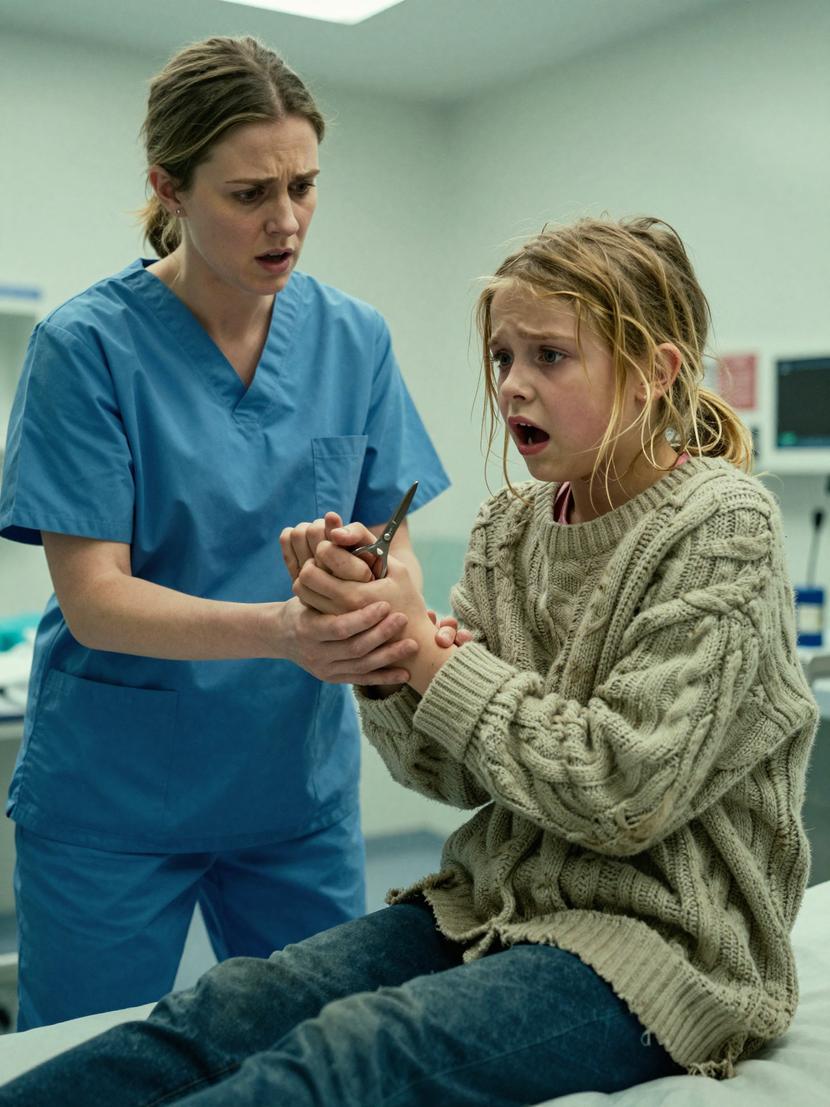
I reached for my sturdy trauma shears—specialized for quickly cutting through thick coats, seatbelts, leather.
‘Let’s get her undressed,’ I told my team.
Sliding the blade beneath the ruined collar near her collarbone, a sudden jolt froze me.
Her eyes flung wide open—not sluggish anymore, but wild, frantic, terror-stricken beyond anything I’d seen in a child.
Before I could move, her freezing little hands snapped up, gripping my wrist with astonishing strength.
‘No!’ she screamed, raw and desperate, her voice fracturing the sterile silence of the trauma bay. ‘Please! Don’t cut it!’
Dr. Turner, my resident, stepped forward, puzzled. ‘Sweetheart, we have to. The sweater’s soaking us, the cold’s killing her, and I need to see where she’s bleeding.’
‘No!’ she shrieked again, thrashing violently, crossing her arms in a desperate shield over the bulky sweater.
‘Hold her shoulders gently,’ I ordered, trying to soothe both her and myself. Her heart monitor was screaming—every second of resistance was a second bleeding out somewhere inside.
‘Honey,’ I whispered, lowering myself closer. ‘I’m so sorry, but if we don’t take this off, you could die. I need you to trust me.’
I aimed the shears at the hem to cut upward—but then she broke down, sobbing, voice cracking with a terrifying plea.
‘Please, please,’ she begged, looking into my eyes with a raw fierceness that halted me cold. ‘If you cut it, he’ll die. I promised Mommy I’d keep him safe.’
A deep silence fell. The chaotic hum of the trauma bay seemed to fade until the only sound was the rapid beeping of her heart and the icy wind outside.
‘If you cut it, he’ll die.’
Her words echoed in my mind, striking deeper than any wound I’d ever encountered.
I peered down at the oversized wool, stretched oddly across her chest—too bulky for just her.
Dropping the scissors with a clang, I hushed my team. Slowly, I raised my hands in surrender.
‘Okay,’ I said softly, voice trembling. ‘I won’t cut it. But you have to let me see what’s inside.’
Tears streamed down her bruised, dirty cheeks as she hesitated.
Then, trembling, she peeled the thick wool aside.
My breath hitched. My knees wobbled.
Nestled close against her bare, freezing skin was a tiny miracle.
A newborn’s fragile face, curled tightly in a desperate ball—wrapped by the tattered sweater that must have belonged to their father.
The baby’s lips were a chilling dusky blue; his chest rose and fell in shallow, desperate gasps. Hypothermic, yes—but alive.
The trauma team around me froze, collective disbelief choking the room.
‘Oh my God,’ Dr. Turner whispered hoarsely, stepping back.
‘Don’t just stand there!’ I snapped, adrenaline surging. ‘Call the NICU! Page the neonatal team! We need them here now—severe pediatric hypothermia, infant, unknown age. Move, move!’
Movement stirred. Nurses sprinted to the phones.
I bent close to the girl, whose trembling blue eyes pleaded for solace.
‘I kept him warm,’ she managed through chattering teeth. ‘Mommy said… keep Noah warm.’
The tears I slammed away threatened to betray me. This seven-year-old had endured depths of sacrifice I’ll never forget.
Trapped in that mangled, frozen sedan on a merciless winter night, she’d stripped off her own coat, donned their father’s colossal sweater, and pressed her newborn brother to her bare chest.
Her tiny body had been his incubator—the fragile furnace that kept him alive.
‘You did perfectly,’ I choked out, voice tight but steady. ‘You’re a hero. But I need you to let me take him now so we can help him get warm. Can you do that?’
She studied me, then slowly released her desperate grip.
‘Okay,’ she whispered.
‘Turner, warm blankets—stat!’ I ordered.
Carefully, I slid my hands under Noah’s armpits and lifted him out. His skin was icy cold against my gloves.
An infant’s frailty wrapped in the warmth of a sister’s love.
As the trauma unit doors swung open, the NICU team flooded in with heated isolettes and advanced monitors. They took Noah swiftly, their gentle hands a balm for the fragile life they fought to save.
Turning back to Lily, I finally picked up the trauma shears. This time, she didn’t resist. I sliced down the battered sweater, peeling away the frozen wool from her pale, mottled skin.
A grim bruise stretched like a dark ribbon across her abdomen—the telltale seatbelt sign.
Underneath, her belly was rigid, a silent scream of internal bleeding.
‘Her vitals are crashing!’ Turner shouted. ‘Blood pressure’s plummeting; she’s slipping into shock!’
We had mere seconds. I screamed orders to start massive transfusion, intubate, drop chest tubes—every heartbeat a battle.
We bypassed the CT scanner—no time for pictures. Straight to Surgical Suite 3.
The race was on.
Inside the OR, the tide of blood threatened to drown us. The spleen was pulverized, the main artery torn wide open like a ruptured dam.
I felt for the thick pulsing vessel with trembling fingers, pinched it shut, then clamped it. Slowly, the flood slowed.
We packed her abdomen with gauze to buy precious moments, buying her life.
Five hours to save a seven-year-old who had given everything for her brother.
But as the shock settled, a cruel truth emerged—the battle was far from over.
Days later in the Pediatric ICU, Lily’s brain was fragile. She awoke terrified, thrashing and fighting the ventilator, haunted by the loss she feared.
She searched for Noah, for the warm weight she once held close.
I pulled out my phone, rushed a FaceTime call to Paula at the NICU. Noah’s peaceful, pink face appeared on screen.
Holding the screen before Lily, the terror melted, replaced by tearful relief.
‘He’s alive,’ I whispered. ‘You saved him.’
Slowly, Lily began to heal, whispering broken stories of the crash that stole her parents but not their newborn son.
‘Daddy hit the brakes hard,’ she recalled. ‘Mommy told me to keep Noah warm. That I was a big girl now.’
Her bravery rendered the trauma bay silent.
But the biggest fight remained—a second surgery revealed necrotic bowel from the blood loss, signaling the monstrous infection lurking inside.
During a terrifying code blue in the OR, we battled death hand-to-hand, resecting dead tissue while Dr. Turner pumped with desperate compressions.
With a thundering defibrillator shock, we wrestled life back to her fragile heart.
Three grueling hours later, Lily was closed and safe—though left hollowed by the fight.
The following week was a vigil.
Lily remained in a deep coma, while Noah thrived under NICU’s watchful eyes.
Every day, a photo of Noah brightened the sterile PICU room—a beacon of hope in the shadows.
At last, Lily awoke, her eyes weary but alive.
‘Did you keep him warm?’ she rasped.
I nodded, tears blurring my vision.
We reunited the siblings in a gentle moment that healed all wounds—she cradled Noah, warm and safe, sobbing soft, powerful sobs of relief.
Before they left for Briar County to live with their grandparents, I gave Lily a small, treasured square of dark red wool from their father’s ruined sweater.
‘Hold this,’ I told her. ‘When you feel cold or scared, remember the strongest, warmest heart I’ve ever known.’
She squeezed it tight and whispered thanks.
As she wheeled away toward a new life, I stood beside my team contemplating the darkest and brightest facets of humanity.
I’m Megan, trauma surgeon. I’ve seen horror beyond imagining. But I learned that coldest winter nights can burn with the fiercest flames of love, courage, and resilience—shining brightly through the darkest trauma, led by a brave seven-year-old girl in an oversized sweater.