
There’s a unique, haunting scent that clings to the air whenever a grave accident crashes through the doors of the trauma bay—a metallic tang of copper mingled with the sharp sting of antiseptic, the acrid burn of scorched rubber, and the chill of unforgiving winter air creeping inside.
For twelve relentless years, I’ve been an attending trauma surgeon at Summit Ridge Trauma Center here in Chicago. I’ve stared down the grotesque aftermath of mangled metal and shattered glass time and again. I thought I had built an impenetrable fortress around my heart, that I was immune to the horrors. That night proved me wrong.
It was a bone-chilling Tuesday in late January, the thermometer outside plunging to a merciless negative ten degrees. A sudden flash freeze transformed Route 47 into a slick, treacherous tomb. For over an hour, the emergency radio screamed, broadcasting chaos from the scene of a devastating twenty-five-car pile-up.
Suddenly, the double doors of the ambulance bay slammed open. A howl of icy wind cascaded behind the paramedics’ frantic shouts.
‘Response Unit One! Clear the way! We need a central line kit, now!’ one barked, shoving a stretcher with such force its wheels screeched against the linoleum.
Rushing to the stretcher’s head, I snapped on my gloves. Nurses and residents swarmed the bed like a hive of frantic bees.
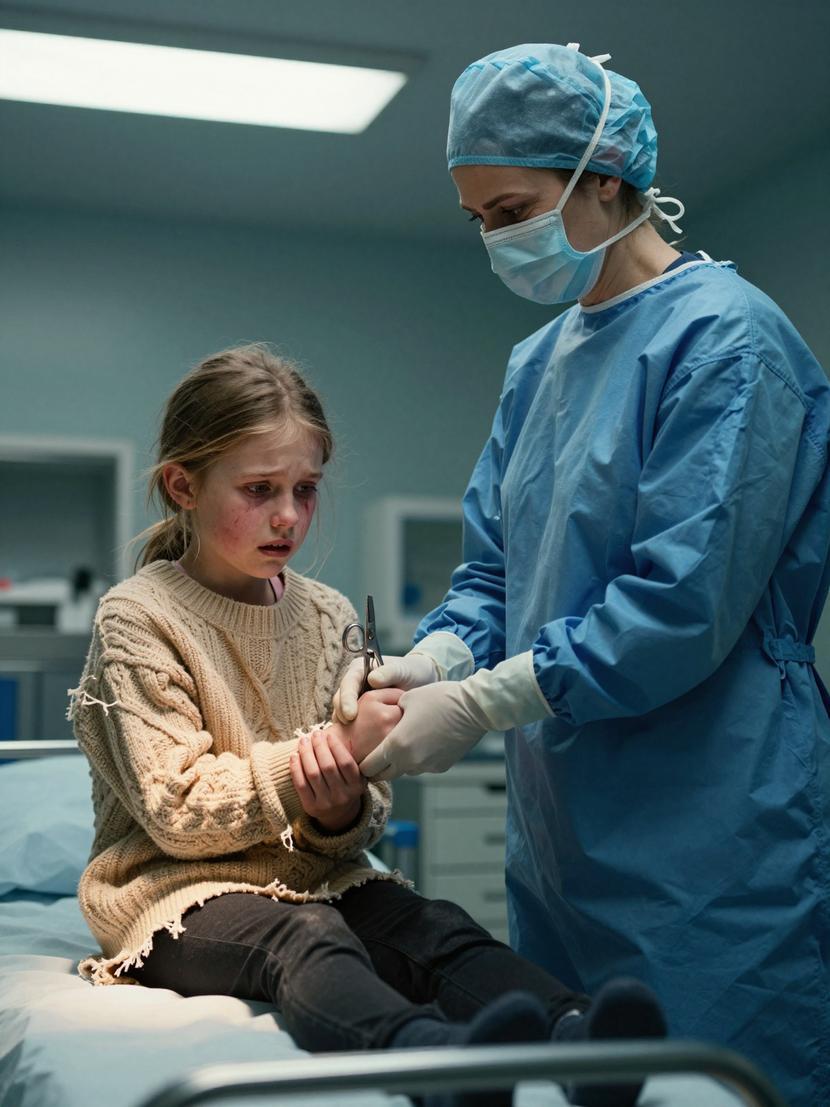
On that narrow mattress lay a fragile, small girl, no older than seven. Her blonde hair clung to a pale, translucent forehead, her skin nearly glowing under the cold white glare of the fluorescent lights.
But it was her clothing that seized my attention—a massive, oversized cable-knit sweater swallowing her frame whole. The wool, battered and torn, soaked with icy slush and littered with debris from the wrecked car, clung to her like a heavy shroud.
‘Talk to me,’ I urged gently, shining my penlight into her sluggish eyes.
She blinked faintly.
‘Female, about seven years old,’ the paramedic rattled off, breathless. ‘Pulled from the backseat of a sedan crushed between two semis. Parents in the front—didn’t survive. She was trapped nearly forty minutes in freezing cold. Blood pressure dropping fast. Heart rate dangerously elevated. Suspected severe internal bleeding and hypothermia.’
My heart sank, but trauma taught me to steady my soul and focus. The golden hour in trauma care—sixty minutes that mean the difference between life and death. Step one: expose the wounds. One cannot mend what remains hidden.
‘On three, team—transfer,’ I commanded.
One, two, three.
We lifted the girl onto the trauma table. Her breath was a fragile whisper, a soft, shaky whimper escaping her lips.
‘I’m Doctor Megan,’ I said firmly, trying to pierce her fog of shock. ‘We’re here to help. Hold still, please.’
Reaching to my side, I gripped the heavy trauma shears—designed to slice through thick coats and tangled seatbelts with ruthless efficiency. There was no time for gentleness.
‘Expose,’ I ordered.
Leaning over her, I slid the bottom blade under the torn collar of the sweater near her collarbone.
Suddenly, her eyes snapped wide open—desperation flaring within them like wildfire.
Before I could proceed, her tiny, icy fingers clamped fiercely around my wrist, strength far beyond her size.
‘No!’ she screamed—a raw, piercing plea that stilled the room. ‘No! Don’t cut it!’
Dr. Turner stepped closer, puzzled. ‘Sweetheart, we have to. It’s soaked and cold. We need to see your belly to make sure you’re not hurt worse.’
‘No!’ she yelled again, writhing against the restraint, kicking violently. She crossed her arms tightly over the sweater’s bulk, clutching the ruined wool to her chest. ‘You can’t take it! You can’t!’
‘Hold her gently,’ I instructed the nurses, voice calm but adrenaline spiking. Every second of delay chipped away at her fragile life.
‘Honey,’ I leaned closer, voice soft but urgent, ‘I’m so sorry, but I have to cut this sweater off. You’re badly hurt. If I don’t, you could die. Do you understand?’
As I prepared to cut from the bottom up, her sobs erupted—a heart-wrenching, body-shaking outpour.
‘Please, please,’ she begged, tear tracks carving paths through grime and bruises. ‘If you cut it, he’ll die. Please don’t kill him. I promised Mommy I’d keep him safe.’
Time froze.
The shears hovered mid-air, the trauma team silent but for the frantic beeping of her monitor and the howl of the winter storm outside.
‘If you cut it, he’ll die.’
I looked deep into her eyes—it wasn’t mere fear. It was fierce, protectiveness, the raw will of a guardian.
My gaze dropped to the oversized sweater she gripped, unnatural bulges beneath the wool pulling my curiosity.
I set the shears down with a clatter.
‘No one move,’ I whispered.
I raised my hands slowly, showing empty palms. ‘Okay,’ I said, voice trembling yet steady. ‘I won’t cut it. But you have to let me see what’s inside.’
Tears streaked from her bruised cheeks, her body trembling uncontrollably from the cold.
She hesitated—then, tentatively, pulled the thick wool aside.
I leaned in, peering into the dark cavern beneath the ruined garment.
My breath caught.
There, nestled against her bare chest, was an impossibility.
A tiny, fragile infant face—Jonah’s—no more than weeks old, curled tight within the warmth of his sister’s body and the oversized cable-knit, seemingly their father’s sweater.
He didn’t cry.
His lips were an alarming dusky blue, his chest rising and falling in shallow, rapid gasps.
Severely hypothermic, yet alive.
The trauma bay held its breath.
‘Oh my god,’ Dr. Turner whispered, stepping back, voice broken.
‘Don’t just stand there!’ I snapped, adrenaline surging anew. ‘Page the Newborn Critical Care Unit! Neonatal team, stat! Pediatric severe hypothermia! Infant, unknown age! Move!’
Nurses rushed, phones clattered.
I glanced back to Abigail, exhaustion and pleading etched in her eyes, teeth chattering as she trembled.
‘I kept him warm,’ she stammered, voice feeble. ‘Mommy said… keep Jonah warm.’
Tears blurred my vision. Twelve years as a trauma surgeon had never prepared me for this kind of sacrifice.
Trapped in that crushed sedan, frozen and alone, Abigail had stripped her own coat, wrapped herself in her father’s massive sweater, and held Jonah close to her bare skin—body heat her only shield.
She had given everything she had to save him.
‘You did beautifully,’ I whispered, voice thick. ‘You’re a hero. But now, I need you to trust me and let me help him get warm. Can you do that?’
She searched me slowly, then released her grip.
‘Okay,’ she breathed.
‘Turner, warm blankets now!’ I ordered, reaching beneath the sweater.
The infant’s icy skin shocked my gloves. Gently, I cradled him out of the woolen cocoon. He was feather-light.
The cold air hit him, and his first weak, rasping cry sliced through the room—the sweetest sound I’d ever heard.
The lead pediatric nurse met me, blankets steaming in her arms.
Jonah was swaddled tightly and rushed into the glowing incubator as the neonatal team poured in, their magical hands assessing and stabilizing.
Back to Abigail.
She did not resist this time as I took up the shears, slicing down the soaked wool sweater.
Her skin was mottled, shockingly pale, cold to the touch.
Then my heart clenched again.
Across her small belly, a vast, dark bruise shaped exactly like a seatbelt spanned from hip to hip.
We call it the seatbelt sign, a silent, brutal warning that the violent force had sliced into her abdomen.
Her belly was rigid, muscle taut—the body’s desperate defense against horrific internal bleeding.
‘Pressure dropping!’ Dr. Turner shouted. ‘Sixty over forty. Heart rate soaring—she’s spiraling into hypovolemic shock!’
She was bleeding to death from within.
Her eyes rolled back.
‘Unresponsive,’ a nurse declared.
‘Massive transfusion protocol, now! Two units O-negative, rapid infusion! Pediatrics intubation kit—STAT!’
Controlled chaos descended as Dr. Turner swiftly intubated, the respiratory therapist bagging aggressively.
‘Pressure’s tanking further,’ cried a nurse, panic sharp in her voice.
No minutes left. Seconds.
‘Bypass CT scan,’ I commanded. ‘Direct to Surgery Bay 4. Bleed source control—immediate.’
‘Surgery Bay 4 is prepped,’ the charge nurse confirmed.
We raced down the corridor, wheels clattering, staff pushing bags of blood into her veins with grim urgency.
‘Hold on, Abigail,’ I whispered, eyes locked on her pale face.
Crashing through the operating doors, the surgical team awaited, cold steel gleaming.
She was transferred swiftly, blue sterile drapes cloaking her battered form.
‘Betadine splash,’ I ordered. Hands scrubbing fiercely, heart pounding as the biological dance of survival began.
The anesthesiologist’s grim warning barely registered. ‘She’s barely holding on. Fast is the key.’
I gripped the scalpel, breath steadying, slicing deep into her abdomen.
Blood erupted—not trickling, but roaring—filling the field, cold and thick.
‘Suction max!’ I barked, drowning the crimson flood as the scrub nurse responded.
Operating blindly in this drowning flood, I plunged inside, feeling for the torn artery.
‘Clamp!’ I cried, fingers finding the slippery splenic artery torn wide open.
Pinching it shut bought a fragile pause.
Metal clamp followed, locking the flow, and slowly, monitors began to stabilize.
‘Pressure rising—holding at seventy over fifty.’
But Abigail’s body was battered—hours of trauma, blood loss, and cold had taken their toll.
We opted for damage control surgery—removing the shattered spleen, packing the abdomen with laparotomy pads, and leaving her belly open beneath a vacuum dressing to prevent lethal pressure buildup.
Ten torturous minutes later, the ruined organ lay in a basin. Her vitals wavered but endured.
‘To Children’s Critical Care Unit,’ I said, exhaustion tightening my limbs.
After shedding my bloody gown, I sought answers.
On the third floor, the Newborn Critical Care Unit was a sanctuary of warmth—soft light, delicate scent of lotion and sterilized milk.
Next to Isolette 4 stood a City Patrol Officer—mid-fifties, rain-soaked uniform, eyes weary yet alert.
Inside the incubator lay Jonah, peaceful, skin pink, resting under glowing warmth with steady breaths.
‘He’s a fighter,’ the officer murmured.
I stepped closer. ‘Because of Abigail.’
He nodded slowly, recounting the terrifying scene of the crash—the mashed blue sedan crushed between a jackknifed semi and barrier, the front seats wrecked, parents lost instantly.
He confessed confusion when first reaching the back seat—an empty car seat, unbuckled straps, his heart pounding at the thought the infant was lost.
Then he saw Abigail, wedged low, wrapped in that oversized sweater, silence in her terror-filled gaze.
‘She didn’t cry,’ he whispered. ‘When I reached her after forty minutes and pried the door open, she growled like a wounded animal.’
Tears brimmed.
‘I carried her to the ambulance, thinking she held a stuffed animal. I had no idea her brother was tucked inside.’
I pieced it together—the bravery of a seven-year-old unbuckling an infant, stripping off her own coat, wrapping Jonah in their father’s sweater, holding him close like a lifeline.
‘Her name,’ the officer continued, ‘is Abigail. Baby’s name is Jonah. They’d been visiting family in Wisconsin.’
‘Is she going to make it?’ he asked, eyes desperate.
‘She lost nearly half her blood,’ I replied honestly, ‘touched by trauma and in a medically induced coma.’
I moved to the Children’s Critical Care Unit. In room 312, Abigail lay plugged into machines, the ventilator’s hiss the soundtrack of her fragile fight.
Tubes and wires mapped her tiny body, the vacuum dressing pulsing over her open abdomen as monitors told a dire tale.
I sat beside her, unmoving through dark hours filled with snow and storm outside.
The golden twenty-four hours after massive hemorrhage—a game of waiting and hoping.
At dawn, Dr. Turner arrived.
‘Go home, Megan,’ he urged. ‘She’s stable for now.’
Four hours later, the phone shattered silence.
‘Dr. Megan,’ the charge nurse whispered urgently. ‘Her brain pressure is spiking, heart rate soaring. She’s agitated—fighting the ventilator. I think she’s waking. Terrified.’
I raced back, bursting into the chaos of her thrashing form.
Held down by nurses, bound by restraints to keep life support intact, Abigail’s wide blue eyes screamed panic behind the breathing tube.
‘Sedate!’ the charge nurse pleaded, but I stopped her, desperate to witness the fragile flickers of her mind.
‘Emily, look at me,’ I called, voice cutting through alarms.
For a moment, her gaze locked to mine.
Through silent screams she clawed at her chest, trembling, searching for the heavy warmth that was gone.
My heart shattered.
‘She’s looking for Jonah,’ I realized aloud.
I called Patricia in the Newborn Critical Care Unit, bypassing hospital systems in haste.
‘Patricia, FaceTime now! Show Jonah. Please.’
Moments later, the glowing incubator and Jonah’s peaceful face filled the screen.
Holding the phone to Abigail’s eyes, the chaos in her faded.
Her body slackened, heart monitor tones softened.
A fragile smile broke through the tears.
‘He’s okay,’ I whispered, brushing her damp hair back. ‘You saved him.’
Her tiny nod said everything.
For days, I lived in that room—balancing fluids, antibiotics, watching a tenuous dance of survival.
Her brain was intact, her spirit fighting.
Each awakening, I showed her a new photo of Jonah—a tether to hope.
On day three, breathing strong enough, I removed the tube.
‘How do you feel?’
‘Is Jonah really warm?’ her voice cracked.
‘He’s warm,’ I smiled through tears. ‘Doing wonderfully.’
She finally spoke of that night—broken, chilling memories of speeding, crashing, shattered glass, the ache in her belly as they slammed to a halt.
Her mother’s final words, ‘Take care of Jonah. Keep him warm,’ etched forever in her heart.
Her sacrifice was unfathomable.
Yet the battle wasn’t over.
Her abdominal wound, open and vulnerable, invited deadly infection.
The ‘second look’ surgery loomed—a dangerous attempt to close, clean, and heal.
As we wheeled her down, she gripped my coat.
‘Promise me,’ she whispered, eyes fierce. ‘If I don’t wake, promise me you’ll keep Jonah warm.’
‘I promise,’ I vowed, voice thick.
Surgery revealed worse than feared—black, necrotic bowel drowning us in septic shock.
Code Blue screamed as her heart flatlined.
Relentless CPR, desperate drug pushes, frantic cleansing—our fight for her life surged.
A defibrillator shock brought a fragile rhythm back—hope clung like a thread.
Hours later, stitches sealed the wounds, the infection source removed.
Yet the next week was a crucible of prayer and perseverance.
Abigail lay comatose, sepsis crushed by antibiotics.
Jonah thrived, his photos tethered to her bedside like lifelines.
On day eight, sedatives relaxed, fingers twitched, and eyes fluttered open.
I removed the breathing tube as tears blurred my vision.
She looked at me, whispered, ‘Did you keep him warm?’
Words failed. I nodded.
The NICU head nurse entered with Jonah, warm, peaceful wrapped in blue.
Abigail reached, cradled him close, sobbing a river of relief.
‘I got you, Jonah,’ she breathed.
In that room, surrounded by hardened hands and healing hearts, we remembered why we endure—the fierce, unyielding power of love.
A month later, Abigail and Jonah left for their grandparents in Wisconsin.
Before goodbye, I knelt, placing a small, clean square of their father’s wool into her hands.
‘Hold this,’ I said softly, ‘to remind you of your warmth—and strength.’
She clasped it tight, embracing me.
‘Thank you, Dr. Megan.’
I watched her roll down the hall, stepping into a future she fought so fiercely to reach.
I’m a trauma surgeon. I’ve seen darkness unimaginable. But from a seven-year-old in an oversized sweater, I learned that even in the coldest blackest night, the human spirit burns bright enough to save us all.