
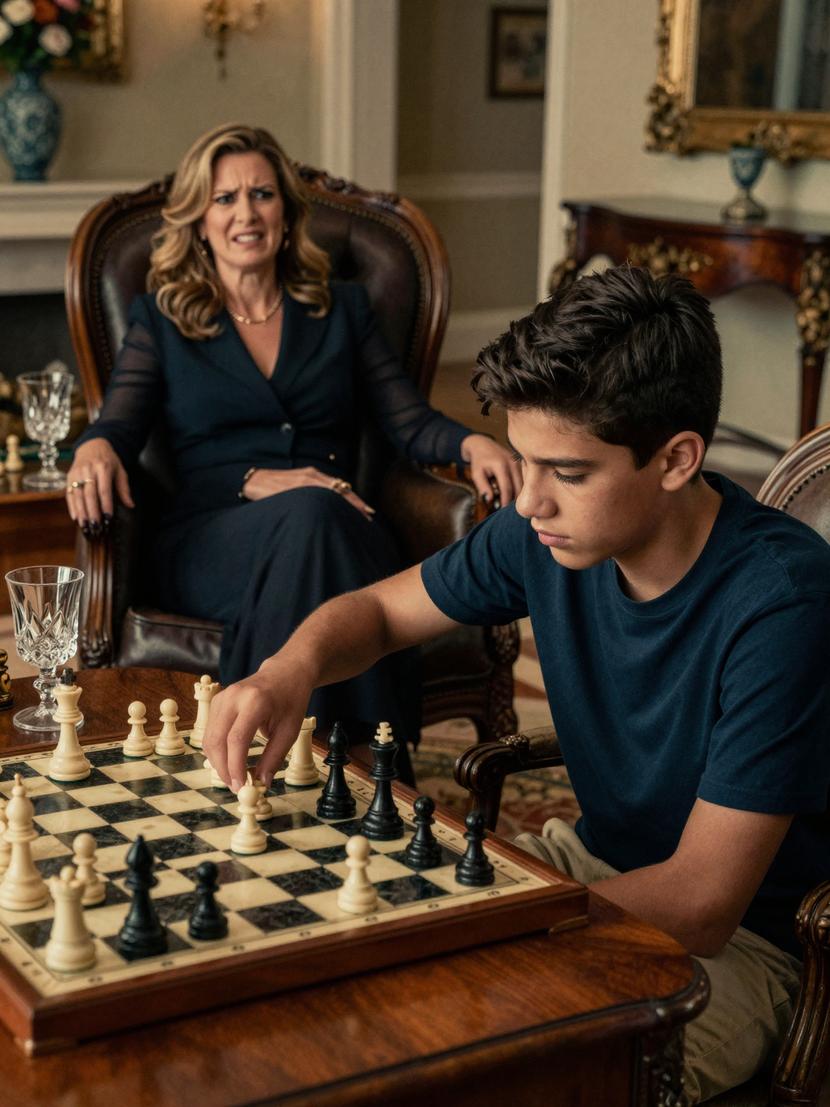
Cecilia Hartman’s laughter rippled through the opulent halls of Crescent Oaks manor, her voice sharp and mocking. ‘Come here, boy. Why don’t you entertain us—show me how chess is played in the slums?’ she sneered, eyes glittering with cruel amusement. Her guests, a crowd of polished businessmen, influential politicians, and elegant boardwives, exchanged secret smirks behind their crystal flutes brimming with champagne.
Mateo Salazar, a quiet and composed 17-year-old, stood at the side, helping his mother, Elena, serve hors d’oeuvres during this lavish charity gala. The irony wasn’t lost on Cecilia—an event meant to uplift underprivileged youth, yet here was one of them, relegated to menial tasks in her sprawling home.
‘I doubt this boy even knows how the pieces move,’ Cecilia taunted, gesturing dismissively toward the Tuscan ivory board resting elegantly on the coffee table. ‘Let’s see if he can manage more than just moving the pawns.’
Mr. Langford, a titan of the hotel industry, whispered to his wife, “I bet he doesn’t even know the knight jumps in an L-shape.”
The room rippled with condescending laughter. Elena’s eyes fell to the silver serving tray, fingers trembling under its weight. Two decades she had toiled in this house, nurturing her son on a maid’s modest salary—and now, the woman she had known since childhood had turned Mateo into a spectacle for her genteel acquaintances. What once was a spoiled girl had grown into a merciless socialite.
‘Elena,’ Cecilia ordered sweetly but coldly, ‘you can pause serving. Watch your son play; it’ll be quite the lesson for both of you.’
Mateo’s dark eyes scanned not just the board but every face in that room filled with privilege and ignorance. At 17, he had learned to listen in silence, letting action speak louder than words. There was a stillness about him—an electric calm like the quiet before a storm—that caused some guests to hesitate. His fingers twitched ever so slightly, as if moving pieces unseen, plotting a game far beyond what any had imagined.
‘Of course, Mrs. Hartman,’ Mateo responded, voice steady and respectful, drawing curious glances. ‘It would be my honor.’
Cecilia sank into her leather armchair with a smirk, playing the queen awaiting her unsuspecting gladiator. ‘Have you ever played on a board like this?’ she mocked, her hand sweeping over the smooth, expensive Tuscan ivory board.
‘Real Italian marble,’ Andrea Collins, seated by the window with a critical gaze, whispered. ‘Each piece likely worth more than—well, you know.’
‘Cecilia, are you certain this isn’t a form of cruelty? Poor boy will be humiliated,’ Andrea’s concern cut through the aristocratic chatter.
‘Nonsense,’ Cecilia dismissed, touching her diamond earrings thoughtfully. ‘It’s an education. He’ll remember the day he played chess in a mansion like this.’
What Cecilia Hartman didn’t realize, and was soon to discover in the most humiliating fashion, was that this “boy from the slums” had spent eight relentless years mastering chess’s artistry. While his peers lost themselves in games and distractions, Mateo devoured dusty tomes from the Northside reading hall and meticulously studied legendary matches on a broken computer he’d painstakingly repaired himself.
During the long, silent nights when Elena juggled double shifts, Mateo memorized over 200 openings and could recite the 50 most formidable defenses without hesitation. Far from a mere player, he was a prodigy, a quietly burning storm ready to rewrite every assumption this crowd cherished about class and talent.
As Cecilia theatrically arranged her pieces, Mateo’s gaze swept the room once more—not preparing merely to play, but to challenge the very foundations of their entitlement.
The air thickened with anticipation. Cecilia took the white pieces with the assured dominance of one unused to defeat. ‘I always play white—it’s tradition,’ she declared, unbothered by the fact that serious matches assign colors by lot.
Mateo arranged the black pieces with reverent precision, each standing proudly in the center of its square. Mr. Langford’s brow furrowed—the finesse was unmistakable, a mark of countless battles fought and won mentally.
‘Let’s raise the stakes,’ Cecilia grinned venomously. “If he manages to startle me even once, I’ll donate a thousand dollars to some public school.” Snickers bubbled through the audience, but Mateo’s smile held secrets far beyond their understanding. Elena caught the familiar, subtle curve—a sign she knew well; the defiant smile he wore when underestimated, the quiet promise to herself and the world alike.
Cecilia’s first move was a cautious pawn to E4. ‘Indian King opening. Something we learned at Harvard,’ she explained, almost patronizingly, as if teaching a child to tie shoelaces.
Mateo answered crisply with C5—the Sicilian Defense. The room’s confidence faltered, replaced with a hushed curiosity. That was no novice’s move; it was the reply of someone who hadn’t just learned moves, but mastered their meaning.
‘Fascinating,’ Andrea murmured, leaning forward with a glint of genuine interest. Cecilia hesitated—a crack in her facade. Mateo saw it. She knew a few openings, yes, but the deep ethos of the game eluded her.
She followed with NF3—safe, textbook, the kind of move one learns at social chess clubs, not battle tested on serious boards. Mateo’s mind drifted briefly—back to the torn chess book he’d rescued from trash at the Northside reading hall when he was just nine, the first spark of a fire that refused to be snuffed out.
‘Mom, why chess?’ he had asked the weary Elena back then.
‘Why not?’ she had replied, exhausted but hopeful. ‘The rich kids think they’re better than us—maybe it’s time you prove otherwise.’
With no lessons, no internet, no fancy tutors, only books and relentless determination shaped Mateo’s path.
Back at Crescent Oaks, Cecilia’s timid D3 move betrayed her cautious nature, safe and controlling—like her social life. Mateo responded confidently with NC6, developing his defense fluidly. Each move quick, deliberate—as if following a secret script known by heart.
‘He’s moving too fast!’ Cecilia whispered, eyes darting nervously. ‘In real chess, you take your time to think.’
Mateo then staged his first psychological gambit—pausing for a full fifteen seconds as if wrestling with the complexities, before softly moving G6 to fianchetto his bishop. To the untrained it might seem impulsive, but it was the trigger for a deeply layered strategy unfolding step by step.
‘See? No patience,’ Cecilia gleefully proclaimed to her crowd.
Yet Mr. Langford caught the design immediately. ‘Cecilia, that’s the start of the Dragon variation.’
‘A… what?’ Cecilia snapped, irritated at being challenged.
‘A Sicilian variation,’ Langford explained calmly, ‘quite advanced.’
Cecilia’s shoulders tightened, the game slipping from her control.
Mateo was no mere responder; he was dictating tempo, orchestrating the board’s harmony with every calculated piece placement. Elena watched from the corner, breath caught in hope and anxiety. For the first time in twenty years, she caught a flicker of something unfamiliar in Cecilia Hartman’s eyes—fear, and perhaps the dawning realization that no amount of wealth insulated her from being wrong.
Each attempt by Cecilia to belittle only sharpened Mateo’s resolve, fueling his silent vow to overwrite the injustice imposed by birth and circumstance.
Unseen by most, every smirk, every snide comment was inscribing Cecilia’s own downfall onto this polished 64-square arena—the stage for one of Crescent Oaks’ most stunning reversals.
Mateo’s tenth move—a seemingly innocuous pawn sacrifice—sent a shockwave through the room. Mr. Langford coughed sharply on his whiskey, eyes wide.
‘Cecilia,’ he hissed under his breath, ‘this boy isn’t an amateur.’
But Cecilia, blinded by arrogance, waved the warning off. ‘Relax. He must have copied some moves from the internet. I’ll wrap this up in minutes.’
Then, breaking the heavy silence, Mateo quietly approached Elena—the worn yet regal figure observing from the shadows. ‘Mama,’ he whispered, voice steady and resolved, ‘remember when you said I would show them who we really are?’
Elena’s eyes glistened, heart swelling with pride and vindication. She recalled vividly the day Mateo turned fifteen—no party, no cake—only raw promise and quiet dreams.
Andrea Collins leaned in, awestruck. ‘That boy has more class than all of us combined.’
Impatient, Cecilia tapped her fingers nervously. ‘Shall we continue? I have other engagements,’ she insisted, desperate to reclaim control.
Mateo returned to the board, no longer a spectacle, but a young man armored in sweat, sacrifice, and unyielding purpose.
His eleventh move was a masterstroke of precision—delicate yet devastating—forcing Cecilia into a corner. A double-threat emerged so intricate that, if she saved her king, her queen would fall; if she protected her queen, mate would come within three moves.
“This… this can’t be,” Cecilia stammered, eyes swimming as realization dawned.
Langford shook his head in disbelief. ‘You’re being outplayed by a boy who’s probably never set foot in a formal chess club.’
As Cecilia flailed for escape, the room’s attention sharpened; Andrea paused mid-sip, Langford set aside his phone, and even Cecilia’s wife abandoned her magazine with wary fascination.
Elena saw that familiar steely gaze—one Mateo had worn in countless Northside reading hall hours and dawn revelations solving puzzles by candlelight when their electricity failed.
In a desperate, final bid, Cecilia moved her piece—but the moment had passed. ‘Check,’ Mateo announced, gently placing his queen, unveiling a triple threat no one anticipated.
A charged silence enveloped the room. Cecilia stared, trembling—not with fear, but rage and disbelief at being so utterly outmatched by the boy she mocked.
“You must have seen that sequence before,” she accused, voice rising. “Nobody can master that alone.”
Mateo’s first true smile bloomed—a quiet, proud curve. ‘You’re right. Garry Kasparov taught me.’
‘Kasparov taught you?’ Langford’s voice cracked with incredulity.
‘Not in person,’ Mateo clarified, moving a piece to the final checkmate position. ‘But I have studied all his recorded games—1,183 in total.’ The famous sequence he executed was lifted straight from Kasparov’s 1984 World Championship match against Karpov.
Cecilia glanced around, seeking allies, but met only judgmental silence. For the first time, the room’s privileged façade shattered into quiet shame.
Elena stepped forward, voice steady and resounding. ‘My son woke at dawn every day to study. He walked six miles to the Northside reading hall because we had no internet. When I worked double shifts, he stayed up all night solving puzzles by candlelight during blackouts.’
The room was utterly still. Mateo’s gaze returned to his mother—filled with love and unwavering determination, compelling even the proudest to avert their eyes.
‘Checkmate,’ Mateo declared softly, the queen’s position sealing Cecilia’s defeat.
Cecilia sat frozen, eyes locked on the board as if expecting the pieces to stir themselves back to her favor. When she finally lifted her gaze to Mateo, their eyes met—his calm, resolute; hers burning with frustration and disbelief.
But the atmosphere had shifted irrevocably. No longer was Mateo mere entertainment. He was a force of nature, a living refutation of every prejudice in that room—from talent to class to worthiness. The guests now looked at Cecilia with a mix of embarrassment and silent condemnation unlike anything she had ever known.
What Cecilia Hartman didn’t yet understand was that this checkmate was simply the first move in a grander game—one destined to challenge every social convention she had taken for granted. And Mateo, the boy she had dismissed so lightly, would emerge not only victorious but as the embodiment of true nobility—one measured not by wealth or name, but by heart, grit, and brilliance.