
Imagine stepping out of a high-stakes meeting worth millions, the sun blazing down on Porto Serena’s bustling streets, when a small, desperate voice shatters your world. This isn’t a scene from a film—it was the moment that forever split Rafael’s life into before and after.
Rafael was a man who always wore control like armor. As president of a leading tech company in Porto Serena, he manipulated fortunes with a mere signature, owned a sleek penthouse gazing over the restless ocean, and kept a calendar where even a breath felt extravagant.
To the outside world, he was the embodiment of success. Yet inside, since the death of his wife Elena three years ago, he’d felt like nothing more than a machine forced to keep going.
Each day began at five a.m., papers skimmed before a sip of coffee, then a ruthless dive into work—a desperate plummet into a void where memories of Elena might drown. The more he worked, the more he tried to erase the hollow spot her absence carved.
That December morning grew heavy with heat, Porto Serena suffocating beneath a lazy humidity. Rafael walked down Rua das Mangueiras after a meeting with foreign investors—a triumph for anyone but him. Numbers couldn’t fill the silence of his vast, empty home, nor drown the lonely echo of a vacant bed.
The city roared around him: vendors hawking their goods, tourists snapping photos, workers darting by clutching food. The world buzzed in vivid color, yet Rafael felt like a ghost, trapped in another’s story.
Then, from a dark alleyway, a faint sound caught him—a crying unlike any other. No shouting, no clamoring—just a low, shattered sob burdened by a grief so ancient it seemed woven into the fabric of the morning itself.
He could have walked on. After all, countless suffering went unseen. But something—perhaps a whisper of Elena’s voice buried deep inside—forced him to pause.
In the narrow passage between old, crumbling bricks, where light barely touched the ground and dampness clung to the air, Rafael saw her.
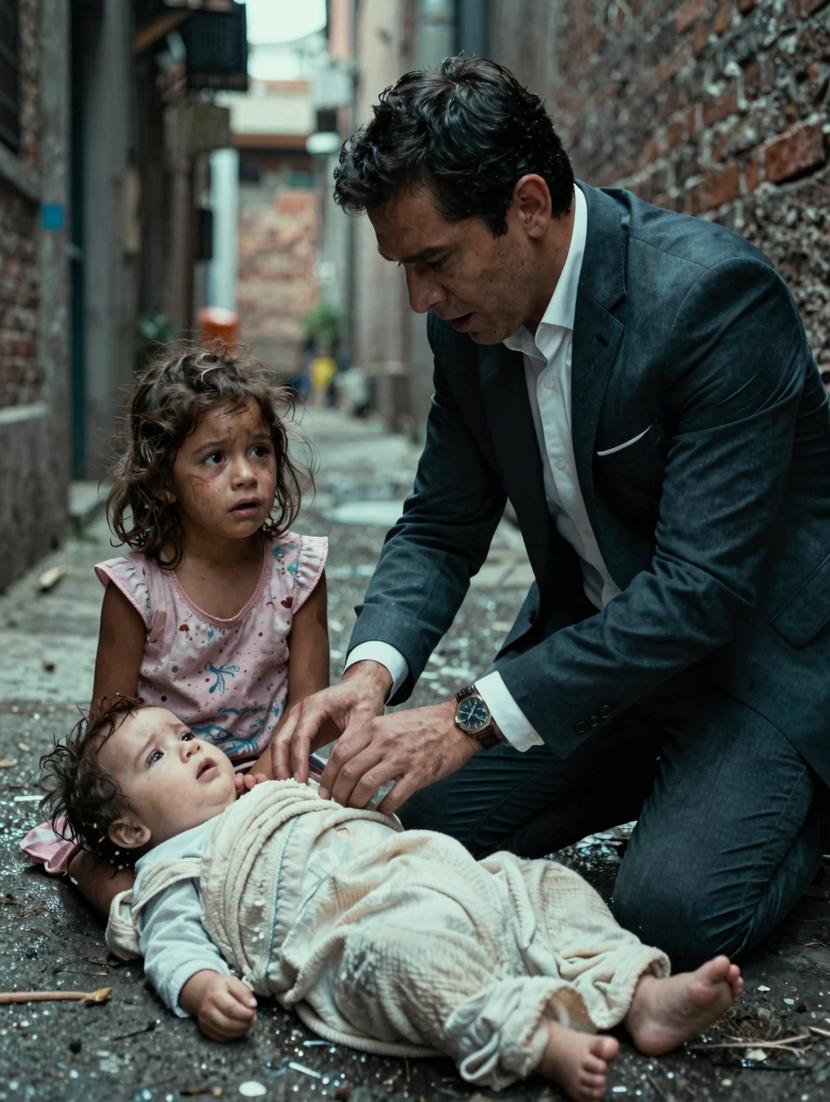
A little girl, no older than eight, curled against the grime of the alley floor. Her tangled brown hair plastered to a tear-streaked face, her clothes nothing but tattered patches, her bare feet rough and worn.
In her arms lay a limp toddler, lifeless as a forgotten doll.
Pale skin, cracked lips, a fragile body cold as death—so unlike the sweltering heat surrounding them that it sent a chill piercing through Rafael’s chest.
The girl raised her head, eyes wide and shimmering with fear, exhaustion, and a haunting pride.
‘Sir,’ she whispered, voice trembling like fragile glass, ‘can you please bury my little sister? She didn’t wake up today. She’s so cold. I don’t have money for a proper burial, but I promise I’ll work and pay you back when I grow up.’
The city’s noise vanished—no honking horns, no murmurs, no heat—only the fierce weight of her words.
Rafael’s heart clenched, unearthing memories from deep within: Elena in a hospital bed, the relentless beep of machines, helpless doctors, and cruel finality that no medicine could touch. He scanned for an adult nearby—none. Only the girl’s broken sobs filled the quiet.
Fighting back the instinct to flee, he dropped to his knees on the filthy ground, suit forgotten.
The girl hesitated, gently touching the baby’s neck, unwilling to meet the truth. The skin was icy, breath absent.
‘No,’ he thought, eyes squeezed tight. Then, trembling, he pressed for a pulse.
One faint beat.
Another.
Barely there, but unmistakably alive.
‘She’s not dead,’ Rafael breathed, relief flooding back. ‘Your sister is still alive.’
Her eyes sparkled with stunned hope.
‘Really?’ she asked, voice cracking. ‘I thought she went to heaven with Grandma…’
Rafael scrambled for his phone and called the hospital urgently.
“This is Rafael Acevedo. We have a pediatric emergency—baby in critical condition. Please prepare, we’re on our way.”
He opened his arms. ‘Give me your sister. We have to move quickly.’
The girl hesitated, assessing the suited man—a stranger in her world—but vulnerability drew her to trust.
Carefully, she handed over the fragile bundle, clutching a crumpled plastic bag full of her precious few possessions, and followed him out.
City life surged on obliviously, but for Rafael, reality had tilted irrevocably.
Traffic crawled to the hospital—blaring horns, weaving motorcycles, endless red lights. Every stopped moment a fresh torment.
The baby’s breath was faint in his arms. Mara, the older sister, clung to her bag of “important things.”
‘I always gave her my food first,’ she whispered. ‘But she grew so quiet… and today, she didn’t wake up. I thought she was gone…’
Rafael’s jaw tightened. This wasn’t mere hunger—it was a cruel failure of the world, the system, and himself.
At the hospital, a team awaited. Swift hands moved the baby onto a stretcher amidst brisk commands.
‘Severe pneumonia, dehydration, low weight,’ the doctor explained. ‘ICU, immediately.’
Rafael hesitated, unwilling to release the frail child, as if letting go would mean losing her.
‘We’ll do everything we can,’ the doctor promised.
For a heartbeat, Elena’s memory flashed sharply—her face, her fight.
At last, something might be saved.
A small hand tugged him, and he looked down to see Mara’s shaky gaze.
‘Please don’t leave,’ she begged. ‘If you go, we’ll be alone again.’
An invisible chain bound him to these two fragile souls.
The hours melted into stark hospital corridors, white machines, and bitter coffee.
Mara never left his side, trailing him like a shadow. She wouldn’t eat unless he was near, seeking safety in his presence. Observant nurses noticed.
So did Patrícia Mendes, the social worker, clipboard in hand, with professional empathy.
‘Are you related to these girls?’ she asked.
‘No,’ Rafael replied, voice steady but soft. ‘I found them on the street. I brought the baby here—if I hadn’t stopped, she wouldn’t have made it.’
Patrícia jotted notes.
‘Still,’ she said carefully, ‘the Guardianship Council must intervene. Two minors cannot be left in the care of a stranger, regardless of good intentions or resources.’
Her words hung heavy, tinged with reproach.
For the first time in years, fury sparked within Rafael.
He wanted to argue that love and responsibility outweighed bureaucracy, that abandonment was unthinkable. But Mara watched, fragile and hopeful.
This was not a fight he could win with words.
Morning brought news from ICU.
‘The baby is very ill,’ the doctor reported. ‘Malnutrition and pneumonia are severe. Yet, she’s responding to treatment. If the next 48 hours pass, chances improve.’
Mara sobbed in relief, clinging to Rafael as warmth thawed a frozen part of his heart.
Days blurred—medical updates, social worker visits, and the slow unfolding of a case file. Searches for relatives, adoption considerations.
One truth shone ever clearer: Mara found peace only when Rafael was close. She ate when he was near; her restless sleep calmed with him beside her.
Patrícia pressed,
‘I know you share a bond, Mr. Acevedo, but families wait years to adopt. We cannot bypass procedure because of your status.’
Rafael inhaled deeply.
‘I seek no special favors,’ he said quietly. ‘Just look beyond paperwork. Ask Mara what she wants.’
Weeks later, in juvenile court, the air was thick with anticipation—stale from air conditioning and polished wood.
The judge browsed a thick file; the prosecutor prepared her notes. Mara stood beside Rafael—small and simple in dress, he in his crisp suit, yet with his heart laid bare.
‘Mr. Rafael Acevedo,’ the judge began, ‘we convene to decide the future of Mara and Sara. But first, I wish to hear from the child herself.’
All eyes turned to Mara.
Her hands trembled, but her voice was steady and courageous.
‘I want to stay with him.’
A murmur rippled through the room.
‘He didn’t leave me alone on the street,’ she declared. ‘He didn’t let my sister die. Everyone turned away. But he didn’t.’
The prosecutor rose.
‘Your Honor, an emotional plea from a traumatized child cannot be the sole basis for custody…’
Rafael’s voice broke as he spoke,
‘With due respect,’ he said, ‘this girl understands abandonment more than anyone here. She lost her grandmother, cared for a sick baby alone, and starved herself to feed her sister. She asks only not to be alone again.’
He paused, steadying himself.
‘I know loss intimately. I lost my wife and buried myself in work for three years. But finding Mara and Sara made me realize I could no longer run. I don’t ask for privilege—only the chance to be their family.’
Silence stretched.
The judge leaned back, steepling fingers.
‘Given the risks, absence of suitable relatives, medical facts, the bond formed, and the child’s wishes—we grant provisional custody to Mr. Rafael Acevedo.’
Mara clung to him, as if the world both shattered and rebuilt in that embrace. Rafael closed his eyes, a tear finally slipping after years of restraint.
The battle was far from over, but the path was clear.
His mansion had never seemed so vast until the day he stepped inside holding Mara’s hand and carrying Sara, now stable in his arms.
Everything was new to Mara—the blooming garden, gleaming walls, soft beds. And new to Rafael—the echoing laughter, scattered toys, drawings plastered on the fridge.
That night, Mara left a small piece of notebook paper on the table.
Three shaky figures drawn with a child’s hand: a tall man, a girl with braids, and a smiling baby.
Beneath them, one crooked word: family.
Rafael treasured it like the most valuable contract he’d ever signed, sliding it into a leather folder once reserved for business affairs.
Months that followed were imperfect—evaluations, social visits, fears waking in the night, fevers, nightmares of cold alleys.
But also first birthdays celebrated, first school days, Sara toddling through the garden, Mara grinning with toothpaste smeared cheek to cheek, Rafael learning to braid hair and read bedtime tales.
One evening, Mara peeked from her room clutching a blanket.
‘Can I ask something, Dad?’ she whispered shyly.
His heart stuttered.
‘Of course, daughter.’
‘Do you think… will I ever be too heavy for you to carry? So you won’t want me anymore?’
Kneeling, Rafael held her hands, gazing into her earnest eyes.
‘Listen carefully, Mara,’ he said. ‘You’re not a burden. Neither you nor Sara. You’re the light that makes this house shine again. I will never grow tired of you. Never.’
Her smile bloomed—finally free of fear. She wrapped him tight, and for a moment, Rafael felt as if he held Elena too.
Time moved in waves.
Temporary custody became adoption.
Signatures weren’t obligations but affirmations of a bond undeniable—a family made real.
His company thrived, but his heart found new focus: school plays, doctor visits, lakeside picnics.
The once silent mansion now resonated with joy, spilled juice, and an art gallery of childish masterpieces.
Rafael had rescued two girls from a forgotten alley, but in truth, they had saved him.
Because family isn’t defined by blood. It’s forged by compassion when the world turns away—and by choosing, bravely, not to look away.
Now, I ask you—what would you have done in Rafael’s place?