
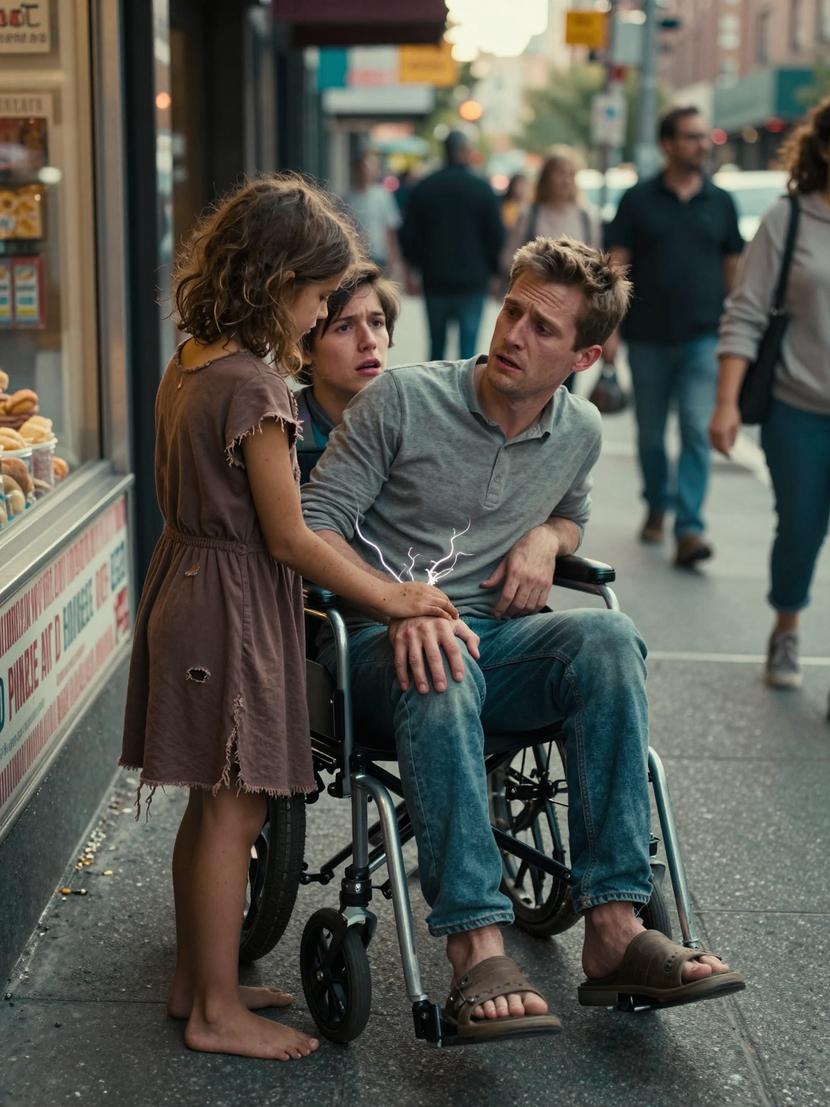
At first, no one seemed to see her.
She stood alone amid the ceaseless rush of Chicago’s teeming sidewalks, yet the bustling crowd parted around her like she was a mere shadow—there, but untouchable. Her brown dress hung worn and ripped, slipping off one slender shoulder. Her bare feet, darkened with grime and dust from the streets, barely made a sound as she stood still. Tangled hair fell over eyes far too clear and calm for a child who couldn’t have been older than thirteen.
Her gaze met the man in the wheelchair just ahead, halting abruptly in front of him.
He was twenty-nine, though years had etched deep lines into his face, making him seem far older. His name was Daniel Mercer. His wheelchair parked outside a shuttered deli on North Alder Street, a small cardboard sign propped against its wheel that read:
“Disabled. Anything helps.”
Daniel was accustomed to the world’s neglect, to being overlooked, talked down to, or pitied silently. Coins sometimes clinked into his cup; food was rarer. Words, almost never.
But then, the girl’s voice broke through the noise of the city.
“If you give me food,” she whispered, her breath soft as a secret, ‘I can make your legs work again.’
Daniel blinked, disbelief anchoring him to the spot.
Cruel jokes about his paralysis, empty sympathy—he was used to them all. But this? This was something else entirely.
He looked up at her properly for the first time. Her eyes were steady, unwavering, carrying a certainty that wasn’t desperation or wild hope.
“Really?” he rasped, the words slipping out before fear could silence him. “You can do that?”
The girl’s lips curved in a faint, knowing smile—not playful, but somber and sure.
Daniel let out a short, bitter laugh. “Kids like you? Doctors told me this is impossible.”
She tilted her head ever so slightly. “They just didn’t listen closely enough.”
A strange, almost electric chill slithered up Daniels’ spine despite the warmth of the afternoon sunlight.
From his weathered bag, Daniel pulled out half of his only sandwich for the day—a turkey sandwich, its smell familiar and comforting. He hesitated, then extended it to her.
She accepted it with reverence, as though it were a precious offering.
“Sit up straight,” she commanded softly.
“Excuse me?” Daniel frowned, uncertain.
“Please,” she said gently, but with an unyielding note.
Against his better judgment, he adjusted his posture.
The girl’s small, dirt-streaked hand came to rest on his knee.
And then—pain shattered the stillness. Sharp, fierce, like electric fire ripping through his legs.
Daniel gasped, clutching the wheels in alarm. “What the hell—what are you doing?!”
Leaning in close, she whispered words swallowed by the city’s clatter. Her voice was almost lost in the urban symphony.
Then, just as suddenly, the pain disappeared.
Daniel sat frozen.
For the first time in six years, a warm, pulsing sensation flooded his limbs—not numbness. Not phantom tingling. Warmth.
His breath faltered. “I… I felt something.”
The girl took a step back, the crowd already starting to pull her away.
“I’ll come back tonight,” she promised quietly. “If you still want to walk.”
And then, without another word, she vanished.
Daniel’s heart hammered in his chest—hope, hunger, fear all tangled deep within him.
Was it a trick of the mind? Or had the impossible just brushed past his life?
He couldn’t sleep that night.
In his small, bare studio, rain tapped steadily against the windowpane as he lay staring at the ceiling. Doctors had branded his injury permanent—the crash on the freeway that shattered his spine, they said, was irrevocable.
He had accepted those words.
Until today.
Then, at precisely 9:47 p.m., a timid knock startled him.
His heart leapt—no one ever visited.
Rolling towards the door, he opened it.
There she stood, dry despite the rain, in her ragged dress, her eyes calm and certain.
“You came,” he whispered.
“You fed me,” she replied simply. “That matters.”
She stepped inside and glanced around the sparse room—no TV, no couch, just a thin mattress on the floor.
“You lost more than your legs,” she said quietly.
Daniel hesitated. “Who are you?”
No answer.
Instead, she bent down, placing both hands on his knees.
“Stand,” she commanded.
He chuckled bitterly. “I can’t.”
“You can,” she insisted softly. “You’re just afraid.”
His eyes squeezed shut as fear flooded him—the fear of falling, of failure, of believing and losing again.
Then the pain returned.
But this time, it was different—not sharp or cruel, but alive.
His toes curled. His calves flexed.
Wide-eyed, he gasped, ‘Oh my God.’
“Now,” she said, voice firm and commanding. “Stand.”
With a cry, Daniel pushed against the wheelchair’s arms.
His legs trembled violently, wavering beneath his weight.
Then, for a moment that felt like forever, they held.
He was standing.
Three seconds.
Then he collapsed to his knees, tears streaming, sobs shaking his body.
He laughed and cried all at once, trembling hands tracing his legs as if afraid they might disappear.
When he looked up, the girl was retreating toward the door.
“Wait!” he called out. “Please—don’t leave. Who are you?”
She paused.
“My name doesn’t matter,” she said, her voice a whisper. “What you do next… that’s what counts.”
Then she was gone.
The next morning, Daniel walked.
Not far. Not steady. But enough.
Doctors declared it a miracle. Reporters called it unexplainable. Social media buzzed with hope.
But Daniel knew the truth.
He searched the city for her.
Days turned into weeks.
No one had seen the barefoot girl.
Until one night, at the public library, Daniel stumbled on a yellowed newspaper clipping.
“LOCAL GIRL, 13, DIES SAVING CHILD IN HIT-AND-RUN.”
His blood ran cold when he recognized the photo.
The same eyes.
The same faint, knowing smile.
The same torn dress.
She had died two years before Daniel’s accident.
He sank into the chair, breath caught in his chest.
Then he read the last line:
“Witnesses say the girl whispered something before she passed.”
Closing his eyes, he recalled the whisper he never heard.
And suddenly, it echoed clear inside his mind:
“You’re not done yet.”
Folding the paper, Daniel rose—strong, unsteady, but standing.
Outside, the city pulsed and moved as always.
But somewhere in the crowd, he knew—a barefoot girl smiled.
And walked beside him.