
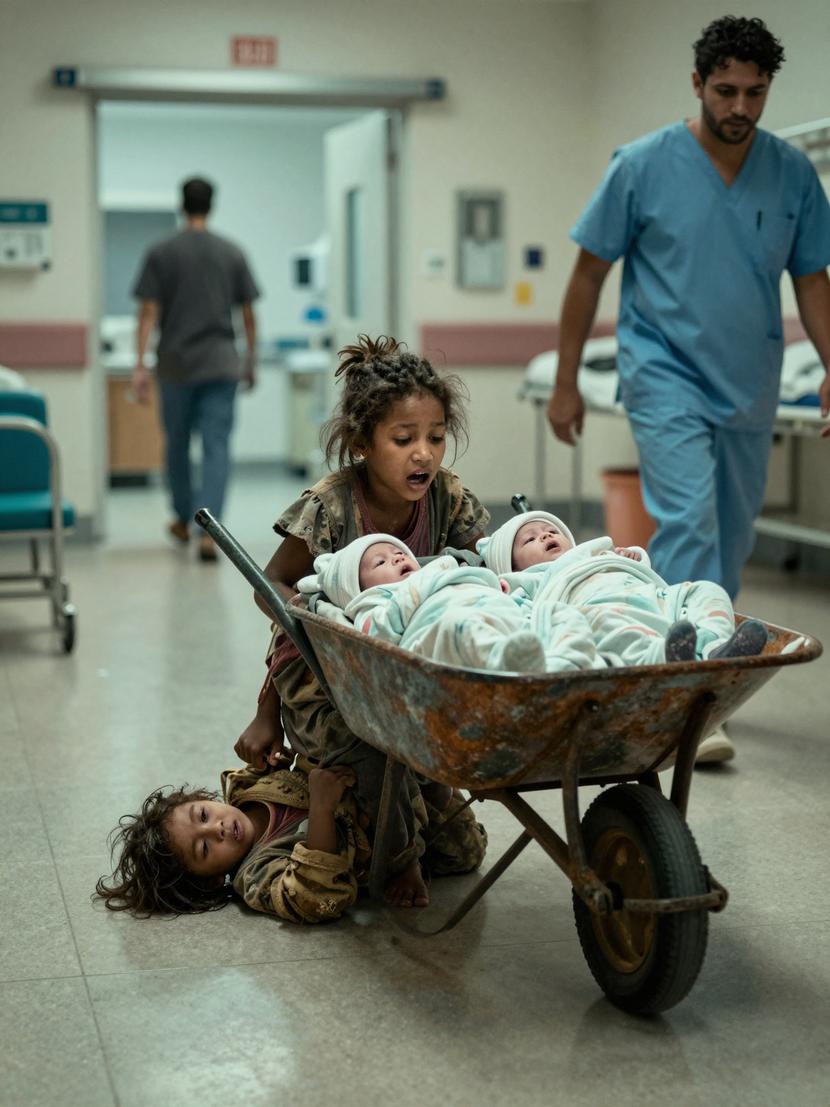
The emergency room at St. Elara County Hospital had witnessed countless crises—broken bones, heartbreak, and the relentless pulse of human survival—but nothing had prepared them for the sight that greeted them that fateful morning.
When the automatic doors slid open with their usual soft whoosh, a hush fell over the triage area. There, pushing with quiet determination, was a tiny figure—a girl no older than seven. Dust clung to her tangled hair, her small hands gripping the handles of a rusted, weather-beaten wheelbarrow. Inside, swaddled in a thin, threadbare blanket, lay two fragile newborns, their pale faces barely stirring but breathing with desperate fragility.
Her breath caught, voice barely a whisper yet resolute. “Please… my mom’s been sleeping for three days. Someone has to help her.”
For a brief moment, the chaos of the ER stilled into a stunned silence. Then, like a tidal wave, it surged back—doctors darting forward, nurses lifting the infants with delicate hands, a stretcher materializing beneath swift command. The girl’s slender legs buckled, and she crumpled onto the cold tile floor, unconscious from exhaustion.
Hours later, as bright fluorescent lights danced painfully across her eyelids, she blinked awake. A soft voice wrapped around her like a warm blanket. “Hey there, sweetheart. You’re safe now.”
Marjorie Ellis, silver-haired and steady-eyed, sat beside her with a gentle smile.
Maya’s eyes fluttered open wider. Suddenly upright, hesitation turning into urgency. “Where are my brothers? Where’s Noah and Ava?”
Marjorie pointed tenderly toward two tiny bassinets beside the bed. “They’re right here, Maya. Safe. The doctors are watching over them closely.”
A shaky breath escaped Maya, a fragile blend of sob and relief.
“You brought them here just in time,” Marjorie whispered. “You saved their lives.”
Later, Dr. Adrian Walker strode into the room, his calm presence steady, alongside Tara Kim, a social worker clutching a file.
“Hi, Maya. We need to ask you some questions to help your mom, alright?” Tara’s voice was soft, but kind.
Maya hugged her knees tightly, eyes wary and cautious. “Are you going to separate us?”
Dr. Walker knelt, framing his gaze to meet hers with unwavering kindness. “No one will separate you. We just want to understand what happened to help you all.”
“Is someone trying to wake my mom?” Maya’s voice cracked with hope.
Exchanging quiet, concerned glances, Tara answered gently, “There are people at home right now, doing everything they possibly can.”
Maya nodded solemnly, pulling a crumpled piece of paper from her pocket.
“This is our house,” she murmured, revealing a shaky drawing: a blue house, a towering tree, and the number 44 scrawled beneath it. “I tucked the number in my pocket so I wouldn’t forget the way back.”
Dr. Walker swallowed hard, emotions tight in his throat. “How far did you walk, Maya?”
She thought, eyes distant. “Until the sun got tired, and the stars took its place.”
As twilight embraced the quiet countryside, Officer Ethan Reed and Detective Owen Blake traced Maya’s fragile breadcrumbs down a dusty dirt path. They arrived at a small blue house, shadows folding in silence, its fence broken and sagging.
Inside, the stillness was heavy. The countertop bore empty formula cans, bottles lined up like sentinels drying. On the refrigerator door, a handwritten feeding chart, written in a child’s uneven scrawl: times, measurements, and hopeful checkmarks.
In the bedroom, Clara Bennett lay unconscious, pale but breathing, surrounded by damp cloths, tiny spoons, and half-full glasses of water.
“She fought to sustain her family,” whispered Detective Blake.
“No,” Officer Reed corrected, voice thick with admiration, “Her daughter did.”
Back at St. Elara County Hospital, Dr. Walker studied Clara’s chart: severe dehydration, malnutrition, and complications wrought by untreated postpartum depression.
“If Maya hadn’t kept giving her water, she wouldn’t be here today,” he said, voice heavy with disbelief.
The next morning, Maya sat beside Marjorie, the quiet strength of the nurse soothing the child.
“They found your house, Maya. Your mom is now at another hospital, where doctors are helping her wake up,” Marjorie offered softly.
“Is she still sleeping?” Maya’s whisper trembled on the edge of hope and fear.
“Yes. But when she stirred, she said your name,” Marjorie said, eyes glistening.
Maya stared at the ceiling, memories flooding her small frame. “I used to count how many times I tried to wake her… I gave her water by spoonfuls, just like she did for the babies.”
“You did everything right,” Marjorie choked back tears. “You saved them all.”
Later that afternoon, child psychologist Dr. Elena Cruz arrived, carrying a box of dolls.
“Can you show me what a normal day at home looked like?” she asked gently.
Maya arranged the figures carefully — a mother, and three children.
“On good days, Mom would rise early, singing softly while feeding the babies. But sometimes, her heart got too heavy,” Maya explained, her voice barely above a whisper. “I’d bring her tea and keep the babies calm.”
Dr. Cruz noticed Maya positioning her own doll between the mother and the babies—as if she were the fragile bridge holding them all together.
“That’s a lot of responsibility for someone your age,” the doctor said tenderly.
Maya shrugged. “Mom says I was born with an old soul.”
Weeks slipped by. Clara slowly emerged from the depths of unconsciousness, inching toward recovery—but months of healing lay ahead. The children needed stability, a safe harbor.
Marjorie couldn’t rest that night. At dawn, she knocked on Dr. Walker’s office door.
“I’ve been a licensed foster caregiver for years,” she said firmly. “I want to take Maya and the twins into my home.”
“A big step,” Dr. Walker acknowledged.
“I know,” Marjorie said softly. “But these children need each other. Perhaps… I need them too.”
A week later, Maya stepped into Marjorie’s warm home on Cedarbrook Lane. The guest room boasted bright quilts, a small desk, and shelves filled with toys. Across the hall, sunlight poured into a nursery where Noah and Ava slept peacefully.
In the quiet nights that followed, Maya tiptoed down the hall again and again, checking on the twins. Marjorie often found her there, singing lullabies soft enough to float on the night air.
“One evening, as you tucked them in, you asked about your mom,” Marjorie said gently.
“When can I see her?” Maya whispered.
“Soon,” Marjorie promised. “She’ll be so proud of you.”
Maya hesitated. “I just hope she remembers me.”
Marjorie smiled, voice steady. “She could never forget you. You are her heartbeat.”
Moving day to Birch Hollow Rehabilitation Center was bittersweet. Maya’s hands trembled around the stroller holding Ava and Noah.
“You ready, sweetheart?” Marjorie whispered.
Through the glass, Maya spotted Clara beneath a blooming cherry tree, thinner but alert, seated in a wheelchair.
“Mom!” Maya cried, breaking into a run. Clara caught her just in time.
In that silent embrace, tears flowed freely.
“Let me see you,” Clara murmured, cupping Maya’s face. “My brave girl. You kept your promise.”
“I did,” Maya breathed. “I took care of Noah and Ava.”
Clara’s trembling hand brushed back a stray curl. “And you saved me too.”
Later, beneath the cherry branches, Maya shared a folded note with Dr. Walker.
“My dearest Maya, if you’re reading this, something must have happened to me. None of this is your fault. You are my light, my strength, and the best thing that ever happened to me. I’m fighting to stay with you. If the darkness wins for a while, remember—it’s because I’m still trying, not because I gave up.”
Dr. Walker swallowed hard. “This note shows what we’ve always known—your mom never gave up.”
By summer’s warm embrace, Clara was strong enough to leave rehab. Thanks to the Community Care Initiative, she moved into a subsidized apartment near the hospital and Marjorie’s house.
On moving day, Maya carried her butterfly journal, filled with drawings—the blue house, the hospital, Marjorie’s warm home, and their bright new apartment.
Marjorie pulled Maya close. “You’ll come visit, right?”
“Of course,” Maya smiled, handing over a folded drawing: two houses joined by hearts. “See? We’re connected now. Not just dotted lines—solid ones.”
Officer Ethan Reed and Detective Owen Blake arrived that afternoon, smiling warmly. They presented Maya with a framed version of her original crayon drawing next to a family picture bursting with smiles.
“From where it began,” Officer Reed said softly, “to where you are now.”
One year later, the hospital auditorium shimmered under a banner: “The Maya Bennett Family Support Program—One Year Anniversary.”
Dr. Walker spoke with pride. “What began with one little girl’s courage has now helped over fifty families. Today, we celebrate strength, survival, and transformation.”
In the front row sat Clara, radiant and healthy, with Noah and Ava, Marjorie beside her beaming. Maya, now nine, stepped forward clutching a folder.
“My mom says family means people who care for each other when times get hard,” Maya told the crowd. “But I think community means noticing when a family is struggling—and doing something about it.”
She revealed her drawings again: the blue house, the hospital, Marjorie’s home, and their sunlit apartment.
“This is for everyone who helped us. So no other child has to push a wheelbarrow to find help again.”
The room rose in a swell of applause, a tribute to courage and love.
That evening, Maya sketched quietly in the park, the twins playing nearby, Marjorie gently pushing them on swings.
Clara leaned over. “What are you drawing now?”
“Our family—the one we built together,” Maya smiled.
Around the twins, small hands joined, forming a circle of warmth. In the distance, a faded wheelbarrow rested—not a symbol of struggle, but a beacon of the strength that carried them all to safety and hope.