
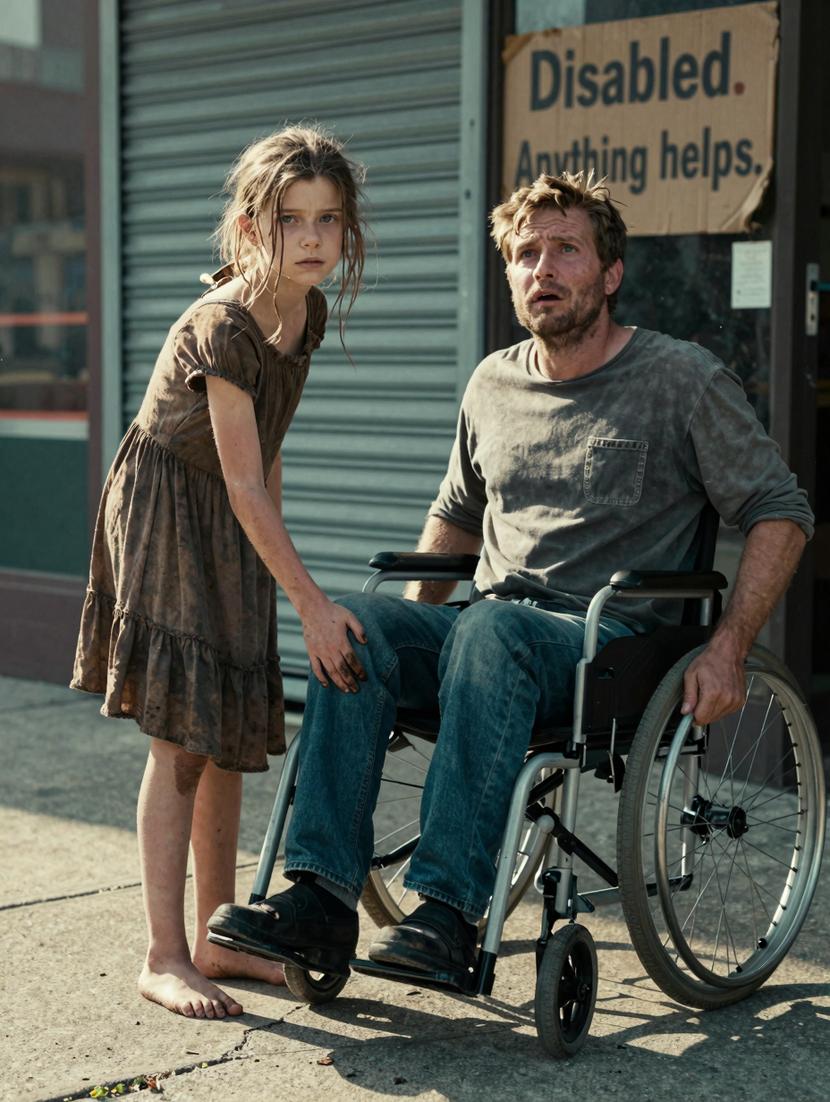
At first, no one noticed the girl standing silently in the heart of a bustling Cleveland sidewalk. It was as if she were a ghost woven into the city’s endless current of walkers and chatter. Her dress, tattered and worn, hung loosely from one shoulder, stained a faded brown. Bare feet darkened with grime barely touched the cracked concrete, and wild, tangled hair veiled her face. She looked no older than thirteen, a fragile enigma amid the noise.
She stopped abruptly in front of a man confined to a wheelchair. His name was Daniel Mercer, twenty-nine years old with deep furrows etched by years of hardship. His chair rested outside a shuttered deli on North Willow Street, a worn cardboard sign propped against the wheel:
‘Disabled. Anything helps.’
Daniel had grown numb to being unseen, to the indifferent passing of life around him. Occasionally, coins clattered onto the pavement. Food was rarer. Words—never.
So when a soft voice spoke, he thought at first it was his imagination.
‘If you give me food,’ the girl said quietly, ‘I can make your legs work again.’
Daniel blinked, disbelief tightening his throat. People often threw scorn or pity his way, but never this—a promise replacing mockery.
He looked down at her, really seeing for the first time. Her eyes were not wild with desperation or pleads; they were calm, steady, and impossibly certain.
‘Really?’ he croaked, voice barely above a whisper. ‘You can do that?’
A faint, knowing smile curved her lips—not childish amusement, but quiet assurance.
Daniel chuckled bitterly. ‘Kid, doctors couldn’t fix me.’
She tilted her head slightly. ‘They never listened closely enough.’
An invisible thread seemed to shift that moment, a subtle current threading through the air. Despite the warmth of the afternoon, a cold shiver crept up Daniel’s arms.
Uncertain but driven by something he couldn’t name, Daniel reached into his bag and pulled out the only thing he had left: half a turkey sandwich. He held it out hesitantly.
The girl accepted it with reverence, as if holding a fragile treasure.
‘Sit up straight,’ she instructed softly.
Daniel frowned. ‘What?’
‘Please.’
Against his better judgment, he sat upright. The girl placed a small, grimy hand gently on his knee.
Then— pain flared through his legs, sharp and shocking.
‘Hey—what are you—’ he gasped, clutching the wheels desperately.
She leaned close, whispering words swallowed by the noisy city around them.
Then, just as suddenly as it had come, the pain vanished.
Daniel froze, breath caught in his chest. Warmth blossomed in his numb limbs—not cold emptiness, not fake phantom pressure, but real heat radiating from within.
‘I… I felt something,’ he stammered.
The girl stepped back, already fading into the throng.
‘I’ll come back tonight,’ she said over her shoulder. ‘If you still want to walk.’
And then she vanished.
Daniel sat trembling, his heart pounding like a wild drumbeat. Was it hunger? Hope? A trick of the mind? Or had something impossible slipped into his shattered life?
That night, his small studio was wrapped in silence, rain ticking softly against the windowpane. Doctors had condemned him to a life in this chair, claiming his spinal injury was permanent, irreversible. He’d accepted that fate—until today.
Then, at exactly 9:47 p.m., an unexpected knock shattered the loneliness.
Daniel’s heart leapt. No one ever came.
He rolled to the door and opened it.
There she stood—dry despite the rain—same torn dress, the same calm, piercing eyes.
‘You came,’ Daniel whispered.
‘You fed me,’ she said simply. ‘That matters.’
She stepped inside quietly, surveying the sparse room: no distractions, no comfort. Just a bare mattress on the floor.
‘You’ve lost more than your legs,’ she murmured.
Daniel swallowed hard. ‘Who are you?’
No answer.
Instead, she knelt and placed her hands firmly over his knees.
‘Stand.’
A hollow laugh escaped him. ‘I can’t.’
‘You can,’ she said, voice sharp with conviction. ‘You’re just afraid.’
Swallowing the flood of fear—the terror of failure, of falling, of reclaimed hope—Daniel closed his eyes.
Then the ache returned, but alive and pulsing, different this time.
His toes twitched.
His calves clenched.
His eyes flew open in shock. ‘Oh my God.’
‘Now,’ the girl said steadily, ‘stand.’
With a cry, Daniel pushed down on the chair’s arms. His legs trembled wildly, treacherous and fragile.
Then—slowly—they held his weight.
He stood.
Three seconds.
Then his knees gave out, and he collapsed, tears breaking free as laughter and sobs tangled together. His hands shook, touching his legs as if to convince himself they were real.
When he looked up, the girl was already retreating toward the door.
‘Wait!’ he cried. ‘Don’t go. Please. Who are you?’
She paused, a faint smile flickering.
‘My name doesn’t matter,’ she said. ‘What you do next does.’
And then she was gone.
The next morning, Daniel walked. Not far, not steady—but enough.
Doctors called it a miracle. Reporters called it unexplainable. Social media erupted.
But Daniel knew better.
He searched the city streets for her.
Days slipped into weeks with no sign of the girl.
Then one evening in the dim light of the public library, Daniel found an old newspaper clipping.
“LOCAL GIRL, 13, DIES SAVING CHILD IN HIT-AND-RUN.”
His blood turned to ice when he saw the photo: the same eyes, the same faint smile, the same torn, brown dress.
She had died two years before his accident.
Daniel sank back, breath caught tight in his chest.
His eyes darted to the last line:
“Witnesses say the girl whispered something before she died.”
He closed his eyes, the memory of an unheard whisper flooding back.
Suddenly, he heard it clearly in his mind:
‘You’re not done yet.’
Folding the paper, Daniel rose—stronger, steadier—ready to rewrite his fate.
Outside, the restless city surged onward.
But somewhere, he knew, a barefoot girl smiled, walking beside him.