
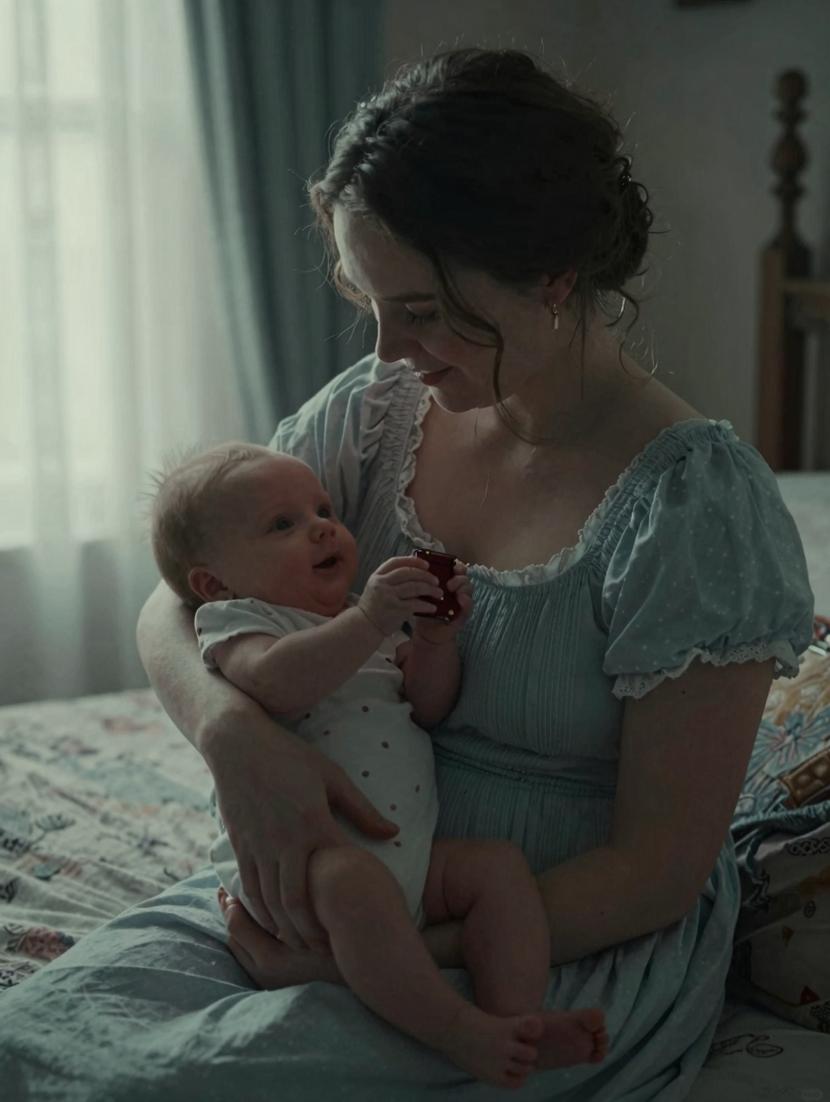
In the vast, echoing halls of Hawthorne Manor, a silent dread clung to every corner. No one dared voice the unthinkable, yet the chilling truth weighed heavily on every soul inside: little Mila Harrington was slipping away.
The doctors had been brutally clinical, their words slicing through the heavy air like a death sentence. Three months—maybe less—was all the fragile infant had left. A countdown against time itself.
Edward Harrington, a titan of industry and wealth, stood by the window of Mila’s room, the usual swagger of a man who bends fortune to his will utterly shattered. For the first time, money held no power over life.
The mansion was breathtaking in its perfection—immaculate floors gleaming, rare art adorning walls washed in Mila’s favorite soft hues, every inch infused with meticulous care. Yet it wasn’t peace that roamed these silent halls. It was guilt, thick and suffocating, wrapping tightly around the hearts of those trapped within.
Edward spared no expense: a battalion of private doctors chained to high-tech monitors, rotating nurses with clinical precision, animal therapy visits, gentle melodies floating through the air, toys imported from faraway lands. Every detail blurred into a flawless sanctuary — except for the one essential thing missing.
Mila’s eyes were windows into a distant world; glazed, unfocused, as if she existed behind an impenetrable veil.
Since the tragic loss of his wife, Edward had withered away from the titan the world once knew. Boardroom battles replaced by ghostly absence, phone calls unanswered, meetings forsaken. The Harrington empire could endure without him, but Mila could not.
Their days merged into a relentless routine: before dawn, a careful breakfast untouched; medication meticulously administered; every flutter, breath, subtle flicker recorded in an endless notebook, as if capturing time might hold it at bay.
Mila’s rare responses were whispers on the wind—nods, faint shakes of her tiny head, or nothing at all. She sat by the window, staring at the shifting light, disconnected from the vibrant world around her.
Still, Edward spoke to her. Weaving stories of far-flung adventures, inventing fairy tales, weaving promises like fragile threads. Yet the chasm between them yawned wider with each silent moment, aching with a grief neither knew how to mend.
Then Clara Whitman arrived.
There was no practiced cheerfulness as Clara entered Hawthorne Manor. No bright smile promising miracles. Instead, she carried a stillness, a quiet calm born from a grief that had drained every last tear.
Just months before, Clara’s own newborn had slipped through her fingers, leaving behind an empty crib and silence so loud it echoed in her bones.
Scanning job listings, she had stumbled upon an ad: a sprawling house, light duties, care for a seriously ill child. Experience? Not necessary. Patience? Essential.
Was it fate or desperation? Clara couldn’t tell. But as she applied, something clenched deep in her chest—a mingling of fear and hope—that maybe, just maybe, she could find a way back from despair.
Edward greeted her with a guarded politeness, laying down strict protocols: distance, respect, discretion. Clara accepted without hesitation, settling quietly into a guest room at the far end of the sprawling estate, her simple suitcase a ghost of a presence.
Her first days were quiet observations. She dusted and straightened, eased nurses’ burdens, drew back heavy curtains to flood the bedrooms with morning light, arranged pale flowers like whispers of life, and folded blankets with gentle care.
Clara didn’t rush toward Mila. She watched from doorways, understanding a loneliness so deep it defied words.
What struck Clara most wasn’t the child’s pallid skin or the fragile wisps of fresh hair. It was the emptiness — a hollow space where life’s spark should have shone. It was an emptiness she recognized all too well, the void left by loss in the quiet after the storm.
So Clara chose a weapon soaring higher than words: patience.
A small music box found its home near Mila’s bed. When soft notes trickled out, Mila barely turned her head, yet it was a victory—a delicate flicker in the darkness. Clara read stories aloud from the hallway, her voice steady and unintrusive, a gentle heartbeat in the silence.
Slowly, Edward began to notice. The mansion’s icy air softened; Clara brought warmth without noise, filling the space between them with tenderness rather than obligation.
One quiet night, Edward glimpsed Mila cradling the music box, her hands tentative but real. It was as if she’d finally allowed herself a fragile wish.
Without a word, he summoned Clara to his study. “Thank you,” he breathed, his voice heavy with unspeakable hope and lingering fear.
Weeks unfolded like fragile blossoms. Trust, painstakingly grown, allowed Clara to brush Mila’s delicate new hair. Then, shattering the fragile calm, Mila’s voice—so rare—whispered a sharp pain.
“It hurts… don’t touch me, Mommy.”
Clara froze. Not from shock at the pain, but at the charged word…
“Mommy.”
Mila’s barely spoken word carried weight—memory and fear intertwined. It was no accidental utterance. Clara’s heart clenched, her voice dropping as she replied, “Okay. We’ll stop, for now.”
That night, sleep eluded Clara. Edward had told her Mila’s mother was gone. So why did that word tremble with such raw emotion? Why did Mila flinch as if bracing for a scream?
In the following days, Clara watched closely. Mila startled at shadows, bristled at raised voices. And troublingly, her condition worsened after certain medications.
Her investigation led her to a forsaken storage room tucked deep within the manor—in a dusty cabinet, boxes marked with faded labels; bottles and ampoules infused with names Mila herself couldn’t speak of. Some bore red warnings; others were dated years back. One name was repeated over and over:
Mila Harrington.
Fingers trembling, Clara photographed everything, spending sleepless nights scouring medical studies and warnings. The truth clawed at her heart:
Experimental drugs. Devastating side effects. Medicines outlawed in many countries.
This was not careful healing.
It was a slow poison.
Imagining Mila’s fragile frame receiving these lethal doses sparked a fire within Clara—a fierce, protective fury.
She kept silent—for now. Edward sat at Mila’s bedside in quiet desperation. But the child’s danger was real, and more than that, Mila trusted Clara.
She meticulously tracked every medication, every dose, every reaction. Quietly, she observed the nursing staff and cross-referenced supplies.
The cruelest revelation was the overlap—the toxic drugs should have been stopped, yet they were still administered.
Everything changed that fateful evening when Edward entered Mila’s room unannounced, only to find her resting, unusually peaceful, against Clara’s shoulder.
His exhaustion and fear boiled over in a harsh demand, “What are you doing, Clara?”
Clara rose swiftly, attempting explanation. But Edward’s wounded pride saw transgression.
That’s when Mila panicked.
She lunged for Clara, clutching her shirt as if for life itself, whispering with trembling desperation, “Mommy… don’t let him scream.”
The storm of silence that followed was different from any before. It was a revelation.
For the first time, Edward saw not simply a sick child.
He saw fear.
A little girl terrified, who did not run to her father.
He rushed toward Clara.
That night, locked away in his office, Edward poured over Mila’s medical records like a man uncovering the cruel foundations of a nightmare. Drug names, dosages, recommendations—all exposing no hope, only danger.
Dawn saw a transformed Edward. Orders were given: stop the questionable medications immediately. When pressed, he said nothing—not to nurses, not to Clara.
Yet something miraculous stirred.
Mila seemed more present, eating small bites, asking for stories, breaking shy, tentative smiles.
But Clara knew the truth could no longer be hers alone to bear.
With quiet resolve, she tucked a bottle into her bag and, on her day off, sought out Dr. Elena Price, a trusted friend at a private clinic. Clara laid bare the facts. Dr. Price listened without judgment and sent the samples for urgent analysis.
Two days later, the verdict was undeniable.
“This isn’t for children,” Dr. Price declared grimly. “And the dosages are brutal.”
The report detailed deadly consequences: extreme fatigue, organ damage, suppression of vital functions. This was not aggressive treatment.
It was reckless endangerment.
And behind it all was Dr. Marcus Vale.
Clara presented the findings to Edward with quiet clarity, no grandstanding. The truth needed no spectacle.
Edward’s face drained of color, hands trembling. “I trusted him,” Clara whispered, “He promised a cure.”
What followed was not an outburst.
It was a cold, silent resolve.
Edward unleashed his vast network, probing archives and contacts. Clara scoured forums and long-forgotten news stories. A damning pattern emerged—other families, silenced victims.
Both knew silence was complicity.
Their fight moved quickly to prosecutors.
Investigations unearthed ties to pharmaceutical giants and unauthorized trials. The media frenzy exploded.
But with light came shadows: whispers blaming Edward’s absence, smear campaigns on Clara’s motives, threatening messages seeking to break them.
Unyielding, Clara stood her ground. Edward seethed quietly, telling her, “If they’re afraid, it means we’ve touched the truth.”
Amid the chaos, a subtle miracle blossomed within Hawthorne Manor.
Mila returned—not suddenly, but in precious steps.
She ventured into the garden, giggling softly when Edward brought her favorite treats. Her drawings blossomed with color—trees filled with life, open windows, holding hands.
The courtroom swelled with families, united by shared scars. Mila’s case was no longer a tale of wealth and courage—it was a beacon for every exhausted parent who had fought against silence.
Clara’s testimony was steady and clear, free of performative tears. Edward followed, embracing his failings without defense.
“Fear blinds even the sharpest minds,” he admitted.
On the third day, Mila’s drawing was unveiled: a bald girl clasping two hands, beneath shaky handwriting: “Now I feel safe.”
Silence gripped the room.
Because finally, it was understood.
This was about life—pure and simple.
The verdict came swiftly: guilty on all counts.
No applause—only a collective exhale.
Marcus Vale was convicted.
Reforms were mandated, placing strict limits on experimental treatments for children.
At last, the system faced itself.
Back home, the mansion shed its mournful quiet. Music drifted through hallways, footsteps echoed with purpose, laughter blossomed.
Mila began school, nervous yet proud. She made friends, raised her hand, filled her notebooks with vibrant drawings telling stories of pain and hope. Teachers marveled at her talent.
The girl who once barely whispered now found her voice in color.
At a school event, Mila walked on stage clutching an envelope. Clara watched from the crowd, unaware of the surprise.
Taking a deep breath, Mila read aloud:
“Clara has always been more than my caregiver. She is my mother—in every way that matters.”
A social worker stepped forward, announcing Clara’s adoption was official.
Clara covered her mouth, tears spilling freely. Mila bounded into her arms as waves of applause swelled around them. Edward no longer held back; tears spoke where words failed.
Years slipped by.
Mila grew—scarred yet radiant with an unquenchable light.
Edward became the father she deserved. Clara was family, not employee.
One quiet afternoon at a downtown gallery, Mila unveiled her first art exhibition—portraits of hospital beds, pale windows, clasped hands, shadows blossoming into color.
Before the crowd, Mila spoke with quiet strength:
“Many think my strength came from medicine. But my first strength came from Clara’s heart. She loved me when I was hard to love. She stayed when I didn’t know how to ask.”
The audience rose in a standing ovation.
Clara took Mila’s hand, Edward’s smile folding into a peaceful pride:
The true treasure was never wealth — but the choice to protect those you love.
That night, Hawthorne Manor felt transformed—no longer grand or perfect,
but alive.
And Clara understood: life doesn’t always return what it takes,
but sometimes, it hands you a chance to love again—to become a refuge,
and to shatter the silence that quietly kills.
All it took was a whispered word in a silent room—a word destined to bury the truth no longer.