
The biting wind surged through the empty autumn street, stirring a swirl of yellow leaves that skittered across the cracked sidewalks, brushing against the weary brick facades of a forgotten neighborhood. Officer Daniel Ortega had carried his badge for twelve relentless years. He had faced overdoses that stole breath and hope, navigated fiery wrecks, and defused domestic altercations that branded souls far deeper than any visible scar. Yet that morning, nothing in his experience braced him for the moment that would paralyze his steps.
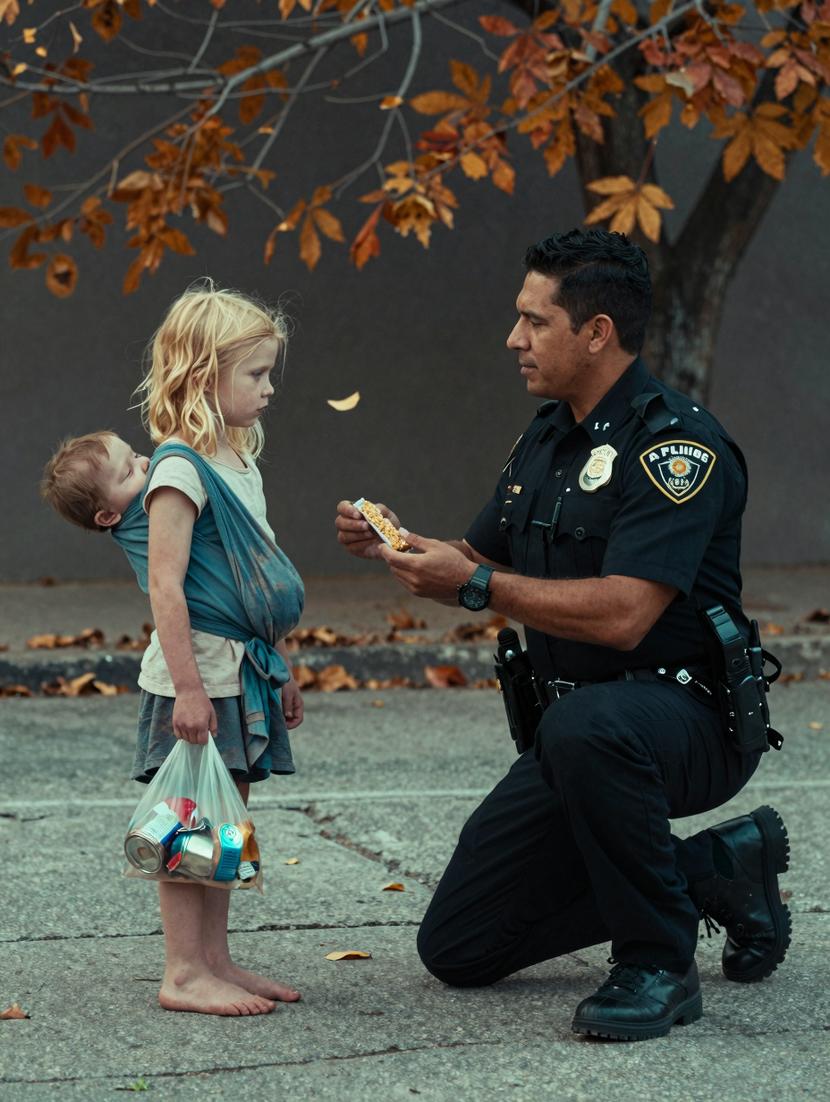
Beneath a canopy woven from amber and rust-colored leaves, a frail figure shuffled unsteadily forward. Barefoot on the icy concrete, she seemed smaller than five, her tangled blond hair matted and clinging to cheeks streaked with the grime and salt of silent tears. Clutched in one tiny hand was a battered plastic bag, overflowing with crushed cans and torn scraps—her scavenged world.
And then Daniel’s eyes caught the makeshift sling.
A faded blue T-shirt, knotted awkwardly over her shoulder and stretched across her chest, cradled a sleeping baby. So small, his head nestled just beneath her chin. His skin was pallid, lips cracked and fragile as dry petals. Even in sleep, exhaustion clung to him like a shroud.
Daniel’s breath hitched.
He had witnessed poverty’s unrelenting grip before. He had seen children caught in its merciless snare. But never had he encountered this—a child become both sister and guardian, propping up another’s life while weighing her own down.
His call had been routine—reports of suspicious activity near the dumpsters by Cedar Park. Expecting a homeless adult or a cluster of rambunctious teens, he was unprepared for this scene.
The girl bent slowly, her hand reaching for a dented soda can, slipping it into the bag with a practiced ease that bespoke survival rather than play. Her shirt hung loosely, slipping from one shoulder, revealing the sharp outline of ribs beneath fragile skin.
Beside her, the baby stirred, a faint, weary whimper escaping before he burrowed closer, seeking warmth against the biting wind.
Daniel noticed the cracked lips, the flushed cheeks, the instinctive curve of her body shielding the baby. This was no mere poverty.
This was abandonment.
At first, she seemed unaware of his presence, eyes fixed on the ground as if searching for some hidden treasure worthy of a few cents. When their gazes finally met, her body stiffened as if frozen by fear.
Her brown eyes darted over the badge, radio, and holster—her grip on the battered bag tightening. Daniel recognized that look all too well—not fear of a stranger but the terror of authority itself.
He remained still, lowering himself slightly to appear less imposing. The wind rattled the skeletal branches above, and her shoulders trembled as she adjusted the sling holding the fragile life against her.
The baby’s breathing was shallow but steady.
Daniel’s thoughts flew home—to his six-year-old daughter engrossed in cartoons and snacks, warm, safe, and blissfully unaware of hardship. The contrast struck him like a cold slap.
Gently, he asked her name. Her voice barely more than a whisper, fragile as the autumn breeze.
She told him—slowly, cautiously—that she and the baby were sheltering behind the abandoned wash house. The infant was her brother. Their mother had gone out in search of food.
She never returned.
Three nights had passed since.
She spoke of wrapping him in bits of cloth to keep warmth, feeding him whatever scraps she could find. Someone had whispered about exchanging bottles for money, so she’d become a collector.
Daniel felt his throat close tight.
This was no longer just a heartbreaking scene—it was an urgent crisis unfolding in real time. The baby needed warmth, food, medical care. The girl needed safety—swiftly.
Yet Daniel knew that one misstep could send her fleeing into the shadows, and if she disappeared, finding her again might be impossible.
So he made a choice.
He would not act solely as an officer.
He would act as a fellow human being.
Slowly, he reached into his jacket, withdrew a granola bar stashed for long shifts. He unwrapped it carefully, extending it with hands that trembled barely.
The girl hesitated, eyes flickering between him and the food.
Then she took a tentative, trembling step forward.
That fragile moment marked the first brittle thread of trust woven into a life shaped by fear.
What Daniel did not know was that after the first bite—after a faint sigh of relief—the words she whispered would linger forever, breaking his heart in ways no academy had prepared him for.
They would ignite a chain of events destined to change not just her life and her baby brother’s, but his own.
Because sometimes, the deepest kindness does not emerge from those with endless resources but from someone refusing to turn away.
Daniel could have treated this as any other call—another report, another file lost in sadness.
But he stayed.
And in that choice lay the fragile divide between despair and hope.
In a world rushing past, too often blind to suffering, remember this: one moment of genuine compassion can rewrite a destiny. You don’t have to fix everything.
Sometimes all it takes is simply to stop—and care.