
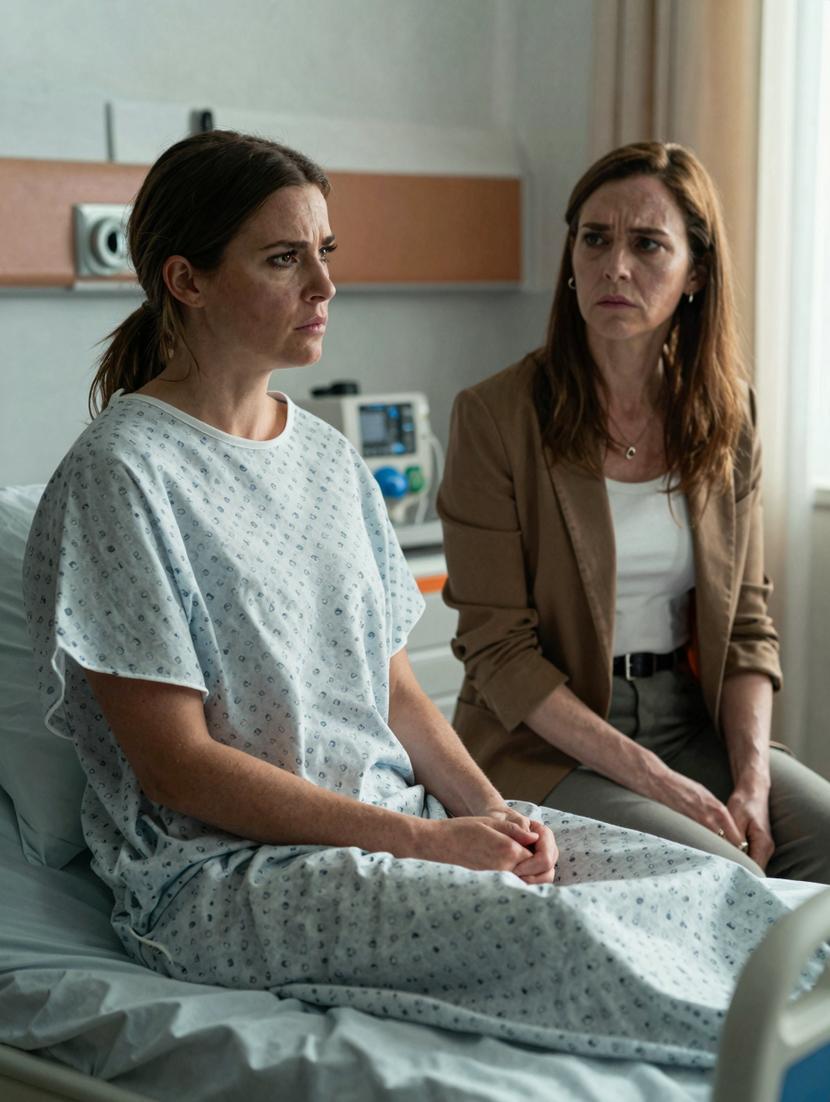
My name is Megan Carter. At 34 years old, I’ve dedicated my life to architectural preservation, breathing new life into forgotten gems. Having an identical twin sister, Tessa, I always believed we were inseparable—two halves of a whole with shared memories and faces. But, nothing prepared me for the nightmare she would unleash on me. Just last month, I awoke from a grueling 12-hour emergency heart surgery only to find I was, in every legal sense, homeless. While I lay unconscious, Tessa had forged my signature, stolen my identity, and sold my lovingly restored Victorian mansion to her boyfriend, Derek, for a paltry $200,000—less than half its true value.
This is the story of the treachery, the deceit, and the justice that followed.
Part 1: The House and The Hustle
That house was my sanctuary. Bought five years ago—a ramshackle 1890s Victorian in a fading neighborhood—it consumed every ounce of my time, every spare dime, every exhausted weekend laboring to pull it from decay. To my family, it was just an old money pit. To me, it was a living, breathing legacy.
While Tessa flitted from one escapade to the next—chasing dubious get-rich-quick schemes and an endless parade of dubious boyfriends—I was meticulously repairing century-old windows, stripping layers of wallpaper tinted by time, and sanding the original hardwood floors to gleaming perfection.
“You’re wasting your life on that wreck, Meg,” she’d sneer, eyeing my paint-spattered clothes and tired hands as she stood in my dust-choked kitchen, decked out in some flashy outfit she’d probably return the next day. ‘You could be out living, like me.’
For Tessa, ‘living it up’ meant frantic nights promoting nightclubs, failing MLM schemes, and revolving through men all driving flashy cars but without clear incomes.
Our parents merely shrugged it off. “That’s just Tessa being Tessa,” they’d say with a tired shake of the head.
It was always this way: I was the responsible rock, the steady anchor; Tessa, the wild card, a relentless project. At our 30th birthday dinner, my parents bestowed on me a practical, sturdy luggage set while handing Tessa the down payment for a luxury car lease. “She just needs a little push to find her path,” Dad explained, placing a comforting hand on my arm.
Looking back, the warning signs were there.
Three months before my surgery, Tessa’s sudden fascination with my house was unsettling. She began dropping by unannounced—a rarity—wandering through the gleaming dining room with feigned admiration.
‘Wow, Meg, you’ve really done a lot here,’ she murmured, eyes flicking over every detail. ‘You must have mountains of paperwork for all this restoration. Where do you keep it? You always seem so organized.’
I was naive enough to think she was finally appreciating my labor. “It’s all in a filing cabinet in my office—permits, receipts, the deed, appraisals. You have to keep everything for the historic tax credits.”
She smiled thinly, scrolling on her phone. “So smart. Just curious about the process. Maybe I’ll try flipping houses, too.”
At the time, I thought she was photographing the antique chandelier. Now I know she was cataloging my filing system.
Part 2: The Crisis and the “Caring” Sister
Then came the diagnosis that shattered everything.
Weeks of fatigue and shortness of breath had been pinned on work exhaustion and long plastering days. But one afternoon, as I hauled a heavy box upstairs, the world blurred and whitened. I collapsed halfway up the stairs, gasping for breath on the landing.
Despite the dizziness and fear, I drove myself to Harborview Clinic. The sterile walls and the relentlessly beeping machine of the EKG greeted me with grim truths. Dr. Kline’s face was grave.
“Ms. Carter,” he said softly but with steel in his voice, “you have a severe, congenital heart defect. Your mitral valve is critically failing. You need immediate surgery—a 12-hour procedure—and weeks in Cedarview Recovery Unit.”
Reality blurred into a haze. I called my parents, then Tessa. Within the hour, my mother was sobbing, my father drained of color. And Tessa? She was flawless—a pillar of support. Holding my hand tightly, managing nurses, soothing our worried parents.
“Focus only on healing, Meg,” she whispered, tears shimmering in her eyes. “I’ll take care of everything at home—plants, mail, the works. Don’t worry.”
Mom nodded approvingly. “See? Your sister cares. You just need to spend more time together.”
But the day before surgery, while helping me pack, Tessa asked a question that should’ve set off sirens.
“Where do you keep the spare house key? And the filing cabinet key? Just in case there’s an emergency, like a burst pipe or something.”
I shared everything—spare key under the loose brick by the porch, cabinet key in the desk drawer. After all, she was my twin, my emergency contact, my closest person.
Part 3: The Betrayal
The surgery was a success, but the recovery was torturous. Two weeks tethered to machines in Cedarview Recovery Unit, drifting between pain and sedation.
Tessa’s visits were almost always during odd hours, when our parents weren’t around. Nurses later mentioned her uncanny interest in my medication schedule—“Is she lucid? How much pain is she in? When’s her next dose?” I believed her concern; it was calculated malice.
On day 15, when I was moved to a regular room, I was nearly drifting back to sleep when Diane, my elderly and fiercely loyal neighbor, slipped quietly through the doorway.
“Oh Megan, thank God,” Diane whispered urgently. “I shouldn’t even be here, but your house… people are moving your things out. I confronted them—your sister and Derek—she said you sold it.”
My heart plummeted. “No! I didn’t sell anything! I’ve been unconscious!”
Chaos erupted. Nurses, parents, Tessa—all converged. Tessa’s face paled at Diane’s presence.
“What is she doing here? Visiting hours are over,” Tessa snapped, the protective veneer cracking.
Diane stood her ground. “Tell her, Tessa. Tell her about the fraudulent sale, about moving her belongings, the forged signature.”
My mother hesitated, confused. “She said you made the decision, Meg. That the medical bills were overwhelming.”
“She’s lying!” I snapped fiercely. “I was under sedation—I couldn’t have signed anything.”
Tessa’s voice dropped to a sickly sweet tone. “You’re mixed up. We talked before surgery. You were worried about the money and agreed selling was smart. Derek’s being generous, taking it as is.”
“As is? The house is fully restored, worth half a million!”
Dad tried to mediate, “What’s done is done. Emma’s trying to help. You can stay with us.”
I saw the lines of betrayal drawn sharply around me.
Diane produced pictures—the moving trucks, Derek’s crew hauling family antiques, Tessa filling her car with files, even recordings of her boasting about handling the sale while I was drugged.
Tessa lunged for Diane’s phone. “You have no right!”
Suddenly, Dr. Kline entered, tension palpable.
“This is beyond family drama,” he stated firmly. “Ms. Carter was under a fentanyl drip and heavy sedation for ten days. She couldn’t sign a document, let alone a real estate contract. I have the medical records. Plus, security footage confirms Tessa timed her visits to coincide with peak sedation.”
Tessa shrieked, “It’s a family matter!”
Dr. Kline’s icy glare silenced the room. “This is fraud, not family matters.”
My parents scrambled to defend her. “We can work this out. No police.”
But Diane was relentless. “She stole from her own twin during a life-saving surgery.”
Security arrived to escort Tessa away as Dr. Kline contacted a friend at Rivergate District Attorney’s Office.
The perfect mask had shattered, but this was only the beginning. The timing was their undoing; medical records don’t lie.
Part 4: The Investigation
Detective Elena Navarro entered my hospital room like a tempest. With a keen eye and relentless focus, she unpacked layers of a sprawling fraud network.
“Tessa and Derek aren’t just flipping houses. They’re running a sophisticated scam—stealing identities, forging documents, selling homes to shell companies, then grabbing loans and disappearing,” she explained.
I stared at the mounting evidence—dozens of suspicious sales across counties, victims blurred in and out of consciousness but her name echoed in every forged contract.
“Your house was their crown jewel—no mortgage, fully restored, clean and valuable. They needed it to secure their big loan.”
Indeed, Derek had mortgaged my property for $450,000 the day after a bogus $200,000 purchase—and the money vanished offshore.
My parents, ever the enablers, pleaded for leniency.
“There’s no need for courts,” Mom begged. “Emma can repay slowly.”
Dr. Kline cut through their delusion. “This is about justice, not money.”
I found my voice, confronting them. “You treated all her betrayals as minor—college fund stolen, identity fraud—just ‘misunderstandings.’ You taught her she could do anything and face no consequences.”
For the first time, silence reigned.
Detective Navarro laid bare Tessa’s months of calculated prep—document photos, signature practice with Derek, secret meetings.
They’d rushed their scheme, leaving undeniable proof: hospital records confirmed I was under anesthesia during the supposed sale.
Faced with the evidence, Derek cracked, revealing Tessa’s cold plan: “She said it had to happen during Megan’s surgery—she’d be too weak and drugged to resist. Mom and Dad would handle the fallout—the cleanup crew.”
The twist slashed deeper than my surgery itself.
UPDATE: One Year Later
Now, sunlight spills into my restored Victorian, gilding its ornate gables. Getting my home back was an uphill battle, but justice prevailed.
The trial grabbed headlines as “THE TWISTED TWIN.” Our story of betrayal during open-heart surgery exposed a vast corruption network.
Tessa’s cold emails to Derek spelled out their plan, including chilling lines like, “Once she’s under for surgery, we move.”
The judge condemned her cruelty, sentencing Tessa to 15 years, Derek to 8. Bank officials and a corrupt notary were also arrested.
Mom finally faced the truth in tearful testimony. “I thought I was protecting her, but I hurt everyone, especially you, Megan. I am so sorry.”
Dad admitted his failures: “I taught one daughter she could do no wrong, and the other to accept being wronged.”
They’ve entered family therapy, finally confronting years of damage.
The Federal Investigations Bureau froze offshore accounts, recovering millions, including the stolen mortgage.
Though initially tainted, my home is now a beacon of resilience. Diane helped cleanse the energy with sage. Detective Navarro gifted me a top-tier security system.
Dr. Kline connected me with a nonprofit protecting patients’ assets during medical crises. I now share my story widely, helping others evade betrayal. Together with Diane, I turned the ground floor into a meeting space for fraud survivors—sharing stories beneath the very chandelier Tessa tried to snatch.
Months into her sentence, Tessa requested a prison visit. Across the table, the stranger wearing my face whispered regrets, her voice small and broken.
“I resented your dedication… the house symbolized everything I wasn’t. Patient. Honest. I told myself you’d recover and rebuild. But watching you in that hospital bed… I don’t know who I became.”
I left with mixed feelings but firmer boundaries. Some twins share everything, but we now share only a cautionary tale of choices and consequences.
Today, my Victorian stands proud—its history now etched with betrayal and redemption. The garden, once mocked by Tessa, blooms with “Survivor Roses,” reminding me—and all who enter—that strength grows from hardship. My heart scar has faded to a silver line, a permanent mark of vulnerability and unyielding courage.
The house she tried to steal became my fortress—and a testament that even the deepest betrayals can forge newfound strength.