
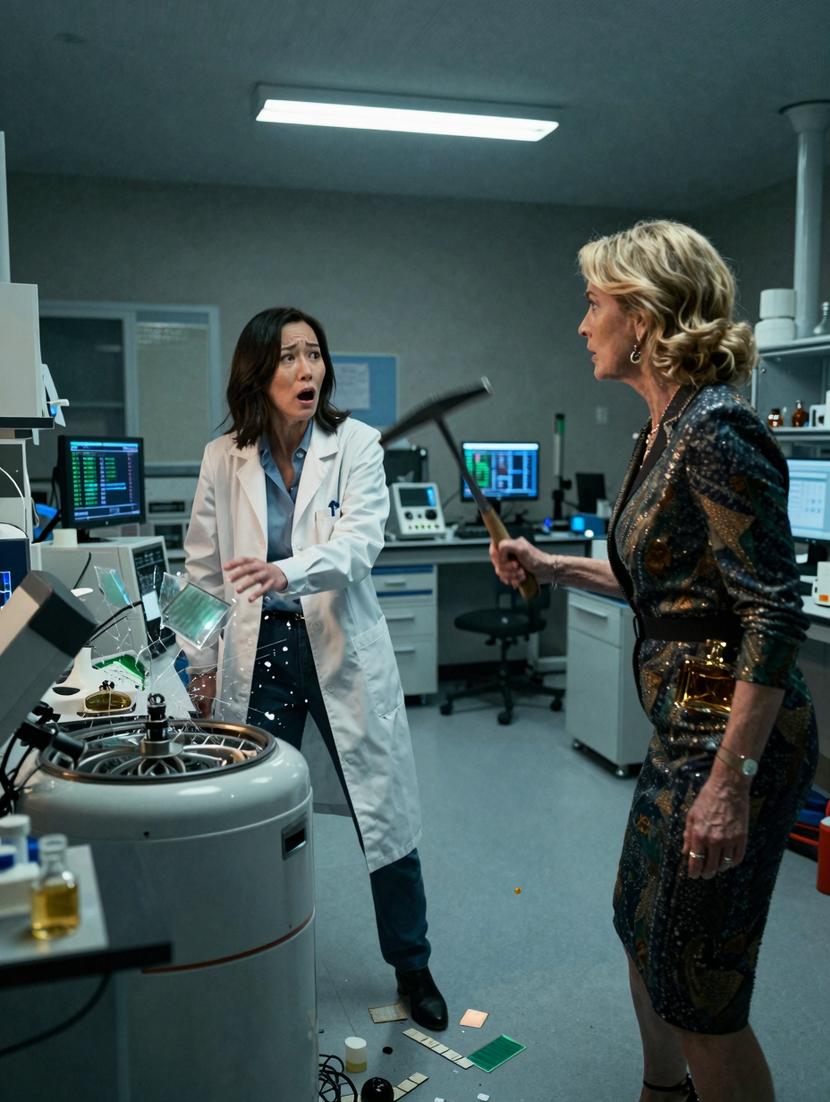
I’m Dr. Laura Bennett, 28 years old, and a neuroscientist whose life has been an unyielding climb marked by relentless sacrifice and sleepless nights. This past week was meant to be the pinnacle of my career—the moment my entire twenties spent buried in the lab bore fruit. After eight grueling years of endless 80-hour weeks, surviving on instant ramen and nothing but sheer grit, I became the youngest ever recipient of the coveted Newman Grant for my groundbreaking work in neural regeneration.
But instead of basking in victory, I’m writing this now from a cramped, borrowed office after standing amidst the ruins of my $300,000 lab—watching as the people I once called family were handcuffed and led away.
They barged in, wielding crowbars and baseless entitlement, believing they’d destroy everything I’d built just to hand that prestigious grant to my brother, Evan. What they never anticipated? The trap I’d meticulously set with backups, endless documentation, security cameras, and my lawyer’s number burning on speed-dial.
Part 1: The Golden Son vs. The “Easy” Daughter
To truly grasp why my mother smashed a $50,000 centrifuge with a crowbar, you must understand the toxic hierarchy of our family.
Evan—26, effortlessly charming, effortlessly irresponsible. A man-child draped in the golden child halo, constantly spinning tales about “finding his true passion” while tails of failed jobs litter his past, none lasting over three months. Now on his third failed college attempt, his university transitions are marked more by parties than classes.
And me? The “easy” one. The “responsible” one who stretched scholarships to the limit, juggled three jobs, and handled life’s brutal punches with silent endurance. My family doesn’t see my achievements as earned victories—they see them as an endless charity fund, always open for when Evan inevitably stumbles.
When news of my Newman Grant win—a $250,000 prize intended for three years of research funding—reached my parents, I thought it might change the narrative. I was wrong.
“My dear Laura,” my father greeted with a false sweetness, “do you think some of that could help Evan with tuition? He’s thinking of switching majors to Philosophy.”
I countered swiftly, “Dad, it’s not a cash prize. It’s a research grant locked to my project—non-transferable.”
The convivial air froze. I returned to the lab, unaware that behind closed doors, they were plotting a far more destructive assault.
Part 2: The Midnight Siege
Late one evening, the lab was silent except for the faint hum of my simulation running. The university building, deserted; the sterile scent of machines and chemicals filled the air. Then—a sound at the door. A key card click that should have been impossible. Dr. Caldwell, my boss, was halfway across the world in Berlin, and no one else had access.
The door swung open.
There they were: Mom, Dad, and Evan, stepping in as if the lab was their personal domain.
“How did you even get in?” my voice barely masked my shock.
“My little rebel still holds his old student card,” my mother announced with a smirk, the scent of expensive perfume invading my sanctuary.
My blood chilled. “That card was deactivated two years ago when Evan dropped out. If you used it—”
“Enough with the rules, Laura,” my father thundered, blocking my path. “We just want to talk.”
Evan leaned casually against the wall, a smirk playing on his lips—the embodiment of entitlement and mockery.
Then, like a force of nature, my mom swept her arm across my workstation. Years of painstakingly organized petri dishes, fragile glass slides, irreplaceable data logs shattered to the floor in a cacophony of destruction.
“He’s trying again, Laura!” she cried, each word drenched in frantic desperation as her high heels crushed my delicate cultures. “Evan’s ready to commit—to school! This grant could turn his life around!”
The irony wasn’t lost on me: destroying my career to hand him a handout.
I stood frozen, eyes darting to my phone perched on the shelf. The little red recording light blinked steadily. Every breach, every act of vandalism, every bitter word was captured—not just by my device, but by triggered security cameras silently rolling footage through the hallways.
“Mom,” I said, voice low but steady, “the Newman Grant isn’t something you can transfer. It’s awarded to me, specifically for this project. You can’t just gift it to Evan.”
“Don’t be selfish!” my father growled, the voice of disappointment we all knew well. “Evan’s struggled. You’ve had it easy your whole life!”
“Easy?” I spat, burning with years of pent-up frustration. “Easy? Because I spent years buried in research, giving up holidays and nights while Evan partied through three failed colleges? Easy because I earned this grant fair and square, while he expected it to be handed to him on a silver platter?”
Evan shrugged, flicking his nails with feigned boredom. “You already have the job here. I’m starting from scratch.”
That was the breaking point. Mom reached for my primary research cabinet—the vault of my work, the heart of everything.
I snapped. “Touch that cabinet, and I will press charges.”
Part 3: The Cage Closes
My mother froze, her hand hovering midair, eyes wide. Threats weren’t unfamiliar here, but always delivered by them—not me.
“You wouldn’t dare,” my father growled, stepping forward.
“Family doesn’t demolish each other’s dreams,” I shot back, my voice cold steel. “Family doesn’t demand sacrifices of achievements. And family doesn’t break into labs and get violent.”
“Break in?” Mom sneered. “Evan’s card let us in, you brat.”
I smiled—cold, calculated. They recoiled.
“Evan’s card was deactivated years ago,” I said, each word deliberate, “which means you broke in illegally. You’re trespassing, you’ve damaged university property, and you tried to sabotage my awarded research. The university will be pressing charges.”
Kevin’s smirk faltered, sweat pooling at his brow.
I held up my phone, time stamps blinking. “I’ve been recording everything since you entered. Campus security was alerted the moment you tried the invalid card. They’re on their way now.”
Rage pulled my mother to violence; she grabbed a nearby digital speaker and hurled it against the wall.
“You ungrateful brat! After all we’ve done!”
“Everything you’ve done…” I laughed bitterly. “Like spending my college fund on Evan’s failed business ventures? Missing my graduation because he needed bail for a DUI? Or right now—destroying what I built to give him what he didn’t earn?”
“I EARNED THIS!” Evan finally snapped, his mask shattered. “I DESERVE A CHANCE!”
“You’ve had three chances—and blew them all!” I roared. “The Newman Grant isn’t a chance. It’s a reward. You can’t earn what you didn’t work for!”
At that moment, the door crashed open.
Two campus security officers rushed in, followed closely by Dr. Caldwell, exhausted but furious.
“What the hell happened here?” Dr. Caldwell gasped, surveying the carnage.
“These people trespassed, used deactivated key cards, destroyed property. I have proof. I want to press charges,” I said, voice steady despite shock.
“Laura, please,” my mother begged in a pathetic whine, “we can fix this as a family.”
Dr. Caldwell’s reply was ice cold. “Escort them to the security office. The board will want to review this. And call the police. This is criminal.”
As they were led away—mother pleading, father silent, Evan shell-shocked—Dr. Caldwell turned to me, concern etched deep.
“Are you okay, Dr. Bennett?”
I surveyed the wreckage—years of work shattered like forgotten dreams—but inside, a strange calm.
“No,” I whispered, “but I will be.”
UPDATE 1: The Boardroom Battle
By morning, the university’s emergency board meeting was convened. I sat poised at one end of a vast oak table, facing stoic administrators and the university’s legal counsel.
The security footage played on a screen—relentless, raw—mom’s hysterics, dad’s fury, Evan’s entitlement all on brutal display. The moment mom threw the speaker caused even the sternest faces to flinch.
Dean Wallace cut the video. “Damage estimates top $300,000,” she said coldly, “excluding research delays.”
The figure hit me like a fist. Three hundred thousand dollars—all from a brother desperate to claim my hard-earned success.
“But,” I replied, voice unwavering, “I’m a pessimist by necessity. I maintain redundant, off-site backups. Every step documented and protected. The physical lab is wrecked, but my research remains intact.”
Dr. Caldwell nodded with a faint smile—a silent nod to my meticulousness.
Dean Wallace’s tone sharpened. “Your family’s actions exposed severe security gaps and a troubling misunderstanding of academic grants as exchangeable assets.”
“I agree,” I responded firmly. “I support full legal action. They must face consequences.”
The room grew silent—they expected a plea, a defense. But I was no longer that version of Laura.
“This goes beyond last night,” I declared. I revealed the stolen college funds, missed graduations, endless sacrifices forced into silence. I displayed texts, emails, a tapestry of favoritism and fraud. “I love my family, but I refuse to sacrifice myself for them anymore.”
The board exchanged knowing glances. Dean Wallace’s eyes softened with newfound respect.
“We’ve decided,” she stated, voice measured, “to press full charges for trespass and criminal damage, significantly upgrade all lab security, and—given your professionalism and foresight—double your grant funding.”
I blinked, stunned.
“You saved millions in research with your backups,” Dr. Caldwell added proudly. “Your composure proved exceptional. We’re also allocating you a new, larger lab in the main science tower, immediately.”
The university wasn’t just standing by me—they were investing in my future.
That afternoon, my phone buzzed. A message from Mom: “The police are here. How could you do this to your own family?”
I didn’t reply. I walked to my pristine, new lab—ready to rebuild.
FINAL UPDATE: New Horizons
The press release blew up, but one email stood out—from Dr. Sofia Navarro, Head of the Global Neuroscience Institute.
Dr. Bennett,
Your research is impressive, but your integrity even more so. I had a troubling encounter with your brother Evan three years ago, when he attempted academic fraud against a colleague. We have the records. Let’s discuss.
The pieces clicked—Evan’s “failure” wasn’t quitting; he was expelled for plagiarism.
Before replying, the phone rang.
“Nana,” my grandmother, the only family member who’d truly supported me.
“I saw the footage,” she rasped. “Your mother’s spinning stories, but the truth is different. Your grandfather left a separate trust for grandchildren’s education. Your father was supposed to inform you but hid your share—spent Evan’s portion on bad business and buried yours.”
All my student loans, all those extra jobs—it was fraud.
“I’ve alerted the trust’s lawyers,” Nana said firmly. “They’ll contact you. This isn’t just money; it’s deceit.”
After hanging up, I accepted Dr. Navarro’s invitation. An hour later, we were video calling. She offered me a leadership role at their brand-new Swiss facility.
Dr. Caldwell had already shared my file. ‘She’s been held back long enough. It’s time to let her fly,’ he’d said.
So, here’s where we stand:
My Parents: Facing criminal charges for over $300,000 in damages, civil suits for fraud and embezzlement, and shattered reputations. My father has been disbarred.
Evan: Blacklisted for academic fraud, party to the lawsuit, and last I heard, working as a barback.
Me: Thriving at the Global Neuroscience Institute, debt-free thanks to my inheritance, and living in a beautiful apartment overlooking Lake Geneva.
Last week, I received a desperate text from Mom: “You’ve destroyed this family. We have nothing.”
I replied once: “No, Mom. You had a family. You just valued Evan more than me. You made a bad investment.”
I blocked them all.
That night, watching them ruin my lab, I thought my world had ended. Instead, they taught me the greatest lesson: sometimes destruction clears the path for new growth. And now, I am finally free to soar.