
The Summit Federal Bank of Redridge carried the stale scent of recycled air and whispered fortunes, a place where money seemed more a shadow than an ally.
Caleb Mercer stepped inside at 11:47 a.m. on an unremarkable Tuesday. His teal work shirt hung faded around his shoulders, its collar frayed as if it had weathered many storms. His joggers bore a fresh smear of engine grease just above the left knee, and his boots still clung to damp, muddy tracks from that very morning. In his grasp, he carried an old, battered suitcase—rust curling at its hinges, a relic more fitting for a forgotten job site than a polished bank lobby.
Fading lines marked the threadbare leather, its scars telling silent stories.
Caleb joined the queue.
The woman ahead stole a glance over her shoulder, her eyes narrowing, then darting again. She shifted her purse deftly to the other shoulder and nudged herself forward, a subtle yet unmistakable gesture of unease.
But Caleb was impervious. Or perhaps, indifferent.
He approached Service Desk 3 with measured steps.
Martin Calder, branch manager, had become an expert in unspoken truths. His so-called ‘situational awareness’ was a honed instinct, at times whispered among staff as prejudice dressed in professionalism. From the moment Caleb crossed the threshold, Calder saw a problem—a visitor who didn’t fit the picture.
Adjusting his pristine silk tie with a practiced flick, Calder moved forward.
“Sir,” he said, cold and clipped, “How can I assist you today?”
“I’m here to make a deposit,” Caleb replied, voice steady.
“A deposit, yes.”
Calder’s eyes flickered to the suitcase, recoiling almost imperceptibly, as if assessing something toxic. “We have strict protocols for large cash deposits—compliance requirements, mandatory pre-scheduled appointments, proper documentation.”
Caleb tapped his shirt pocket lightly. “I have documentation.”
“I’m sure you do,” Calder said smoothly, the voice of a man accustomed to quietly defusing disturbances. “But today, this branch isn’t equipped to handle something of this nature.”
“Nature,” Caleb echoed, flatly.
“Our regular clients are waiting. I’m certain you understand.”
His eyes scanned the lobby, noting the supposed crowd: two elderly ladies chatting quietly at a teller window, a young couple signing papers in a corner, a man absorbed in his phone.
Not busy at all.
“I can wait,” Caleb said simply.
Calder’s jaw tightened imperceptibly. A subtle nod sent a silent command to the security desk.
Grant Bishop, the security officer—a man who’d been here two years—caught the signal and rose.
“Time’s up, pal,” Bishop said, hand landing firmly on Caleb’s shoulder, neither violent nor inviting. “You’re making people uncomfortable.”
“I haven’t done a thing,” Caleb murmured.
“I know, I know,” Bishop replied quietly, tone cautious like he was speaking to a stranger in unknown waters. “But the manager’s asked you to leave, so let’s make this easy, okay?”
“I just want to make a deposit.”
“Sir—”
“That’s all.”
“Sir,” Bishop’s grip tightened. “Let’s move.”
The tellers watched, the couple stopped signing, and one elderly woman now turned fully around clutching her bag tightly.
Caleb didn’t resist. He shouldered the suitcase and accompanied Bishop toward the exit.
Calder theatrically held open the glass door, his posture announcing, I grant you grace even in removal.
The harsh midday sun struck Caleb as the door hissed shut behind him.
“And stay out,” Calder’s voice was muffled but the menace clear, lips pressed into a thin line as he stepped away. Bishop crossed his arms by the door like a sentinel.
Caleb stood on the concrete sidewalk.
He wasn’t angry. He wasn’t humiliated. His gaze was calculating.
Ten measured steps brought him to the curb.
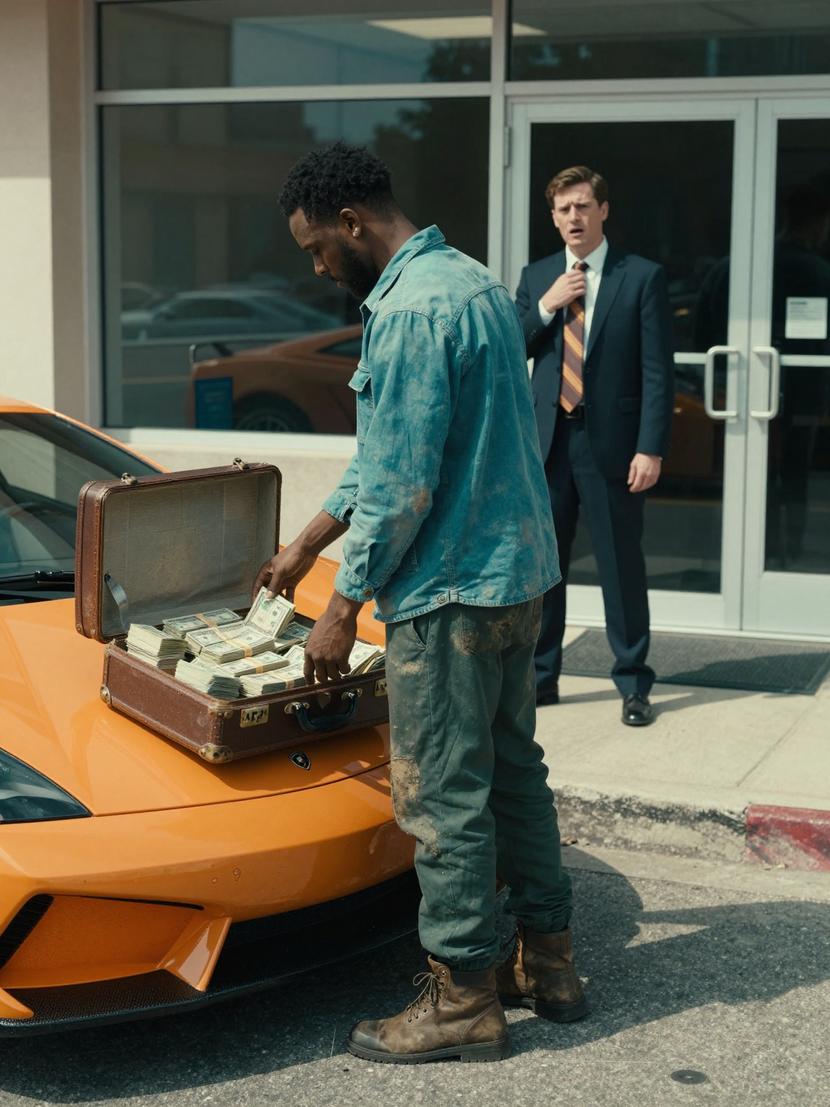
Parked legally at the meter, two minutes left on the ticket, rested a Lamborghini Gallardo painted the blazing hue of Arancio Borealis—an orange so vivid it seemed lit from within. The car crouched low, as though ready to pounce.
Several pedestrians had slowed, drawn by the captivating sight.
Caleb extracted a key fob from his pocket. A chirp and a flash from the car’s lights responded.
He placed the worn suitcase atop the hood.
With a sharp click, the rusty latches popped open.
Inside lay bundled bricks of cash—neatly stacked, banded, organized. Hundreds of thousands in crisp bills. Liquid capital not born from an ATM or a lucky break but forged through years of grit, smart choices, or both.
Caleb made no show of counting or spreading the notes. He simply stood, hand resting on the suitcase’s edge, his eyes locking back at the bank.
The bank returned his stare.
Calder had moved closer to the glass, his stillness heavy with disbelief. Bishop stood beside him, both men fixed on the burning orange car, the battered suitcase, the man they’d just cast out.
A woman on the sidewalk lifted her phone, recording.
A delivery cyclist slowed, wheels grinding to a halt to watch.
Calder stepped outside.
His tie remained straight, his jacket impeccable, but his posture had shifted—the invisible droop of a man confronting a stark, uncomfortable truth.
“Mr.—” he faltered, unsure. “Sir, please, you’re welcome to come back inside. We can absolutely—”
“I’m fine,” Caleb said quietly.
“My apologies for the earlier confusion. It was a miscommunication, and I—”
“There was no miscommunication,” Caleb interrupted, voice calm but firm. “You looked at my boots and made a choice. That’s not miscommunication. That’s a decision.”
Calder opened his mouth. Closed it.
“I’ve banked with Pioneer Trust for eleven years,” Caleb continued. “My accountant has urged me to diversify. I thought I’d try somewhere local.” His gaze drifted to the bank’s sign. “Now I know.”
“Sir, I assure you—”
“My name is Caleb Mercer.” He let the words hang. “You can verify that.”
Calder’s color drained the precise way it does when the weight of a mistake settles in.
Caleb closed the suitcase, transferring it gently to the passenger seat of the Lamborghini. He circled to the driver’s side.
Bishop had followed Calder out, now standing back with relaxed hands, a man who wished for any place but here.
“I—I’m sorry,” Bishop whispered, sincere. “I was just doing my job. But I—That doesn’t make it right.”
Caleb held his gaze for a long moment.
“I know,” he said simply, neither forgiving nor condemning.
He slid into the sleek leather seat.
The V10 engine roared to life—a sound like controlled thunder, a beast awakening.
Calder remained rooted on the sidewalk as the Gallardo’s growl faded into the city traffic, the car cruising smoothly, without flash or fanfare.
The woman’s phone continued recording.
Calder turned and reentered the bank. The glass door swallowed him, the hiss behind sealing the moment.
Inside the regional director’s office, forty-five minutes later, Calder’s phone rang.
He let it roll to voicemail.
It rang again.
“Martin,” the director’s voice was careful—strained by the undercurrent of a problem with legal weight—“I need the facts on what happened today.”
“It was a misunderstanding,” Calder began weakly. “A walk-in, no appointment, unusual appearance—”
“Caleb Mercer.”
Calder paused.
“You know the name.”
“I… I looked him up after—”
“He’s been flagged as a high-net-worth target for six months. His Pioneer Trust account holds nine figures, Martin. Nine figures. And he walked into your branch today.”
Silence.
“And you had security remove him.”
The quiet was heavy—the sound of a man crumbling.
“I’m going to need an incident report. And then I want you here, in my office. Today.”
“Yes sir.”
“And Martin—”
“Yes?”
“Do not call him. Email him. Send him gifts. Nothing. You don’t get to fix this.”
The line fell silent.
Caleb parked in the underground garage of a shimmering glass tower on the east side of the financial district.
On the twenty-third floor, Monica, his accountant—a compact woman with a steady gaze—waited with two steaming cups of coffee and a folder.
“How did it go?” she asked.
“Cross them off the list,” Caleb said.
She scribbled notes. “Pioneer it is, then.”
“Pioneer it is.”
He sank into the chair, coffee warm between his hands, eyes tracing the sprawling cityscape beyond the windows.
“You want to hear something ironic?” he said.
“Always.”
“The man who threw me out—I felt it the second I walked in. The look. I’ve known it all my life.” Caleb turned the cup slowly. “Shipyards. Warehouses. Job sites. Come in dirty, and they judge you without a word.”
“And?”
“It used to sting.” He set the cup down. “Now? I almost feel sorry for them. They’ll never know who they let slip away. They go home thinking they were right.”
Monica met his eyes.
“Almost feel sorry,” she said.
“Almost,” Caleb agreed.
The next morning, a local financial reporter posted a brief video. She’d been filming nearby for an entirely dull segment on parking rules for small businesses when the vivid orange Lamborghini pulled up and the rusted suitcase emerged.
She captured it all.
Caption: When the bank judges the cover, not the book.
By noon, the video amassed two million views.
By four, Summit Federal Bank’s regional communications released a statement pledging “commitment to respectful service for all clients.”
By six, Calder was placed under administrative review.
No photo. No name in the statement.
Yet three witnesses from the lobby had already chimed in, and the internet, when curious, never forgets.
That evening, Caleb sat quietly at home in a peaceful west-side neighborhood. His three-bedroom house, the workshop out back where he spent weekends, a quiet retreat. The Gallardo rested in the driveway—a trophy too wide for his garage, yet still a source of joy.
His phone buzzed relentlessly—friends, former coworkers, his nephew.
He watched the video once, then placed his phone face down.
Soup simmered on the stove, calling him back to simple chores.
He ate at the kitchen counter, gazing out onto the street.
No anger burned in him—not really. Not surprise either. Anger was for those caught unaware. Caleb had long stopped being surprised by the look he’d seen so many times.
What lingered was weariness. Fatigue from a constant test. Exhaustion from the insistence of proving worth. Tiredness that a man must flash extraordinary proof—a flashy car, a suitcase full of cash—just to be taken seriously in certain rooms.
He rinsed the bowl, dried it, tucked it into the cabinet.
He thought of Grant Bishop—the apology on the sidewalk. That didn’t make it right, but it was genuine.
That mattered.
A little.
Two weeks later, Caleb finalized his move to Pioneer Trust: three new accounts, a thoughtfully structured investment portfolio, and formal private client onboarding. His new contact, Linda Barrett, a seasoned private client advisor with twenty-two years at Pioneer, had asked about his work, his vision, his goals.
She listened before she spoke.
“I like this bank,” Caleb said to Monica later.
“I knew you would,” Monica smiled. “I picked it.”
Three months on, Summit Federal’s regional director announced a “comprehensive client experience review,” corporate speak for ensuring no such incident ever again played out under the unforgiving eye of a camera.
Calder had been moved to a compliance role forty miles from the city, the kind of job with no clients, no show.
No public statements followed.
No outreach to Caleb.
He sat in a small office, bathed in fluorescent light, no marble floors, haunted by the memory of a rusty suitcase, a blazing orange car, and a long unblinking look from a man he’d misjudged.
He mostly failed to forget.
Grant Bishop requested reassignment eight weeks later.
He traded the bank for community outreach, working with housing-insecure residents in the northern neighborhoods. The pay was lower, hours longer.
But he slept better.
That rusted suitcase found its place in Caleb’s workshop—not a trophy, not a symbol.
It was his father’s—a companion of thirty years, carried across job sites and states, the holder of a lifetime’s hard-earned savings handed down six months before his passing, sealed with a note: ‘Don’t let anyone tell you what you’re worth.’
Caleb had meant to deposit it, a quiet memorial.
He never got the chance.
And he no longer minded.
The cash moved quietly at Pioneer Trust, working behind the scenes in Caleb’s life.
But the suitcase remained—rusted, battered—beside the tools in his workshop, still ready for work, still telling stories.