
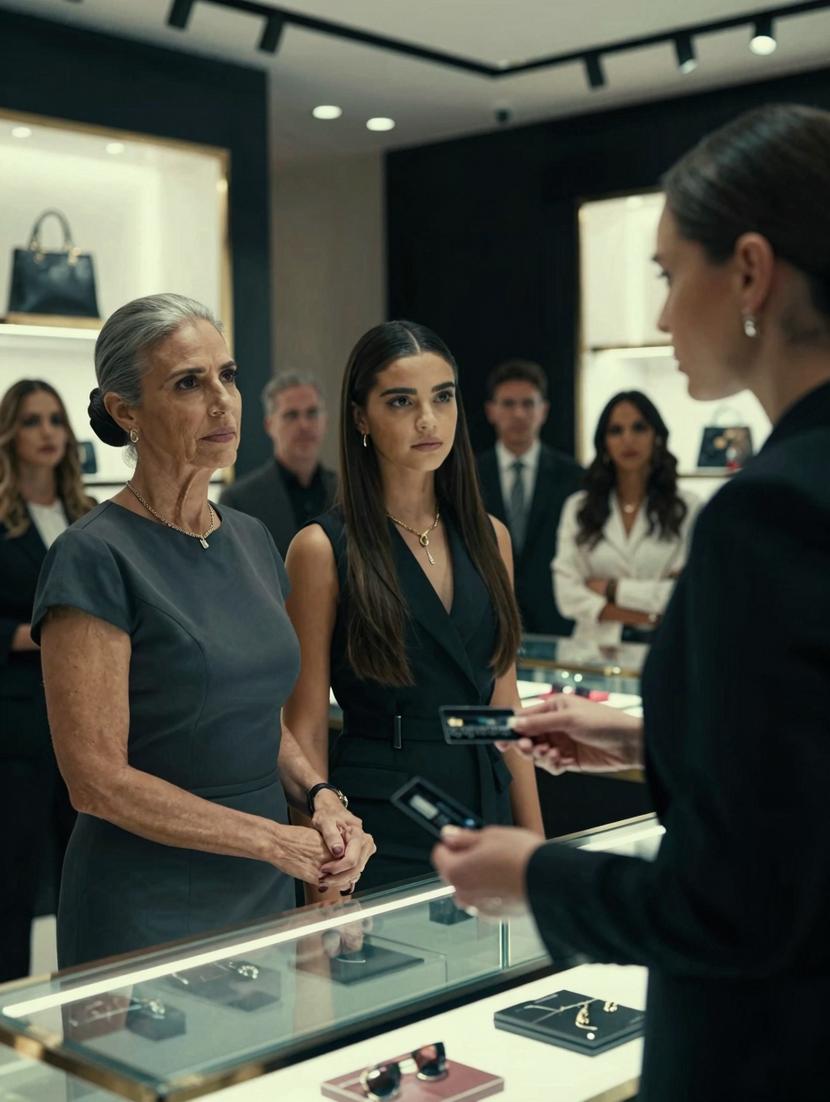
Marina Vargas had never paid much heed to the idea that clothes could define a person’s worth. Yet, as she stood hesitantly before the gleaming window of a luxury boutique in Porto Azul, she suddenly grasped how unforgiving society still was. Her simple dress whispered quiet humility, her shoes bore the weary marks of many journeys, and her gray hair was pulled back neatly in a no-nonsense bun. She’d traveled all the way from the countryside with one aim burning in her heart: to find a dress worthy of a night that transcended ordinary life. After five long years away in the United States, her daughter Camila was returning to receive a prestigious honor—and Marina was determined to stand beside her with the grace and dignity the moment demanded.
With a steadying breath, Marina pushed open the boutique’s heavy door. This wasn’t about vanity. She had never sought to dazzle others. But this ceremony represented every sacrifice, every early morning, every bit of relentless hope she’d poured into Camila’s future. She needed to look the part—not for show, but to honor their story.
No sooner had she stepped inside than a young saleswoman’s gaze swept over her with a flicker of disdain—the kind of look that slices beneath the skin. A cold smile bloomed on the woman’s lips, but it was none of kindness.
“Excuse me, are you sure this is the right place?” the saleswoman asked, her tone dripping with politeness that felt sharp as broken glass.
Marina met her eyes without flinching. “I’m looking for a dress for a ceremony,” she said quietly. “Something elegant.”
The woman’s lips twitched, as if biting back a smirk, when another woman—more refined, undoubtedly the manager—glided over. Her eyes measured Marina like currency, cold and calculating.
“Our dresses start at five thousand reais,” she said, voice cool and patronizing. “Perhaps the shops downstairs might be more suited to… your budget.”
The words stabbed deep, but Marina held herself upright. She had weathered storms far fiercer—years of cleaning floors, being spoken to as if invisible, the sharp edges of cruel commands and biting remarks. She had survived widowhood, hunger gnawing at her bones, exhaustion that clawed at her spirit, sleepless nights trembling with uncertainty. Two dismissive women would not shatter her.
“I can pay,” she stated firmly, voice steady and calm. “I just want to see some options.”
The saleswoman rummaged and presented a black dress—a dull, lifeless thing that seemed to whisper, “This is what you deserve.”
Marina held the fabric in her hands. It was not unsightly, but it was as joyless as a shadow, utterly devoid of celebration or hope. It was nothing like the vision she’d cherished—the day she would watch Camila, radiant and proud, accept an award before a crowd of executives, journalists, and dignitaries. She had the means to buy anything in the boutique. But at that moment, she understood: the barrier was never money—it was prejudice.
“May I see the dresses in the window?” she asked gently, gesturing toward the shimmering gowns bathed in spotlights.
The manager sniffed in dismissive disbelief. “Those are exclusive. Imported. Over fifteen thousand reais each. One must be realistic.”
Eyes from other customers now darted curiously in Marina’s direction. An elegantly dressed woman murmured just loud enough for others to hear, “These places really let anyone in nowadays.”
Burning blush crept across Marina’s cheeks, but she said nothing. Her dignity was not tethered to the approval of strangers. Her phone vibrated. A message from Camila appeared: “Mom, I’m almost there. I can’t wait to see you. Thank you for being with me today.”
Marina smiled softly, warmth flooding her chest. “I’ll wait,” she whispered to no one but herself. “Someone important is coming.”
They directed her to a stiff chair in the back. She sat quietly, glancing at the clock. Minutes ticked away like a slow drumbeat. Her mind wandered back.
At nineteen, she had been young and hopeful, pregnant with a love that felt unbreakable. Rafael, her husband, was a mechanic with hands calloused by honest labor but dreams as vast as the endless sky. He had placed his hand gently on her belly, promising, “If it’s a girl, her name will be Camila.” He wanted to see his daughter reach heights they never could.
But fate was cruel. When Camila was two, Rafael died in a tragic accident. Marina stood alone at twenty-one, a young widow with a child, no career, no safety net—and no time to crumble.
“What will we do now?” Camila once asked, her wide eyes searching.
“We will work,” Marina vowed. “So you can have the life your father dreamed of.”
And work she did. From dawn’s first light until long after the stars peeked out, Marina cleaned houses, stretched every coin as thin as it could go, and every night—no matter how exhausted—sat beside her daughter. “Study hard,” she encouraged. “Education is a treasure no one can steal.”
Camila listened, blossomed, earning scholarships, turning pages late into the night. University beckoned—software engineering—a world Marina barely understood but supported fiercely.
Then came the hardest goodbye: Camila boarding a plane to the United States.
Fear shook Marina to her core, but she let her go.
Camila struggled, toiled, and triumphed. She built a thriving company and earned a reputation as one of the most admired entrepreneurs on Tech Coast.
The money came later.
But Marina remained unshaken.
Because her work had never been for wealth.
It had been to set Camila free.
The boutique door swung open.
Camila entered. She was the picture of elegance and confidence, but it was not her exquisite attire that commanded silence—it was her radiant presence.
Her eyes sought Marina’s—their silent promise bridging years of struggle.
Then came the staff, their gaze heavy with judgment.
“Mom, stay right there,” Camila said with quiet authority.
She stepped forward into the center of the boutique.
“I want to understand why my mother is being made to feel she doesn’t belong here.”
The manager attempted to intervene. “There must be some misunderstanding—”
“No,” Camila interrupted sharply. “This was humiliation.”
She took Marina’s hand, helping her to her feet, then wrapped her in a protective embrace.
“Were you treated well?” Camila asked gently.
Marina shook her head, brushing it off. “It was nothing.”
Camila’s smile was tinged with sadness. “Then why were you made to sit quietly while they decided what kind of person you are?”
An aching silence fell.
“Ten minutes ago, you told her these dresses were too expensive for someone like her. You offered the cheapest, dullest option. You suggested she leave. What changed now? My bag? My shoes? My last name?”
No one dared respond.
Camila placed a sleek black card on the counter.
“This card could buy every single dress here for my mother. But that’s not what matters. She should never have needed to prove her worth to earn respect.”
Her gaze swept the room. “This is Marina Vargas. She raised her daughter alone. She worked tirelessly so I could study and dream. That daughter is me.”
Silence wrapped the boutique like a heavy cloak.
“I am Camila Vargas, founder and CEO of one of the world’s leading AI companies. Tomorrow, I accept a national award. There, I will sit in the front row—not because of my success, but because every step I took began with her.”
Some lowered their eyes, shame settling in.
“But the greatest truth,” Camila continued, “is that my mother’s simplicity holds more true class than all the arrogance in this room.”
Marina squeezed her daughter’s hand. “Shall we go?”
“Yes,” Camila said firmly. “This place doesn’t deserve to sell you anything.”
The next boutique welcomed Marina with warm smiles and open hearts.
She selected a navy blue dress—stunning. A perfect dress.
The following day at the grand theater, Camila stood illuminated on stage.
Before delivering her speech, she looked out into the crowd, her eyes finding Marina’s.
“My success belongs to her,” she declared, voice rich with gratitude.
Marina’s tears flowed—not of sorrow, but of profound recognition.
Later, Camila held her close.
“I’m proud to be your daughter.”
Marina smiled through her tears. “And I’m proud that you never forgot where you came from.”