
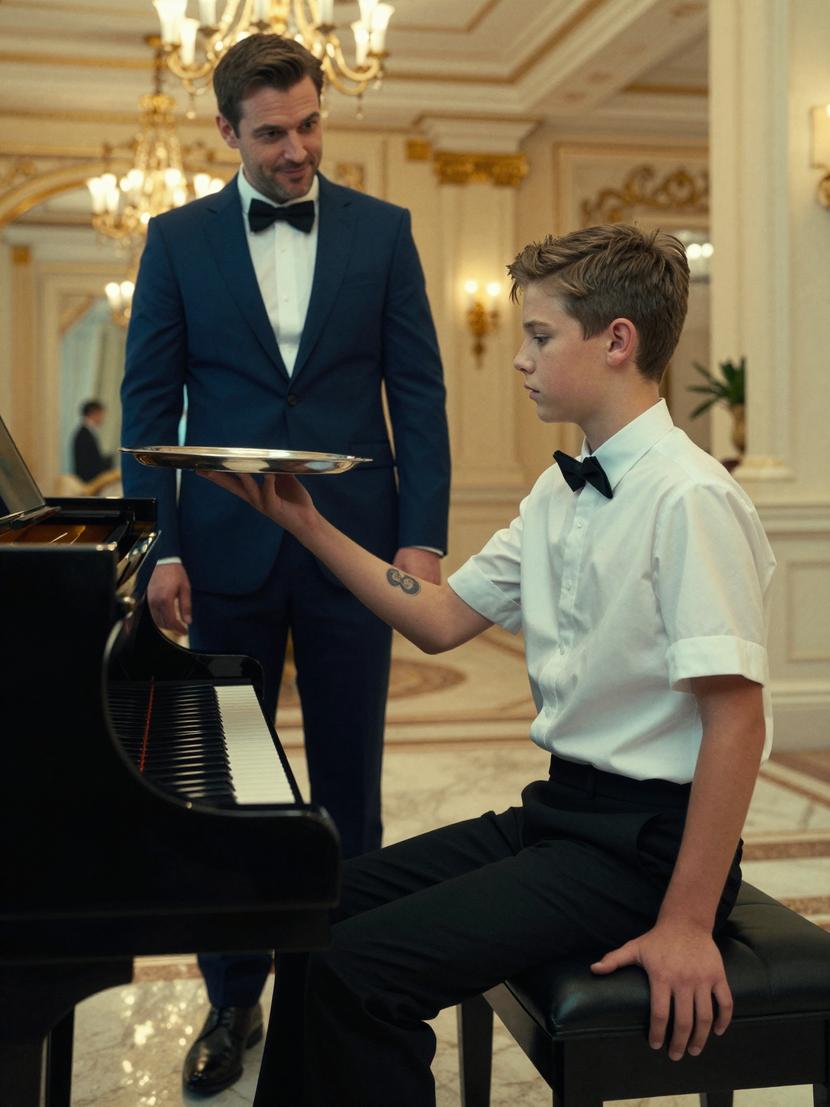
The chandelier chandeliers hung in the elegant ballroom sparkled like shards of frozen starlight, casting a warm honeyed glow that danced across the gleaming marble floor. Laughter wove effortlessly through the air, mingling with the soft murmur of aristocratic whispers and the faint, tasteful tinkling of crystal glasses meeting in delicate cheers.
This was an evening where affluence didn’t need introduction — it seeped from every shimmering gown, every polished shoe, every languid smile that suggested ease born of privilege.
Against one distant wall, a luminous black grand piano sat solemn and still, as if a majestic beast biding its time, hungry for a hand worthy enough to awaken its voice.
Nearby, barely noticeable except to those who truly looked, stood a slender boy in a crisply starched waiter’s uniform, no older than fifteen. His shoes were impeccably clean though subtly worn at the edges, and his young hands, steady despite their youth, balanced a silver tray adorned with sparkling glasses like fragile treasures.
Unseen by the revelers, Adrian had been gazing at the piano for what felt like an eternity.
To the guests, he was just another invisible piece of the evening’s machinery—silent, attentive, fading into the backdrop. But beneath his quiet exterior, his heart hammered with a force greater than the music filling the room. Each faint melody drifting through the air stirred memories he’d long tried to tuck away, calling him like a distant beacon.
Steeling himself, Adrian swallowed hard, gathering a courage that had built throughout the night like a slow-burning flame.
He edged closer to the piano, careful not to shatter the fragile moment poised in the air. Nearby, a tall man clad in an impeccably tailored navy suit laughed easily with a nearby group, his wristwatch gleaming with the promise of unimaginable wealth — likely worth more in a day than Adrian’s family earned in years.
In a voice barely louder than a whisper but carrying immeasurable weight, Adrian asked, ‘May I… play the piano?’
The man’s laughter froze mid-breath. Slowly, he pivoted, eyes scanning down the boy’s plain uniform, the glinting tray, landing finally on Adrian himself.
A mocking smirk curled his lips. ‘You? Have you ever even touched a piano before?’
A ripple of casual chuckles passed through the onlookers — not cruel, merely indifferent, the kind reserved for impossibilities.
A flush crept up Adrian’s cheeks. Old instincts begged him to look down, apologize silently, retreat back into the shadows.
But something far stronger anchored him in place.
He said nothing in reply — no excuses, no defenses — only a slow, solemn nod. Then, with delicate precision, he set the silver tray on a nearby table.
The slight clink of metal meeting wood pierced the ambient music more sharply than any loud note.
Without another word, Adrian approached the bench and seated himself before the keys.
The crowd stirred uneasily. Skepticism, curiosity, even boredom rippled in the hush.
His fingers lifted, hesitating a moment as if greeting a dear old friend lost long ago.
As his sleeve shifted upwards, a faded tattoo in the shape of a small guitar appeared on his wrist—simple, unassuming, yet unmistakably real.
The man’s sardonic smile faltered. His gaze locked onto the ink, and for the very first time that night, the amusement in his eyes vanished.
Adrian’s finger pressed a single key.
The note rang out: pure, crystalline, flawless.
Then another — then another.
Within heartbeats, tentative tones blossomed into a cascade of music so vivid, so aching with life, that all other sounds dissolved into silence. This was no mere melody. It was an outpouring of emotion — longing, hope, sorrow — all the words Adrian had never spoken surged through his fingertips.
Guests turned, glasses frozen mid-air, even distant servers paused, captivated.
The piano sang as if the music had always belonged in the elegant ballroom’s grandeur.
Each note struck with a confidence far beyond the boy’s years; this was no amateur’s touch, no shallow talent.
This was a homecoming.
Near the piano, the well-dressed man felt a sudden, unfamiliar constriction in his chest. Recognition — pure and impossible — blossomed there.
Years before, a video had quietly circulated in exclusive musical circles. A small child, no older than eight, playing with breathtaking virtuosity on a battered roadside keyboard. Raw emotion, undeniable brilliance, unforgettable.
Then the child had vanished.
No name, no past. Only a simple symbol drawn beside the keyboard in black marker: a small guitar.
The man’s voice dropped to a near breathless whisper, scarcely audible.
‘Could it be… are you the one?’
Adrian never ceased playing. But in his eyes, a silent answer flickered.
The final note stretched, hanging in the air like a question no one dared to break.
An immense silence suffused the room — profound and complete.
Slowly, applause blossomed.
One hand. Then another.
Soon, the entire elegant ballroom erupted with clapping born of awe and disbelief. People rose to their feet, some cheering, others simply staring — trying to grasp the magnitude of what they had witnessed.
Adrian lowered his hands from the keys with trembling grace.
For a flicker of a moment, fear clouded his eyes — as though he had unveiled a fragment of his soul too vulnerable to bear.
The sharply dressed man stepped forward, skepticism replaced by reverence.
‘What’s your name?’ he asked softly.
Adrian hesitated, then whispered, ‘…Adrian.’
To the crowd, the name was unknown.
But the music lingered like undeniable proof of a rare gift.
‘Where did you learn to play like that?’ the man inquired.
Adrian’s gaze drifted between the piano and his own hands.
‘My mom,’ he said quietly. ‘Before she fell ill.’
The simple words stretched, deepening the silence that followed.
‘I used to play in the underground station after… after she couldn’t teach anymore,’ Adrian continued, his voice steady but soft. ‘Someone recorded it. Then we had to move. I stopped playing for a while.’
‘Why?’ asked the man.
Adrian’s eyes dropped, shadows darkening his face.
‘Because playing didn’t pay for medicine.’
That truth landed heavier than any note could.
Around them, the glittering luxury suddenly felt fragile, almost ashamed.
The man swallowed hard, wrestling with a feeling foreign to him after all these years: regret.
‘I’m sorry,’ he said, voice thick.
Adrian shook his head gently.
‘It’s okay. You didn’t know.’
In that quiet confession, the man recognized a vital truth:
Talent thrives in the most unlikely places.
Greatness disregards wealth.
And sometimes, the person serving drinks is the most extraordinary soul in the room.
‘Adrian,’ the man said carefully, ‘would you… play again? Not as a waiter. As the musician you are.’
Adrian looked up, uncertain.
‘For everyone?’ he asked.
‘For the world,’ the man replied earnestly.
Months later, that very melody echoed through a different venue — larger, brighter, filled with an audience gathered for a single purpose.
On the stage gleamed a grand piano.
Beside it sat Adrian, no longer invisible.
When his fingers touched the keys, the music swelled with the same soul-stirring power as that unforgettable night in the elegant ballroom.
Only now, no one laughed.
They listened.
And somewhere in the crowd, the man who had once sneered quietly wiped tears from his eyes — grateful that he had been wrong.
Because sometimes, the smallest question —
‘Can I play this piano?’
— becomes the spark that lights a life the world nearly overlooked.
And sometimes… the one no one sees is exactly the one everyone has been waiting for.