
There’s an unmistakable scent that invades the emergency bay when a devastating accident sends its victims through the doors—a metallic, heavy tang of copper blood mingling with the sharp bite of antiseptic, the acrid sting of burning rubber, and the bone-chilling dampness of a relentless winter storm.
I am Laura, a senior trauma surgeon at Central City Trauma Center, and for twelve relentless years, I’ve stared into the wreckage of twisted metal and shattered lives. I believed I had armored my heart, numbed myself against the horrors humanity can endure. But that night, I was wrong.
It was a brutal Tuesday, late January, when temperatures plunged below negative ten. Highway 57 had iced over instantly in a merciless flash freeze. Our emergency radio crackled unceasingly—a monstrous twenty-five-car pile-up had brought chaos to the frozen asphalt.
The heavy double doors to the emergency bay slammed open, and with them came a tempest of freezing wind, the frantic shouts of paramedics piercing the air.
‘Trauma One! Clearing the way! Central line kit needed—stat!’ a paramedic barked, barreling a stretcher whose wheels skidded wildly on the linoleum.
I lunged forward, snapping on gloves as my nurses and residents swarmed like a hive around the stretcher.
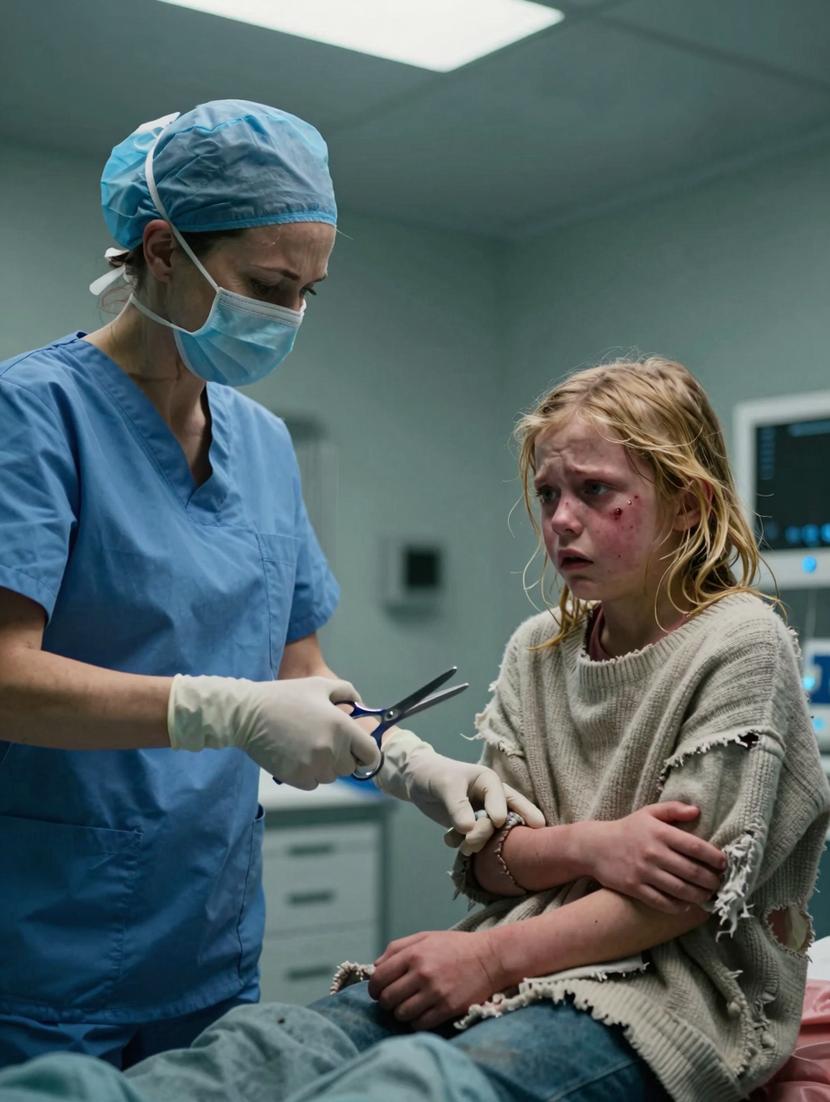
On that narrow bed lay a tiny girl, no older than seven. Her blonde hair clung damply to her pale, almost translucent skin, illuminated harshly by fluorescent lights that felt colder than the January night outside.
But it was the giant sweater she wore that seized my attention—a massive, adult-sized cable-knit, shredded and soaked, weighed down by frozen slush and filthy debris. Its wool clung to her small frame, as if trying to shield secrets beneath.
‘Talk to me,’ I whispered urgently, shining my penlight into her dimming eyes.
Her gaze was sluggish but conscious.
The paramedic panted out details: “Female, approximately seven years old. Found trapped in the backseat of a sedan crushed between two semi-trucks. Parents in the front—no survivors. Over forty minutes trapped in freezing cold. Blood pressure dropping, heart rate spiking. Possible severe internal bleeding and hypothermia.”
My heart chilled, but instinct took hold. In trauma medicine, the first sixty minutes—the golden hour—are everything. Step one: expose the patient. You can’t treat what you can’t see.
‘On three, transfer,’ I commanded. “One, two, three!’
Together, we hoisted her fragile form onto the trauma table. A faint, ragged whimper escaped her lips.
‘I’m Dr. Laura. You’re safe now,’ I soothed, voice firm but gentle. “We have to help you. Please, hold still.”
I reached for my trauma shears—rugged scissors forged to slice through winter’s weight: thick coats, seatbelts, leather. Time was no luxury.
‘Expose,’ I ordered my team.
Leaning close, I slid the shears beneath the ragged collar near her collarbone, preparing to cut through the irreplaceable wool.
Suddenly, her eyes snapped open—not sluggish but wild, desperate, filled with raw terror I’d never seen.
Before I could act, her tiny, ice-cold hands clenched fiercely around my wrist, grip like iron.
“No!” she screamed, voice cracking into the hushed bay. “Please—don’t cut it!”
Dr. Collins, my resident, stepped forward, puzzled. ‘Sweetheart, we have to. It’s soaked through—and cold. We need to see your belly to stop the bleeding.’
But she shrieked again, twisting violently, legs thrashing. She crossed her arms tightly over the sweater’s swollen front, clutching the ruined wool against her chest. “You can’t take it! Please!”
‘Hold her gently,’ I instructed nurses, calm but alarm rising. Her heart monitor blared panic in every beep. Every fight stole precious life.
I leaned closer. “Honey, I’m so sorry, but I have to cut the sweater off. You’re hurt badly. If I don’t, you could die. Please understand.”
I moved the scissors downward, aiming to cut from the hem up.
Her sobs erupted—a deep, wrenching sob that shook her tiny frame. “Please, please,” she begged, eyes locked on mine. “If you cut it… he’ll die. I promised Mommy I’d keep him safe.”
Time stalled.
The shears hovered in midair.
Silence swallowed the trauma bay save the harsh rhythm of her heart monitor and the howling wind beyond the windows.
The weight of her words rippled through me.
Not a child’s fear, but fierce, protective love.
I peered down at the enormous sweater trembling in her grasp, its bulk oddly distorted.
Dropping the scissors with a clatter, I whispered, “Nobody move.”
Slowly, I raised my hands, showing sheathed palms.
“Okay,” I said softly, voice trembling. “I won’t cut it. But you have to let me see inside.”
Tears streamed down her pale, bruised face. Shivering from hypothermia, she hesitated—then, trembling, she peeled back the thick wool.
I leaned in, staring into the deep, dark expanse beneath the oversized sweater.
My breath hitched.
My knees weakened.
Nestled against her freezing skin was a fragile, impossible sight—a newborn face, pale and fragile.
Ethan.
An infant no more than weeks old curled tight, cocooned by his sister’s body heat and their father’s massive sweater.
His lips were a haunting blue, chest fluttering in shallow gasps—but alive.
A stunned hush fell over us all.
Dr. Collins whispered brokenly, “Oh my god.”
Adrenaline surged.
‘Call the Silverlake NICU! Neonatal team—STAT! Severe pediatric hypothermia, infant unknown age! Move!’ I roared.
Scrambling nurses sprinted to phones. Organized chaos erupted anew.
Back at the table, the little girl’s shaking gaze met mine.
“I kept him warm,” she murmured. “Mommy said… keep Ethan warm.”
Tears pricked my eyes, blurring vision. I blinked fiercely—no training could prepare me for such sacrifice.
Trapped for forty merciless minutes in that crushed sedan, she’d watched her parents perish. Naked to frostbite, she’d stripped her own coat, layered on their father’s heavy sweater, and wrapped Ethan tight against her bare skin—a living incubator, her fragile warmth his only shield.
“You did perfectly, sweetheart,” my voice cracked. “You’re a hero. You saved him. But now I have to take him so my friends can warm him. Can you do that for me?”
Her haunted eyes searched mine, then slowly released their iron grip.
“Okay,” she whispered.
‘Dr. Collins, blankets! Now!’ I ordered.
I slid my gloved hands beneath Ethan’s tiny armpits, lifting him like a feather.
Cold as marble—until the trauma room’s air hit, stirring a faint, precious cry.
Nurse Robinson stepped forward, wrapping him in heated blankets.
The neonatal team burst in with a radiant isolette incubator, surrounding and whisking him away to safety.
Turning to Abigail—it finally was time.
With steady hands, I raised the trauma shears and sliced through the sweater’s center. Peeling away soaked wool, her mottled skin revealed a dark, ominous bruise stretched across her belly—the brutal imprint of a lap seatbelt.
The “seatbelt sign” in trauma care was never good.
Underneath, her abdomen was rock hard.
Internal bleeding flooding her fragile body.
“She’s crashing,” Dr. Collins warned, tension thick.
As her blood pressure plummeted, heart rate soared, she sank into shock.
Her eyes rolled back.
“She’s gone,” a nurse cried.
“Massive transfusion! O-negative, rapid! Pediatric intubation kit, now!” I shouted, gripping the stretcher rails.
Controlled chaos grasped us as Dr. Collins intubated, Therapist Adams bagging breaths. But the bleeding was relentless.
“We’re skipping CT,” I ordered. “Straight to OR 7. No time for pictures. Find the bleed—now!”
The surgical team awaited as we barreled down hospital corridors, blood bags squeezed with urgency.
“Hold on, Abigail. Fight for us,” I breathed.
Inside OR 7, under merciless lights, we laid her bare, draped in sterile blue but for a window of bruised flesh.
Dr. Wilson gave a somber glance. “She’s barely holding. Be fast, Laura. If she arrests…”
“Scalpel,” I replied, palm open.
With a sharp incision, I breached muscle—and was drowned in dark, voluminous blood.
A flood unleashed.
“Suction! Maximum!” I commanded.
Blind and desperate, I plunged hands into her cavity against icy blood and swelling organs.
Packing gauze frantically, we pushed and pinned bleeding in a primitive battle to cling to life.
‘Okay, Collins, slowly remove the upper left pack on my count!’
Blood erupted in a geyser—shattered spleen, torn artery.
“Clamp!” I roared.
Pinching ruptured vessels with bare fingers—then securing clamps—bleeding eased.
“She’s stabilizing!” Dr. Wilson exhaled.
Damage control dictated: fractured spleen removed, packs left inside, abdomen left open beneath a vacuum dressing to protect her fragile lungs.
Later, drained and exhausted, I scrubbed my hands raw and sought answers.
Up to Silverlake NICU, the air thick with baby lotion and quiet hope, I found Lieutenant Harris standing near Ethan’s incubator—pink and peacefully breathing, shielded from the deadly cold by Abigail’s warmth.
He recounts: a blue sedan trapped and crushed on Highway 57, parents lost instantly.
Abigail, hidden under her father’s sweater on the floorboard, silent and terrified.
A frightened girl who growled like a wounded animal when rescued.
“I thought she was clinging to a toy,” he whispered.
“She unbuckled Ethan,” I realized, heart breaking anew. “In freezing dark, she freed him, wrapped him in warmth, and became his protector.”
“Seven years old,” the lieutenant said softly. “Abigail and Ethan. Coming home from their grandparents.”
Back at Willow Pediatric ICU, surrounded by beeping machines, Abigail lay frail and tethered by tubes—her body fighting for life.
Hours passed in vigil, the storm outside raging in sympathy.
At dawn, her vitals steadied—a fragile victory.
But then came the terror of awakening.
She woke terrified, thrashing violently, bound to her bed, choking on the ventilator.
“No sedatives yet!” I snapped, stopping Nurse Jenkins. “We must know her brain survived.”
I leaned close, voice sharp: ‘Abigail! Look at me! You’re safe. You’re in the hospital. Do you understand?’
Her wild eyes locked onto mine, her small hands clawing at the empty space where Ethan had been.
She was searching for him.
I called Janet in the NICU.
“Open FaceTime—show her Ethan—now!”
A moment later, the glowing screen displayed Ethan, warm and breathing peacefully.
I held the phone to Abigail’s face.
The transformation was immediate.
Her panic dissolved, hands fell slack, tears shifted from sheer terror to overwhelming relief.
“He’s okay,” I whispered. “You saved him.”
For days, I remained by her side, watching as her body weathered each storm—from open wounds to sepsis, darkness and doubt.
Finally ready, the second surgery loomed—a perilous attempt to close the wounds, wash away infection, reunite broken tissues.
But beneath the sterile drapes, death had taken root—the dark, necrotic blackness of starved intestines threatening to reclaim her.
Chaos erupted. Abigail’s heart faltered; CPR thundered. We fought for every breath, every beat.
I cut away death and poured warm saline floods, desperate to stem the tide.
When all seemed lost, a faint rhythm flickered on the monitors—a pulse, fragile and slow, but alive.
Three exhausting hours later, her wounds closed, infection contained.
Days turned to a long, anxious week as Abigail lingered in deep coma, her fight quietly fierce.
Meanwhile, Ethan thrived, a vibrant pink beacon of hope taped proudly by her bedside.
At last, sedation eased, breathing tube removed, Abigail woke—weak, weary, but awake.
Her first words, a rasping whisper: “Is Ethan really warm?”
I smiled through tears. “He’s warm. He’s safe. He’s thriving.”
Nurses brought Ethan to her side. Fragile arms wrapped around a brother saved by her courage.
“I got you, Ethan,” she murmured, cradling warmth and love.
Before they left for a new life with their grandparents, I gave Abigail a small, folded scrap—a piece of her father’s sweater, a symbol of strength and protection.
“Hold this when you’re scared or cold,” I told her softly, “and remember the warmest heart I’ve ever seen.”
She clutched it to her chest and whispered a grateful thanks.
As they rolled away, I stood rooted, knowing trauma had shown me something profound: in the deepest darkness and coldest despair, the human spirit can blaze with a fierce, life-saving light.