
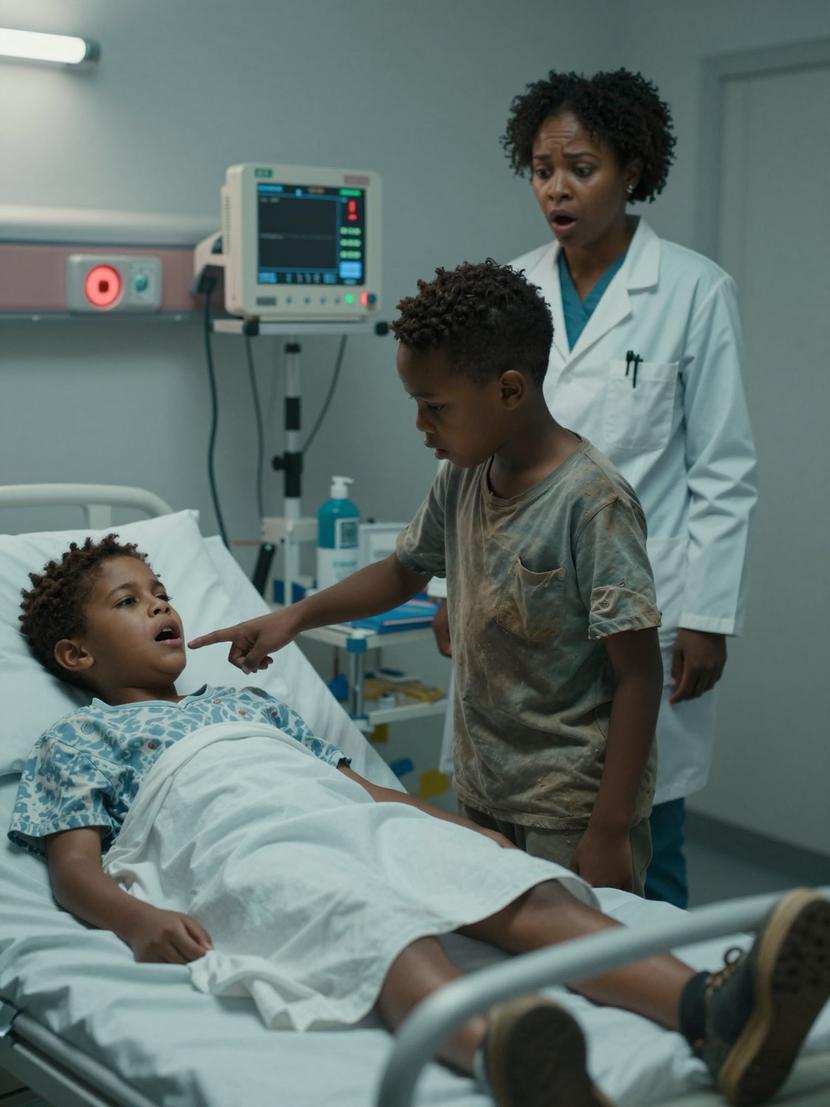
The intensive care unit hovered in a fragile silence, punctuated only by the relentless beep of monitors marking the fading life of a boy no one could save. Eighteen of the world’s most brilliant doctors stood frozen, exhausted and baffled, as Jasper’s chest rose and fell with shallow, desperate breaths. Unknown to them, a quiet truth lay hidden deep in his struggling throat, unnoticed and unexamined amid the medical frenzy.
Then came Darian’s small, steady voice—a whisper cutting through despair—soft but piercing, the kind of voice no one expected to hold the key to a miracle eighteen experts had overlooked. The boy stepped forward, eyes fierce and focused for someone so young, his presence an outlier in the sterile room dominated by power and prestige.
Darian tilted his head, his gaze narrowing with quiet intensity. He sensed something amiss, a subtle hitch in the rhythm of Jasper’s breath—a faint resistance like a shadow lurking in the curve of his throat where machines failed to see.
The doctors exchanged hesitant glances, skeptical but clinging to hope as he pointed determinedly to the hidden bend of tissue elusive to their tests and cameras. Suddenly, alarms screamed into life, pumps flashed red, and chaos erupted around the bedside—nurses rushing, doctors commanding—while Darian held his ground, his eyes locked on a truth no one else dared trust.
Just ten years old, dressed in worn clothes with holes worn into his threadbare shoes, Darian seemed worlds apart from the luxury of the Whitmore estate. Yet he refused to look away from the fragile boy gasping for air.
Eighteen doctors had failed Jasper despite their knowledge, their machines, their polished credentials. Gabriel Harper, the billionaire father, stood shattered—his tailored suit rumpled, his face a mask of powerless grief as he watched helplessly, realizing that no amount of wealth could buy salvation. Hope, fragile and unexpected, had come from far beyond his world.
Weeks before, life had seemed perfect for Gabriel Harper, a titan praised as both visionary and philanthropist, a builder of hospitals and dreams—yet blind to the stark realities just beyond his estate walls. The Whitmore estate towered large and opulent, a fortress of comfort, but his greatest joy was Jasper—gentle, brilliant, compassionate—and untouched by the arrogance that wealth often breeds.
That stormy morning, Jasper had asked questions that pierced Gabriel’s rehearsed defenses. He spoke softly about homeless children, faces blurred in the cold shadows outside Gracewood Chapel, wondering aloud why some suffered in silence while others bathed in privilege. Gabriel, rushed and distant, dismissed the questions with rehearsed complexity, opting for meetings over moments—unaware that these words would come back to haunt him when raw truth demanded courage.
Hours later, Jasper collapsed at school without warning. The ordinary day turned to nightmare. Doctors flooded the scene, rushed him to the hospital, and Gabriel’s illusion of control shattered into countless pieces.
Specialists gathered, machines swarmed his son’s bedside, and every test returned inconclusive—confidence slipping into confusion, power dissolving into fear. Days stretched endlessly as Jasper weakened, breath shallow, skin pale as winter frost.
Gabriel scoured the globe, calling in experts, convinced that somewhere, hidden inside the archives of medical knowledge, lay salvation money could unlock. But none arrived.
Desperation pulled Gabriel to Gracewood Chapel—the only place Jasper had ever noticed, a place Gabriel never thought to truly see. Inside, stark yet alive, warmth replaced grandeur, and hope replaced despair. Here, Grandmother Mabel, a fixture of faith carved from decades of service and hardship, greeted him with steady eyes and open heart.
Among the children sat Darian—an orphan, an observer—absorbing donated medical books with a wisdom beyond his years, noticing patterns and whispers that escaped even some professionals. He listened, not just to words but to silences, attuned to the invisible.
Gabriel poured out Jasper’s story, voice cracking under the weight of helplessness. Grandmother Mabel listened patiently, a living reminder that even fragmented paths can lead somewhere meaningful, even when darkness obscures the way.
As Gabriel prepared to leave, Darian’s quiet voice stopped him. “Sometimes,” he said softly, “the answers hide where no one thinks to look.” Gabriel smiled, initially brushing the remark aside as the ramblings of a child—until the night Jasper stopped breathing.
Chaos erupted as sirens screamed, doctors battled to revive his son, and Gabriel crumpled—a man undone by raw fragility. The doctors finally admitted defeat, and Gabriel remained at Jasper’s side, praying in the silent bargain of hopelessness, bargaining with nothing but faith.
Dawn brought a glimmer—the arrival of Dr. Harper, sharp-eyed and relentless, whose unconventional theory challenged the status quo. She suggested a tiny obstruction might be lurking, subtle and elusive, evading the detection of standard scans.
Hope flickered as teams probed endlessly, days passing in agonizing frustration. Jasper’s strength waned; Gabriel abandoned all else, choosing presence and prayer over profit and power.
Grandmother Mabel returned with Darian, bridging worlds with nothing but trust and quiet conviction. Exhausted skepticism gave way, and permission was granted for the boy to observe.
Darian approached Jasper not as a clinical puzzle but as a story crying to be heard. Watching the fragile breaths, he noticed hesitation in assisted breathing, a subtle struggle where machines measured only numbers.
He pointed again to the shadowed bend in Jasper’s throat, prompting Dr. Harper to reconsider overlooked angles born of routine fatigue.
When Jasper’s breath finally failed again, an emergency endoscopy was performed with patient precision. This time, the camera lingered where haste had once swept by—revealing a cruel secret: a tiny plastic fragment lodged like a trap.
The fragment—a mere blue pen cap broken into a fragment—had formed a deceptive valve, allowing life by a thread while suffocating slowly, hidden from scans but deadly persistent. The room shuddered with the shock of revelation.
Gabriel recalled Jasper’s habit of chewing pen caps, moments once dismissed as innocent quirks now laden with painful meaning. Guilt surged as the accident, the silence, and the invisible harm converged.
Jasper awoke, fragile and wary, whispering truths about school, fear, and a shove that sparked more than bruises—emotional wounds borne in silence, shielded to protect his father’s busy world.
Gabriel listened, broken and humbled, vowing presence over absence, honesty over denial, unity over isolation—recognizing the strength woven in vulnerability and the courage in his son’s quiet endurance.
Healing blossomed with each steady breath, peaceful sleep replacing restless nights. Hope rekindled, shining brightest through the boy who had saved a life without seeking glory.
Darian spoke of invisibility—how he observed what others missed because his own presence went unseen—reminding Gabriel that often, the voices overlooked hold the keys to salvation.
When asked about reward, Darian refused money, requesting only attention for children like himself—those waiting not for charity but for belief.
Gabriel, transformed, returned to Gracewood Chapel with builders and blueprints, seeing poverty not as a distant problem but a call to action. He committed resources, listened deeply, and learned humility through genuine service.
Hope reshaped the shelter, and Darian rose as an advisor—championing inclusion, collaboration, and dignity—crafting futures through partnership rather than rescue alone.
But in the shadows, Martin Caldwell watched resentment simmer and envy harden into calculated plans. As admiration shifted, Martin unearthed long-buried secrets, unleashing threats cloaked in silence.
Faced with confrontation, Gabriel admitted past wrongs without defense—choosing honesty over shame, compassion over conflict—refusing fear’s dominion over his morality.
He extended understanding where retaliation awaited, leaving Martin disarmed, confronted by his own bitterness where enemies dissolved into emptiness.
At home, Jasper recovered, new friendships blooming, and Gabriel learned that true leadership begins not with control but with listening—balancing justice with empathy.
Darian’s keen observation saved one life, but his profound lesson saved many—revealing that miracles often come disguised as the neglected voices finally allowed to be heard.