
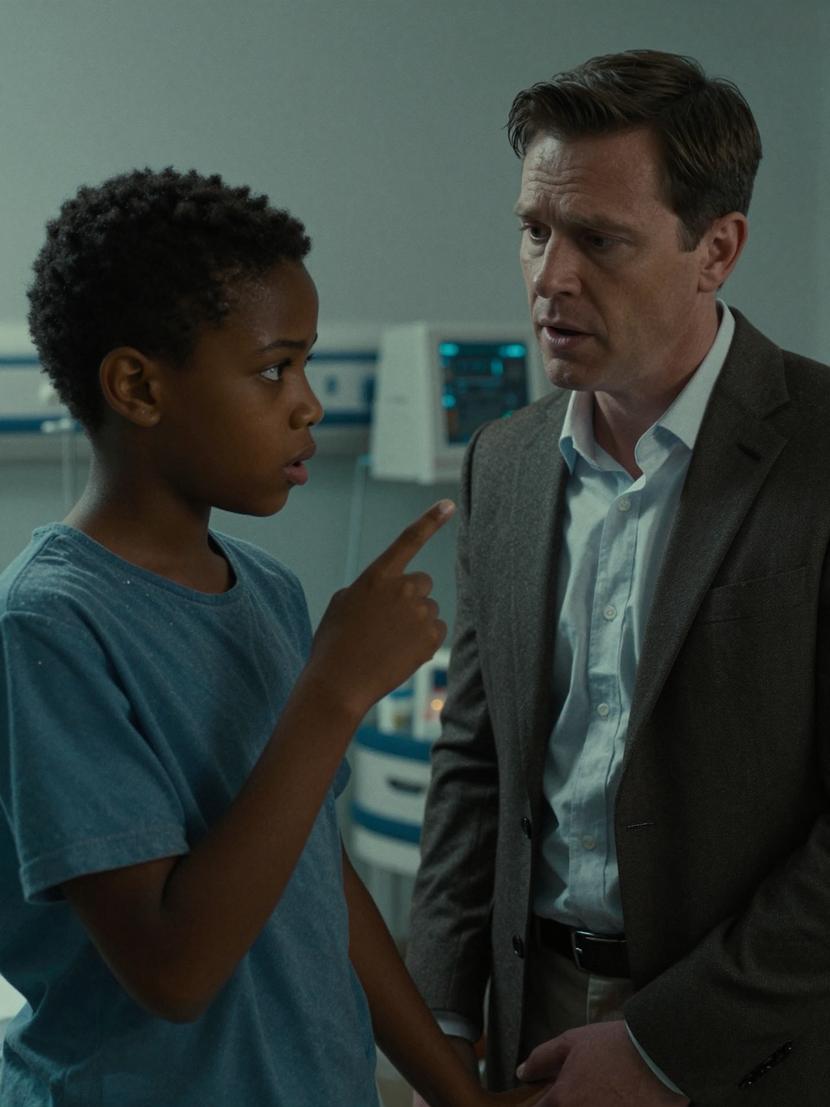
The sterile silence of the intensive care unit felt suffocating, as the endless beeping of monitors echoed like a dirge. Around the bed lay eighteen of the world’s most esteemed doctors—experts renowned for their brilliance—yet all frozen, helpless, watchful over a child whose life was slipping away. No one saw the invisible threat lingering quietly in Liam’s desperate struggle for each breath. Minutes ticked by with no movement, no solution, no hope. Until a soft voice, barely heard over the chaos, broke the stillness—spoken by a boy nobody expected to hold the key to a mystery that had eluded the brightest minds.
Darian tilted his head slightly, eyes narrowing in deep, focused thought. He sensed something amiss where the flow of air should have been smooth and constant—a hesitation, a subtle blockage hiding in the shadows of Liam’s throat. It was a detail invisible to machines and overlooked by fatigued experts.
The doctors exchanged doubtful glances but, driven by desperation, they allowed Darian’s voice to point—straight toward a hidden bend, a shaded corner where cameras had failed to linger, and exhausted examinations had rushed past.
Suddenly, alarms blared—urgent, piercing. Monitors flashed fiery red, and the room erupted into controlled chaos: nurses sprinted, doctors barked orders amid frantic movements. Yet Darian remained still, unwavering, his eyes locked on the boy whose fragile life depended on what he had noticed.
At just ten years old, clad in tattered clothes and worn shoes, Darian looked out of place amid the weight of wealth, influence, and prestige. Yet his gaze never faltered.
Eighteen doctors had come and gone, armed with vast knowledge, cutting-edge technology, and global acclaim—and all had failed Liam. His father, Damian Calder, a billionaire once certain that money could conquer any crisis, now stood broken and powerless, clinging to the smallest thread of hope.
Damian’s tailored suit was rumpled, his usually sharp eyes hollow as he faced the unshakable truth: wealth could not command miracles. Yet hope slipped quietly into the room—not through the hands of experts, but through the eyes of a boy the world had taught him to overlook.
Weeks earlier, Damian’s life had seemed perfect. Praised as a visionary and philanthropist, a man reputed for building hospitals, he never paused long enough to see the suffering lurking just beyond the shadows of his extravagant mansion in Brighton. Within those walls overflowed luxury, but Damian’s greatest treasure was his son Liam: gentle, brilliant, and kind-hearted, untouched by the arrogance that often cloaks privilege.
That rainy morning, Liam’s innocent curiosity shattered Damian’s carefully rehearsed composure. Liam spoke softly about the homeless children huddled outside their neighborhood church, wondering why some lives were forgotten and others surrounded by comfort. Damian deflected him with practiced explanations, speaking of complexity and commitments, choosing meetings over moments—a choice that would soon return to haunt him.
Hours later, Liam collapsed at school without warning. An ordinary day twisted suddenly into a nightmare. Surgeons and specialists swarmed, the machines encircled Liam, but every test baffled the experts. All returned inconclusive—confidence crumbling to confusion—proof that even power held no dominion over fear and the unknown.
Days stretched unyieldingly as Liam’s breaths grew shallow, his skin faded to ghostly pallor. Damian summoned the best from across the globe, searching for answers money might buy. None succeeded. Helplessness settled like a cold fog, as Damian watched his son vanish before his eyes—knowing brilliance, ambition, and wealth could not shield against loss.
In a moment of desperation, Damian found himself at the small church Liam had noticed, drawn by uncertainty—seeking solace, perspective, or grace. Inside, stark warmth embraced him. Luxuries gave way to shared humanity, embodied by Grandmother Mabel. Her lifetime of service and unshaken faith offered quiet strength against decades of hardship.
Among the children sat Darian—an orphan with observant eyes—quietly immersed in medical books donated to this humble sanctuary. His mind devoured patterns and details many would miss, listening more closely than most dared.
Damian shared Liam’s story with a fractured voice; Grandmother Mabel listened patiently, believing that even broken paths could still lead somewhere hopeful, even when darkness obscured the way.
As Damian turned to leave, Darian whispered, ‘Sometimes the answers hide where no one thinks to look.’ Damian barely heard the words, dismissing them as childish hope.
That night, everything crashed down again. Liam stopped breathing. Alarms screamed, and frantic efforts flooded the room. Damian collapsed to his knees, watching fragility in its rawest form, stripped of power and pride.
Doctors confessed defeat, uncertainty hanging heavy in the air. Damian prayed through the long, merciless night—bargaining with silence, begging for mercy without expectation.
Morning delivered Dr. Carlisle—sharp-eyed, relentless—a woman willing to challenge convention. ‘I believe something small,’ she said, ‘something subtle may be blocking Liam’s airway. It might evade machines designed to catch only the obvious.’
Hope flickered once more as teams scoured every angle. Days passed, and failures multiplied. Liam weakened further. Damian abandoned business pursuits, devoting himself wholly to the boy, presence supplanting profit.
Finally, Grandmother Mabel returned, accompanied by Darian. With no credentials, but armed with acute observation and trust, they challenged convention—testing Damian’s desperation against his pride.
Too weary to resist, the doctors permitted Darian’s silent examination. Not as a case, but as a story to be understood, he listened deeply.
He noticed once again the hesitation that punctuated assisted breaths, and his finger pointed toward that concealed bend—a place once dismissed by routine but now reluctantly reconsidered by Dr. Carlisle.
When Liam’s condition crashed again, an emergency endoscopy was performed. The camera lingered where fatigue had once hurried it past—unveiling the sinister truth: a tiny fragment of plastic lodged just right, creating a cruel valve.
This fragment, a piece of a blue pen cap, was a silent killer—undetectable by scans, yet slowly suffocating Liam’s life over weeks.
The surgeons extracted the fragment with delicate care, a moment heavy with thunderous realization.
Damian recalled whispers of Liam chewing pen caps—a habit ignored, a moment missed. Guilt crashed over him like a wave, connecting accident to silence, to the hidden pain.
Liam awoke gently, whispering truths no one had heard—stories of school hallways shadowed by fear, a shove hidden beneath laughter, and wounds deeper than flesh, carried alone to protect his busy father.
Damian listened, broken by regret but resolute to change. He promised presence, honesty, and unity—understanding now that true strength grows from vulnerability, and courage thrives in quiet endurance.
Healing soon followed. Liam’s breaths grew steady, his sleep peaceful, and hope blossomed anew.
Damian turned to Darian, the boy who had rescued his son without seeking recognition.
Darian spoke softly of invisibility—how living unseen made him notice what others missed—and he reminded Damian that the answers often dwell in the overlooked.
When offered a reward, Darian refused money, asking instead for attention for children like him—those waiting to be seen, waiting for belief instead of charity.
Transformed, Damian returned to the church with builders and plans, seeing poverty with clear eyes. He committed resources, listening intently, learning humility through service.
Hope reshaped the shelter, and Darian became an advisor—insisting on inclusion, collaboration, and dignity—crafting futures built on shared effort, not rescue alone.
But in the shadows, resentment brewed. Gavin Harrington watched fame and admiration shift away, jealousy hardening to strategy. Quiet threats emerged; buried secrets surfaced. Damian faced confrontation, the true test of whether redemption endures scrutiny and whether change can survive truth.
Before his rival, Damian admitted past mistakes without defense—choosing openness over denial, compassion over combat—refusing to let fear steer morality.
Offering understanding rather than retaliation, he left Gavin unsettled, exposed not by enemies but by his own emptiness.
At home, Liam recovered fully, friendships blossomed, and Damian learned to balance justice with empathy—realizing leadership begins with listening, not control.
Darian’s simple observation had saved one precious life—but his profound lesson saved countless more, proving that miracles often arrive disguised as neglected voices finally given permission to speak.