
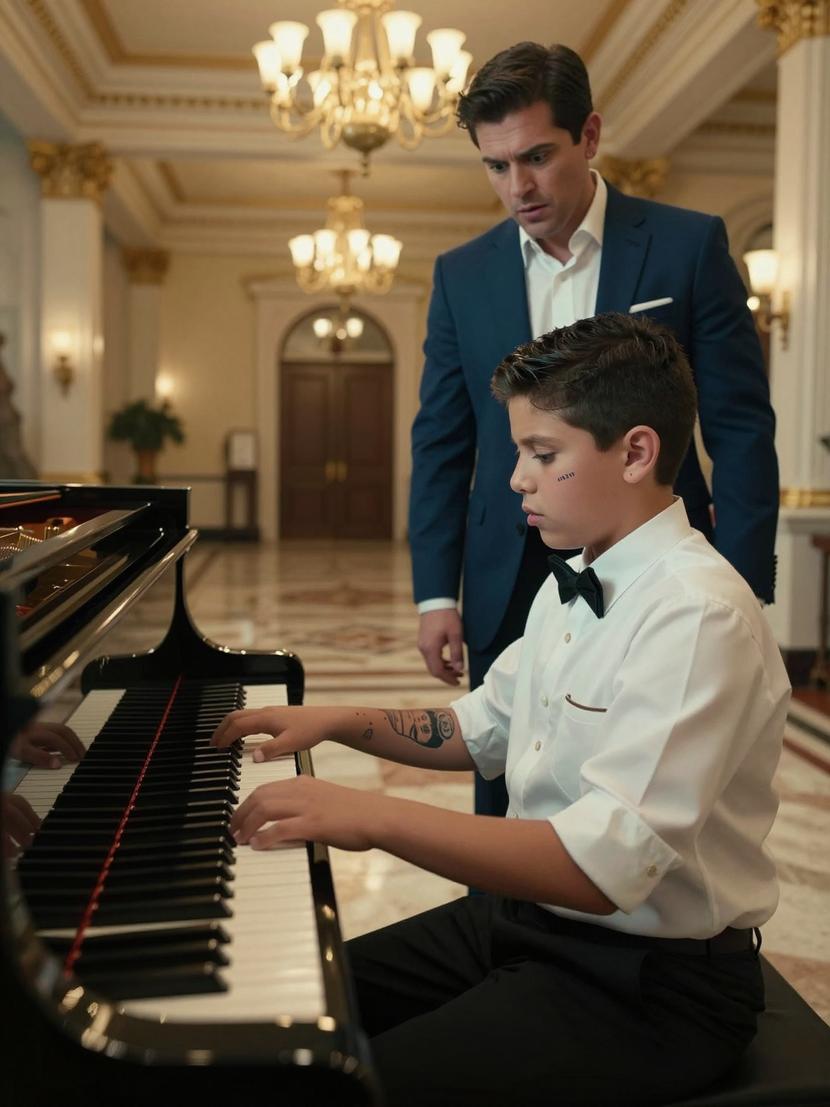
Beneath the glittering chandelier in the opulent hall, light scattered like shards of frozen starlight, dancing with a golden warmth that kissed the polished marble beneath. The air buzzed softly with laughter, conversations weaving through the space, punctuated occasionally by the delicate clink of crystal glasses. It was an evening where affluence breathed in every fabric, in every effortless grin, needing no introduction—only presence.
Against the far wall rested a glossy black grand piano, majestic yet silent, as if holding its breath, waiting for a worthy soul to summon its voice. Nearby, almost invisible amid the sparkling crowd, stood a slender boy cloaked in a perfectly pressed waiter’s uniform. Not yet sixteen, Mateo’s shoes were neat but bore the soft scars of time, his young hands steadied a silver tray brimming with sparkling glasses.
No one noticed how his gaze had lingered so long on the piano, nor did they see the stirring within him—a pulse beating louder than the music that floated softly from unseen speakers. Each delicate note seemed to reach into his memory, tugging him closer to a forgotten dream.
A swallow. A trembling breath. Courage—the kind that had taken the entire evening to muster—gathered silently within him. Step by cautious step, Mateo edged toward the piano, careful not to shatter the fragile moment.
Close by, a tall man in a tailored navy suit laughed with a circle of guests; his wristwatch shimmered like a secret fortune, its worth likely surpassing Mateo’s family annual income. The boy’s voice, soft and uncertain but genuine, broke through the hum. ‘May I… play this piano?’
A pause hit the man’s laughter, the room’s light flickering as attention shifted. He turned, eyes scanning downward until they rested on the uniform, the tray, the young boy. A smirk cracked his face.
‘You?’ His voice carried just enough for others to hear, soaked in disbelief. ‘Have you ever even touched a piano before?’
Laughter trickled from the guests—mild, not mocking, but dismissive, like a joke too obvious to merit defense.
Heat flared across Mateo’s cheeks. The old reflex urged him to lower his eyes, to apologize and retreat into invisibility. But something more potent anchored him still.
Without a word of defense, without protest, he gave a solitary, confident nod. The silver tray landed softly on a nearby table—its faint clatter louder than any background melody.
He seated himself at the piano bench.
A hush drifted through the crowd—an uncertain stirring. Some watched with curiosity, others with amusement, a few already texting beneath the low lights. Mateo lifted his hands, letting them hover above the keys, as if greeting an old friend separated by too many years.
His sleeve shifted subtly, revealing a small, weathered guitar tattoo etched on his wrist—simple, faded, undeniable.
The man’s amused expression faltered, his gaze locked onto the mark. The smile fled.
Mateo pressed a single key.
A crystal-clear note resonated—a cry of purity and perfection. Then another. And another.
Within moments, tentative murmurs dissolved as the air thickened with music so vivid and alive it washed over the guests, stealing their breath unnoticed. The melody bore more than beauty; it carried a tapestry of emotions—longing, memory, hope, loss—every fragment of Mateo’s untold story poured through his fingertips.
Glassware paused midair. Servants halted at a distance. Conversation melted away before the swell of the song. The piano and the hall breathed as one, echoing a homecoming that had never truly ended.
Near the keys, the sharply dressed man felt a pang twist inside him—a recognition he had long buried. Years ago, a secret video had circled quietly among private music circles: a child no older than eight, playing with raw, breathtaking brilliance on a battered roadside keyboard. The world held its breath then, but the child vanished—no name, no trail, only a solitary symbol drawn in marker beside the instrument: a small guitar.
His voice dropped to a whisper, fragile yet charged: ‘Wait… are you the one?’
Mateo’s fingers never faltered, but in his gaze, the answer shimmered.
As the last note lingered like a question hanging in the air, deep and profound silence claimed the room.
Then applause began—a single hand at first, hesitating—but swiftly growing into a roaring tide. People rose, some cheering, others simply stunned, grasping the magnitude of the moment they had witnessed.
Mateo lowered his hands softly, vulnerability flickering in his eyes as though he had bared too much of his soul to the world.
The man approached, the earlier mockery gone, replaced with respect and something tender.
‘What’s your name?’ he asked, voice gentle.
Mateo hesitated, then whispered, ‘Mateo.’
The name hung lightly among the opulence, unfamiliar to the crowd. But the echo of music remained—the undeniable proof of a rare gift.
‘Where did you learn to play like that?’ the man pressed.
Mateo’s gaze fell to the piano, then back to his own hands. ‘My mother,’ he said softly. ‘Before she got sick.’
The room seemed to breathe in the silence, heavier somehow.
‘I played in the subway after… when she couldn’t teach anymore,’ he continued, voice breaking slightly. ‘Someone recorded it—then we had to move away. I stopped playing for a time.’
‘Why?’ the man asked, leaning closer.
Mateo’s eyes dropped once more. ‘Because playing didn’t pay for medicine.’
The truth settled like a weight, louder than any note. Around them, the dazzling luxury suddenly felt fragile, almost ashamed.
The man swallowed, wrestling with a long-lost regret.
‘I’m sorry,’ he said, almost to himself.
Mateo shook his head, a small, forgiving smile surfacing. ‘It’s okay. You didn’t know.’
In that quiet moment, the man understood something vital: brilliance arises anywhere, untethered by wealth or circumstance. Sometimes, the brightest stars shine hidden behind the most unassuming masks.
‘Mateo,’ the man said carefully, ‘would you… play again? Not as a waiter, but as a musician.’
Mateo looked up, uncertain but hopeful.
‘For everyone?’ he asked.
‘For the world,’ the man confirmed.
Months later, the same haunting melody graced a grander stage—brighter, larger, a room brimming with expectant faces. There, a gleaming piano awaited.
Beside it sat a young performer no longer unseen.
When Mateo’s fingers met the keys, the music carried the hopes and echoes of that unforgettable night, but now, no one laughed.
They listened.
And in the crowd, the man who once doubted wiped silent tears from his eyes—grateful that he had been wrong. For sometimes, the quietest question—
“Can I play this piano?”
—becomes the first note in a life the world almost forgot.