
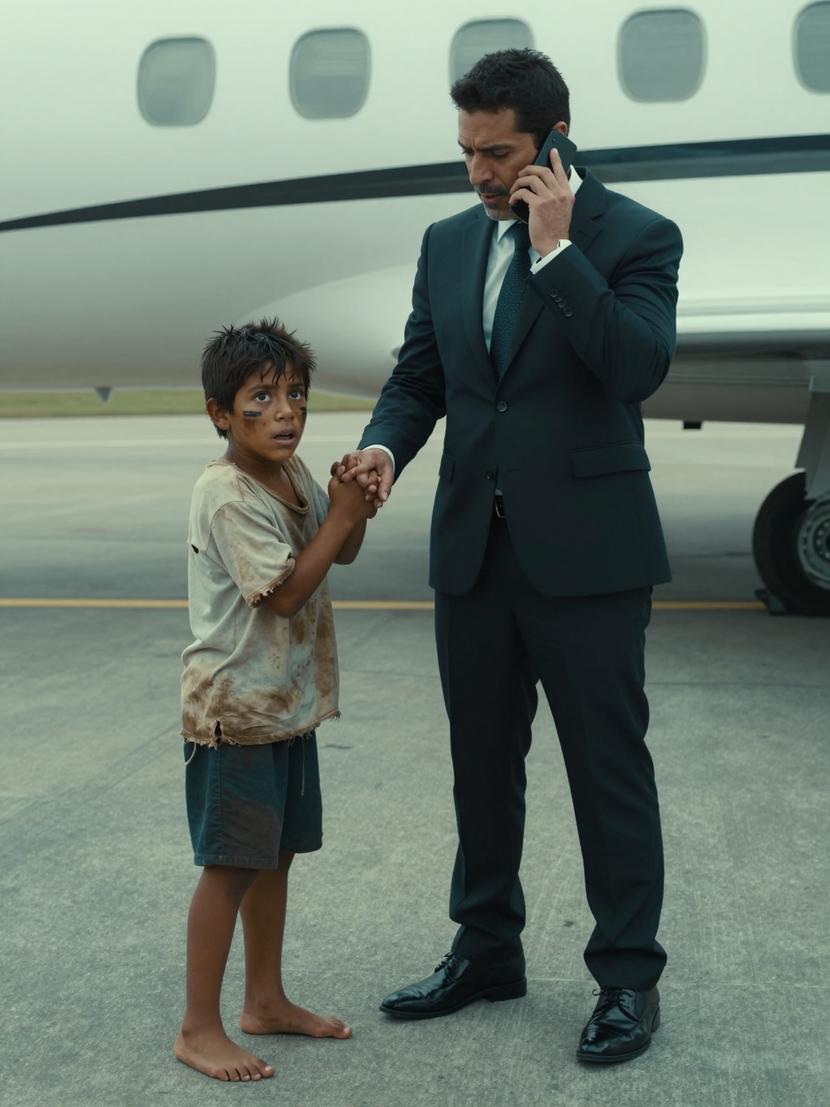
The roar of the jet engines filled the air, a sharp, relentless pulse vibrating through the runway as the boy sprinted forward.
People later whispered they’d only noticed him because he seemed impossibly out of place. Not on that runway. Not near a private jet. Not anywhere near the controlled chaos surrounding the sleek machine.
He was barefoot, his thin feet skimming the polished concrete. His shirt hung ragged, torn at the shoulder, smeared with dark oil that streaked across his sun-kissed face like tribal war paint. No older than twelve, fragile, trembling—and running with a desperate urgency, like invisible shadows clawed at his heels.
Ahead of him stood a man who embodied power—Carlos Moreno—worth more in numbers than most dream of.
Carlos straightened the cuff of his Italian suit, a sharp contrast to the grimy boy charging at him. Phone pressed to his ear, his voice steady—calm, controlled, untouchable.
‘Tell them I’ll sign this deal only after we land,’ he said, voice iron-clad. ‘No delays.’
Then a small, grimy hand clutched his sleeve.
‘Sir—please—don’t board that jet!’
The plea was raw—half scream, half prayer.
Carlos froze.
An air hostess reacted instantly, stepping between them, heels striking the runway with sharp clicks, her irritation plain.
‘Hey! What do you think you’re doing?’ she barked, shoving the boy backward. ‘You have no business here!’
The boy stumbled but held his ground, gripping the jet’s side, eyes wide, breaths heaving.
‘Please,’ he gasped. ‘Please, sir—’
‘Security!’ the hostess commanded, voice rising. ‘Remove him!’
Eyes turned. Pilots paused, ground crew stopped. Two suited men glanced away, pretending not to see. That was the world Carlos moved in: problems vanished rather than acknowledged.
Any other man would have ignored the boy, turned away.
But something in Carlos’s gut tethered him.
Maybe it was the boy’s refusal to weep.
Maybe the absence of a beggar’s plea for money.
Or perhaps the intensity of those eyes—locked not on him but beneath the jet.
“Stop.”
Carlos’s voice sliced through the noise like a sharp blade.
The hostess turned, startled. ‘Sir, he’s causing a scene—’
‘I said stop,’ Carlos repeated, his gaze steady on the boy. ‘Let him speak.’
The runway held its breath.
The boy swallowed hard, hands shaking like leaves in a storm.
‘I clean under planes,’ he confessed quietly. ‘I wipe oil, check bolts. Not supposed to touch anything else. But today—I saw.’
The hostess snorted dismissively. ‘This is nonsense.’
Carlos ignored her.
‘What did you see?’ he pressed.
The boy’s voice dropped to a whisper.
‘Someone was messing under the jet. Not maintenance. No uniform. He hid something.’
A tense silence stretched—a gust of jet fuel mingling with the fear in the air.
Carlos felt an unease he hadn’t known in years.
— Six Hours Earlier —
His name was Mateo.
No one knew a last name. No one asked.
Every morning before dawn, Mateo arrived—sweeping hangars, wiping grease from aircraft bellies—for coins that barely paid for dinner. No ID. No papers. No safety net. Just survival.
He admired planes for their brutal honesty: roaring, clear, dangerous.
People? Not so much.
That morning, Mateo spotted something wrong almost immediately.
A man crouched beneath the private jet—too sharp-dressed for a mechanic, too anxious to be ground crew. Nervous glances over his shoulder, jittery movements.
He worked fast. Too fast. Careless.
Mateo stayed silent, hidden.
He watched.
The man slipped a small object—a device—into a panel beneath the wing. Concealed. Tight-wrapped. Deliberate.
Then, smooth as if nothing happened, the man dusted his hands on his pants and disappeared.
Mateo waited. Then crawled beneath the jet.
He didn’t touch a thing.
Saw enough.
By the time he ran to Carlos, his lungs burned, legs trembling like broken glass.
But he ran anyway.
Because he carried a truth no one else wanted to hear.
— Back on the Runway —
Carlos studied the jet’s dark underbelly.
Decades in high-stakes finance taught him to trust patterns—not people.
And this pattern screamed danger.
‘Call maintenance,’ he said quietly.
The hostess laughed nervously. ‘Sir, we’re cleared for departure. There’s no time.’
Carlos shook his head, stepping forward.
‘No. We’re not going anywhere.’
Security arrived—two men, efficient, blank-faced.
‘Sir,’ one nodded toward Mateo, ‘We’ll handle this boy.’
Carlos met his gaze.
‘First, you handle the plane.’
The man faltered.
That was enough.
‘Now,’ Carlos ordered.
Maintenance crews swarmed the jet like ants.
Ten minutes later, screams pierced the air.
They found it—an intricate device hidden in the panel. Small. Sophisticated. Deadly.
Not an explosion—but a silent trigger designed to engage mid-flight.
A kill switch. Quiet. Clean. No survivors.
The runway erupted into chaos.
Phones blared. Authorities flooded in. The hostess’s face drained of color.
Carlos stood still.
His eyes locked on Mateo.
The boy stood apart, hugging himself, trembling now that the adrenaline faded.
‘You saved my life,’ Carlos said.
Mateo shook his head.
‘I didn’t want anyone to die.’
— What No One Talks About —
The investigation made headlines. So did Carlos.
What didn’t make the news was how close this boy came to being ignored.
How fast security demanded he be removed.
How easily his warning could’ve been silenced.
Carlos knew that world well.
He built his empire by drowning out voices.
But Mateo had been invisible.
And invisibility kills.
Two days later, Carlos requested Mateo be brought to his office.
The boy arrived in hand-me-down clothes that swallowed him, eyes flickering with fear, bracing for rejection.
Carlos didn’t sit behind his desk.
He sat across from Mateo.
‘What do you want?’ Carlos asked.
Mateo blinked, confused.
‘If you could ask for anything,’ Carlos said, ‘what would it be?’
The boy pondered—longer than anyone expected.
‘A job,’ he said finally. ‘A real one. With training.’
Carlos smiled.
‘Consider it done.’
— The Twist No One Saw Coming —
Weeks later, the story turned.
The man who planted the device wasn’t a terrorist.
He was a corporate saboteur—an insider hired by a rival company desperate to derail Carlos’s multi-million-dollar deal.
No ideology. Just cold, ruthless greed.
That part barely made the headlines.
Because it’s easier to believe in monsters than in the quiet corruption of money.
Carlos changed after that.
Not loudly. Not for show.
But deeply.
He funded training programs for kids like Mateo.
He demanded background checks on every contractor who touched his life.
And whenever someone tried to silence a voice that didn’t ‘belong,’ Carlos remembered the dirty boy on the runway.
— One Last Scene —
Months later, Mateo stood confidently inside a hangar.
Boots spotless, gear fitted, confidence radiating.
Carlos watched from afar as Mateo explained a technical detail to a group of sharp-eyed engineers.
Focused. Precise. Calm.
The air hostess passed by, not recognizing him.
Carlos smiled.
Because the world almost missed its warning.
And sometimes, the difference between life and death isn’t power—it’s who you choose to listen to.
— Final Line —
He was rich enough to ignore the warning.
Alive because he didn’t.