
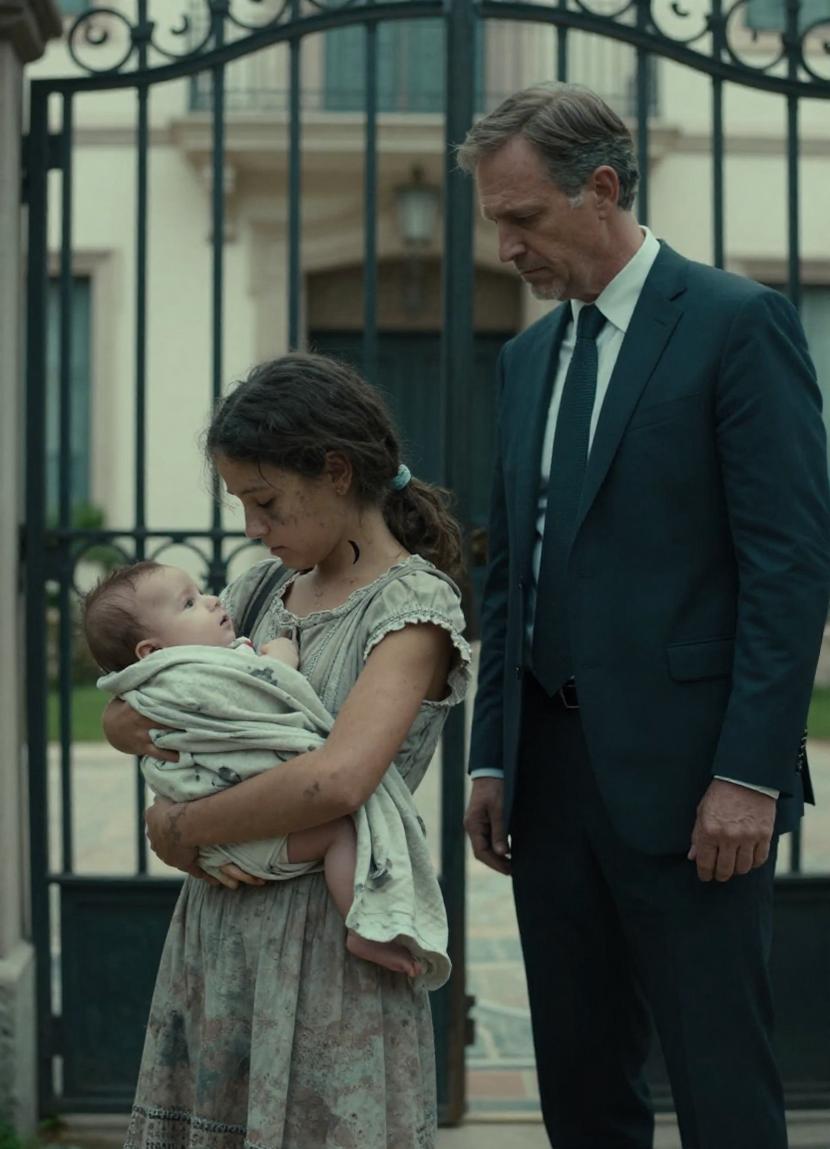
“Sir, do you need a maid? I can do anything… my sister is starving.”
The desperate plea shattered the quiet as William Grant approached the towering iron gates of the Wellington estate. His strides faltered. He paused, a flicker of surprise—and something deeper—shadowing his sharp features.
Turning slowly, he faced the source of the voice.
Before him stood a fragile girl, no older than eighteen, her dress tattered and dust smeared across her cheeks like a silent testament to hardship. Cradled carefully on her back, swathed in a faded, threadbare cloth, was a tiny infant whose breaths were so shallow they seemed fragile whispers of life itself.
This was not the world William Grant inhabited. Here, requests were seldom made with such naked vulnerability.
His eyes, keen and assessing, were drawn involuntarily to a delicate crescent-shaped birthmark etched on the side of the girl’s neck.
His chest tightened, breath catching in a sudden, visceral way.
His late sister, Florence Grant, bore the very same mark.
Florence, lost to time and silence nearly two decades ago, had left behind a void William had never bothered to fill—until now.
“Who are you?” William’s voice cracked slightly, sharper than intent, as the weight of the moment pressed down.
The girl flinched instinctively, tightening her hold on the sleeping child.
“My name’s Sofia Ramos,” she murmured. “Please, sir. We have no one left. I’ll clean, cook, do whatever you need… just don’t let my little sister go hungry.”
Something deep within William shifted—not pity, but recognition, a stirring of long-buried hope.
He motioned subtly for the driver to wait and crouched to meet Sofia’s gaze with care.
“That mark,” he said softly, “where did you get it?”
Sofia bit her trembling lip, hesitation flickering through her eyes.
“I was born with it. Mama said it ran in the family. She told me once she had a brother… but he left before I could remember him at all.”
William’s heart thundered in his chest.
Could this fragile girl be the thread reconnecting him to a family he thought lost forever?
The Wellington estate rose behind them, grand and imposing—a monument to William’s lifetime of success. But in this moment, its walls meant nothing.
Before inviting Sofia and her baby sister inside, he asked the staff to bring food and water to the gate.
Sofia ate slowly, each bite measured as if savoring fleeting hope, breaking pieces of bread to feed little Camila whenever the baby stirred restless. William watched quietly, a tight ache knotting his chest.
“Tell me about your parents,” he finally urged gently.
“My mother was Isabela Ramos,” Sofia said, voice trembling like leaves in a storm. “She was a seamstress and died last winter. She never spoke much about her family… only that her brother became very rich and forgot us.”
The floor seemed to shift beneath William’s feet.
Isabela.
Florence Elena Grant—his sister—had used her middle name when she vanished from their lives.
“Did your mother have a mark like yours?” he asked, hope and sorrow mingling.
Sofia nodded, eyes downcast.
“Right there,” she whispered, pointing at her neck. “She hid it beneath scarves.”
There could be no doubt now.
Sofia was his niece.
And the child in her arms—Camila—was his very blood.
“Why didn’t she come to me?” William’s voice was barely audible, laden with regret.
Sofia’s reply was soft yet piercing.
“She said you wouldn’t care. Said people with wealth never look back.”
The sting of those words cut deeper than any headline or scandal.
William, a man who had built empires and commanded respect across continents, realized his greatest failure had been letting his own sister die believing she was unwanted.
And now, his niece stood at his gate, pleading for the barest mercy to feed a child.
At last, William’s voice broke as he spoke his truth.
“Come inside. Both of you. You’re not strangers. You’re family.”
For the first time, Sofia allowed tears to spill—not in loud sobs, but in quiet surrender, breathing hope into a life gripped by hardship.
The days that followed reshaped the soul of the Wellington estate—once filled with cold luxury, now alive with tender sounds: a baby’s delicate cries, shy laughter, hushed meals shared under fading sunlight.
Sofia was no longer asked to scrub floors or serve invisibly.
“You don’t need to work for your keep,” William told her one afternoon, eyes soft with promise. “You need to learn, to read, to dream. To live the life your mother wished for you.”
“I didn’t want charity,” Sofia insisted fiercely. “I just asked for work.”
William shook his head with a bittersweet smile.
“This isn’t charity. It’s my responsibility. One I delayed too long.”
Trust, fragile yet enduring, grew between them.
Camila tugged at William’s tie, giggling at his awkward attempts to soothe her. Sofia revealed talents beneath her worn exterior—sharp mind, fierce heart, unyielding love for her sister.
One golden afternoon in the garden, William finally confessed what had weighed heavy in his soul.
“I was your mother’s brother. I failed her. And I failed you.”
Sofia was silent, the air thick with unspoken pain.
Then, softly, she said, “She never hated you. She just believed you didn’t want her.”
From that day on, Sofia and Camila were no longer wanderers at a gate.
They became Grants—by blood, by name, and most importantly, by love.
William had spent his life amassing wealth, but now he understood that the greatest fortune was not silver or gold.
It was the family he had nearly lost—and the precious chance to make things right.