
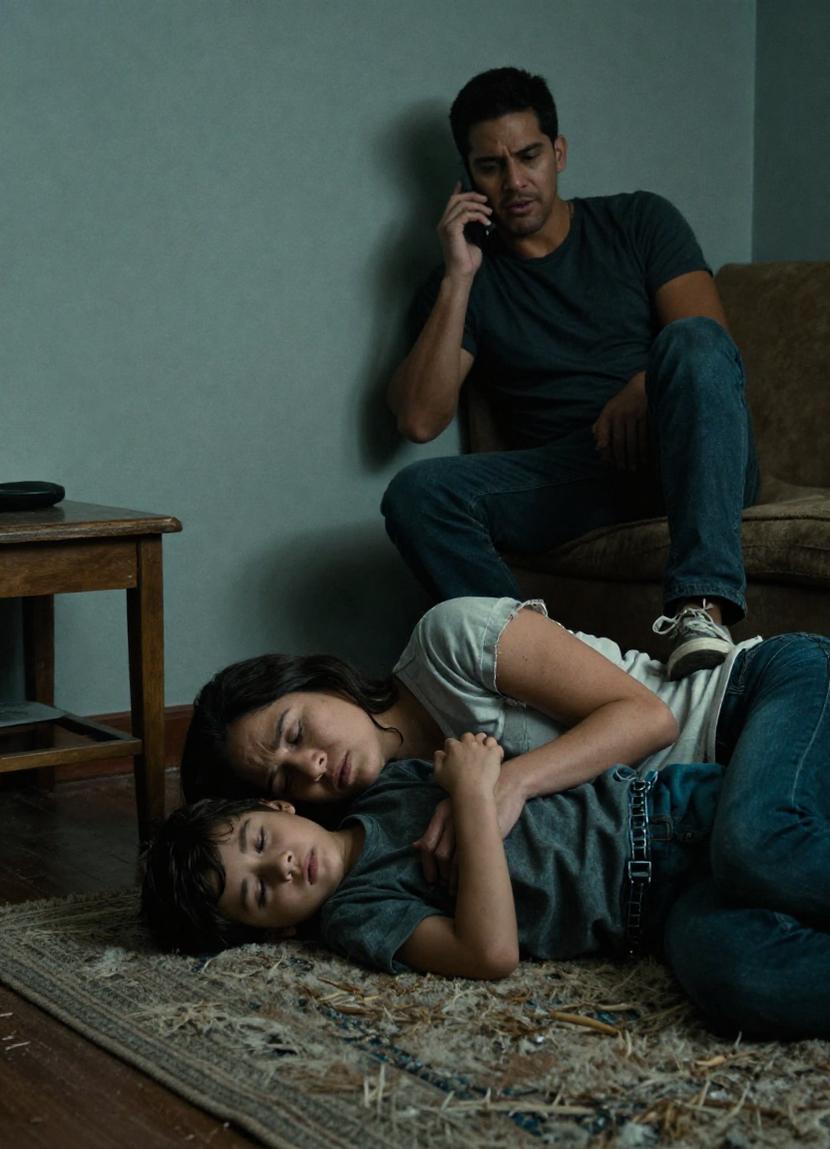
That night, Lucas stepped into the kitchen with a strange determination that almost cracked the cold mask he usually wore. The house, for a fleeting moment, shimmered with a false sense of normalcy. He hummed a nervous tune under his breath, wiped the counters with an almost obsessive care, twice over, and set the table not with our usual worn-out plates, but with the fine dishes we hadn’t used in years. Lucas poured a small cup of apple juice for Mateo, his smile stretched a bit too wide—too forced.
“Look at Dad,” Mateo giggled, eyes twinkling with childish delight. “Chef Lucas.”
I forced a smile, but beneath it, tension coiled tight like a spring ready to snap. Lucas’s sudden bursts of care felt more like rehearsed steps in a sinister dance. He wasn’t being kinder—he was calculating, cautious, as if tiptoeing around some dark secret.
We ate chicken and rice, a meal meant to soothe the soul and create safety. But Lucas barely touched his food. His eyes flicked nervously towards his face-down phone, awaiting some grim signal hidden in the silence.
Halfway through dinner, an unwelcome heaviness swept over me. My tongue thickened, my limbs slowing until I could swear I was sinking beneath invisible waves. Mateo’s eyes fluttered rapidly, panic prickling my skin.
“Mom,” he murmured, voice trembling, “I’m… so tired.”
Lucas placed a reassuring hand on Mateo’s shoulder, soft and calm, too calm. “It’s okay, buddy. Just rest.”
A sharp knife of terror sliced through the haze.
I tried to rise swiftly, but the room tipped violently. My knees buckled beneath me, hands grasping at the table that seemed to slip away from my grasp like a cruel illusion. The floor rushed up, darkness clawing to swallow me whole.
And then, a glimmer of defiance.
I surrendered my body to the fall but fought to keep my mind alert, feigning unconsciousness on the threadbare rug by the couch—its fibers laced with the faint scent of detergent and forgotten comfort. Mateo collapsed beside me with a soft whimper, then stillness.
I wanted to reach for him, to scream—to fight back tears.
But I forced myself to lie still.
Footsteps, slow and deliberate, approached. Lucas’s shadow fell over my face, his shoe nudging my shoulder as if testing. “Good,” he breathed.
Then came the dreadful phone call.
He retreated down the hall, voice low, urgent, relieved.
“It’s done,” Lucas whispered over the line. “They ate it. They’ll both be gone soon.”
My heart clenched in ice.
A woman’s sharp voice cut through the speaker like a dagger. “Are you sure?”
“Yeah,” he said flatly. “I followed the dose perfectly. It’ll look like an accident poisoning. I’ll call 911 after… after it’s too late.”
“Finally,” she exhaled. “Then we can stop hiding.”
Lucas exhaled deeply, like releasing a breath held hostage for years. “I’ll be free.”
Footsteps shuffled. A door opened—that of our closet. A drawer slid open.
Then a metallic clink.
He returned, dragging a heavy duffel bag, hovering over us. His silence pressed against my skin, squeezing like the cold grip of a noose.
“Goodbye,” he whispered before the front door creaked open, letting in a rush of cold air, then slammed shut behind him.
Silence engulfed the house.
My heart thundered so loudly I feared it would betray us.
I cracked my lips, barely a breath, and whispered to Mateo, “Don’t move yet…”
Then, faint but undeniable, I felt it—his tiny fingers twitching against mine.
He was still awake.
He squeezed my hand weakly, fear shimmering in his eyes. Relief threatened to break me then.
“Quiet,” I murmured, barely audible. “Pretend.”
His breath came ragged and shallow. The poison, whatever Lucas had slipped into our meal, hadn’t claimed him entirely—perhaps he drank less juice, or fate lent us a fragile mercy.
We lay still, shrouded in oppressive silence, until the house felt utterly deserted—no echo of footsteps, no creak of door or key. Then I dared to peek, catching the microwave’s glowing digits:
8:42 p.m.
Sand filled my limbs, but with agonizing effort I slipped my hand into my back pocket, inch by painstaking inch. My phone illuminated, heart leaping. I quickly dimmed the screen.
No signal. One bar flickered, then nothing. Of course. Always the living room’s dead zone. Lucas had joked about it once.
I dragged myself by my elbows toward the hallway, Mateo trailing silently, fragile as a wounded bird. Every inch screamed with pain.
In the hallway, one bar flickered alive.
I dialed 911.
The call failed.
I tried again, trembling with desperation.
Finally, a voice answered. “911, what’s your emergency?”
“My husband poisoned us,” I whispered, voice raw and shaking. “He’s gone, but my son’s alive. Please, we need help—now.”
“Your address? Are you safe right now?”
“I don’t know if he’ll come back. He said he’d call later to stage it accidental.”
“Stay on the line. Help’s coming. Can you get fresh air? Reach an unlocked door?”
I glanced at Mateo, his wide eyes rings of fear. “Mateo, can you stand?”
He struggled, knees trembling. “I feel weird.”
“We’ll move slowly to the bathroom and lock the door. Stay with me, okay? If you feel sleepy, keep staring at me.”
We staggered into the bathroom; I locked the door behind us. I turned on the faucet, coaxing Mateo to sip tiny amounts of water. Don’t hero this, I remembered from a past first-aid class—get help, buy time.
The dispatcher’s questions blurred through my fog: what we ate, when, allergies. Nausea hammered my brain.
Then my phone buzzed—a message.
Unknown number.
‘CHECK THE TRASH. PROOF. HE’S COMING BACK.’
My stomach tightened painfully. The same woman? A neighbor? Someone watching, waiting?
I opened the bathroom cabinet and found an ancient bottle of activated charcoal—leftover from Mateo’s stomach bug months ago. Hesitating only a moment, I decided: no more risking guesses.
Far-off sirens began to wail, growing louder.
Then, the front doorknob rattled downstairs.
Lucas was home.
He wasn’t alone.
Two pairs of footsteps crossed the living room.
The dispatcher’s voice pulled me back from panic. “Police are arriving. Stay in that room. Don’t open the door.”
I clamped my hand over Mateo’s mouth—not to silence, but to remind him: stillness. Silence.
Outside, footsteps halted. A low male voice I didn’t recognize muttered, “I thought you said they were out.”
“They are,” Lucas whispered coldly. “I checked.”
Ice flooded my veins. He hadn’t come back by himself. He’d brought reinforcements—accomplices ensuring no mistakes.
His shoes stopped right outside the bathroom door. My breath caught, imagining him trying the knob—then realizing it was locked.
But he didn’t.
Instead, he murmured cruelly, “In a minute, we call it in. Cry. Say we found them like this.”
His companion laughed darkly. “You sure the kid won’t wake up?”
Lucas’s voice hardened. “He ate enough. He won’t.”
Tears brimmed in Mateo’s eyes. I anchored us with my gaze. Not yet. Hold on.
Suddenly, loud pounding shattered the silence.
“POLICE! OPEN UP!”
Chaos erupted. The stranger cursed. Lucas hissed back furious orders.
Drawers slammed, something metallic clattered—like bottles thrown in haste.
“Officers are at the door,” the dispatcher instructed firmly. “Do not open.”
Voices spilled into the house:
“Sir, step away from the hallway.”
“Hands where we can see them!”
“Who else is inside?”
Lucas tried his charade. “Officer, I called—my wife and son collapsed, I—”
A sharp voice cut him off. “We received a 911 call from your wife. She’s alive.”
Silence cracked the tension. Lucas’s breath hitched like a man caught red-handed.
I unlocked the bathroom and slipped out with Mateo, legs trembling but steady. Officers swarmed the hallway; one knelt to Mateo, whispering soothing words while another guided me toward paramedics.
Lucas stood defeated in the living room, hands half-raised, face contorting into false shock. His eyes locked with mine, no guilt, no apology—only fury.
‘You lied,’ he spat, the mask slipping away.
Paramedics worked swiftly. A cuff tightened around my arm, questions poured about what we’d eaten. Oxygen masked Mateo’s face as I clung to hope.
Detectives swarmed the house. They combed through the trash, just as the warning text had said. Hidden beneath crumpled paper towels was a torn label from pesticide concentrate—chemical weapons Lucas kept “for ants.” They snapped photos, bagged the proof, treating it as dangerous evidence.
Phone records revealed the truth.
The woman on the line? Marina Lopez—Lucas’s ex, the “ancient history” he lied about, the “just a friend” he kept secret.
The stranger? A coworker recruited to “cover the mess.”
And the mysterious text? From Mrs. Navarro, our watchful neighbor across the street. She’d seen Lucas with chemical containers, overheard his hushed, sinister laughter on the phone, and refused to be complicit.
As the ambulance doors shut and Mateo squeezed my hand inside, I glanced back at Lucas, shackled and escorted away. He pleaded, charm slipping like sand through fingers—like consequences were optional.
All I cared about was the steady rise and fall of Mateo’s chest.
Because tonight, my darkest fears paled next to reality’s horror.
But we survived.
What would you do? Stay still to gather evidence or move faster to flee? Should Mrs. Navarro stay hidden or be hailed as a hero?
At the hospital, the antiseptic sting and machine hum offered hollow comfort. Sleep evaded me, haunted by visions of Lucas’s cold smile lurking in shadows. The steady beep of the monitor mocked with its slow rhythm—You’re alive. Stay alive.
At 3 a.m., Detective Morales returned, calm yet fierce.
“We’ve secured your home,” she assured, pulling a chair near. “You shouldn’t have to return anytime soon.”
I nodded, words lost in a knot of fear and exhaustion.
Mateo stirred beside me, small hand threading through mine.
Morales looked at me thoughtfully. “You mentioned an anonymous texter. We traced it.”
My heart thudded. “Who?”
“Mrs. Navarro.”
Mrs. Navarro—the rose-tending, raccoon-scolding woman I barely knew—had been watching.
“She wishes to remain anonymous, afraid of retaliation. Given Lucas’s preparedness, I understand.”
Preparedness—such a benign word for what he’d unleashed.
“He bought the chemicals two months ago. Researched doses, symptoms, and how to mask them. He communicated through burn phones, plotting a clean break—insurance cash, no messy custody, a fresh start,” Detective Morales explained gently.
Numbness flooded me. Months of terror behind gentle kisses and bedtime stories.
“Will he get bail?”
Morales’s jaw tightened. “Not tonight. Maybe never.”
But the reassurance felt thin.
When she left, the room hollowed out, too quiet. I kept tracing Mateo’s pulse, grounding myself.
My phone buzzed again.
Unknown number.
‘I’ll testify now. Make sure he can’t hurt anyone else.’
Mrs. Navarro was breaking her silence.
I typed with trembling fingers: Thank you. You saved us.
Her reply flashed immediately:
No. You saved yourself. You woke up. You fought. Now finish it.
Her words weren’t about vengeance.
They were about survival.
Survival wasn’t a single moment.
It was a choice—a fierce, repeated act.
Two days later, Detective Morales joined me in a stark interview room. Mateo was downstairs, coloring somber shapes unlike his usual bright creatures.
Morales laid a sealed evidence bag on the table. Inside: a small, cold, unmistakable metal key.
“Lucas rented a storage unit under a false name,” she revealed softly. “We executed a warrant this morning.”
I braced myself.
The unit was musty, shadowed by a single flickering bulb. Against the wall lay two identical duffel bags. One empty. The other… contained horrors.
Inside were manuals on undetectable poisons, fake IDs with Lucas’s face in multiple guises, burner phones, a notebook detailing doses and chilling annotations — increase next time, perfect mixture — and a photo of Mateo and me, snapped covertly from our own window.
My breath caught. “He stalked us?”
“He tracked your routines. Meal times, outings, when you slept.”
A cold dread unravelled inside.
Morales handed me a worn recipe card, Lucas’s scrawled handwriting scarring the paper.
Trial 1—too bitter.
Trial 2—increase ratio.
Trial 3—perfect.
Not meals he’d perfected.
Poison he’d crafted.
Nausea surged.
“There’s more.”
She unfolded a message thread between Lucas and Marina that darkened from rekindled desire to cold calculations.
‘She won’t leave. She thinks marriage is still worth fighting for.’
‘If she’s gone, no divorce mess. No custody.’
‘The kid too?’
‘He can’t stay. He’s her anchor.’
The term pierced me—Mateo, my anchor, suddenly a liability.
Tears blurred my vision.
Morales didn’t flinch.
“We’re charging attempted murder of a minor,” she said. “This cements the case.”
“How long…?”
“Since before Mateo was born.”
The design had existed long before I saw the cracks.
I had not lived with a husband.
I had been trapped inside a blueprint for destruction.
But I wasn’t the woman on the floor pretending to be unconscious.
I was awake.
And dangerously so.
Six months later, the courtroom was colder than any hospital room I’d known—sterile, rigid.
Trials aren’t the dramatic fury people imagine. They’re slow, meticulous dismantling.
Lucas entered, diminished but still wielding that chilling sheen of control. His eyes found mine, gleaming with venomous confidence.
My lawyer leaned close. “Don’t look at him unless you have to.”
But I did. Once. Because endings require facing monsters.
The prosecution laid out the damning evidence: the storage unit, messages, recordings, recipe card, pesticide, duffel bag, and my overheard phone call. Mrs. Navarro testified behind a screen; her voice trembled but held firm.
When the defense portrayed Lucas as overwhelmed, confused, Detective Morales presented the notebook.
The courtroom fell silent.
No one keeps meticulous poison trials for three years by accident.
Then I spoke.
Heart pounding, hands shaking, voice steady.
I detailed every horror: the dinner, the wave of sickness, the fall, the phone call, the locked bathroom door, the small fingers clutching mine.
When I whispered, “Don’t move yet,” jurors recoiled as if tasting the fear with me.
Lucas sat frozen, staring at me like a problem to be solved.
I stepped down, knees weak. My attorney steadied me. “You did it.”
But it wasn’t over.
After three tense days, the jury spoke.
Guilty on all counts. First-degree attempted murder. Attempted murder of a child. Conspiracy. Premeditation.
Lucas did not flinch, only tightened his jaw.
His mask fractured.
As officers took him away, he threw one final venomous glance my way.
“You should have stayed down,” he hissed. “Both of you.”
The old terror clawed at me, but another voice echoed deep inside.
Now finish it.
Mrs. Navarro had been right.
Survival was not surrender.
It was defiance.
Mateo and I stepped out into the harsh sunlight after the trial. His hand found mine—steadily, surely.
“Are we safe now?” he asked quietly.
I met his eyes, raw with honesty.
“We’re safer than ever.
Not safe.
But safer.
Because monsters don’t vanish when they’re locked away.
But neither do those who survive them.