
Michael Harper returned home that afternoon, every fiber of his being drained from the relentless grind of a merciless day. Floundering product launches, withdrawing investors, grueling meetings that left his spirit fractured—he sought only one thing: silence. The oppressive void that had swallowed his home since Emily’s passing eight months ago.
But then—there it was. Laughter. Sharp, clear, impossible. His sons’ laughter. Eli, Owen, and Liam hadn’t uttered that sound since their mother’s death. Not once.
Frozen in place, Michael followed that unexpected joy to the sunroom. What he saw there shattered the brittle shell he’d built around his heart: Ella Grant, the maid his mother-in-law Margaret had brought in, was crouched on the floor, hands and knees. His boys clung to her back, faces radiant with pure delight. Liam gripped a makeshift rein fashioned from a rope around Ella’s neck; she tossed her head back in carefree laughter alongside them.
Breath caught, Michael stood rooted, overwhelmed. Those boys—ghosts once wandering their own home—were alive again. Playing, laughing, reclaiming the childhood stolen from grief. And it wasn’t his doing. It was hers.
A rush of emotions crashed through him—relief, profound gratitude, a searing shame. Ella’s gaze lifted meet his, fear flickering. The laughter ceased. The boys slipped off her back, clinging close as if safeguarding something fragile. He nodded wordlessly and turned away, before the tears could surface.
He couldn’t understand it. Was it misplaced gratitude to feel indebted to an employee? Yet that laughter—raw, unguarded—was the treasure he didn’t know he’d lost until now.
Michael unraveled the mystery in the days that followed. He’d tried everything—therapy, psychologists, meticulously crafted routines, every toy in their nursery, tomes on grief—yet his sons had vanished inwardly. And then Ella arrived. She didn’t flee from their sorrow. She stepped squarely into the grief, walking through it, and resurrected their joy.
The next morning he descended early—not for work, but to witness it again. Ella was silently preparing breakfast; the boys still clad in pajamas burst in exuberant. “Ella, can we play horse like yesterday?” Liam asked bashfully. Michael’s chest tightened. He should have forbade it. Instead, he said nothing.
Moments like that multiplied. Eli confided a dream. Owen peppered her with dinosaur questions. Liam nestled close. Ella listened—really listened—loving them like they were the only things that mattered. And they loved her back.
Michael began arriving home early, crafting lame excuses, ignoring meetings—all to drown in laughter’s warm glow, to see this house come alive again. Ella never performed, never imposed a forced cheer—her love was instinctive, quiet, effortless.
Emily lingered everywhere—the lingering scent of her perfume in her paintings, her forgotten coffee mug on the counter, the grocery list scribbled in her familiar hand. Michael preserved every trace. At night, he wandered the silent rooms searching for what was lost, avoiding the emptiness of their shared bed, retreating instead to his office where sleep was an uneasy stranger.
One sleepless night, he found Ella in the library, basking in the soft lamp’s glow with a worn book cradled in her hands. She looked serene. He settled beside her, hesitant.
“What are you reading?” he murmured.
“Beloved, by Toni Morrison,” she replied, voice gentle.
“Heavy reading for bedtime.”
“Sometimes heavy thoughts need heavy books,” she said quietly. Michael almost smiled—almost.
Their hushed conversation wove through memories of Emily, the small moments the boys shared—the flowers she adored, her off-key songs, dessert-first Tuesdays. Tears burned behind Michael’s eyes. “Thank you,” he whispered, “for carrying her memory.”
Ella closed her book and rose. “Good night, Michael.”
She left softly, and for the first time in months, Michael felt his emptiness soften. Ella wasn’t just healing the boys—she was mending him too.
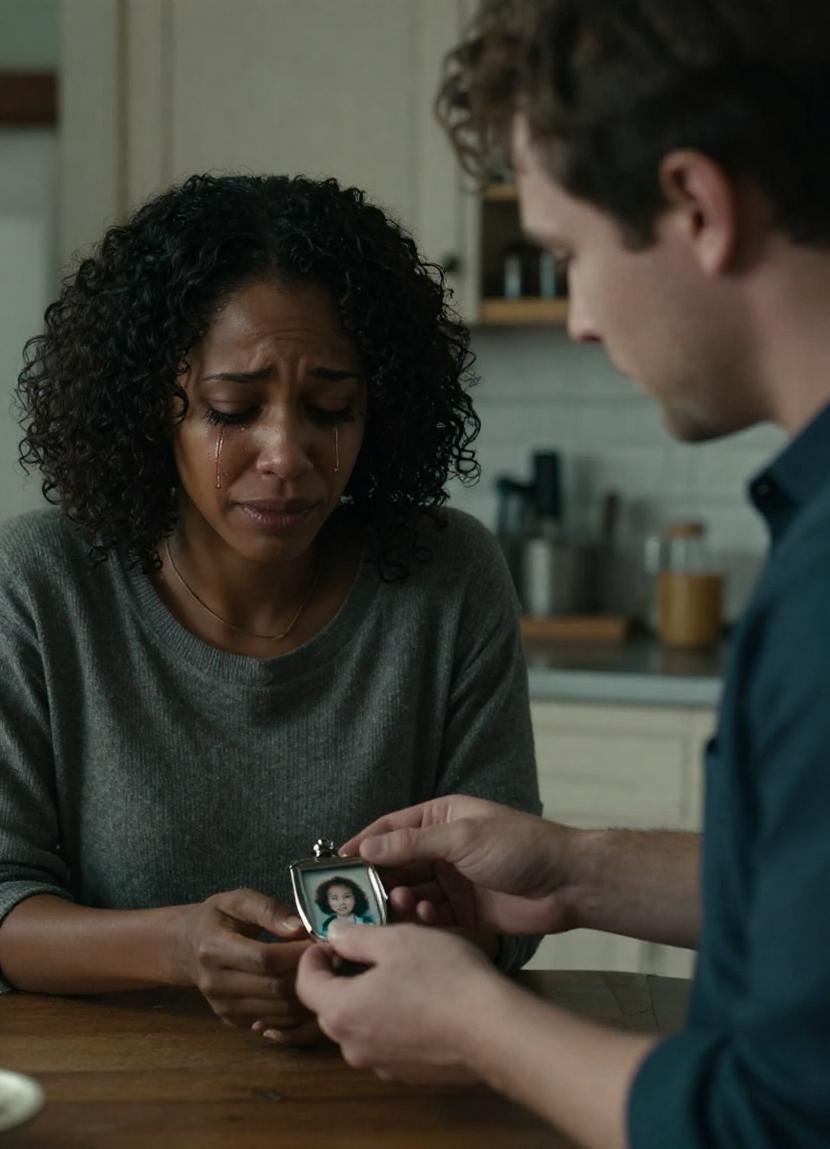
Three weeks later, Michael arrived home late—around eight. The boys were asleep, but from the kitchen came the soft sound of crying. He found Ella holding a silver locket, her shoulders shaking. Cautiously, he stepped closer.
“I’m sorry,” she choked out.
“Who’s in the locket?” he asked gently.
Ella froze, whispering, “Grace… my daughter. She died two years ago of leukemia. She was three.” Her words hung thick like smoke. Michael felt a fracture inside him.
Trembling hands unfolded the locket to reveal a tiny photograph: a bright-eyed little girl with a gap-toothed smile clutching a dandelion.
“My husband blamed me,” Ella murmured brokenly. “He said I should’ve noticed sooner, pushed doctors harder.”
Michael said nothing. He watched, understanding that grief dwells deep in quiet corners, and often the ones bearing it are the truest warriors.
Michael should have intervened—should have saved her from that agony. But the marriage shattered. He took everything in their divorce—photos, toys, clothes. This locket was all she had left. His throat tightened; words deserted him.
“I became a nanny because…” Ella’s voice shattered completely, “because I can’t live in a world without children’s laughter. It makes the unbearable quiet bearable.”
“When I heard about your boys, about what they’d lost… I thought maybe I could help them where I couldn’t help my daughter.” She looked up, tears spilling. “I’m sorry. I know it’s unprofessional.”
“You’re not just helping them heal,” Michael interrupted, voice hoarse. “You’re healing yourself.”
Ella shook her head, sorrow buried so deep. “I don’t think I’ll ever heal.”
“Maybe not,” he said gently. “But loving my sons… it’s keeping you alive, just as you keep them alive.” He reached out, covering her trembling hand.
They sat like that—two souls engulfed in grief, clinging to each other in the night’s shadow.
“Does it get easier?” she whispered.
Michael thought of Emily, of the cold side of the bed he still reached for each morning. “No,” he said honestly, “but the missing changes. It becomes a presence, not a void.”
Ella nodded, tears falling. She closed the locket and held it tight. “Thank you… for not looking away.”
“And thank you,” Michael said, “for showing up.”
In that piercing moment, the boundaries between them blurred. No longer employer and employee—they were two broken souls finding fragile sanctuary amid the ruins.
Mother’s Day loomed like a shadow Michael had tried to outrun. Last year, Emily was alive, the boys’ messy cards littering the kitchen with sticky handprints and crayon scribbles—the laughter and tears of a family whole. This year, the fridge was empty. Michael braced himself merely to survive.
But downstairs, he heard voices in the playroom. Ella sat on the floor with Eli, Owen, and Liam, surrounded by construction paper, crayons, glue sticks—making cards not for Emily—but for Ella.
Michael stepped quietly closer. Liam held up his drawing first: a stick figure with dark skin and a beaming smile, encircled by hearts. “For Ella,” he said. Michael’s breath caught.
Eli’s card read, “I love you, Ella,” with three stick figures holding hands.
A knot twisted inside him—no anger, only a tangle of loss and relief. Ella looked up, pale. “I didn’t ask them to,” she whispered. “We should make cards for their mother.”
“Yes,” Michael said tightly.
Owen raised another card—angel wings and flowers. “We miss you, Mommy.”
The air escaped him. They hadn’t forgotten Emily. They’d carved space for someone new.
Liam tugged Michael’s sleeve. “Can Ella come with us to see mommy?”
Michael looked at Ella. She shook her head. “No… it’s private. For you boys.”
“You’re family,” Liam said simply.
The words lingered. Michael hesitated. Bringing Ella to Emily’s grave felt like crossing a sacred threshold. Yet looking into his sons’ hopeful eyes, the words came—“She can.”
Ella’s eyes widened. “Are you sure?”
Michael nodded. “Yes.”
An hour later, standing together at Emily’s resting place, the boys laid angel cards on the headstone, then stepped back. Liam took Ella’s hand and tugged her forward.
“Tell mommy you’re nice,” he whispered.
Ella knelt, tears streaming. “I hope you don’t mind that I love them,” she murmured. “I’m not trying to replace you. I just—couldn’t help it.”
Eli whispered to the stone, “Mommy, Ella makes the best pancakes. She plays with us. She doesn’t get sad when we talk about you.”
Michael’s throat tightened. He’d been the one falling apart, withdrawing, convincing his sons that loving someone new meant forgetting. Ella wiped her tears, meeting his gaze—understanding, forgiveness, the silent permission to live again passing between them.
Two months later, Michael attended a charity gala at the Maplewood Club. Avoiding such events since Emily’s death, he only came under Margaret’s insistent urging.
The room brimmed with polite faces—those who sent flowers after the funeral, then vanished. Caleb Morris, a fellow tech CEO, arrived with his wife Monica.
“Michael, good to see you out,” Caleb said, shaking his hand. “How are the boys?”
“Better,” Michael said quietly. “Much better, actually.”
Monica smiled, sharp beneath sweetness. “I hear you found wonderful help. What’s her name again?”
“Ella Grant,” Michael answered carefully.
“And she’s been quite devoted to the children, I hear. Excellent at her job,” Monica continued, her tone laced with false charm. “Some might say unusually involved for household staff.” She glanced at Caleb. “There was a photo last week—at the farmers market—the boys holding her hands, Michael pushing the cart. Very domestic. A young widower, three impressionable children…”
Michael’s jaw clenched.
“I’m not sure what you’re implying.”
“Nothing,” Monica said, touching his arm lightly. “Just that people talk. Maybe consider the optics—for the boys’ sake.”
His voice cooled sharply. “The boys are happy for the first time in eight months. That’s the only optic I care about.” He strode away, hands trembling.
The whispers grew louder. Society columns hinted—“Which widowed tech titan is getting too close with the help?” Photos surfaced online—Jane laughing with the boys at playgrounds, tagged simply “Nanny.”
Then came the call from Westwood Academy. The head’s voice was polite but firm. ‘Given the recent attention and concerns, perhaps it’s best if the boys enroll next semester.”
Michael gripped the phone, chest tightening—not due to the school’s decision, but what it meant: rejection fueled by gossip. Ella would hear. She’d see the whispers. And she’d leave.
He raced home, mind a storm, straight to Ella’s room in the guest cottage. The door stood ajar. Inside, she packed—a half-filled suitcase, clothes folded with mechanical precision, hands trembling.
Michael hesitated in the doorway.
“I can’t stay,” she said quietly. “I’ve become the problem. Don’t—”
“Ella…” his voice rough, desperate.
She looked up, red-rimmed eyes. “Your boys were rejected because of me. Gossip, people who don’t matter.”
“They matter to Eli, Owen, and Liam,” he said firmly.
Her voice cracked. “They’ll grow up hearing whispers. Punished for loving someone like me.”
“Your place?” Michael stepped inside. “Your place is with my sons.”
Ella shook her head, tears falling on the shirts in her hands. “I’m just the maid, Michael. That’s all I was ever supposed to be.”
“You stopped being the maid the day my sons laughed again.”
Her eyes flashed fierce and broken. “Then what am I? What am I to them? To you?”
Words stuck in his throat.
“You can’t say it,” she spat bitterly. “Because I’m Black. I’m young. I’m staff. People will always judge. Staying will punish your boys.”
“Let them judge. I don’t care. You should.”
“Rick, Owen, Liam deserve better than scandal. Better than someone they love being an issue.”
Silence crackled. Ella slumped on the bed’s edge.
“When Grace died,” she whispered, “I vowed never to love another child. Losing her almost buried me. But your boys… I couldn’t stop myself. And now I must leave before that love destroys me.”
Michael knelt before her, heart pounding. “What if you didn’t have to leave? What if I spoke the truth? Made clear you’re not just staff?”
Searching his face.
“What truth?”
“That you are indispensable. My children need you. I need you. Not maid, not nanny. Someone who sits in the dark with me, who brought light into a dying house.”
“I’m not her,” Ella whispered. “I’ll never be Emily.”
“I know,” Michael’s voice broke. “I don’t ask that of you. Just that you stay. Because thinking of you leaving takes my breath away.”
Ella buried her face, sobbing. He remained knelt, terrified of rejection.
Finally, she met his eyes. “If I stay, it can’t be like this. No hiding. No pretending.”
“Then don’t,” he said.
“Your world won’t accept me.”
“Then my world changes.”
Her eyes shifted. “I’ll stay. But not as your employee. As myself. Whole. I wouldn’t want it any other way.”
They stood, two broken souls tempering love from wreckage.
The following week, Michael stopped hiding.
A Wall Street Journal interview awaited, the PR team’s carefully crafted corporate lines ready. When Claire Lin, the reporter, arrived, Michael answered on autopilot. Then she paused.
“Mr. Harper, there’s been public curiosity about your private life. Care to comment?”
Old Michael would’ve declined. Instead, he thought of Ella’s packing, the boys’ frightened faces.
“Yes,” he said.
Claire’s brows rose.
“Ella Grant is why my sons are alive in every way that matters. After Emily died, they silenced, withdrew. Specialists, therapists, toys, books—nothing worked. Then Ella came. She didn’t fix, just loved. Played horse on hands and knees. Read stories. Sat with them through nightmares. Gave them permission to heal.”
“Some allege the relationship’s inappropriate,” Claire said carefully.
Michael’s jaw tightened. “Some see a young Black woman caring for three white boys and leap to wrong conclusions. That’s false. She is family. Anyone blind to that doesn’t decide what my children need.”
Ella’s breath caught, the envelope shaking in her hands.
“I don’t know what to say.”
“Then don’t,” Michael said softly, stepping close. “Just stay. Here. With us.”
Tears traced Ella’s cheeks. “I never thought anyone would see me this way—not just staff, but someone who matters.”
“You always did,” he said. “To my sons and me. Now, officially, you will. No more whispers, no more hiding. Just us.”
Ella laughed through tears, relief and disbelief weaving in the sound. She stepped into his arms. “I don’t know how to thank you.”
“Don’t,” he whispered, lifting her chin to meet his eyes. “Just stay. With me. With them.”
In the gold-hued garden, surrounded by Emily’s beloved peonies, they stood—a family reborn from sorrow, laughter echoing where silence once reigned.
Michael entwined their fingers. “This,” he whispered, “is just the beginning.”
Ella smiled through tears. “Then let’s make it count.”
For the first time in months, in a house that knew only grief, laughter rang out—not just from the boys, but from two healed hearts, filling every corner with hope, love, and promise.
Ella’s hand in his, Michael felt something beyond sorrow—hope.
Six months later, the Grace and Emily Foundation opened its doors.
Families from across the Northeast arrived: parents of sick children, grandparents raising grandchildren, siblings bracing against cancer’s storm.
The east wing, long dormant, now pulsed with life—tears, laughter, stories of survival against the impossible.
The dedication was modest—donors, reporters, families who would find refuge there. Michael stood at the podium, chest tight, prepared remarks untouched in his pocket. Instead, he saw Ella at the back, flanked by Eli, Owen, Liam, all dressed in matching outfits Emily would have adored—their smiles genuine, radiant.
Clearing his throat, he began, “I built my company believing every challenge could be solved by understanding systems. But when I lost my wife, I learned some things can’t be fixed. Only survived.”
Silence fell.
“We were drowning—my sons and I—in a house bursting with everything but what we needed most.” His gaze found Ella’s.
“Then someone entered our lives—someone who taught me healing doesn’t come from fixing, but from presence, from staying, from loving people not for what they could be, but their mess.” Ella wiped tears away.
“This foundation exists because two women believed unbearable loss can only be answered by unbearable love.”
He paused. “Emily taught me to give all. Ella Grant showed my sons and me how to live again.” He motioned to her, “Ella, join me.”
She shook her head, but the boys encouraged her gently forward. Trembling, she took the stage. Michael drew an envelope from his pocket.
“This makes you co-director of this foundation and legal co-guardian of my children.”
Ella’s knees nearly buckled. “You already are,” he whispered. “This makes it official.”
The boys rushed forward, wrapping her in embraces. She knelt, holding them close, sobbing while the crowd rose to applaud. Michael barely heard, focused entirely on his family—the ones grief almost unraveled, and the one rebuilding them.
Later, after guests left, Michael found them in the garden, the boys chasing each other among flowers they had planted months ago. Ella sat on Emily’s bench, watching with a gentle smile. Michael joined her.
“Thank you,” she whispered.
“For what? For staying? For fighting for me? For forging something beautiful from pain?”
He looked at her—a woman who stepped into shattered lives and refused to flee.
“I think God sent you,” he said simply.
Ella’s eyes widened in surprise.
“I was angry at Him for a long time—for taking Emily, leaving me with three boys I couldn’t reach. But then you appeared, and maybe He never left us. Maybe He just sent help… in a way I never expected.”
Tears welled in Ella’s eyes.
Liam rushed over, laughing breathlessly, ‘Papa, Mama Ella, come play with us!’
The name didn’t sting. It felt right.
Michael stood, pulling Ella to her feet. Together, they joined the boys in the grass. The sun set over the garden, where everything had changed.
Michael realized something he’d been blind to: Love doesn’t end with death. It transforms.
Emily showed him how to love fully. Ella showed him how to love again. And his three boys taught him healing was possible, even when impossible seemed certain.
Their home, once a tomb, breathed life anew. Not because grief vanished—it never would—but because they learned to carry it together. Together, they had found each other.
Ella caught his eye and smiled—a genuine smile, full of hope and belonging. Michael smiled back.
For the first time in over a year, he wasn’t just surviving. He was living.
Because sometimes, when all falls apart, God pieces it back in ways beyond imagining—not erasing loss, but proving love is mightier than grief, presence trumps perfection, and family isn’t just birthright—it’s who stays when darkness falls. It’s who brings the light.