
The Weight of Silence
Edward Mason stepped into his sprawling penthouse, the door shutting softly behind him, sealing in a silence as oppressive as the thick fog outside. The city’s distant hum and the gentle tapping of rain against the glass could not soften the heaviness that clung to the air. His briefcase was soggy, his suit drenched, and yet the cold discomfort outside paled beside the cold absence that had settled inside his home for years.
Tonight, however, shattered that stillness. A sound — small, fragile, but unmistakably alive — floated through the corridor. Laughter. Light, breathless, untamed laughter.
Edward froze, heart pounding wildly against his ribs. It was a sound he’d almost forgotten, a sound that once filled these walls before grief transformed everything. Before his wife’s battle and eventual passing left him alone with Clara — his daughter who had never taken a step, never crawled, never joined the lively rhythm of childhood’s dance.
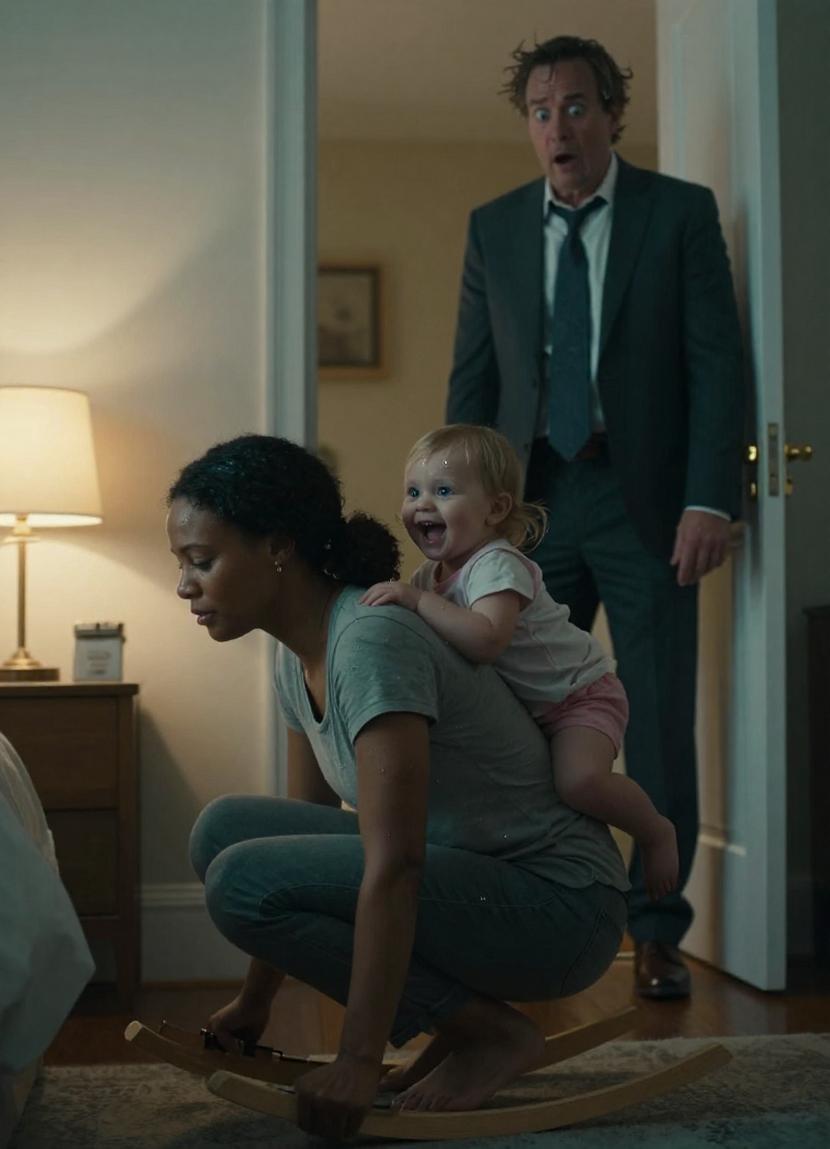
Drawn forward by the echo of that unexpected joy, Edward found the door to Clara’s room slightly open. Peering inside, his breath caught in his throat. In the center of the room, illuminated by the soft glow of a bedside lamp, was Nina—the new maid he had reluctantly hired just a fortnight prior. Her dark hair was pulled back with care, her posture steady and purposeful. On her back, holding on with fierce determination, was Clara. Clara, whose legs had always been still, now clung tightly to Nina’s shoulders, her entire being quivering with gleeful laughter.
Nina swayed gently, rocking back and forth like a patient swing. And then, almost as if summoned by some quiet miracle, Clara slid down and, against all odds, rose on trembling legs. She wobbled, faltered, yet did not fall. For one breathtaking moment, Edward witnessed the impossible — Clara standing.
His voice caught between disbelief and hope, he stammered, “What… what is happening?”
Nina met his gaze calmly, a quiet confidence in her smile. ‘Just playing, sir,’ she said softly.
Clara’s wide, blue eyes locked with Edward’s, filled with a courage he had never seen before. Slowly, bravely, she took three tentative steps toward him, then collapsed into his waiting arms. Tears spilled from Edward’s eyes unchecked as he caught her like the most precious treasure. Clara giggled, tugging playfully at his tie, her warmth flooding the cold spaces inside him.
For three long years, Edward had cradled Clara like fragile glass, terrified any movement would shatter her. Now she clung to him, trusting wholly in his embrace.
Nina quietly moved aside, standing in the shadowed corner, her hands wiped on the fabric of her jeans. She wasn’t seeking praise; this moment was less a triumph and more a whispered truth she had always believed.
“How… how long has this been?” Edward’s voice trembled.
“Two days, sir,” Nina answered without hurry. “She started standing on the bed, holding on to my shoulders. Today, she let go.”
Edward’s disbelief deepened, heavy with the weight of medical reports and bleak prognoses. “The doctors said… they said she could never walk.”
Nina interrupted softly, ‘They never said she would. Not unless she felt safe enough to try.’
The words struck Edward like a blow. He looked down at Clara, nestled peacefully in his arms, and realization dawned. ‘No machines. No therapies. No schedules or pressure. Just play. Just trust.’
“I tried everything,” Edward admitted, voice low, brittle. “Physical therapy, specialists, even sensory deprivation chambers. Nothing worked.”
Nina nodded knowingly. “Because they were trying to fix her. She never needed fixing.”
Searching her eyes, Edward asked, “Then what did she need?”
Nina’s breath caught, and her voice softened, “Presence. Someone who didn’t demand, didn’t expect — just stayed.”
His hands shook. “Why did you stay?”
Her gaze did not waver. “Because she reminded me of someone I couldn’t save.”
Edward’s breath hitched. Nina lowered herself onto a small bench near the wall and spoke steadily, “His name was Milo. He was two, non-verbal. His parents lacked patience. I was his nanny, pleading with them to slow down, but they fired me.”
Silence stretched between them.
“He died alone in a hospital bed a year later. I wasn’t there.” Her eyes shimmered but remained dry. “I promised if I ever met another child like him, I’d stay. No matter the cost.”
Emotion tightened Edward’s throat. “You didn’t have to.”
“No,” she agreed, voice resolute. “But she needed someone who would.”
Their eyes rested on Clara, thumb nestled in her small mouth, drifting toward slumber.
“She’s not afraid of falling,” Nina murmured. “She’s afraid of being left behind.”
Edward’s jaw clenched. “I was always leaving… meetings, flights, calls. I thought providing everything meant I was enough.”
Nina’s silence was answering enough.
Swallowing hard, Edward whispered, “I want to be better.”
Nina rose slowly. “Then don’t say it. Show her.”
He nodded, tears glistening anew. “I will.” For the first time in years, those words were true.
Morning light filled the penthouse differently the next day. Pancakes sizzled in the kitchen; Nina hummed a soft tune. Edward shed his suit and briefcase, trading them for rolled-up sleeves and bare feet.
He sat cross-legged on the living room rug, watching Clara stack colorful wooden blocks. Her tongue peeked out in concentration while her hands balanced each piece. Edward said nothing — no instructions, no corrections — just presence.
Suddenly, the tower wobbled. Clara tipped sideways. Edward flinched, ready to rush, but paused as she sat back up, glancing at the falling blocks with a grin.
“Try again,” she whispered to herself, reaching for the blocks.
Edward froze — resilience blossomed where fear once reigned.
At the doorway, Nina leaned, drying her hands on a towel. “Surprised?” she asked quietly.
“I am,” he replied, eyes never leaving Clara. “I thought she was broken.”
“She was never broken,” Nina said gently. “Just waiting for someone to stop rushing.”
“I rushed everything,” Edward confessed. “Her healing, her growth, even my own grief.”
No answer. Only steady understanding.
“How do I fix that?” he pressed.
She knelt beside him, placing a small green dinosaur toy in his palm. “You don’t fix it,” she said firmly. “You stay. You show up. That’s all.”
Edward turned the toy over, then held it out to Clara. She paused, smiled, and crawled into his lap without hesitation — trust pouring from her tiny frame.
Eyes closed, he breathed her warmth. “I can’t believe I nearly missed this,” he whispered.
Behind him, Nina said softly, “You didn’t. You’re here now.”
Long silence followed before Edward turned to her, voice low, steady. “Will you stay?”
Her usual composure flickered with hesitation. “As nanny?”
“No,” he shook his head. “As family.”
She paced slowly, folding her arms. “I didn’t take this job forever.”
“I know. I hired you as a maid, but you are more — you’re the first person who truly saw her, and maybe the first who truly saw me.”
Her gaze softened but held steady.
“I’m not asking out of guilt or charity,” Edward said quietly. “I’m asking because I need someone to keep me accountable — for the man I’ve failed and for the father I still can become.”
Clara stirred, fingers gripping his shirt.
Nina exhaled. “And if I stay,” she asked, “what happens when work calls you back? When the world pulls you away and you forget this feeling?”
“I won’t,” Edward said quickly.
She gave him a look that saw through all promises.
“Then remind me,” he whispered.
She moved to the window, drawing aside the curtain to the bustling city below, speaking after a long pause. “If I stay, it won’t be just as a nanny or housekeeper.”
Edward stood, clasping Clara gently. “Then as what?”
“A mirror — one you cannot ignore.”
He nodded, emotion rising. “Deal?”
A small but genuine smile blossomed. “Then I’ll stay.”
Clara opened her eyes, giggling at Edward and Nina, weaving a new bond from their shared hope. He kissed her head, thankful for the woman who saw her before he could.
Days passed, and the penthouse transformed. Walls bloomed with Clara’s bright, crooked drawings. Books once untouched now lay scattered. The scent of lavender and pancakes replaced cold polish. Edward rose earlier, brewed coffee, learned to braid with awkward fingers but full heart. Nina arrived early, steady and present, no longer fading into the background but anchoring their fragile new normal.
One morning, Clara stood by the window, tiny hands pressed to the glass.
“Do you see something?” Edward asked softly.
“People,” she replied.
Edward blinked — she spoke.
Nina in the kitchen responded coolly, “She’s been whispering words all week, waiting to say them to you.”
Edward knelt beside Clara, heart pounding. “People?”
She nodded. “Little.”
He smiled. “They look small from up here.”
“Like me?”
His chest tightened. Her voice a whisper: “I don’t want you to go today.”
He froze, caught between world and moment. Nina watched. Then Edward met her gaze.
“Then I won’t,” he promised.
A radiant smile stretched across Clara’s face. Edward looked at Nina.
“She said it to me.”
Nina nodded gently. “Because she believes you now.”
Edward breathed in the miracle of his daughter’s voice — a voice born not of pressure, but of safety and unwavering presence.
Clara ran to Nina, arms wrapping around her legs. Nina brushed her hair and looked up at Edward.
“She knows,” she said softly. “You’re staying.”
And this time, he was.
The End.