
The Weight of Silence
Marshall Reed had never before felt silence weigh so heavily in his penthouse. It hung in the air like a dense, unyielding fog, broken only by the distant roar of city life and the delicate rhythm of rain tapping against the floor-to-ceiling windows. Entering after a grueling day, briefcase in hand, drenched shoes squelching softly against the polished floor, and his suit clinging uncomfortably to his frame, Marshall steeled himself for another evening steeped in solitude. Yet, what cut through the stillness was something so foreign, so unexpected, it stole his breath away—laughter.
High-pitched, breathless, completely unrestrained, it stopped Marshall dead in his tracks. For a split second, he questioned if his mind played tricks on him. His memories surged back to brighter days—before the shadow of loss darkened their home, before his wife’s illness claimed her and left him and his daughter, Clara, adrift in a silent sea of grief. Since that heartbreak, Clara’s laughter had vanished, replaced by a quiet so complete it seemed to swallow every corner of the penthouse.
Marshall’s heart thundered in his chest as he followed the sound. The door to Clara’s room stood slightly open. Peering inside, he was rendered speechless by the scene before him.
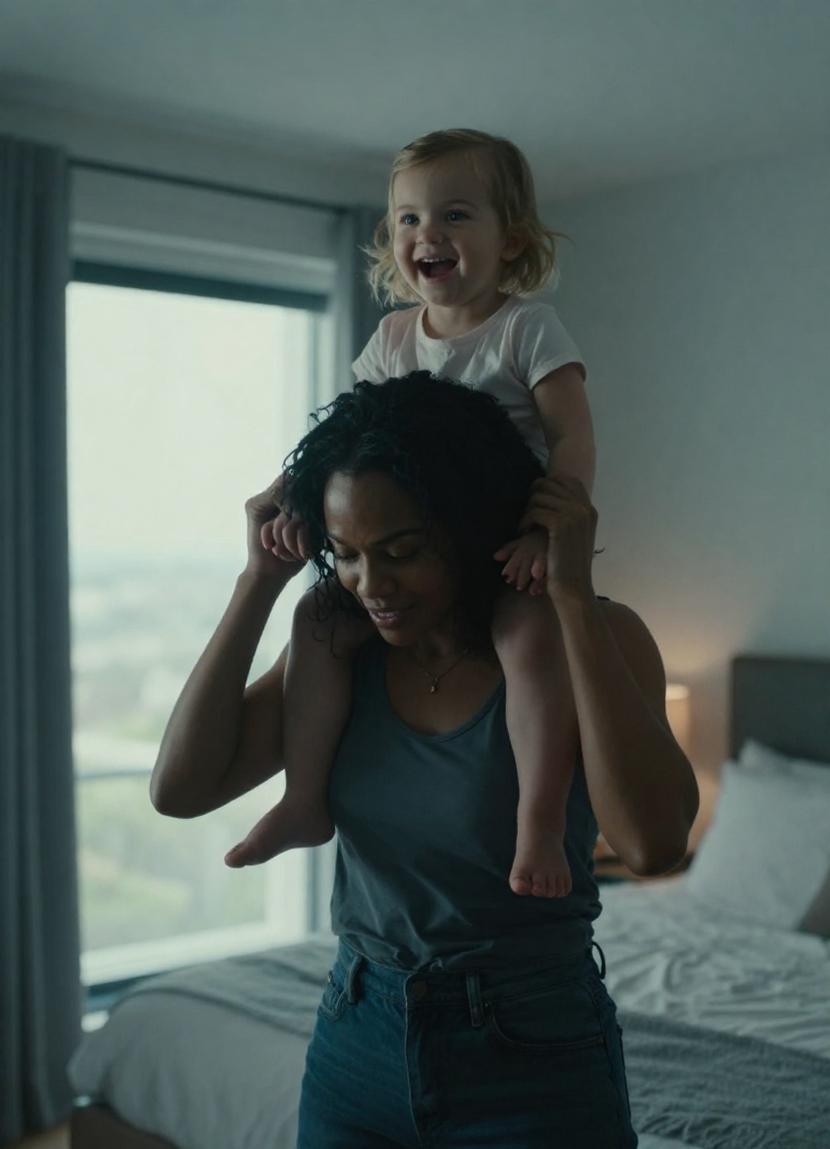
There, at the center of the room, was Naya—the new maid he’d employed two weeks ago. Her dark hair was pulled back neatly, spine straight with an unshakable poise. And perched on her back, giggling uncontrollably, was Clara. Clara, whose legs had always hung lifeless. Clara, who had never taken a crawl, much less stood. Now she clung to Naya’s shoulders, her tiny legs gripping for balance, her entire body trembling with laughter.
Naya swayed gently in a slow, steady rhythm, like a lullaby in motion. Marshall was transfixed as Clara slipped off Naya’s back—and then, astonishingly, wobbled upright. She stood.
For the first time since her birth, Marshall saw his daughter standing.
His voice broke as he whispered, desperate for confirmation. ‘What… how is this possible?’
Naya looked over her shoulder, serene and unshaken, her smile tender yet unwavering. ‘Just playing, sir,’ she said softly.
Clara’s wide blue eyes met her father’s, filled with surprise but free from fear. Then, gathering a courage that tightened Marshall’s throat, she took tentative, unsteady steps toward him before collapsing into his arms. He caught her as though she were the rarest treasure, tears streaming down his cheeks unchecked. Clara laughed softly into his chest, her fragile fingers tugging playfully at his tie.
For three long years, Marshall had cradled her like precious china—so vulnerable, so delicate. Now, she clung to him as if she knew, without doubt, he would never release her.
Naya quietly stepped away from the bed, standing in a corner, wiping her hands on her jeans. She wasn’t seeking praise or acknowledgement. She simply existed in the moment, as though this miracle was something she had quietly believed in all along.
‘How long has she been able to do this?’ Marshall’s voice cracked, laden with disbelief.
‘Two days,’ Naya replied softly. ‘She has been standing on the bed, holding onto my shoulders. Today, she took that step—letting go.’
Marshall blinked, stunned. ‘The doctors—they said it wasn’t possible… that she might never walk.’
Gently interrupting, Naya said, ‘They never said she couldn’t walk. They said it might happen only if she felt safe enough to try.’
Her words hit Marshall like a punch to the chest. He gazed once more at Clara, now serene and resting in his arms. ‘No machines. No therapists. No rigid schedules. Just play. Just trust.’
‘I tried everything,’ Marshall confessed quietly. ‘Physical therapy, specialists, even sensory deprivation. None of it worked.’
Naya nodded knowingly. ‘Because they were trying to fix her. But she wasn’t broken.’
Marshall met her steady gaze. ‘Then what did she need?’
After a brief pause, Naya answered, ‘Presence. Someone who didn’t expect her to perform. Someone who simply stayed.’
His hands trembled as the weight of her words settled. ‘Why did you stay?’
Her gaze never faltered. ‘Because she reminded me of someone I lost.’
Marshall’s breath caught. Naya lowered herself onto the bench by the wall, her voice steady yet soft. ‘His name was Dante. He was two, non-verbal. His parents had no patience. I was his nanny until I begged them to slow down—I was fired instead.’
Marshall remained silent, knowing the pain behind those words.
‘He died alone in a hospital a year later. I wasn’t there when he passed,’ she admitted, eyes glistening but no tears falling. ‘I promised if I ever met another child like him, I’d stay. No matter what.’
Marshall’s throat felt tight. ‘You didn’t have to,’ he whispered.
‘No,’ she said quietly. ‘But she needed someone who would.’
Their eyes turned to Clara, now gently dozing in Marshall’s lap, thumb nestled in her mouth.
‘She’s not afraid of falling,’ Naya said softly. ‘She’s afraid of being left behind.’
Marshall’s jaw clenched. ‘I was always leaving—meetings, flights, calls. I thought providing everything was enough.’
Naya said nothing, but Marshall felt the truth in her silence.
He swallowed hard. ‘I want to change that.’
Slowly standing, Naya said, ‘Then don’t just say it. Show her.’
Marshall nodded, eyes brimming anew. ‘I will.’ For the first time in years, he truly meant it.
Morning arrived with a new light. The penthouse was no longer just sunbeams filtering through towering glass; it vibrated with warmth. The tantalizing scent of pancakes floated softly from the kitchen, where Naya hummed a gentle tune. Marshall was home—no suit, no tie, no buzzing phone in his pocket. Just a white shirt, sleeves rolled up, sitting cross-legged on the living room rug, barefoot, watching Clara.
Focused, with tongue peeking from pursed lips, Clara stacked wooden blocks in vibrant hues, balancing each one with painstaking care. Marshall didn’t speak. He didn’t guide or correct. He simply existed—present.
Then, a tremble. The tower toppled. Clara wobbled to the side, her hand slipping. Marshall’s instinct urged him to rush—but before he could, she sat upright, studied the fallen tower, and grinned.
‘Try again,’ she murmured like a brave little warrior.
Marshall froze. This was new. Fear had always shattered her attempts before—shouts, frustration, retreat into silence. Now, there was something else: resilience.
At the threshold, Naya watched quietly, drying her hands on a kitchen towel.
‘You’re surprised,’ she stated.
‘More than you know,’ Marshall breathed, eyes locked on Clara. ‘I thought she was broken.’
Naya stepped closer. ‘She was never broken,’ she said gently. ‘She was waiting for someone to stop rushing.’
Marshall met her gaze. ‘I rushed everything—her healing, her growth, even her grief.’
Silence held between them.
He leaned in, searching her eyes. ‘How do I make it right?’
Kneeling, Naya placed a small green dinosaur toy in his palm. ‘You don’t fix it,’ she said simply. ‘You stay. You show up. That’s all.’
Marshall turned the toy over in his hand, looking again at Clara. He extended his hand gently. Clara paused, then crawled into his lap, curling against him like it was the most natural thing in the world. No hesitation. No fear—only trust.
Closing his eyes, Marshall held her close, breathing in the fragile warmth of her body. ‘I almost missed this,’ he whispered.
The soft sound of Naya’s voice came from behind. ‘You didn’t. You’re here now.’
The room grew still. Turning to her, Marshall asked, ‘Will you stay?’
Naya’s usually composed face flickered with hesitation as she folded her arms, standing near the couch. ‘I didn’t take this job to stay forever,’ she said quietly.
Marshall nodded. ‘I know. I hired you as a maid, but you are more than that.’
She raised an eyebrow. ‘Then what am I?’
‘The first person who truly saw her,’ Marshall said slowly. ‘And maybe the first who really saw me.’
Her gaze softened, but she remained still.
Marshall’s voice was low, steady. ‘I don’t ask out of guilt or charity. I ask because I need someone to hold me accountable—for the man I failed to be and the father I still have a chance to become.’
Clara shifted in his arms, tiny fingers curled in the front of his shirt.
Naya exhaled. ‘And if I stay,’ she asked, ‘what happens when you return to work? When the world calls and you forget how this felt?’
‘I won’t,’ he answered, perhaps a little too hastily.
Her expression gave him a knowing look—one that saw through empty promises.
Marshall’s voice dropped. ‘Then remind me.’
Naya moved toward the window, pulling back the white curtain a sliver. The city shimmered below, alive and vast. A long pause followed.
‘If I stay,’ she said slowly, ‘it won’t be just as nanny. Not just as housekeeper.’
Marshall stood, holding Clara close. ‘Then stay as what?’
She turned to him, eyes steady. ‘As a mirror. One you cannot ignore.’
His excitement swelled. ‘Deal?’
Naya smiled—not wide, but deep and real. ‘Then I’ll stay.’
Clara’s eyes fluttered open. She looked up at her father, then glanced over at Naya, and giggled.
Marshall bent down, pressing a gentle kiss to the crown of her head before turning to Naya. ‘Thank you,’ he said quietly, ‘for seeing her before I could.’
Naya said nothing. Instead, she sat beside them, picking up a stray block Clara had dropped. With a careful hand, Clara placed it atop the wobbly tower, and in the sunlit room, the three strangers became something else—not family by blood, not by contract—but family by choice. And that difference was everything.
A week later, the penthouse no longer felt like a cold museum—sterile, curated, unchanging. Life blossomed in every corner. Clara’s crayon drawings adorned the bare walls—sun shapes, lopsided stick figures, joyous purple squiggles. Books, once untouched, lay open on tables. Soft toys peeked from forgotten nooks. The air no longer smelled of polish and emptiness, but of pancakes and lavender.
Marshall transformed alongside his home. He woke before the alarm, resisted the urge to check his phone. He brewed coffee with shaky hands and learned to braid hair—awkwardly, yet determined. Every morning Naya arrived early, poised and steady, but no longer a ghost in the background. She joined them. She guided him—not as nanny, not as help—but as something steadfast; an anchor.
On the seventh morning, Clara stood by the window, palms pressed to the glass.
Marshall came up behind her. ‘See something?’
‘People,’ she whispered.
His breath caught. She spoke.
Naya, in the kitchen, poured tea quietly without a word.
Turning to her, Marshall said, ‘She spoke.’
‘She’s been whispering to me all week,’ Naya answered calmly. ‘Waiting for the right moment to tell you.’
Kneeling beside Clara, Marshall asked, ‘People? Little ones?’
She nodded.
He smiled, heart tightening. ‘They must seem small from up here.’
Her voice dropped to a breath. ‘Like me?’
He nodded.
‘I don’t want you to go today.’
Marshall froze. Naya stepped into the room, watching quietly. He didn’t answer right away.
‘Then I won’t,’ he said softly. ‘Not today.’
Clara smiled—as wide and full-hearted as the sun. Marshall glanced at Naya.
‘She said it to me.’
Naya nodded. ‘Because she believes you this time.’
Marshall sat back, breathless and overwhelmed. His daughter had found her voice—not through therapy or pressure, but through trust. For the first time, he understood: this wasn’t simply about walking. It was about being truly seen, feeling safe, and being held without condition.
Clara ran to Naya, wrapping arms around her legs. Naya stroked her hair gently, then looked back at Marshall.
‘She knows,’ Naya said softly. ‘You’re staying.’
And this time, Marshall was.
The End.