
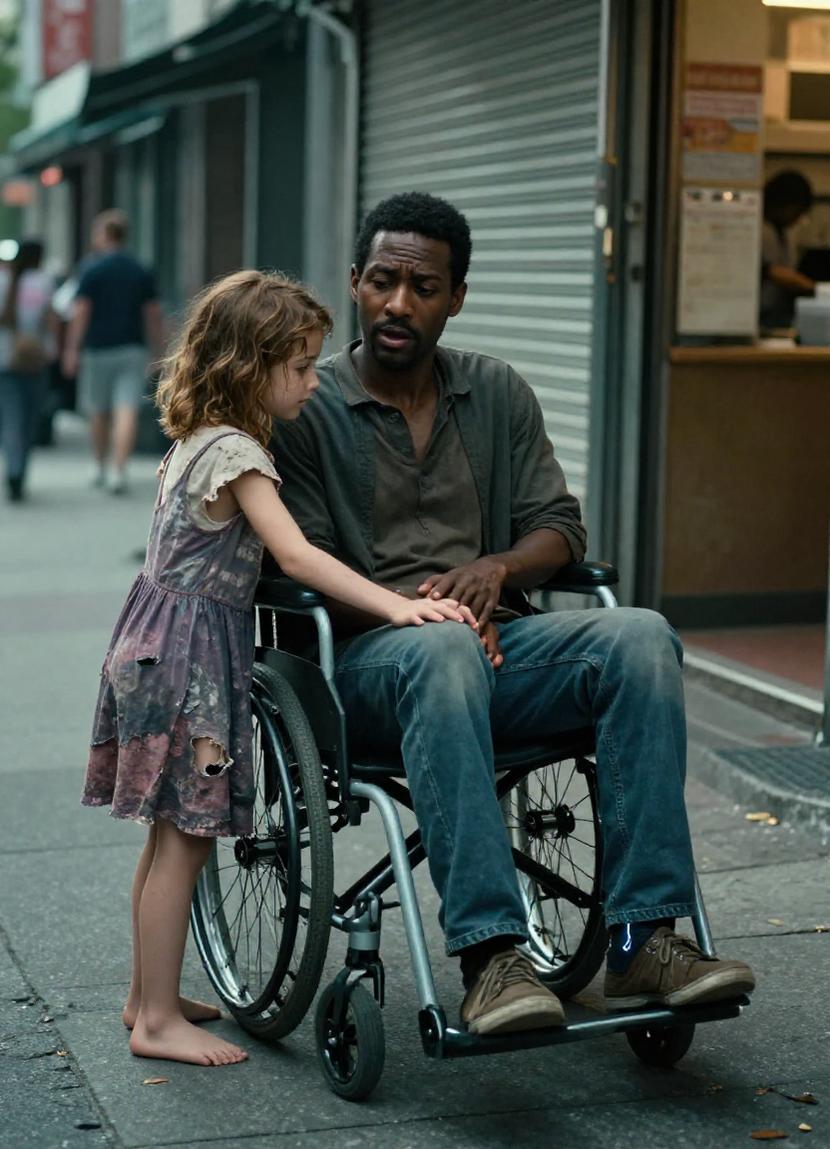
At first, no one saw her.
Amid the throng of hurried footsteps and buzzing chatter filling a busy Chicago sidewalk, she stood like a ghost—unnoticed and untouched. Her dress, torn and stained, hung loosely from one shoulder. Bare feet caked with grime pressed against the cracked pavement. Strands of tangled chestnut hair fell across her pale, dirt-smudged face. She looked no older than thirteen.
She halted before a man in a wheelchair.
David Sinclair was twenty-nine, but the deep furrows lining his face aged him far beyond his years. His wheelchair was parked just outside a shuttered deli on Crestview Avenue. Leaning against the wheel was a cardboard sign scrawled in fading marker: “Disabled. Anything helps.”
Over the years, David had grown used to invisibility—voices of mockery, whispered pity, and casual disregard. Coins clinking into the cup were rare, meals even rarer. Eye contact? Almost never.
So when a quiet voice broke through the urban noise, David thought his mind was playing tricks on him.
‘If you give me food,’ the girl said softly, ‘I can make your legs move again.’
David blinked, startled. Cruel jokes and cheap sympathy were nothing new, but this—this was different.
He looked down, studying her intense, steady gaze—not wild or desperate, but calm and certain as the earth beneath them.
‘Really?’ he croaked, disbelief lacing his voice. ‘You can do that?’
Her lips curled into a subtle, knowing smile—not playful, but deeply quiet.
David let out a harsh laugh, bitter and short. ‘Kid, not even doctors could do that.’
She tilted her head thoughtfully. ‘They didn’t listen.’
A strange chill licked up David’s arms despite the warm afternoon sun, the air itself seeming to shift.
His fingers fumbled into his bag and emerged with half a turkey sandwich—the only food he had all day. After a long pause, he extended it toward her.
She accepted the sandwich with reverence, as if it were a sacred offering.
‘Sit up straight,’ she commanded softly.
‘What?’
‘Please.’
Trust warred with reason, but David obeyed.
The girl’s small, grimy hand rested lightly on his knee.
Suddenly—pain exploded, sharp and electric, surging through his legs.
‘Hey! What are you—’ David gasped, clutching the wheelchair’s rims.
She leaned in, whispering words swallowed by the relentless city sounds.
Then, just as suddenly, the agony faded away.
David froze.
For the first time in six long years, warmth blossomed where numbness had ruled.
Not cold phantom tingles. Warmth, alive and real.
His breath caught. ‘I—I felt something.’
The girl stepped back, turning toward the bustling crowd.
‘I’ll come back tonight,’ she promised quietly, ‘if you still want to walk.’
And with that, she vanished.
Heart pounding like a drum, David sat trembling on the sidewalk.
Had hunger clouded his senses? Hope twisted his reality? Or had the impossible briefly brushed against his shattered life?
Sleep eluded him that night.
In his cramped, dimly lit studio apartment, rain tapped a steady rhythm on the window. Doctors had pronounced his injury permanent—a spinal crash on the freeway that should have ended all movement from the waist down. ‘Accept it,’ they said.
But he had never stopped hoping.
At precisely 9:47 p.m., a soft knock shattered the silence.
David’s heart leapt. Visitors were a rare blessing.
He wheeled over and opened the door.
There she was—dry despite the rain, her dress still torn, eyes as steady and calm as ever.
‘You came,’ he breathed.
‘You fed me,’ she replied simply. ‘That matters.’
She stepped inside, her gaze sweeping the sparse room. No television, no couch—just a thin mattress on the floor.
‘You’ve lost more than your legs,’ she said softly.
Swallowing hard, David asked, ‘Who are you?’
No answer.
She knelt before him, placing her clean, small hands gently on his knees.
‘Stand,’ she commanded.
A bitter laugh escaped his lips. ‘I can’t.’
‘You can,’ she countered, her voice steady. ‘You’re just afraid.’
Closing his eyes, fear flooded him—the fear of falling, failing, and believing again.
Then the pain returned.
But this time, it was different. Alive, pulsing, urgent.
His toes twitched.
His calves clenched.
Eyes snapping open, he gasped, ‘Oh my God.’
‘Now,’ the girl said, voice firm and unwavering, ‘stand.’
With a cry born of desperation and hope, David pushed against the wheelchair’s arms.
Legs trembling violently under him—then, miraculously, they held.
He stood.
For three fleeting seconds.
Then collapsed to his knees, tears streaming as he sobbed.
Laughter and tears mingled on his shaking hands as he touched his legs, afraid they might vanish.
He looked up to see the girl stepping toward the door.
‘Wait!’ he called. ‘Don’t go. Please. Who are you?’
She paused.
‘My name doesn’t matter,’ she said softly. ‘What you do next—that’s what counts.’
And she was gone.
Morning dawned with a fragile light.
David walked the streets—not far, not steady, but with determination.
Doctors called it a miracle. Reporters buzzed about the unexplainable. Social media erupted.
But David knew the truth.
He searched the city for her.
Days bled into weeks.
No one saw the barefoot girl.
Until one night, lost in the musty aisles of the public library, he stumbled on an old newspaper clipping.
‘LOCAL GIRL, 13, DIES SAVING CHILD IN HIT-AND-RUN.’
The photograph froze his blood.
Same eyes—the same quiet smile.
Same ragged dress.
She had died two years before his accident.
David sank back, breath stolen from his chest.
But his eyes caught the last line:
‘Witnesses say the girl whispered something before she passed.’
Closing his eyes, he remembered the whisper he hadn’t heard.
And suddenly, it whispered through him again.
‘You’re not done yet.’
Folding the fragile paper, David rose—stronger, steadier.
Outside, the city swirled in its endless rush.
But somewhere, beyond sight, he knew the barefoot girl was smiling.
And walking quietly beside him.