
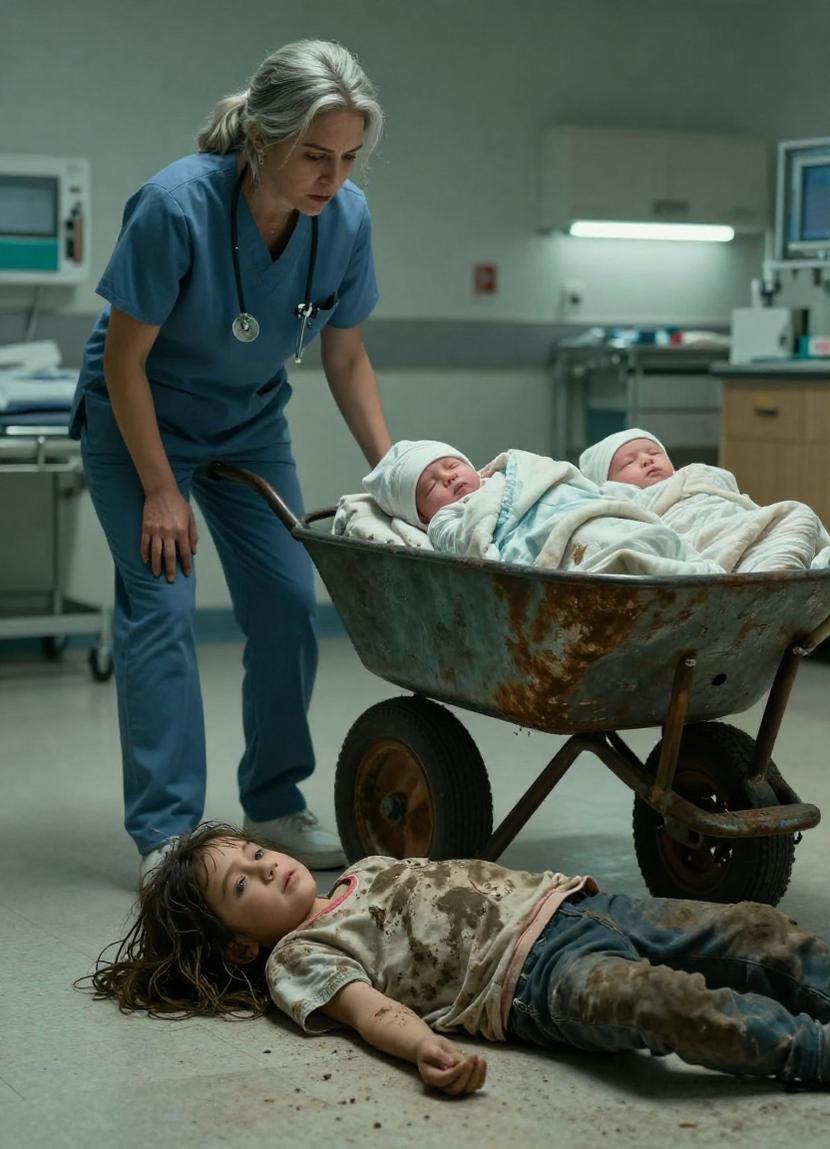
Chaos was hardly unfamiliar to the emergency room at Greenfield Community Hospital—but nothing, not even its busiest days, had prepared the staff for what would walk through its automatic doors on that fateful morning.
As the sensors beeped and the doors parted, the triage nurse’s breath caught. A girl, no older than seven, appeared, pushing an old, rusted wheelbarrow with relentless determination. Inside it lay two fragile newborns, swaddled in a threadbare blanket, their skin ghostly pale but their breaths faintly steady.
The girl’s tangled hair matted against her forehead, her worn clothes torn and muddied. Her voice quivered as she pleaded, “Please… my mom’s been sleeping for three days. Someone has to help her.”
Silence enveloped the room for a heartbeat before erupting into controlled pandemonium. Doctors surged forward, nurses swooped to cradle the babies, and a stretcher materialized just as the girl’s legs buckled beneath her. She collapsed onto the cold tile floor, unconscious.
Time blurred until hours later, when gentle daylight pierced the sterile lights and a soft voice leaned close. “Hey there, sweetheart. You’re safe now.”
Ella’s eyes fluttered open to reveal silver-haired Susan Carter, her nurse and solace, gazing at her with steady kindness.
The girl sat up too fast, urgency flooding her. “Where are my brothers? Eli and Nina—where are they?”
“They’re right here, Ella,” Susan said softly, pointing to two tiny bassinets cradled in the sunlit corner. “They’re safe. The doctors are watching over them.”
A trembling sigh escaped Ella’s lips—a shaky mixture of sobbing relief.
“Thanks to you, they arrived just in time,” Susan added. “You saved them all.”
Later, the burden of questions came gently. Dr. David Morgan, the hospital’s pediatrician, stepped inside alongside social worker Maya Kim, her arms clutching a worn folder.
“Hi, Ella. We just want to understand what happened to help your mom, okay?” Dr. Morgan asked softly.
Ella hugged her knees closer, wary eyes searching, “Are you going to take us apart?”
The doctor knelt to meet her gaze, soothing. “No one will separate you. We just want to make sure everyone stays safe.”
“Is someone trying to wake Mom?” she whispered.
Maya and Dr. Morgan exchanged a somber glance.
“There are people at your house even now, working hard.” Maya said quietly.
Ella pulled a crumpled scrap from her pocket—a shaky drawing of a blue house beneath a big tree, the number 44 neatly written. “This is our home,” she said, voice faint. “I kept the number in my pocket so I’d never forget how to come back.”
Dr. Morgan’s throat tightened. “How far did you walk, Ella?”
She thought, eyes turning distant. “Until the sun grew weary, and the stars took over the sky.”
That evening, Officer Mark Phillips and Detective Ryan Blake followed Ella’s trail along a winding trail near town. They found the quaint yellow cottage—quiet, the fence broken, shadows growing long.
Inside, the silence was heavy with absence. The kitchen was lined with empty formula cans, bottles drying neatly on a rack. On the refrigerator, a child’s handwriting tracked feedings—numbers, times, check marks.
In the bedroom, Maya Vargas lay unconscious but alive. Nearby, damp towels, tiny spoons, and half-full glasses testified to desperate care.
“She fought to keep them alive…” Detective Blake murmured.
“No,” Phillips said quietly. “It was her daughter who did.”
Back at Greenfield, Dr. Morgan reviewed Maya’s chart—a grim story of severe dehydration, malnutrition, and untreated postpartum depression. “If that little girl hadn’t kept giving her water, her mother wouldn’t still be here.”
The next morning, Ella sat beside Susan, fingers entwined.
“They found your house, sweetheart. Your mom’s been moved to another hospital. They’re helping her come back.”
Ella’s voice was barely a whisper. “She’s still sleeping?”
“Yes, but when she opened her eyes, she said your name.”
Ella stared at the ceiling. “I used to count how many times I tried to wake her. I gave her water, spoon by spoon, just like she showed me for the babies.”
Susan held back tears. “You did everything right. You saved all of them.”
That afternoon, child psychologist Dr. Rebecca Shaw arrived with dolls.
“Can you show me what a normal day at home was like?” she asked gently.
Ella lined up the dolls carefully—a mother and three children.
“On good days, Mom would wake early and sing while feeding the babies,” Ella shared quietly. “But sometimes her heart became too heavy. I brought her tea and kept the babies quiet.”
Dr. Shaw noticed Ella placing her own doll between the mother and babies, like a fragile bridge holding them together. “That’s a lot for someone your age,” she said softly.
Ella shrugged. “Mom always said I was born with an old soul.”
Weeks passed with Maya slowly waking, beginning the long road to recovery. But the family needed safety—somewhere to call home.
Susan Carter couldn’t sleep that night. At dawn, determination sparked in her eyes as she knocked on Dr. Morgan’s door.
“I’m a licensed foster caregiver,” she said, voice steady. “I want to take Ella and the twins into my home.”
Dr. Morgan nodded thoughtfully. “It’s a big step.”
Susan smiled gently. “They need each other. And honestly? I think I need them too.”
A week later, Ella stepped into Susan’s welcoming house on Elmwood Avenue. The guest room glowed with bright bedding, a small desk, and shelves waiting for toys. Down the hall, twins Eli and Nina slept peacefully in a nursery sunlit and warm.
At night, Ella tiptoed there, peeking at the sleeping babies. Susan would find her, humming softly, a lullaby of hope.
“One evening, as Ella tucked the twins in, Susan said, ‘Your mother grows stronger every day.’”
“When can I see her?” Ella asked, voice barely above a whisper.
“Soon. She’ll be so proud of you.”
Ella hesitated. “I hope she remembers me.”
Susan’s eyes shone warmly. “She could never forget you. You are her heartbeat.”
The day came to move Maya to Pine Valley Rehab Center. Ella’s hands trembled as she gripped the stroller.
“Ready, sweetheart?” Susan whispered.
Through the glass, they saw Maya sitting beneath a blooming cherry tree. She looked fragile but alert.
‘Mom!’ Ella cried, dashing forward. Maya’s arms caught her just in time.
They held each other silently, tears streaming freely.
“Let me see you,” Maya whispered, cupping Ella’s face with shaky hands. “My brave girl. You kept your promise.”
“I did,” Ella said softly. “I took care of Eli and Nina.”
Maya brushed a strand of hair off Ella’s forehead. “And you saved me too.”
Later, under the cherry blossoms, Ella pulled a folded letter from her pocket. “My dearest Ella, if you’re reading this, something happened to me. None of this is your fault. You are my light, my strength, and the best thing that ever happened to me. I’m fighting to stay with you. If darkness wins for a while, remember—it’s because I never stopped trying.”
Dr. Morgan swallowed, eyes moist. “Your mom never gave up.”
By summer, Maya grew strong enough to leave rehab. Thanks to the new Family Support Initiative, she moved into a subsidized apartment near the hospital and Susan’s home.
On moving day, Ella carried her butterfly journal, pages bursting with drawings of the blue house, the hospital, Susan’s home, and their bright new apartment.
Susan hugged her tightly. “You’ll visit, right?”
Ella smiled, handing over a folded picture—a drawing of two houses connected by hearts. “See? We’re still linked. Not dashed lines anymore, solid ones.”
Officer Mark Phillips and Detective Ryan Blake arrived with warm smiles, presenting Ella a framed version of her original crayon drawing alongside a family photo.
“From where it all began,” Phillips said, “to where you are now.”
One year later, the hospital auditorium buzzed under a banner: “The Ella Vargas Family Support Program — One Year Anniversary.”
Dr. Morgan stood proudly. “One little girl’s courage has inspired and helped fifty families. Today, we celebrate survival, hope, and transformation.”
In the front row, Maya sat radiant and healthy, twins Eli and Nina nestled in her arms. Susan smiled warmly beside them, and between them sat Ella—now nine—holding a folder.
Ella stepped forward, voice steady.
“My mom says family means people who care for each other when things get hard. But I think community means noticing when a family needs help—and actually helping.”
She revealed her drawings—the blue house, the hospital, Susan’s home, and their sunlit apartment.
“This is for everyone who helped us. So no child ever has to push a wheelbarrow to find help again.”
The room rose in a standing ovation.
That evening, Ella sketched in the park. The twins played nearby, Susan gently pushing them on the swings. Maya leaned close.
“What are you drawing now?”
Ella smiled, eyes shining.
“Our family—the one we built together.”
Hands joined around the two babies. In the background, a faint image of the old wheelbarrow rested—not a symbol of struggle, but of the strength and love that carried them home.