
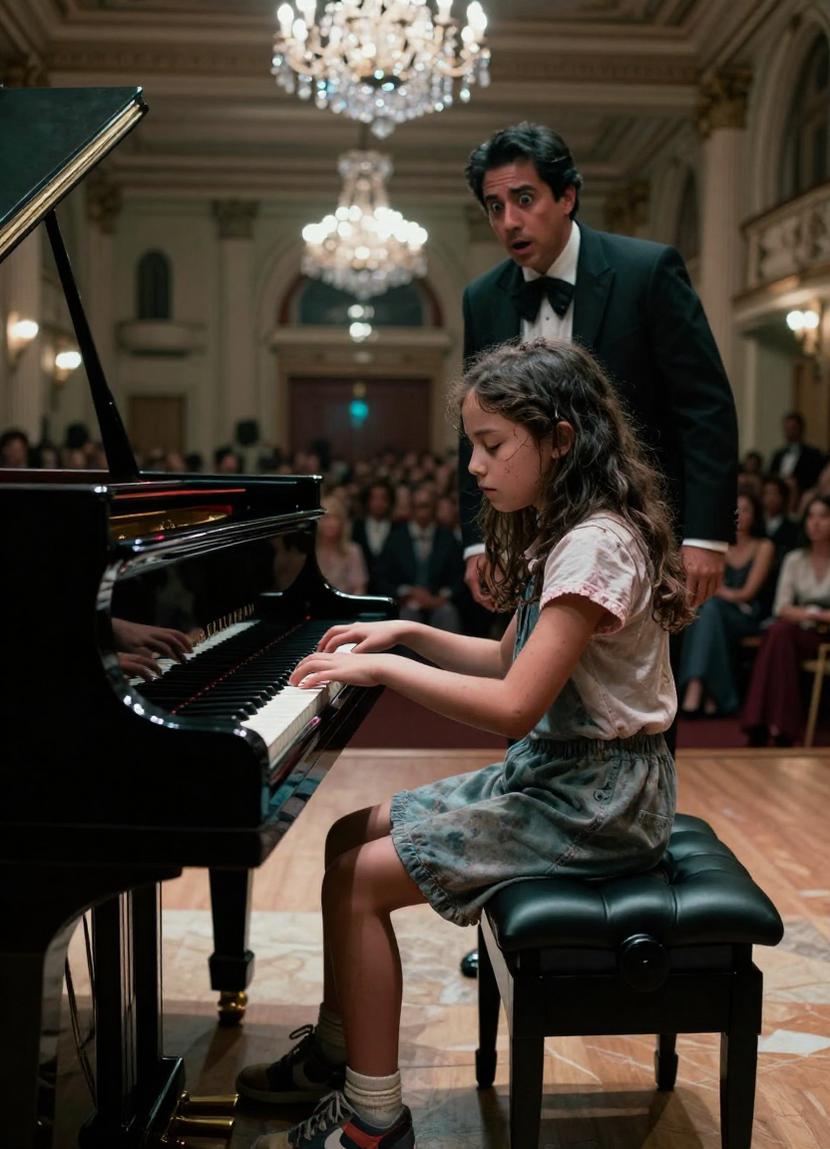
The annual “Pathways for Young Futures” gala lit up Los Angeles with a brutal brilliance, a night of excess held within the grand ballroom of The Carlton Regent. Crystal chandeliers hung like frozen stars, scattering shards of light over the sea of champagne glasses that tinkled like distant bells. Dresses flowed like living art across the marbled floor, every diamond and pearl flashing not just wealth, but the ruthless ease of it—untouchable, unquestioned. The air carried the intoxicating scent of public virtue, practiced smiles, and laughter that gleamed perfect but hollow, as speeches promised hope to the world from behind guarded smiles.
At the heart of this shimmering spectacle ruled Isabel Santero, the evening’s queen of charity, a woman with a flawless visage carved for magazine covers and eyes that never truly softened, even when her lips curved into a smile. She glided from donor to donor like an empress dispensing grace, draped in silk pulled tight across her shoulders, with heirloom jewels anchoring her every move. The room did not simply host Isabel; it bowed under her command.
The string quartet drifted soft melodies, the guests murmured in polished cadence, and the crystal chimed in delicate harmony—until the spell shattered with the crack of raw reality.
A girl no older than twelve slipped past the velvet ropes and the fortress of indifference surrounding the giddy affluent crowd. She was a striking dissonance: an oversized hoodie tearing at the elbow, pants threadbare and stained, sneakers crudely patched with gray tape. Her hair clung damp and dirty to a pale forehead, a mottled canvas of street grime and hunger, her frail frame so narrow it seemed one breath might shatter her. But in her fierce eyes blazed a fire far stronger than starvation, an unyielding promise burning through the night.
Isabel was the first to halt her, her practiced smile freezing sharp enough to cut glass. ‘You don’t belong here,’ she declared quietly but with a steel edge that slid through the room’s conditioned attentiveness. ‘This is a private event, not a refuge. You are trespassing.’
Without drama, she flicked her fingers—a silent summons. Two towering security guards appeared with the bored indifference of men dispatched to erase a stain of ugliness from the gala’s gleaming picture. From the crowd, cruel, hollow chuckles leaked like slow poison, and phones rose like mechanical birds poised to capture the spectacle of a child’s humiliation.
But the girl did not retreat. Instead, she lifted her chin boldly beneath the chandeliers’ flood, locking eyes with the luxury surrounding her as if she were the rightful heir of the room. Her voice rang out, pure and defiant: ‘I came to play the piano. I’m going to play a song you’ll never forget.’
The guards tensed, tightening their grip and beginning to steer her toward the exit. Her taped sneakers scraped the marble, resisting fiercely. Then a calm voice, quiet but unwavering, cut across the tension.
‘Wait.’
From a table near the stage rose Mateo Cruz—a man whose presence silenced whispers even before he moved. A legendary concert pianist, his rare appearances were themselves events wrapped in reverence. Known for hands that could hush entire halls, he approached not with pity but the keen curiosity of a maestro spotting a discord in a flawless score.
‘Ms. Santero,’ Mateo said gently, the faintest smile touching his lips, ‘if I recall correctly, tonight celebrates ‘opportunity’—the kind we trumpet in speeches and call our mission.’
A ripple of discomfort swept through the donors, shadows flickering behind polished smiles as cameras became suddenly more aware, as if the charitable theme might be tested in real time.
Mateo’s gaze did not waver. ‘Why not offer her a chance? Just one. If it’s wasted, escort her out with dignity and move on. If not, then we have honored what we claim to stand for.’
Isabel’s eyes narrowed for the barest heartbeat—a sharp stab to her meticulously crafted image, her brand of virtue. To refuse was social ruin in the spotlight of donors and press, hungry for any fracture in her perfect facade. She forced a stiff smile, brittle as glass, and turned toward the gleaming Steinway, illuminated like a sacred altar.
‘How delightful,’ she said with syrupy venom. ‘The stage is yours, darling. Show us something memorable.’
Her mind was already scripting the story: the girl would ape talent clumsily, be laughed off the floor, become a fleeting anecdote whispered over brunch—that was all anyone would demand. No one asked the girl’s name, offered water, nor wondered how a child so young bore such fierce courage. She walked determinedly to the piano amid a storm of stares and raised phones, her slender body swallowed by the vast stage.
She perched on the bench, legs barely touching the floor, feet hovering nervously near the pedals like one too young to command them. Her dirty fingers hovered briefly above the keys; then, without glancing at the crowd or seeking mercy, she closed her eyes, inhaled a breath trembling with resolve, and began.
The first chord shattered any doubt—it was no beginner’s stumble. The second confirmed that truth. As the melody bloomed, the ballroom transformed in a way even the chandeliers’ brilliance could not conceal. The music that poured from the Steinway was haunting and intricate, a lullaby woven with sorrow: the left hand dragging chains of grief while the right lifted fragile light like a winged flame. Ancient and too truthful to be contrived, the tune slithered beneath skin and settled deep inside, reshaping the room’s very soul.
Voices stilled. Champagne glasses hovered, suspended midair. Somewhere in the front, a crystal tumbler slipped from trembling fingers, shattering on marble with thunderous finality. Yet the girl played on, undeterred, as if broken glass were mere whisper to the burdens she carried.
In the center, Isabel stiffened, her fingers inching toward her throat, her face paling as if the lullaby uprooted a rot festering in her core. Across the ballroom, Mateo jerked upright, chair clattering behind him, eyes wide and haunted—a man witnessing a wound long buried claw its way open.
The final note lingered like an accusation, trembling in the heavy silence. When the girl withdrew her hands, she did not bow, did not smile, did not offer gratitude for being permitted to exist in this gilded cage. She stood, chest heaving and eyes blazing with raw fire, silence pressing down thick on every chest.
Mateo was first to break the spell, stepping toward the stage like one navigating ruins. His voice was rough, torn with disbelief. ‘Where did you learn that lullaby?’ he demanded, urgency unraveling his calm. ‘That piece… it was never published. It was private.’
The girl held his gaze silently awhile before turning her fierce stare on the woman at the heart of the gala. ‘Do you recognize it, Ms. Santero?’ she shouted, accusing and sharp.
Isabel blinked rapidly, her mask cracking as trembling fingers sought to reconstruct it. ‘I don’t know what you mean,’ she faltered, voice uneasy as never before. ‘It’s just a little tune. Anyone might—’
Tears carved dirt trails down the girl’s cheeks, grief finally breaching the dam. ‘THAT’S MY MOTHER’S LULLABY!’ she screamed, the words crashing like thrown chairs. ‘The last song she ever wrote! The one you stole from her desk after firing her, after evicting us from the apartment you rented, after leaving us in the street to rot like we were nothing!’
The room erupted into chaos—journalists swarmed, cameras flashed wildly, chairs scraped back as curious donors turned spectators, scandal blossoming into irresistible spectacle. Isabel’s composure shattered into raw panic.
‘Lies!’ she spat venomous. ‘Get her out! She’s a filthy little con artist! Her mother was a nobody I helped out of charity! She envied my talent!’
‘Enough.’
Mateo’s voice cut through the uproar like a judge’s gavel—loud not for show but for command. The noise stuttered into stunned silence as he positioned himself between the girl and Isabel, a living barrier.
His eyes glinted with ice as he addressed Isabel. ‘Your talent?’ His scorn made many flinch. ‘Her mother was Camila Navarro, my most brilliant student. A composer whose mind scared the mediocre. Her work outshines yours, makes it look like pale imitation.’
Turning to face the cameras, reporters, and donors who had long applauded Isabel’s ‘masterpieces’ without questioning their origins, Mateo leveled each word like a verdict. ‘Those compositions that built your empire,’ he declared steadily and coldly, ‘were not yours—they belonged to Camila Navarro. This woman is a thief.’
A chill swept through the ballroom, a crime felt not just in currency but in stolen genius, a theft of soul. Isabel’s face twisted between fury and terror.
Mateo’s gaze softened as he looked at the girl—recognizing the shape of her jaw, the stubborn tilt of her mouth, the fierce light behind her eyes. Drawn as if by gravity, he knelt at the stage’s edge, shaky in a world upended.
‘Your mother,’ he whispered, voice raw, ‘where has she been? Why did she disappear?’
The girl shuddered, body trembling with the weight of memories. ‘She’s gone,’ she said, voice small, despising its own weakness. ‘Two months ago. Pneumonia. We couldn’t afford the medicine. We lived in a shelter near Mason District.’
Mateo closed his eyes, a single tear escaping silently like a confession. When he opened them again, his voice was broken yet resolute.
‘Camila Navarro was not only my student,’ he declared, addressing all as if in a courtroom, ‘she was the woman I was to marry. She vanished while I was touring abroad. I believed she abandoned me. I never knew she was silenced by fate.’
His hand rested gently on the girl’s shoulder—not for show, but to make the truth tangible. ‘This child you treated like dirt,’ Mateo continued, sweeping his gaze across the room that moments ago had jeered, ‘is my daughter.’
The air cracked, Isabel’s kingdom fractured with it. Once close allies drifted away as if her corruption might taint them, staff and security shifted posture—no longer servants to the queen but wary sentinels watching a suspect—and reporters surged, hungry for collapse.
Ignoring the clamor, Mateo removed his tuxedo jacket and draped it around the girl’s narrow shoulders. The luxurious fabric swallowed her fragile frame, transforming from opulence to shelter—an armor against years of invisible suffering.
He pulled her into a fierce embrace, startling nearby guests into silence. Pressing his face into her tangles of hair, he held her as if doing so might rescue the pieces of a shattered past.
‘Did you come for food?’ he murmured, voice breaking.
The girl gripped his collar, forehead resting on his chest. When she spoke, her whisper bore the weight of a vow forged through hunger and cold. ‘Not just food,’ she said. ‘I saw your name on the guest list at the library. I needed you to hear her song. To know what she did, who she was, and what they took from her. I promised her I’d make the truth loud.’
Mateo held her tighter, and in that glimmering hall—where fortunes had been pledged to generosity—something raw and undeniable rose like a tide: not a staged donation or a photo op, but a child refusing to be erased, a stolen lullaby haunting the night with teeth and truth.