
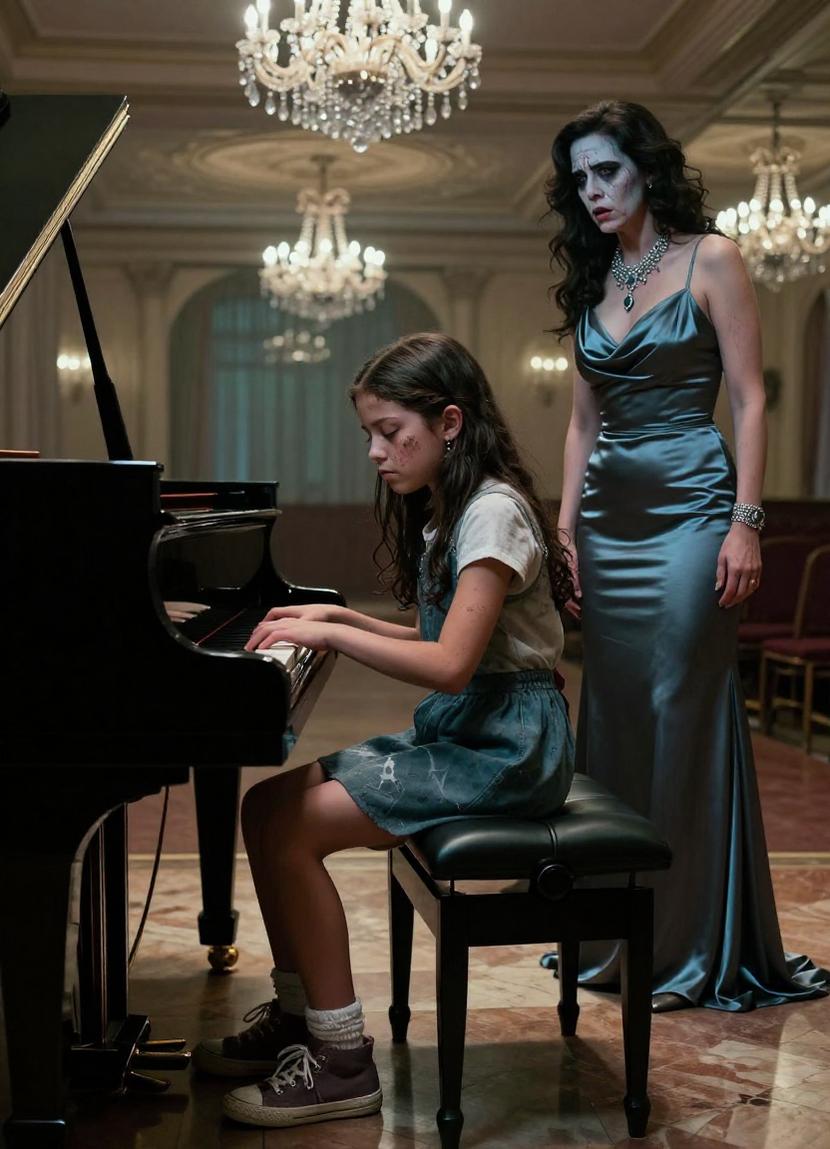
The annual “Pathways for Young Futures” gala sparkled with a dazzling intensity that felt almost brutal, held in a grand ballroom of The Valencia Royale. Crystal chandeliers spilled shimmering light over the room, their glow bouncing off champagne glasses and sleek designer gowns that swept and swirled like living tapestries. Diamonds glittered sharply on wrists and necks, a casual display of untouchable wealth, and the air was thick with the intoxicating perfume of polished virtue—smiles forged in flawless timing, laughter rehearsed to perfection, and generous pledges announced with calculated volume to capture the attention of the city’s elites.
At the heart of this glittering spectacle floated Isabella Calderon, the gala’s reigning luminance and a darling of philanthropic headlines. With a profile almost too perfect for magazines and eyes that never quite melted into genuine warmth, Isabella moved among her donors like a monarch on a well-rehearsed parade. Her silk gown clung like armor across her shoulders, heirloom jewels anchoring her every move in poised elegance. The room wasn’t simply her stage; it was hers to command.
A string quartet filled the air with music soft enough to be almost a whisper of wealth as the bustling murmurs of guests layered delicate sounds over crystal clinks. Everything obeyed the exact choreography of the evening—until a sudden rupture tore through the glamour like a jagged arrow.
A girl, no more than twelve, slipped past the velvet rope and the practiced barrier of indifference that surrounded the event. She was an impossible contradiction—a shadow of destitution plunged into luxury: an oversized hoodie with a shredded elbow, threadbare pants stained with the grinding dirt of the streets, sneakers crudely held together by strips of gray tape, her hair plastered against her brow from a mix of sweat and city dust. Her face was marked by grime and hunger so profound it was almost physical, her body frail as though a gust of air might shatter her. Yet her eyes blazed with a fierce light, sharper than starvation itself — a fierce promise refusing to dim.
Isabella was the first to intercept her, the sharp smile slipping into something cold, razor-edged. “You don’t belong here,” she said softly, her voice slicing through the chatter with icy authority. “This is a private event, not a shelter. You are trespassing.”
Without lifting her hand, Isabella flicked her fingers, summoning two large security guards whose boredom betrayed their eagerness to erase any tarnish from the scene. Around them, the room’s guests released hollow laughs, thinly veiled cruelty masquerading as amusement. Phones began to rise, slowly arching upward, primed to capture the spectacle of a child’s humiliation, as if she were nothing more than a show.
But the girl did not flinch, plead, or retreat. Instead, she lifted her chin directly underneath the glow of crystal light, as if she belonged there more than anyone else. Her voice rang out, clear and steady, slicing clean through the murmurs like a bell toll. “I came to play the piano,” she declared. “I’m going to play a song you won’t forget.”
One guard tightened his grip, already pivoting her toward the exit. Her taped sneakers scraped against the polished marble as she resisted, fighting the pull.
Then a calm, assured voice interrupted, low yet commanding—it stopped the room as if throwing a switch.
“Hold on.”
A man rose from a table near the stage, and the room instantly recognized the rare gravity he carried—no introductions needed. Sebastian Marquez, legendary concert pianist, public appearances so rare they were events within events. His hands had silenced innumerable grand halls, and now he approached not with pity, but with the discerning curiosity of someone hearing a discordant note in a flawless symphony.
“Ms. Calderon,” Sebastian’s tone was almost gentle, lips curling with the faintest smile, “tonight, you told us, is a celebration of ‘opportunity’—the kind we honor with speeches, the kind we call a mission.”
Uncomfortable glances darted among the donors, suddenly aware of the cameras that tracked every moment. A noble cause could easily become a trap when put to the test.
Sebastian’s gaze held steady. “Why not offer her one plate?” he challenged softly. “If it’s a waste of our time, we escort her out with dignity and move on. If it’s not… then we have fulfilled our mission.”
Isabella’s eyes narrowed imperceptibly, the blow landing with surgical precision — her carefully crafted image and brand threatened. Refusing now would spell social ruin amid the press and patrons hanging on her every word. She forced a smile so brittle it was painful and turned toward the grand Steinway gleaming under a golden spotlight like a sacred altar.
“Of course,” she said, sweetness laced with venom. “The stage is yours, darling. Surprise us.”
In her mind, the narrative was set: the girl would pound the keys poorly, become an object of amusement, and the disruption would dissolve into gossip served over brunch. No one asked her name; no one offered her water or kindness. The girl marched toward the piano amid a slow rain of stares and hovering cameras, her small frame swallowed by the vast stage.
She perched on the bench, legs too short to reach far, toes tentatively near the pedals as if hesitant to command them. When her dirt-streaked fingers found the keys, she didn’t seek the room’s approval, didn’t bow her head in apology or plead for mercy. Her eyes closed softly, she drew in a trembling breath, and then she played.
The first chord defied all expectations—it wasn’t a clumsy child’s attempt, nor the second. By the time the melody wove itself through the space, the gala felt irrevocably altered; no chandelier’s brilliance could undo what was stirring beneath the surface. The music that poured forth was intricate and haunting — a lullaby twisted with grief, the left hand dragging sorrow like a heavy chain, while the right hand lifted something delicate and radiant yet painfully fragile. It was an ancient sound, impossibly mature for a child, raw as truth. It crept under the skin and settled within.
Polite conversation died to a whisper; champagne glasses paused midair; a crystal tumbler slipped from a front-row hand, shattering on marble with a thunderous crack that echoed like a sacred bell. The girl did not falter; she played with a fierce resolve, as if shards of glass were nothing, less than the burden she carried.
At the room’s center, Isabella stiffened, fingers rising towards her throat, her face draining of color as if the music had pried open a rotten wound. Across the ballroom, Sebastian sprang up so swiftly his chair clattered behind him, eyes wide in raw shock—the look of a man watching an old torment tear open unexpectedly. Both of them recognized the melody—their shared secret.
The final note lingered, trembling like a whispered accusation. The girl lifted her hands, but she did not bow, smile, or offer a thank you for the charity of presence. She stood, chest heaving, eyes ablaze under the heavy silence that pressed into every lung.
Sebastian was the first to break it, his steps cautious yet deliberate as he crossed the space like a man walking through shattered ruins. His voice emerged rough, edged with disbelief. “Where did you learn that lullaby?” he demanded — not with anger, but a desperate urgency. “That piece was never published. It was… private.”
The girl held his gaze, then locked it firmly on the woman who ruled the gala’s center. Her voice cracked, raw and fierce beyond childhood’s limits. “Do you recognize it, Ms. Calderon?” she shouted, finger stabbing across the glittering room.
Isabella blinked rapidly, scrambling as her control wobbled, her mask cracking. “I don’t know what you mean,” she stammered, voice breaking in a way foreign to her polished speeches. “It’s… just a little tune. Anyone could—”
Tears carved clean paths down the dirt-streaked cheeks of the girl, her grief finally unspooling like a flood breaking dam. “THAT’S MY MOTHER’S LULLABY!” she screamed, voice ringing through the stunned ballroom like a fired shot. “The last song she wrote! The one you stole from her desk after you fired her, after you evicted us from the apartment you rented, after you left us out on the street to vanish like we were nothing!”
The room erupted—journalists surged forward, cameras flashed wildly, chairs scraped back as donors morphed into spectators hungry for scandal, the rich fuel for gossip. Isabella’s pristine composure shattered, replaced by raw panic.
“Lies!” she shrieked, her elegance dissolving into venomous rage. “Get her out! She’s a filthy little con artist! Her mother was nobody, a charity case I helped! She was jealous of my talent!”
“Enough.”
Sebastian’s voice severed the chaos with the crisp authority of a judge’s gavel, laden not with drama but undeniable command. The room stilled as he stepped forward, positioning himself protectively between the girl and Isabella.
His gaze froze Isabella in place, ice cutting through the tension. “Your talent?” he said, the sneer in his tone making several flinch. “Her mother was Elena Ramirez, my most brilliant student. A composer with a mind so fierce it terrified mediocrity. Her work rendered yours mere imitation.”
He turned to face the cameras, the reporters, the donors who had long applauded Isabella’s ‘masterpieces’ without ever questioning their origin. “Those celebrated compositions that built your empire,” Sebastian declared steadily and sharply, “were not yours, Isabella Calderon. They were Elena Ramirez’s. This woman is a thief.”
A wave of horror rippled through the room; theft of money was one crime, but theft of genius—of soul—felt like sacrilege. Isabella’s face contorted into a blend of rage and terror, her empire crumbling.
Sebastian’s gaze shifted back to the girl; now it softened, recognizing more than a melody—he saw the familiar set of jaw, the stubborn line of her mouth, the fierce spark of intelligence within. He stepped closer, drawn by a gravity he could no longer resist.
Kneeling awkwardly beside the stage, as if unsure how to steady himself in a world tilting beneath him, he whispered, “Your mother… where has she been? Why did she disappear?”
The girl’s shoulders shook in full tremors, pain spilling forth uncontrollably. “She’s gone,” she whispered, voice breaking with the weight of unbearable loss. “She died two months ago. Pneumonia. We couldn’t afford medicine. We were staying in a shelter near Calle Esperanza.”
Sebastian closed his eyes briefly, a solitary tear tracing the line of his cheek like a silent confession. When his eyes opened again, his voice was cracked but resolute.
“Elena Ramirez was more than my student,” he said, addressing the spellbound guests as though delivering a final verdict. “She was the woman I planned to marry. She vanished from my life while I toured overseas. I believed she had abandoned me. I had no idea she’d been forced into silence.”
His hand rested gently on the girl’s shoulder—not for show, but to ground the truth hard enough to survive. “And this child you treated like trash,” he said, casting a sweeping glance across the room that had mocked her moments before, “is my daughter.”
A brittle silence shattered Isabella’s reign. Former allies edged away from her, unwilling to be tainted. Hotel staff and security straightened, no longer serving the queen of the night but preparing for judgment. Cameras surged for her collapse.
Sebastian didn’t look at them. Instead, he removed his tuxedo jacket and draped it over the girl’s fragile shoulders, the luxurious fabric swallowing her slight frame—not as opulence, but as protection, a barrier against a world that had long refused to see her.
Then, unobserved, he pulled her close, his embrace a fierce shield that stunned the closest guests into reverence. He buried his face in her tangled hair, holding her as if anchoring what little was left to hold.
“Did you come here for food?” he murmured, voice breaking.
The girl clung to his collar, forehead pressed against his chest, and her whisper carried the fierce weight of a vow forged through hunger and cold. “Not just food,” she said quietly. “I saw your name on the guest list at the library. I needed you to hear her song. I needed someone to know what she did, who she was, and what they stole from her. I promised her I would make the truth roar.”
Sebastian held her tighter, and in the middle of that glittering ballroom—where fortunes had been lavished to applaud generosity—something raw, real, and unrelenting rose to the surface. The night’s mission was fulfilled not with symbolic checks or staged photo ops, but with a starving child who refused to vanish and a stolen lullaby that had returned as a ghost with teeth.