
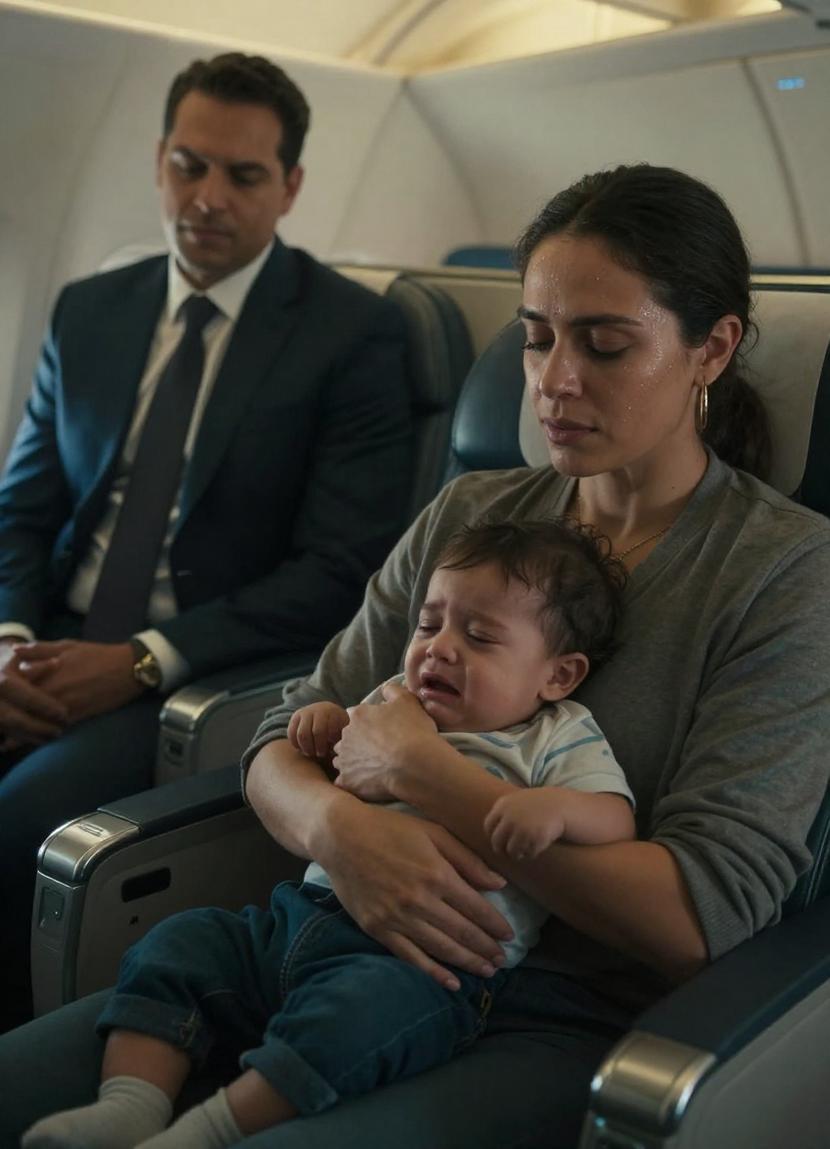
The flight from Barcelona to Madrid was meant to be a brief journey—just a couple of hours slicing through the Spanish sky. Yet for Sergio Navarro, those hours stretched into an unbearable eternity. At forty, Sergio was the embodiment of success: CEO of one of Spain’s most innovative tech empires, his fortune counted in millions beyond his ability to spend, and his name carried weight in boardrooms from Madrid to Tokyo. But here he was, trapped at 30,000 feet in a lavish first-class leather seat that felt more like a gilded cage. In his arms was Mateo, his three-month-old son, wailing with a ferocity that pierced through his polished world.
This was no ordinary infant fuss. Mateo’s crying was wild — a relentless, raw scream fueled by a mysterious discomfort Sergio was powerless to soothe. Two hours into the flight, every attempt he made—to feed with a bottle, offer a pacifier, pace the cabin aisle, rock with measured rhythm—had failed. His tailored €5,000 suit was soaked with cold sweat, his hands trembling as he struggled to calm a child whose distress had become his torment.
Around him, the other first-class passengers, once admirers of the composed CEO, now cast sideways glances heavy with judgment. Behind their polite masks, he saw their thoughts: “How can a man who commands millions fail to comfort his own son?” But it wasn’t their disapproval that cut deepest—it was Sergio’s own crushing sense of inadequacy. Every tear Mateo shed felt like a silent indictment, a bitter echo of Luciana’s absence. His beloved wife had died giving birth, leaving Sergio to raise a son who seemed unreachable, his cries a haunting reminder: ‘You’re not her. You don’t know how to love me.’
Seated just beyond the curtain dividing first class from economy was Isabel Flores. Twenty-eight, with weary eyes that told stories far beyond her years, she cradled her own sleeping miracle—Marina, her two-year-old daughter—gently on her lap. Unlike the slick executives around, Isabel wore worn jeans and a simple shirt. Her few remaining euros were a lifeline after buying plane tickets bound for Madrid, where she hoped to find work cleaning homes or babysitting after her husband’s abandonment.
Mateo’s cries didn’t disturb Isabel—they pierced her heart. A mother’s instinct, invisible yet undeniable, bound her to every child’s pain. Through the translucent curtain, she studied Sergio unraveling: the tight tension of his jaw, the rigid posture of a man used to control but now undone. Sergio held Mateo as if he were glass—a precious but fragile thing to be managed cautiously, without warmth.
The cries escalated, warping the cabin’s atmosphere into a thin fog of helplessness. Flight attendants exchanged furtive, helpless looks. Sergio, on the verge of collapse, slumped back and closed his eyes, wishing he could disappear entirely.
Then Isabel moved.
Quietly, she unfastened her seatbelt, mindful not to stir Marina, and rose. A flight attendant stepped forward, halting her path.
“Ma’am, first class is off limits.”
Isabel didn’t meet the gaze. Her eyes locked on Sergio and the screaming child.
“Please, just let me try,” she said softly, her voice calm but unwavering.
Sergio opened his eyes and met her steady, unflinching gaze. There was no pity or condescension—only pure, profound understanding. In that instant, Sergio felt something he hadn’t in months: hope. This stranger was his last thread in a fraying tapestry. Without fully realizing the gravity of the moment, he entrusted the most precious thing he had—Mateo—to a woman he didn’t know.
His hands shook as he passed the baby over. Isabel accepted Mateo with a natural ease, cradling him immediately, chest against chest, heart echoing heart. There was no inspecting, no distant handling—just the immediate bond between a mother’s intuition and a child’s pain.
What followed seemed almost sacred. Isabel didn’t rock Mateo wildly; she stood still, breathing deeply, exhaling calm into his tense body. Then she began to sway, slow and fluid like the gentle rhythm of the waves.
She sang.
Not a nursery rhyme, but an ancient Andalusian lullaby steeped in moons, olive groves, and whispered legends. Her voice was raw, toughened by hardship, yet wrapped in tender warmth. Unmindful of the glittering suits and polished shoes around her, Isabel focused solely on Mateo, her murmured words weaving safety into the anxious air.
Gradually, the impossible unfolded. The piercing scream softened into raw sobs. Tiny fists unclenched, legs stilled. Sergio watched, breath caught, as tears gave way to wonder. Mateo’s eyelids fluttered open, revealing dark eyes mirroring Luciana’s—the eyes of the mother he never met.
“Shh, it’s over now, mi amor. It’s over,’ Isabel whispered, soothing his back in gentle circles.
Five minutes—barely more than a heartbeat in a lifetime—was all it took. Mateo exhaled a long, peaceful sigh and drifted into restorative sleep.
Sergio sank back, overwhelmed by a swell of tears—shame dissolving into relief. When the plane finally touched down at Nuevo Cielo Airport, Mateo still slept soundly in Isabel’s arms.
At baggage claim, Sergio waited, heart pounding. Isabel appeared, holding Marina’s hand, a worn suitcase trailing behind.
“Wait, please,” Sergio called, stepping in front of her, breath uneven.
She froze, instinctively shielding Marina.
“I’m in a hurry. Mateo’s fine now,” Isabel answered, guarded.
“It’s more than that,” Sergio confessed, searching for words untainted by his usual polish. “You have something… something Mateo and I desperately need. Something I can’t give.”
There, amid the airport’s chaos, Sergio offered the unthinkable: a job not as an ordinary nanny, but as Mateo’s primary caregiver. A salary Isabel couldn’t dream of in years of housecleaning, a home in his sprawling estate for her and Marina, and most of all—steadiness.
Isabel’s wary eyes flickered with memory—of empty promises and hard lessons. “I have a daughter,” she said. “I can’t just move into a stranger’s home.”
“Bring her,” Sergio replied with quiet urgency. “The house is too big for just us. Just one month on trial. If it’s not right, I’ll pay three months’ salary and you’re free to go. But Mateo… Mateo needs you.” His voice cracked then, barely a whisper.
Isabel glanced at Marina, clinging to her hand, curious eyes fixed on Mateo’s luxury stroller. She thought of the grim boardinghouse awaiting them, the uncertainty tensing her future. And then she saw Sergio—the desperate father, stripped of pride, raw and honest. She nodded.
The mansion in El Robledal was another world—gleaming with glass, steel, and white marble; a monument to success but as sterile as a museum of a perfect life that had slipped away. The first days were uneasy; Isabel felt like a ghost in those vast, empty halls. Yet gradually, the quiet magic she carried on that plane began to seep through. She opened curtains that had long been closed, spilling light into shadowed rooms. Aromas of sofrito and home-cooked meals filled the once silent kitchen.
Marina, with all the pure innocence of toddlerhood, became the spark that awakened the house. To her, Sergio wasn’t a distant CEO—he was simply ‘the tall man.’ One afternoon, chasing a stray ball, Marina burst into Sergio’s office. She stopped at the mahogany desk, her wide eyes meeting his.
“Want to play?” she asked, extending the ball.
Sergio, who hadn’t played in years, hesitated—then stepped down from his ivory tower, settling onto the Persian rug. He rolled the ball back with a tentative smile.
That moment shifted everything.
Months later, the mansion was filled with life. Toys scattered across modern floors, laughter echoed from room to room, and an unbreakable family bond took root—one woven not by blood, but by choice.
Sergio began leaving work at dusk. Boardroom battles blurred into background noise; now his priority was Mateo’s bath and bedtime stories. He observed Isabel with newfound focus, learning the gentle art of fatherhood—how to cradle his son, interpret his cries, soften his fears of inadequacy. And as he learned, he found himself falling for the woman who had taught him how to love.
Their love was no instant spark but a slow-burning fire, like Isabel’s stews simmering gently on the stove. He adored her resilience, the way she tied her hair when focused, how she cared for Marina and Mateo with equal devotion. She had saved his son—and, unknowingly, had saved him.
Isabel watched Sergio peel away his armor, revealing tenderness beneath his tailored suits—the vulnerability he showed only when he thought no one was watching.
Nearly a year after that fateful flight, under a blanket of autumn leaves in the garden, the defining moment arrived. Isabel sat on a bench, watching Marina and Mateo—now crawling swiftly—play among the rustling leaves. Sergio settled beside her; a calm hush enveloped them, the kind spoken between souls recognizing their reflection in one another.
“The contract is over,” Sergio said quietly.
Her heart fluttered at the words that carried both an ending and a beginning. “Yes… I suppose I should start looking for an apartment,” she answered, voice steady though her insides trembled.
He turned and took her hand, fingers intertwining with effortless certainty. “No, the nanny contract ends because I don’t want you to be just an employee. Isabel, before you came, this house was empty. I was empty. You brought us back to life.”
He inhaled deeply, defenses laid bare. “I don’t want you to go. I don’t want this to be about work. I want this to be our life. I love you. And I think… I think Mateo and Marina are already siblings in every way except on paper.”
Tears traced warm paths down Isabel’s cheeks—not sorrow but a joy long postponed. “I love you too, Sergio.”
Their kiss was gentle, a quiet arrival after a storm—the seal of a promise forged at thirty thousand feet.
Two years later, sunlight bathed the courtroom. An elderly judge with glasses perused papers, smiling.
“Cases like this are rare,” he said, setting his specs aside. “Usually, here we separate families. Today, we create one.”
Sergio signed the adoption papers for Marina. Isabel signed for Mateo. In that ink-stained moment, a truth deeper than biology was sealed.
Outside, Mateo, now running and bubbling with words, grabbed Sergio’s hand.
“Dad, look!” he exclaimed, pointing to a plane tracing silver across Nuevo Cielo’s sky.
Sergio followed his gaze, squeezing his son’s hand and wrapping an arm around Isabel’s shoulders. He smiled, recalling the tears, fear, and helplessness of that long-ago flight.
“Yes, son,” Sergio said, eyes locked with Isabel’s, overflowing with love. “That airplane—that’s where our real life began.”
The Navarro family’s story spread among friends—not for riches, but for proving that family is not DNA. It is made of those who remain when the sobbing will not cease, who offer help without demand, who choose one another, relentlessly, against all odds. Because the strongest ties are woven not by blood, but by hearts that choose to stay.