
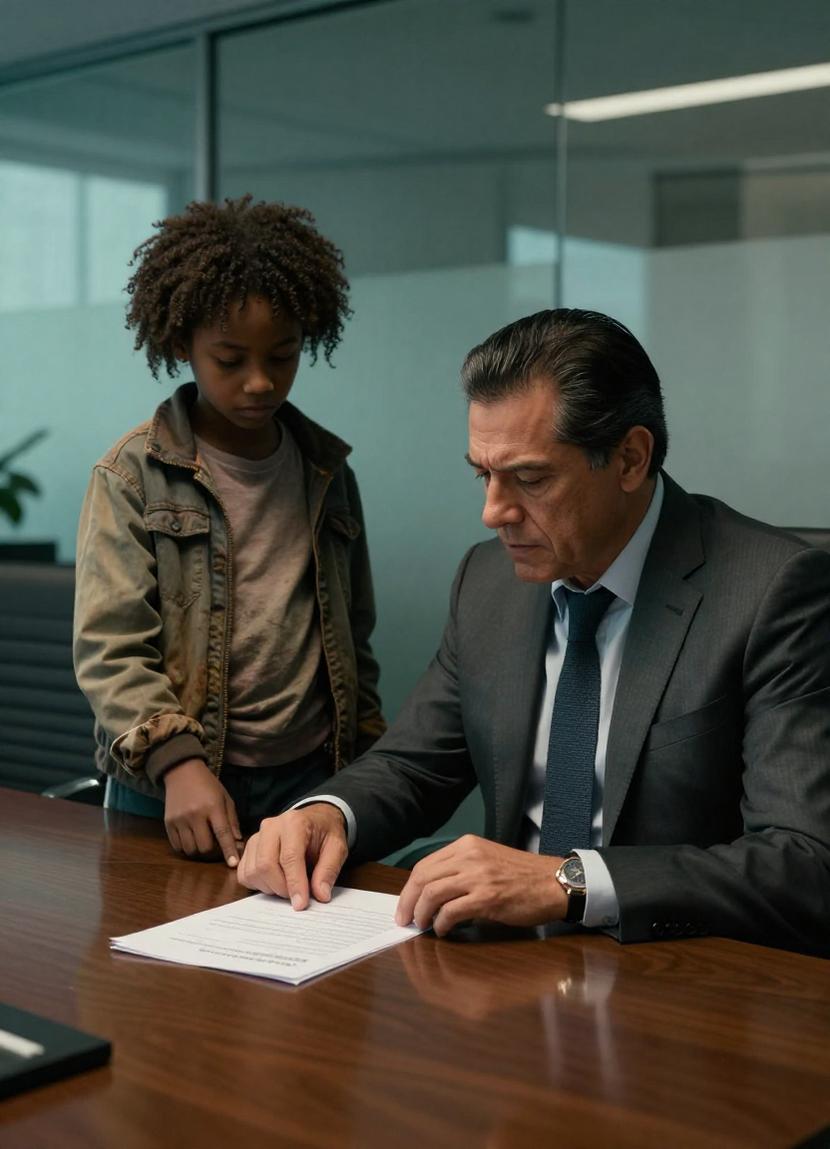
The pen trembled in midair, hovering uncertainly above the final line. Julian Moreno’s hand shook so intensely it seemed his entire body was rebelling against the inevitable. One signature. One signature to erase a lifetime of empire-building in an instant.
His tailored suit clung immaculately to his frame, but his face betrayed him—a ghostly sheen of sweat traced a cold river down his temple, and his dry throat refused to swallow the rising panic. Around the sleek, polished conference table, a ring of stone-faced lawyers sat motionless, their eyes locked onto the bankruptcy documents as if they were a verdict of death.
Then, cutting through the suffocating silence, came a small, careful voice.
“Sir… please don’t sign that.”
Every gaze snapped to the source.
Near the glass wall stood a young girl, no older than twelve. Her jacket was threadbare, woefully inadequate for the biting chill outside, and her shoes were worn ragged at the heels. Security had let her in only because a storm had trapped everyone inside—and because she’d been quietly helping others by holding doors open in the lobby.
But now, her attention wasn’t on the people—it was on the papers.
“There’s a mistake,” she said, voice trembling yet resolute. “A huge one.”
The lead attorney shot up, snapping his chair backward with a thud. “This is a private meeting. You have to leave.”
Julian lifted a steady hand to silence him.
“Wait.”
For the first time in weeks, someone’s voice trembled with something other than fear.
Julian studied her carefully. “What kind of mistake?”
She hesitated, then stepped forward, nervously pointing at the dense legal text.
“That clause… it transfers all the debt from the Seaport Haven deal,” she explained. “But only sixty percent was supposed to transfer within the first five years. The rest isn’t due yet.”
Shock slammed into the room like a thunderclap.
Julian’s eyes dropped to Clause 17C.
He’d combed through the document countless times. So had every attorney. Yet suddenly, his heart pounded with a fresh surge of hope.
“Stop. Review that clause again. Right now.”
The lawyers exchanged tense, irritated looks, but complied.
Minutes ticked by, each heavier than the last. Then one stammered, swallowing hard.
“…She’s right.”
The atmosphere shifted palpably.
“That portion of the debt isn’t legally due yet,” the attorney admitted. “Our liabilities have been grossly overstated.”
Julian breathed in deeply, his lungs rediscovering air long forgotten.
“Find her,” he ordered sharply. “Bring her back immediately.”
Her name was Maya Abebe.
Since losing her mother and home at fourteen, Maya had been surviving on the unforgiving streets—subway stations, church shelters, anything that might offer refuge. By day, she scavenged cans and small jobs, but numbers were a language she always understood.
Her mother, once an accountant, had instilled a simple truth: “Numbers don’t lie. People do.”
Maya had only studied accounting briefly, just enough to spot patterns and sense when something was wrong.
That day, she hadn’t planned to dissect company files. But one odd line burned itself into her mind—and once seen, it could never be forgotten.
Three days later, Maya sat not near the exit or in a corner, but confidently beside Julian Moreno inside the glass-walled conference room of Moreno Global Logistics.
“Tell me everything you see. No holding back,” Julian urged.
She dove in.
Misclassified liabilities. Inflated losses. Debts artificially accelerated to mask the truth. Piece by piece, a sinister pattern unfolded.
This wasn’t simply mismanagement.
It was deliberate manipulation.
Derek Vaughn, the company’s CFO, stormed out before the session ended.
Two weeks later, independent auditors confirmed Maya’s discoveries beyond doubt.
Funds siphoned through phantom vendors. Losses disguised as routine expenses. Numbers contorted just enough to stay hidden.
Derek Vaughn was immediately suspended under investigation.
Six months later, Moreno Global Logistics had not just survived—it had been reborn.
Transparency became the foundation. Vigilance the new norm.
Maya returned to school, wielding a full scholarship from a quiet foundation Julian never sought credit for.
And she returned to the company, too, stepping into a new role as junior financial consultant.
On her first day, Julian pulled her aside, voice low but earnest.
“This company wasn’t saved by money,” he said. “It was saved because someone dared to speak when silence was easier—and safer.”
Maya smiled—small, steady, unstoppable.
The world didn’t pivot because a billionaire avoided ruin.
It turned because a homeless girl dared to see the truth, proving that:
Genius wears no badge.
Truth demands no permission.
And standing silent is rarely the safest choice.
Sometimes, the most critical line in your life is noticed by the soul you least expected to hear it from.